Finding the right local SEO agency can directly impact your business’s visibility and revenue. With 46% of Google searches having local intent and 76% of "near me" searches leading to a visit within 24 hours, selecting an experienced agency is essential. But how do you make the right choice?
Here’s a step-by-step guide to simplify the process:
- Set Clear Goals and Budget: Define measurable goals like increasing calls, improving reviews, or boosting foot traffic. Allocate 5–10% of your marketing budget to local SEO - costs typically range from $750 to $5,000 monthly.
- Evaluate Expertise: Ensure the agency understands local SEO essentials like Google Business Profile optimization, citation management, and local keyword targeting. Ask about their tools and certifications.
- Review Track Record: Look for case studies and testimonials tied to measurable outcomes like leads, revenue, or local rankings. Verify results with data and request client references.
- Compare Pricing and Services: Understand what’s included in their packages (e.g., review management, local link building). Avoid one-size-fits-all plans and agencies promising instant results.
- Assess Communication: Test responsiveness and ensure they provide clear, actionable reports. A dedicated contact and regular updates are key to a successful partnership.
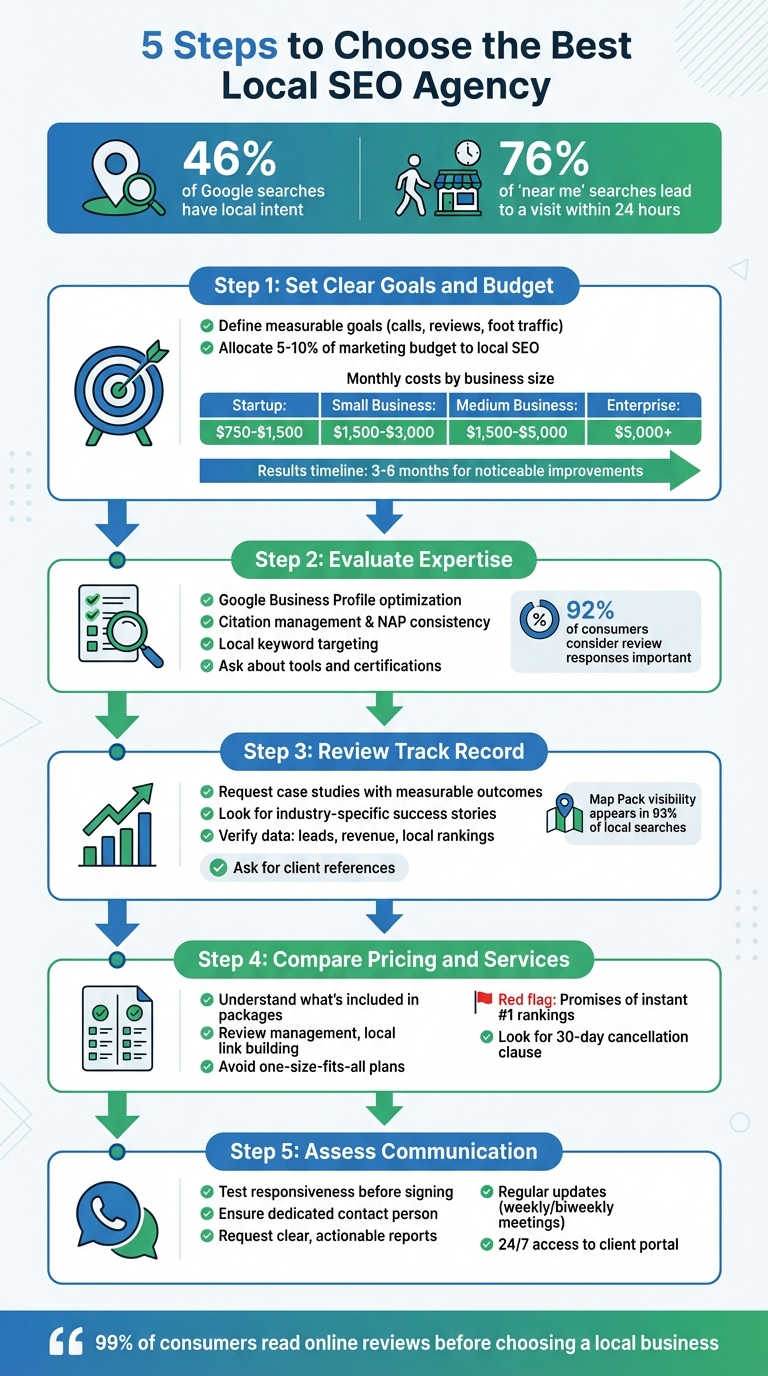
5-Step Guide to Choosing the Best Local SEO Agency
Watch THIS before hiring a local SEO agency!
sbb-itb-0e6533f
Step 1: Define Your Local SEO Goals and Budget
Before reaching out to an agency, take the time to set clear, measurable goals. Vague objectives like "I want to be #1" or "get more traffic" won’t cut it. Instead, focus on specific, actionable outcomes - like increasing phone calls by 20%, improving your Google star rating, or boosting requests for directions to your location.
Your goals should align with your business model. For example, if you own a brick-and-mortar store, you might prioritize increasing foot traffic and visibility in the Google Map Pack. On the other hand, service-area businesses that visit customers should focus on local keyword rankings and optimizing click-to-call features. Knowing your priorities from the start will help you avoid agencies that offer generic, one-size-fits-all solutions instead of tailored strategies.
Identify Your Local SEO Priorities
Start by auditing your online presence using a free tool to identify issues like inconsistent NAP (Name, Address, Phone number) details. Then decide if you need comprehensive support - covering everything from your website and listings to reviews and social media - or if you should zero in on specific tasks like managing reviews or building citations.
Pay attention to key data points. For instance, 82% of consumers read local reviews before making a decision, and resolving negative reviews can win back 73% of unhappy customers. If your reputation management needs work, make that a priority. Similarly, if your business is struggling to appear in local search results, prioritizing Google Business Profile optimization and improving your local pack rankings can make a big difference.
Set realistic expectations for results. Local SEO efforts typically take 3 to 6 months to show noticeable improvements, and achieving sustainable progress can take up to a year. Be wary of any agency that promises instant "#1 rankings" - this is a major red flag.
Once you’ve outlined your priorities, allocate your resources to match your goals and strategy.
Set a Realistic Budget
With your objectives in place, it’s time to establish a budget that supports them. Think of your local SEO budget as a long-term investment. Monthly costs will vary depending on your business size and needs. Here’s a general breakdown:
| Business Size | Monthly SEO Pricing |
|---|---|
| Startup | $750 to $1,500 |
| Small Business | $1,500 to $3,000 |
| Medium-sized Business | $1,500 to $5,000 |
| Enterprise | $5,000+ |
A good rule of thumb is to allocate 5% to 10% of your total marketing budget to local SEO. Local SEO is also much more affordable than national campaigns. While local services generally cost between $500 and $2,500 per month, national campaigns often range from $2,500 to over $10,000 per month.
Keep in mind that most reputable agencies will require a minimum commitment of four to six months to deliver and measure meaningful results.
Step 2: Check the Agency's Local SEO Expertise
After setting your goals and budget, it's time to evaluate potential agencies for their local SEO skills. Many agencies specialize in national or e-commerce SEO but may lack the know-how to optimize Google Business Profiles, build local citations, or use location-specific schema markup effectively.
Ask how they approach the three key local ranking factors: relevance, distance, and prominence. Find out how they audit your business's Name, Address, and Phone number (NAP) consistency across directories - a crucial step in building trust with search engines. This groundwork is essential before you assess their certifications and familiarity with SEO tools.
A reliable agency will dive deep into your market, analyze competitors, and target high-intent local keywords like "near me" searches and geographic modifiers (e.g., "24-hour plumber in [City]"). Considering that 76% of consumers conducting a "near me" search visit a related business within 24 hours, focusing on these queries can directly boost both foot traffic and conversions.
Look for Local SEO Certifications and Tools
The tools an agency uses can reveal a lot about their expertise. Ask which platforms they rely on for managing citations, tracking rankings, and generating reports. Top agencies often use tools like Semrush Listing Management, BrightLocal, or Whitespark to ensure NAP data is consistent and distributed across directories. For rank tracking, they should utilize heatmap tools or map rank trackers capable of pinpointing visibility down to specific ZIP codes or even street corners.
"A Google Business Profile is the center of Local SEO. It takes up the top real estate in SERPs and is utilized within Google Maps, which functions as its own search engine."
– Dustin Fatch, Owner, Marketing Done Right
Review management is another critical area. Tools like GatherUp or Semrush Review Management are essential, especially since 92% of consumers consider how businesses respond to reviews as a sign of quality customer service. If an agency lacks a system for automating review requests and monitoring customer sentiment, they’re missing a key piece of the puzzle.
Here’s a quick breakdown of the tools a qualified agency should be using:
| Tool Category | Recommended Tools | Key Function for Local SEO |
|---|---|---|
| Listing Management | Semrush Listing Management, BrightLocal, Whitespark | Ensures NAP data consistency and updates across directories |
| Rank Tracking | Semrush Map Rank Tracker, Position Tracking | Tracks rankings at ZIP code level and in the Map Pack |
| Review Management | GatherUp, Trustpilot, Semrush Review Management | Automates review requests and monitors customer feedback |
| Technical/Schema | TechnicalSEO, Google Rich Results Test | Creates and validates LocalBusiness schema markup |
Confirm Their Knowledge of Local Ranking Factors
Beyond tools, the agency must demonstrate a strong technical grasp of local SEO. They should be able to implement LocalBusiness schema markup using JSON-LD, providing search engines with detailed structured data like geo-coordinates, business hours, and contact details. This is particularly important as Google’s AI Overviews increasingly pull data directly from structured formats.
Ask them to explain how they would optimize your Google Business Profile. They should outline specific actions like selecting the right business categories, managing the Q&A section, posting updates, and uploading high-quality photos. They should also describe how embedding a Google Map on your website's contact page can strengthen location signals. If they struggle to articulate these steps, it’s a red flag.
Test their familiarity with platform guidelines by presenting a scenario, such as whether a P.O. Box can serve as a business address. A knowledgeable agency will immediately reference Google’s rules and explain why this isn’t allowed. This level of fluency is critical for ensuring your local visibility stays intact.
Step 3: Review Case Studies and Client Testimonials
Once you've confirmed an agency's technical skills, it's time to dig into their track record. Case studies and client testimonials can help you see if their expertise translates into genuine business results. Be cautious of vague claims - look for solid evidence that ties their work to measurable success in your industry.
Ask for anonymized reports that clearly connect their efforts to business outcomes. A trustworthy agency should be able to show how their strategies have directly impacted key metrics like revenue, lead generation, or visibility. The goal is to find a partner who prioritizes long-term growth over short-term wins.
"Start the search for a local SEO agency with a long-term relationship as the goal, rather than swift wins on specific metrics."
– Miriam Ellis, Local SEO Subject Matter Expert, Moz
Focus on examples that align with the challenges your industry faces.
Find Industry-Specific Success Stories
It's crucial to choose an agency with experience in your niche. What works for a dental practice might not work for an HVAC company or a retail store (similar to how cleaning companies require specific strategies) because customer behaviors, keyword priorities, and conversion paths can be vastly different. Make sure the agency has a proven track record in your specific field.
For instance, Phoenix SEO Geek helped an HVAC company in Phoenix that was struggling to rank higher than #15–20 in the local pack for keywords like "AC repair Phoenix." Through targeted local link building and partnerships with the community, the company climbed to ranks #1–3 within six months. This effort led to a 500% boost in organic traffic and a 2,300% return on investment. This example shows how a tailored strategy can deliver real, measurable results.
When reviewing case studies, check for evidence of a customized approach rather than a one-size-fits-all checklist. The agency should explain the specific challenges they tackled, the strategies they implemented, and why those tactics were effective for that particular business. While quick fixes for low rankings can provide temporary boosts, they rarely lead to lasting success.
Verify Results with Measurable Data
Success stories are even more convincing when backed by hard data. Look for metrics that reflect actual business outcomes. In addition to industry-specific examples, make sure the case studies include measurable results like qualified leads, tracked phone calls, form submissions, and revenue growth.
| Metric Category | Specific Data Points to Look For |
|---|---|
| Local Visibility | Map Pack (3-Pack) rankings, AI Overview citations, local organic rankings |
| Lead Generation | Tracked phone calls, form submissions, booked appointments |
| Financial Impact | Total ROI, Average Order Value (AOV), Customer Lifetime Value (CLV) |
| Reputation | Review volume growth, average star rating, owner response rate |
| User Engagement | Clicks-to-call, "Request Directions" clicks, website conversion rate |
Pay close attention to Local 3-Pack visibility, as it appears in 93% of searches with local intent. Case studies should show how the agency has helped clients secure these top spots. Also, consider improvements in review metrics - since 99% of consumers read online reviews before choosing a local business, this can be a game-changer.
Don't just rely on testimonials featured on the agency's website. Instead, ask for direct references and contact information for past or current clients. This allows you to have private conversations about their experiences. Additionally, cross-check testimonials on third-party platforms like Google Business Profile, Facebook, or industry-specific review sites. Authentic success stories often include visual evidence, such as screenshots of improved rankings or traffic dashboards.
"The bottom line is that you do not want to know more than the agency you're hiring."
– Bruce Clay, Founder and President, Bruce Clay Inc.
Lastly, ensure the tactics described in the case studies align with Google's guidelines for online business representation. Be wary of agencies that promise #1 rankings, use secretive methods, or rely heavily on excessive link building. A reputable agency will focus on steady, sustainable growth, which typically takes at least four to six months to achieve noticeable results.
Step 4: Compare Pricing and Service Packages
Once you've reviewed an agency's track record, the next step is to dive into their pricing and service packages. It's crucial to know exactly what you're paying for and ensure it fits within your budget. Take a close look at the pricing details - what's included, what services are considered extras, and how they measure success.
Ask each agency for a detailed list of deliverables. If they can't provide one, that's a red flag. Sending a Request for Proposal (RFP) to your shortlisted agencies is a smart move - it allows you to compare customized solutions instead of generic offerings. Be wary of agencies pushing "one-size-fits-all" plans. A reputable agency will tailor its strategy to your specific market and competition. Match these pricing details with your local SEO goals to see how well their offerings align with your needs.
Understand Common Pricing Models
Local SEO agencies generally follow four main pricing models: monthly retainers, project-based fees, hourly consulting, and performance-based pricing. Here's a quick breakdown:
- Monthly retainers: Typically range from $500 to $2,000 and cover ongoing services like citation management, Google Business Profile optimization, content creation, and monthly reporting. Most agencies require a commitment since SEO results take time to show.
- Project-based fees: These are ideal for specific, one-time tasks like SEO audits, website migrations, or setting up a Google Business Profile. Costs usually fall between $5,000 and $30,000 .
- Hourly consulting: Perfect for strategic advice or troubleshooting, with rates ranging from $100 to $300 per hour .
- Performance-based pricing: Tied to results or ad spend, this model is often used for larger budgets or PPC-integrated campaigns, with fees typically ranging from 12–30% of ad spend.
It's worth noting that extremely low pricing can be a warning sign of underqualified staff or risky tactics. As Dan Shaffer, Director of SEO.com, cautions:
"No agency is in a position to guarantee SEO results, such as page-one ranking. If they do, they're bluffing or relying on black-hat SEO practices".
Create a Comparison Table for Your Options
Once you understand the pricing models, create a side-by-side table to compare what each agency offers. Some agencies include budget-friendly SEO tools, reporting dashboards, and content creation in their base fee, while others charge extra for these . Check if essential services like Google Business Profile management, review monitoring, and local link building are handled in-house.
Focus on outcome-based metrics rather than vanity numbers. The real measure of value lies in leads and sales generated - not just traffic or keyword rankings . Ask how each agency tracks key metrics like clicks-to-call, direction requests, form submissions, and conversion rates to ensure you're getting a return on your investment .
Also, review their contract terms. Agencies that offer a "30-day out" clause show confidence in their results, while those that don't may prioritize cash flow over performance. As Amanda Milligan, a Fractional CMO, explains:
"No failsafe means the agency knows retention is a problem. And they may be more focused on cash flow than results."
Lastly, evaluate whether the agency practices what they preach. High-performing agencies should have a strong online presence, active social media profiles, and quality content on their own websites. If they can't rank their own business locally, it raises serious doubts about the value they can deliver to yours.
Step 5: Evaluate Customer Support and Communication
Once you've compared pricing and service packages, it's time to focus on how well the agency communicates and supports you throughout the partnership. Good communication isn't just a bonus - it's the backbone of a successful relationship with a local SEO agency. Since local SEO requires a long-term commitment, you'll want an agency that's equally invested in your ongoing success. If the agency is tough to reach or dismissive during the initial stages, don't expect their attitude to improve after you sign the contract. How they interact with you before the sale often reflects how they'll treat you as a client.
Pay close attention to how they explain their strategies. If their explanations are packed with jargon and lack clarity, that's a warning sign. A trustworthy agency should be able to simplify complex SEO tactics into terms you can easily understand, regardless of your expertise level.
Test Responsiveness and Support Channels
Before committing to any agency, test their responsiveness. Reach out via email, phone, or chat and see how quickly and professionally they reply. This initial interaction can give you a good sense of the service quality you can expect later on.
Find out who will manage your account. Having a dedicated contact is crucial - avoid agencies where the salesperson vanishes after the deal is signed. Also, ask about the tools they use for communication. Whether it's Slack, email, project management software, or a client portal available 24/7, you'll want to ensure you have multiple ways to reach them when needed. Using different channels to test their accessibility can help you gauge their reliability.
Review Reporting and Update Practices
Consistent, clear reporting is non-negotiable. A good report should cover six key points: what tasks were completed, the results achieved, any obstacles, and the next steps. Ask for a sample report (with client details anonymized) to see if the data is clear and actionable or if it's just a confusing pile of vanity metrics.
Set clear expectations for regular check-ins. Weekly or biweekly meetings, typically lasting about an hour, are common. These sessions provide an opportunity to review progress, share feedback, and adjust strategies as needed based on shifts in the market or your business goals. Additionally, clarify how the agency handles monitoring and responding to online reviews. Since 92% of consumers consider a business owner's response to reviews an essential part of customer service, you’ll need a plan for addressing negative feedback. The agency should notify you immediately if a concerning review appears, rather than responding on your behalf and risking a misrepresentation of your brand’s voice.
Lastly, check if the agency offers a 30-day cancellation option in their contract. Agencies that resist this flexibility may have underlying issues with retention or results.
Conclusion
By sticking to the five steps outlined, you can create a solid plan for selecting a local SEO agency that truly aligns with your goals. Whether your definition of success is more calls, increased foot traffic, or a rise in demo requests, it's essential to find an agency that prioritizes real-world outcomes - not just higher rankings. Choosing wisely ensures you get the most out of your investment by working with a team that understands your market and follows Google's best practices.
"The best agency for your local business will be the one that's there for you when things go right and when they go wrong, for many years to come, because you've made a mutual commitment to traveling together."
- Miriam Ellis, Local SEO Subject Matter Expert, Moz
A thorough evaluation process helps you connect with an agency that communicates effectively and delivers results you can see. Before signing on, ask for anonymized client reports to check their track record, ensure they grasp the ins and outs of local ranking factors, and confirm they're responsive to your needs. Look for a partner that simplifies complex strategies into actionable steps, provides honest and clear reporting tied to your business goals, and stays available when you need support.
Selecting the right agency can transform your local online presence into tangible business growth. With 76% of consumers visiting a business within 24 hours of a "near me" search, a skilled local SEO partner can make a real difference. Follow this step-by-step guide to find an agency dedicated to your long-term success.
FAQs
How can I evaluate if a local SEO agency’s pricing works for my business goals?
To figure out if a local SEO agency’s pricing matches your business goals, start by understanding how they charge for their services. Most agencies use one of three pricing models: monthly retainers, project-based fees, or hourly rates. For small to midsize businesses in the U.S., typical costs range from $1,500 to $5,000 per month. If you’re looking for long-term support - like regular performance reports or citation management - a retainer often makes the most sense. On the other hand, if you only need a one-off service, such as a local SEO audit, a project-based fee might be a better fit.
Next, take a close look at what’s included in their pricing. Ask the agency to break down their deliverables. Will they handle keyword research, optimize your Google Business Profile, or build local backlinks? Make sure their services align with your specific objectives, whether that’s driving more leads or improving your visibility in local searches. This way, you can tie their pricing to clear, measurable outcomes.
Finally, compare their rates to your budget and industry standards. Check out their case studies and client testimonials to see if their results back up their pricing. If their rates are on the higher side, dig deeper to see if they offer additional perks, like advanced analytics or proven methods that set them apart. By matching their pricing to your goals, expected ROI, and market norms, you’ll be in a strong position to choose the agency that’s the right fit for your business.
What tools should a good local SEO agency use to manage my online presence?
A dependable local SEO agency should leverage a variety of tools to manage your online presence and deliver results you can measure. For instance, they might use platforms tailored to local search needs for tasks like keyword research, rank tracking, and competitor analysis. These tools help identify the best local search terms and optimize your Google Business Profile. Citation management tools are also key, ensuring your business information stays consistent across directories - an essential factor for showing up in local search results.
On top of that, monitoring tools such as Google Analytics and Google Search Console play a big role in tracking website performance, analyzing traffic, and identifying indexing issues. Review management platforms are equally important, as they help collect and respond to customer feedback, which strengthens your online reputation. All of these tools work together to streamline workflows, boost your visibility, and provide actionable insights tailored to your specific business objectives.
How long does it take to see results from a local SEO strategy?
When implementing a local SEO strategy, you can generally expect to see results within 3 to 6 months. However, this timeline isn’t set in stone - it depends on several factors, such as your website's current state, the level of competition in your industry, and the effort put into optimization.
For newer websites or businesses operating in highly competitive markets, it might take closer to 6 to 12 months to see substantial progress. The key to success with local SEO lies in staying consistent and giving your strategy enough time to gain traction.