Want your business to show up in local searches like "plumber near me" or "best pizza in [city]"? Local SEO packages are the answer. These bundles focus on improving your visibility in Google Maps and local search results, connecting you with customers ready to take action.
But not all packages are created equal. Some waste your budget on unnecessary extras, while others skip critical elements. Here's what you actually need to rank in the Google Maps Local Pack rankings:
- Google Business Profile (GBP) Optimization: Keep your profile complete, accurate, and active. Profiles with 100+ photos get 1,065% more clicks and 520% more calls.
- Citation Building: Ensure your business's Name, Address, and Phone (NAP) info is consistent across directories to boost trust with search engines.
- Review Management: Reviews directly impact rankings. Businesses with a 4-star rating or higher attract 78% more customers.
- Ranking Tracking: Monitor your local search performance and adjust strategies based on data.
Avoid wasting money on generic content, irrelevant backlinks, or overly complex technical fixes. Focus on these essentials to drive real results and turn local searchers into paying customers.
SEO Basics: How to Rank with Local SEO (Google Map Pack + Organic)
What Are Local SEO Packages?
Local SEO vs Traditional SEO: Key Differences and Ranking Factors
Local SEO packages are service bundles designed to increase your visibility in localized searches - like those in the Google Map Pack (the top three map-based results), "near me" searches, or queries that include specific cities or neighborhoods. The goal? Turning local search traffic into actual leads for your business.
Why do these packages matter? They target high-intent searches - moments when potential customers are ready to take action. Think about someone searching for "emergency plumber now" or "pizza delivery near me." These aren't casual queries; they're urgent needs. In fact, 76% of people who search for something "near me" on their smartphone visit a related business within 24 hours, and 28% of those searches lead to a purchase. For small businesses, this makes local SEO one of the smartest ways to compete - even against national brands.
Unlike traditional SEO, which focuses on reaching broad audiences across the country or globe, local SEO hones in on your specific area. It uses unique ranking factors, like how close you are to the searcher, how complete your Google Business Profile is, and whether your Name, Address, and Phone (NAP) information is consistent across the web.
Common Features in Local SEO Packages
Most local SEO packages include four key services to help boost your local search presence:
- Google Business Profile (GBP) optimization: This is the foundation. It involves claiming, verifying, and fully completing your profile with accurate details like categories, hours, photos, and service descriptions. A well-optimized GBP builds trust and credibility with potential customers.
- Citation building: This ensures your business's NAP information is consistent across directories like Yelp, Yellow Pages, and Facebook. Search engines rely on this consistency to confirm your location and boost your rankings.
- Review management: Reviews are a big deal - 78% of people won’t even consider a business with less than a 4-star rating. This service helps you gather customer reviews, monitor feedback, and respond to both positive and negative comments, which also impacts your local SEO rankings.
- Ranking tracking and reporting: This monitors your performance in the Map Pack across specific ZIP codes or neighborhoods. It helps you see if your visibility is improving over time. Some packages also include extras like local keyword research, location-specific landing pages, and backlinks from community organizations or local news outlets.
Local SEO vs. Traditional SEO
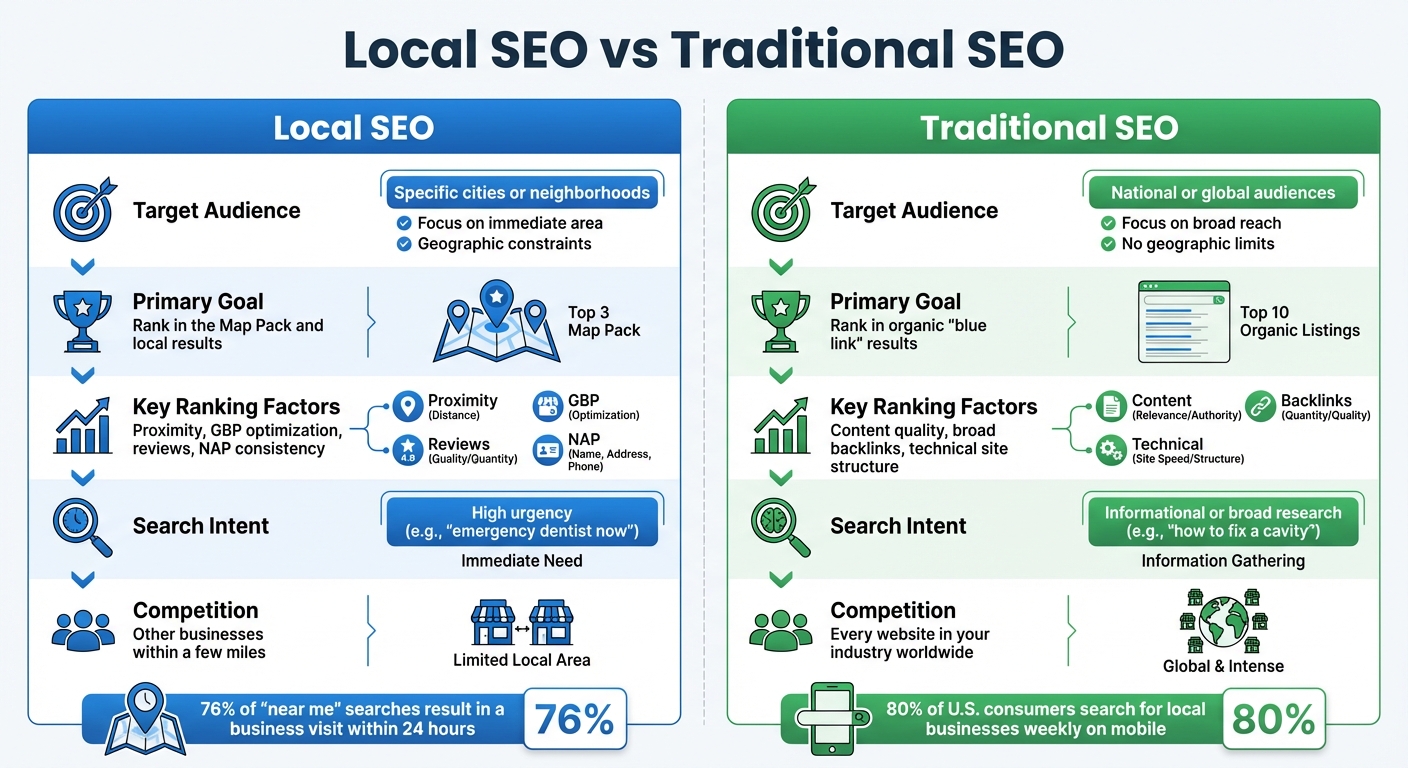
While both local and traditional SEO aim to boost your online visibility, they serve different purposes. Local SEO is all about reaching customers in your immediate area - your city, neighborhood, or service radius. Traditional SEO, on the other hand, targets a broader audience, often at the national or global level.
| Feature | Local SEO | Traditional SEO |
|---|---|---|
| Target Audience | Specific cities or neighborhoods | National or global audiences |
| Primary Goal | Rank in the Map Pack and local results | Rank in organic "blue link" results |
| Key Ranking Factors | Proximity, GBP optimization, reviews, NAP consistency | Content quality, broad backlinks, technical site structure |
| Search Intent | High urgency (e.g., "emergency dentist now") | Informational or broad research (e.g., "how to fix a cavity") |
| Competition | Other businesses within a few miles | Every website in your industry worldwide |
Local SEO focuses on dominating the Google Map Pack, which grabs the most attention - especially on mobile devices, where 80% of U.S. consumers search for local businesses weekly. Traditional SEO, meanwhile, targets the standard organic results below the map, placing you in competition with websites from all over the world. Both approaches have their place, but local SEO is essential when your business relies on nearby customers.
What You Need in a Local SEO Package
If you want to climb the ranks in the Map Pack, you need to focus on the essentials. Below are the four key components every local SEO package should include to help boost your visibility and attract more customers.
Google Business Profile Optimization

Your Google Business Profile (GBP) is like your storefront in the digital world - it's often the first impression potential customers get of your business. Did you know that 70% of consumers are more likely to visit a business with a well-maintained GBP?. Yet, only 56% of local businesses have claimed their profiles. That means there’s a huge opportunity to outshine competitors just by covering the basics.
An effective local SEO package should start with setting up and optimizing your GBP. But it doesn’t stop there. Regular updates and engagement are key. Profiles with 100+ images get 1,065% more website clicks and 520% more phone calls than those with fewer visuals. Weekly Google Posts, automated review requests after positive interactions, and proactive Q&A management can keep your profile active and attractive. Google rewards businesses that stay engaged, and inactive profiles risk losing visibility to more active competitors.
One small but important detail? Keep your hours updated, especially for holidays. Listing incorrect hours can frustrate customers, lead to negative reviews, and hurt your rankings. Regular audits should be part of your package to catch and fix these issues before they impact your business.
"Your Google Business Profile and customer reviews form the high-impact core of local prominence." - Pillar 1: Google Business Profile (GBP) Mastery, buyrout.com
Citation Building for NAP Consistency
Citations are how Google verifies that your business is legit and located where you say it is. Your Name, Address, and Phone number (NAP) must be exactly the same across all platforms - whether it’s Google, Yelp, Facebook, or your website footer. Even small inconsistencies like "Street" vs. "St" or formatting differences in phone numbers can confuse search engines and hurt your rankings.
"The more Google finds consistent NAP citations for your business, the more confident it becomes that your business is legitimate and reliable." - Carlos Silva, Content Marketer, Semrush
Businesses that rank in the top 10 of local search results often have at least 75 citations, with the #1 spot averaging 86. A good SEO package should include citation building on top platforms like Facebook, Yelp, and MapQuest, as well as major aggregators like Data Axle and Localeze, which feed your business info to hundreds of smaller directories. Quarterly NAP audits are a must to catch and fix inconsistencies before they hurt your rankings.
Review Management and Reputation Building
Reviews aren’t just about earning trust - they play a direct role in your Map Pack rankings. Google looks at the number, quality, and recency of reviews to gauge your "prominence", one of the top factors in local search. With 78% of consumers avoiding businesses with less than a 4-star rating and 99% reading reviews before making a decision, managing your online reputation is non-negotiable.
A complete local SEO package should include tools to automate review requests via SMS, email, or QR codes, sent right after positive interactions when customers are most likely to leave feedback. Responding to all reviews - positive and negative - is equally important. 92% of consumers see a business owner’s response as a sign of excellent customer service.
"Ignoring reviews results in a failure to serve and engage with your existing consumer base, win back customers who have left negative reviews, and benefit from the business intelligence gained when review sentiment is analyzed." - Miriam Ellis, Local Search Scientist, Moz
Negative reviews can even be an opportunity. A thoughtful, empathetic response can turn a 1-star review into a 5-star revision. Your package should include review monitoring across platforms like Google, Yelp, and Facebook, along with guidance on crafting responses that protect your reputation and show Google you’re engaged. Detailed performance tracking can also reveal how reviews impact your business.
Ranking Tracking and Performance Monitoring
To improve your rankings, you need to measure them. Local rankings can shift based on proximity, competition, and Google’s algorithm updates, so tracking your performance is essential. A solid SEO package should include ZIP code-level ranking tracking to pinpoint where you’re visible and where you’re falling behind.
Heatmaps are especially useful for visualizing your Map Pack visibility across your service area. For instance, you might rank #1 for "plumber" in your home ZIP code but drop to #8 just a few miles away. This insight can help you decide where to focus efforts like citation building, review requests, or content updates.
Performance monitoring should also track actions taken from your GBP - like phone calls, direction requests, and website clicks. These metrics show whether your profile is actually converting searchers into customers. Businesses in the Map Pack get 126% more traffic and 93% more actions than those in positions 4-10. Monthly reports that tie ranking changes to real business outcomes are essential for understanding what’s working and where to adjust.
Services to Skip in Local SEO Packages
Once you’ve nailed down the essentials, it’s equally important to recognize which services in local SEO packages might not be worth your investment. Some offerings may sound impressive but fail to deliver meaningful results for your rankings. Here’s a breakdown of services that often add cost without real value, so you can allocate your budget wisely.
Generic Content Creation
Beware of packages offering "10 blog posts per month" if the content is just a rinse-and-repeat template with city names swapped out - like replacing "Chicago" with "Dallas." Google prioritizes content that’s unique and locally relevant, reflecting genuine knowledge of the community rather than generic filler.
Content that incorporates local landmarks, provides neighborhood-specific tips, or highlights community events signals to Google that your business is deeply rooted in the area. On the flip side, generic content often fails to connect with users and can lead to high bounce rates. For perspective, 76% of consumers who search for something "near me" visit a related business within a day.
"Avoid mechanically generated, location-swapped content that undermines local relevance. Write naturally and incorporate local language where it fits."
Non-Local Backlinks
Some SEO packages boast hundreds of backlinks, but quantity doesn’t equal quality - especially if those links are from irrelevant national directories or websites outside your service area. These links bring little to no value for local SEO. Instead, focus on building a handful of high-quality local backlinks through meaningful community connections.
For example, sponsoring a neighborhood 5K, joining your local Chamber of Commerce, or collaborating with nearby businesses can generate links that are geographically relevant. This kind of effort pays off: businesses featured in the Map Pack receive 126% more traffic and 93% more user actions compared to those ranked lower.
"A link from a random national directory carries less weight than a link from a respected local organization. Quality over quantity applies here." – Painted Brick Digital
Excessive Technical SEO
While technical SEO is important, some packages push unnecessary enterprise-level fixes that small businesses don’t need. If a provider is proposing extensive site architecture changes or advanced schema implementations beyond basic LocalBusiness markup, you’re likely overpaying for services that won’t impact your local rankings.
The key technical priorities for local SEO are straightforward: ensure your website follows mobile-friendly landing page best practices, loads quickly, and includes proper LocalBusiness schema markup. These basics matter because 80% of local searches conducted on mobile devices result in a conversion. Instead of splurging on overly complex fixes, direct your resources toward essentials like optimizing your Google Business Profile, managing citations, and gathering reviews.
| Service to Skip | Why It Provides Little Value | Better Alternative |
|---|---|---|
| Generic Content | Swapping city names on templates is flagged as duplicate content. | Develop unique content about local events, landmarks, and community news. |
| Non-Local Backlinks | National links lack geographic relevance for local rankings. | Build links by sponsoring local events, joining business groups, or partnering locally. |
| Excessive Technical SEO | Small businesses don’t need complex enterprise-level fixes. | Focus on mobile optimization, page speed, and LocalBusiness schema markup. |
sbb-itb-0e6533f
Local SEO Bot Basic Plan Overview
If you're looking for a no-frills solution to boost your local SEO, the Local SEO Bot Basic Plan might be just what you need. Tailored for small businesses, this plan focuses on the essentials to help you rank higher on Google Maps - without the hassle of manual labor or the high costs of hiring an agency. Here's a closer look at what the Basic Plan offers.
What's Included in the Basic Plan
For just $49/month, the Basic Plan combines AI-powered automation with expert insights to streamline your local SEO efforts. Setup is quick and simple - connect your Google Business Profile, and you're ready to go in under 60 seconds.
Here’s what’s packed into the plan:
- One-click local SEO optimization to instantly update and enhance your profile.
- Google Business Profile management to keep your listing accurate and up-to-date.
- Automated review responses to engage with customers effortlessly.
- Citation building that distributes your business details across 500+ high-quality directories.
- Ranking tracking with automated map scans to monitor your progress in real time.
- A custom local SEO audit conducted by a human expert, identifying violations and opportunities to improve your rankings.
The goal? To land your business in the coveted Google Maps "Map Pack" - the top three local results that drive the most visibility and traffic. And with a 30-day movement guarantee, you can rest assured: if your rankings don't improve, you'll get your money back.
"Everything you need to rank higher on Google Maps, done automatically for a fraction of the cost." – Local SEO Bot
This plan eliminates the time-consuming tasks that would otherwise require hours of manual effort, making it an efficient and cost-effective option.
Local SEO Bot vs. Manual SEO Work
The Basic Plan's automation offers a clear advantage over traditional, manual SEO work. While agencies often charge between $75 and $150 per hour - and starter packages can easily hit $500 per month - this plan handles the same tasks for just $49/month, saving you both time and money.
| Feature | Manual SEO Work | Local SEO Bot Basic Plan |
|---|---|---|
| Setup & Integration | Hours spent researching keywords and filling out details manually. | Instant integration with your Google Business Profile. |
| Profile Auditing | Requires hiring an expert or dedicating time to learn ranking factors. | Personalized audit by a real human expert. |
| Citation Building | Manually submitting business info to hundreds of directories. | Automated distribution to 500+ high-quality directories. |
| Review Management | Crafting individual responses to customer reviews takes significant effort. | Automated review responses. |
| Performance Tracking | Manually checking rankings or using separate tools. | Automated map scans with monthly updates. |
| Cost | Typically $500–$2,000/month for agency management. | Only $49/month. |
Building Your Local SEO Package with Local SEO Bot
Starting with the Basic Plan
For just $49/month, the Basic Plan gives you the tools you need to break into the Google Map Pack, where businesses see a whopping 93% more customer actions. This plan is perfect for early-stage local SEO efforts, with a strong focus on optimizing your Google Business Profile. Experts agree that having a well-optimized profile is crucial for securing a spot in the local 3-pack.
What’s great is that this plan includes foundational elements that would typically cost anywhere from $300 to $900 in traditional local SEO packages. It’s all about achieving relevance quickly - aligning your business with search intent. While building authority through links and reviews can take months, focusing on relevance can deliver results in as little as 10 days. Take, for example, a Portland flooring company that updated its primary category and synced its business details. Within just 10 days, they returned to the local 3-pack for 42 search terms.
The plan also ensures NAP (Name, Address, Phone Number) consistency, automates responses to reviews, and tracks your rankings. This means you can focus on running your business while the system builds the foundation Google uses to rank local searches.
Using Audits and Performance Data to Improve
Once your basic setup is live, it’s time to fine-tune your strategy using audits and performance data. A local SEO audit can pinpoint immediate fixes - like correcting business categories, adding detailed service descriptions, or ensuring your phone number is consistent across directories. Use ranking data to spot areas where your local presence might be weaker. For instance, if your business ranks well in one area but not in a neighboring region, it might be time to create neighborhood-specific content or build citations targeting those areas. A study found that focusing on “near me” keywords led to a 23% increase in Google Business Profile impressions within just 14 days, along with a 29% boost in conversion rates.
Don’t just focus on keyword rankings - dig into your Google Business Profile Insights each month to track actual conversions like calls, direction requests, and website clicks. If impressions are high but clicks are low, it might be time to refresh your business description or upload new photos. Regular audits and data reviews are essential to staying competitive in the local 3-pack.
Conclusion
Getting your business to rank in local search doesn’t require a laundry list of services - just the right ones. Focus your budget on the essentials: Google Business Profile (GBP) optimization, citation building to ensure NAP (Name, Address, Phone) consistency, and review management. These three elements - relevance, distance, and prominence - are what Google uses to determine rankings. By zeroing in on what matters, you can attract high-intent local searches and connect with customers ready to act.
Skip the fluff. Services like generic content creation, non-local backlinks, and endless technical SEO audits often fail to deliver noticeable results for single-location businesses.
"Local SEO rewards the basics done well: a Google Business Profile that signals relevance from the first field, citations that don't confuse the algorithm, pages written for the searcher standing on a street corner with a question" - Gabriel Bertolo
For small businesses, Local SEO Bot's Basic Plan at just $49/month offers a practical starting point. It includes the essentials - GBP management, automated review responses, citation building, and ranking tracking - without the inflated costs of more traditional packages. It’s an affordable way to build a solid foundation for Google’s algorithm to work with, and you can always upgrade as your business grows.
The numbers back this up: 46% of Google searches have local intent, and 80% of local mobile searches lead to conversions. That means nearly half of your potential customers are actively searching for businesses like yours. Follow a local SEO checklist, stay consistent, and let Google’s algorithm do the heavy lifting.
FAQs
What key services should a local SEO package include?
A strong local SEO package should cover the essentials to help your business shine in local search results. At the top of the list is Google Business Profile optimization, which ensures your business details are accurate and visible to potential customers. Another key element is citation building, making sure your business name, address, and phone number (NAP) are consistent across all directories.
To build trust and credibility, review and reputation management is a must. Pair this with local keyword research and content creation to connect with the right audience and on-page optimization to enhance your website's local relevance. Finally, local link building plays a crucial role in boosting your site's authority. Together, these components provide a focused, no-frills approach to climbing the local search rankings.
What’s the difference between local SEO and traditional SEO?
Local SEO and traditional SEO both aim to boost a website’s presence in search results, but they cater to different needs and audiences. Traditional SEO focuses on broad searches, often at a national or global level, and prioritizes things like website authority, technical performance, and high-quality content to attract a wide audience. In contrast, local SEO is designed for businesses targeting customers in specific geographic areas, emphasizing factors like proximity, location relevance, and visibility in local search features like Google’s Map Pack.
Key components of local SEO include optimizing your Google Business Profile, maintaining consistent NAP (Name, Address, Phone) details across online directories, collecting customer reviews, and building local citations or backlinks. These elements help search engines connect businesses with nearby customers, especially for searches like "near me" or queries tied to specific locations. When local SEO strategies are paired with traditional SEO practices like on-page optimization and strong content, businesses can effectively engage local audiences and drive more in-store visits or calls.
Why is building citations important for improving local SEO rankings?
Accurate citation building plays a key role in local SEO by ensuring your business's Name, Address, and Phone number (NAP) details are consistent across directories, review platforms, and other online listings. This consistency acts as a trust signal for search engines like Google, which can help elevate your local search rankings.
When your citations are uniform and precise, it not only boosts your online visibility but also makes it easier for potential customers to locate and reach out to your business. On the flip side, inconsistent or incorrect details can harm your credibility and drag down your rankings.