Affordable Local SEO: Cheap vs Cost-Effective Options
Published January 7, 2026
Affordable local SEO means paying only for the work that moves your Google Maps and local rankings: a complete, active Google Business Profile, accurate citations, a steady flow of reviews, and tracking so you can see whether it's working. You don't need a large agency retainer to get those basics done. For most small businesses the cost-effective route is a low-cost done-for-you service or a small, focused freelancer, adding more only once results justify it.
If you're new to the topic, start with what local SEO is and why it matters. Here's the short version of your options:
- Done-for-you local SEO software: a monthly subscription that handles the routine work (Google Business Profile updates, citations, review replies, rank tracking) with very little of your time.
- A local SEO freelancer or small agency: costs more, but adds custom strategy, content, link building and technical fixes.
- A mix of both: software for the routine work, plus occasional expert help for the parts software can't do.
What Affordable Local SEO Should Include
Whatever you pay, make sure these are covered. They are the parts of local SEO that most directly affect where you show up on Google Maps:
- Google Business Profile optimization: the right primary category, complete services, hours and photos, and regular posts. (See how to set up and optimize your profile.)
- Citations: your business name, address and phone number listed consistently on the directories that matter for your industry and area. Our free Local Citation Finder lists the directories to start with.
- Reviews: a simple, repeatable way to ask every customer for a review, and replies to the reviews you get.
- Rank tracking: a Google Maps rank check across your service area, so you can see whether the work is paying off.
- Reporting you can understand: what was done this month and what changed.
Cheap vs Cost-Effective Local SEO: What's the Difference?
Cheap local SEO is judged by the price. Cost-effective local SEO is judged by what you get back for the money. A low price is fine as long as the essentials above are done properly. Walk away from any offer that relies on:
- Mass-submitted, low-quality directory listings you never get the logins for
- Keyword-stuffing your business name on Google (it can get your profile suspended; see why to avoid keyword stuffing on your Business Profile)
- Bought, fake or incentivized reviews, which break Google's review policies
- "Guaranteed #1 rankings" with no explanation of the actual work
Those shortcuts can cost you far more to undo than they save. If you're comparing local SEO software rather than services, our guide to BrightLocal alternatives covers the main tools side by side. If you want to compare what different providers charge, our local SEO pricing guide breaks down the common pricing models.
Option 1: Done-for-You Local SEO Software (Local SEO Bot)
What It Costs
Local SEO Bot starts at $99 per month as a monthly subscription you can cancel anytime, and it comes with a money-back ranking guarantee. Check the pricing page for current plans and the guarantee terms.
What's Included
It covers the essentials listed above for you: it optimizes your Google Business Profile and publishes posts to it on a schedule, builds 500+ citations in your first month plus premium citations by hand every month (and gives you the login to each one), gives you a review page and QR code for collecting reviews and uses AI to reply to them, and runs weekly geo-grid scans that show where you rank across your service area. Setup takes minutes: you connect your Google Business Profile and pick your keywords.
Multiple Locations
Each location is handled from the same account, so adding a second or third location doesn't mean hiring more help. Agencies can also run it under their own brand for their clients.
Who It Suits
This option is a good fit for small businesses looking for a simple, hands-off cheap local SEO tool. Without the high costs or commitments of traditional agencies, it focuses on boosting your presence in the Map Pack - those top three results in Google Maps. By building citations, managing reviews, and tracking rankings, Local SEO Bot helps you stand out where it matters most.
Option 2: A Local SEO Freelancer or Small Agency
Manual SEO services require a higher financial commitment, but they provide personalized strategies designed to deliver long-term results.
What It Costs
The cost of manual SEO services varies widely. Freelancers and smaller agencies typically charge between $100 and $1,999 per month, while services for multiple locations can exceed $1,699 per location. If you're considering hourly consulting, expect rates to range from $75 to $200 per hour. These price differences reflect the range of strategies and effort levels involved in manual SEO work.
What's Included
Manual SEO relies on human expertise for tasks like technical audits, custom content creation, link building through local partnerships, and tailored Google Business Profile optimization. While some providers use automated tools for repetitive tasks like citation building, the most impactful work - such as creating unique content and building relationships - remains in the hands of skilled professionals.
Multiple Locations
Scaling manual SEO can be tricky. Expanding to more locations often requires hiring additional experts or paying per-location fees, which can exceed $1,699 per month. Because manual tasks are labor-intensive, small teams may struggle to grow without significantly increasing their budgets.
Who It Suits
One of the biggest advantages of manual SEO is its ability to generate lasting results. For example, small businesses spending over $500 per month on SEO are 53.3% more likely to report high satisfaction with their outcomes. A standout case is Dr. David McInnis Orthodontics, which saw a 472% increase in traffic and a 380% boost in patient conversions after a thorough technical optimization in 2025. These services are especially effective for businesses in competitive industries that need to build strong domain authority to outperform well-established rivals.
Cheap vs Cost-Effective: Comparing Your Options
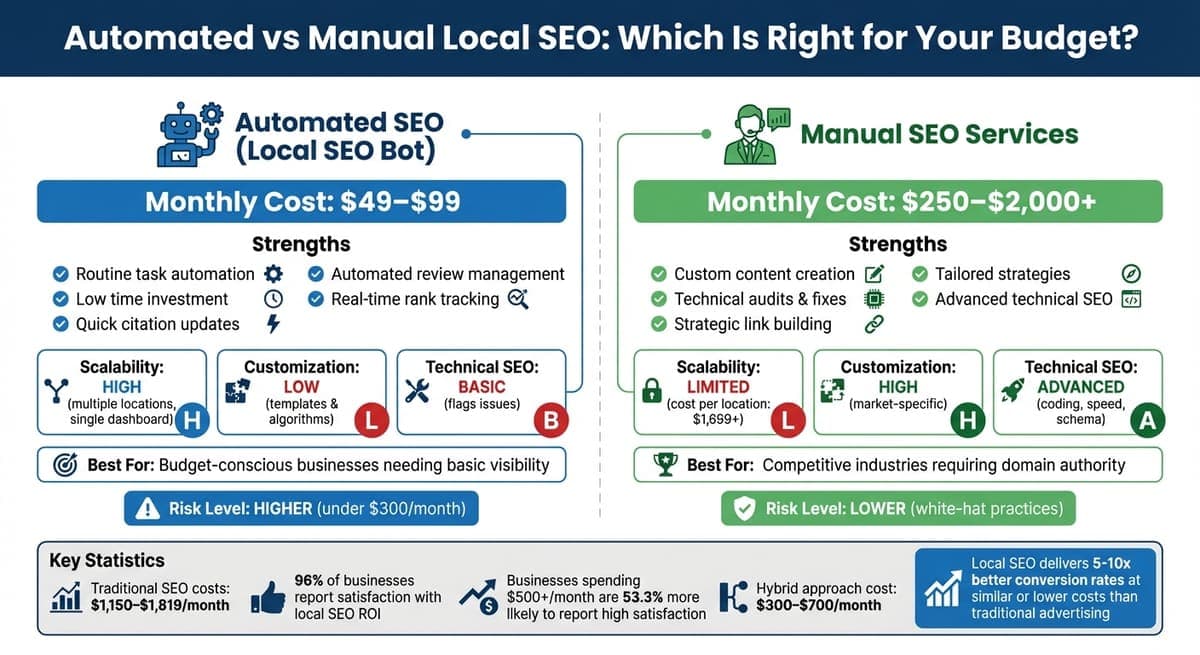
When deciding between automated and manual SEO, it’s important to weigh what each option excels at and where it might fall short. Here’s a quick comparison to help clarify the differences:
| Feature | Done-for-You Software (Local SEO Bot) | Freelancer or Agency |
|---|---|---|
| Monthly Cost | Starting at $99 | $250–$2,000+ |
| Primary Strengths | Quick citation updates, automated review management, real-time rank tracking | Custom content creation, technical fixes, strategic link building |
| Time Investment | Low - the work is done for you | Low to moderate - you brief and review the agency |
| Scalability | High - ideal for managing multiple locations at once | Limited - cost increases per location |
| Customization | Low - relies on templates and algorithms | High - tailored to specific market needs |
| Technical SEO | Basic - flags problems but doesn’t resolve them | Advanced - addresses coding, speed, and schema issues |
| Risk Level | Higher with low-cost automation (under $300/month) | Lower - focuses on sustainable "white-hat" practices |
| Best For | Budget-conscious businesses needing basic visibility and citation updates | Competitive industries requiring tailored strategies and domain authority |
Automated tools are great for simplifying tasks like syncing listings and responding to reviews, freeing up your time for more strategic efforts. On the other hand, manual SEO services, while more expensive, provide long-term benefits such as quality backlinks and optimized site structure that continue to deliver results over time.
For many businesses, combining both approaches can strike the right balance. Using automation for routine maintenance alongside manual SEO for targeted growth can cost between $300 and $700 per month. This hybrid strategy offers measurable results without the hefty price tag of full-service agencies.
"Automation transforms costly SEO efforts into affordable growth." – Arman Advani, SEO Specialist, Search Atlas
It’s worth noting that 96% of businesses report satisfaction with their local SEO ROI, and satisfaction rates increase by 53.3% when monthly spending exceeds $500. If your budget is tight, start with automation to establish a solid foundation, and as your revenue grows, transition into manual services for more advanced strategies.
This comparison helps you align your SEO investment with your business objectives, making it easier to choose the approach that fits your needs. To get started, follow our local SEO checklist to ensure you've covered the essentials.
How to Get Cost-Effective Local SEO on a Small Budget
If you're working with a tight budget - say, under $300 per month - automation can handle the essentials like maintaining accurate citations, keeping your listings consistent, and monitoring reviews. For example, Local SEO Bot handles these for you from $99 per month, which gives you a solid starting point. You can run a free Google Maps rank scan first to see where you stand today.
On the other hand, manual SEO is ideal for highly competitive markets where tailored strategies are a must. If your business requires premium content, strategic link building, or complex technical fixes, investing $500 to $2,000 per month in professional services can provide the depth and expertise that automation alone can't deliver. In fact, small businesses spending over $500 monthly on SEO are 53.3% more likely to report being extremely satisfied with their results. For those aiming for long-term success, this focus on quality can make the higher investment worthwhile.
For many small businesses, the best approach isn't choosing between automation and manual SEO - it’s a strategic mix of both. Using automation for routine tasks while leveraging expert input for technical audits and content strategies often falls in the $300 to $700 monthly range.
"Local SEO delivers 5-10x better conversion rates at similar or lower costs than traditional advertising." – Danielle Birriel, Founder, D&D SEO Services
Whether you begin with automation or dive straight into professional services, investing in local SEO ensures you're visible to customers actively searching for what you offer. Start with what your budget allows, track your progress over 3 to 6 months, and expand your efforts as your revenue grows.
Related Blog Posts
Frequently asked questions
- What’s the best way for small businesses to choose between automated and manual local SEO services?
- Small businesses should weigh their budget, time constraints, and marketing know-how when choosing between automated and manual local SEO services. Automated tools, such as Local SEO Bot, offer a budget-friendly option (starting at $99/month) and take care of tasks like Google Business Profile updates, citation management, and review tracking with minimal effort. These tools are ideal for businesses with limited resources or those seeking a straightforward way to maintain local visibility. On the other hand, manual SEO services - offered by agencies or freelancers - provide a more personalized experience. They craft tailored strategies, produce high-quality content, and focus on custom link-building. While these services come at a higher cost (often ranging from $1,000 to $2,000 per month or more), they deliver in-depth insights and flexibility, which can make a big difference for businesses in competitive markets or those aiming to build a strong brand presence. For many small businesses, a hybrid approach strikes the right balance. Using an automated tool for routine tasks, combined with professional expertise for occasional strategic updates, ensures cost-effectiveness while still tapping into expert guidance when it matters most.
- What are the benefits of combining automated tools with manual SEO expertise?
- Combining automated tools with hands-on SEO expertise offers small businesses a smart and budget-friendly way to improve their local search rankings. Automation takes care of time-consuming tasks like tracking keyword rankings, managing citations, and even drafting responses to customer reviews. This not only saves time but also trims costs, all while ensuring consistency and providing real-time updates - no need for a full-time SEO specialist. But here’s where the magic happens: pairing automation with manual expertise. A human touch brings strategic insights that machines just can’t replicate. Think tailored keyword strategies, content that truly reflects your brand’s voice, and the ability to spot local quirks or potential policy issues. Together, this hybrid method delivers quicker results, minimizes mistakes, and creates a strategy that evolves with market trends - all while keeping costs under control. For small businesses, it’s a winning formula to boost visibility without breaking the bank.
- What should small businesses consider when creating a budget for local SEO services?
- When setting your local SEO budget, it’s important to first assess the services your business requires. Common essentials like optimizing your Google Business Profile, building citations, and managing reviews are often included in most SEO packages. However, if you need extras like content creation or advanced analytics, those can push up the costs. Another key factor is the number of locations you’re optimizing - focusing on a single location tends to be more cost-effective than managing SEO for multiple sites. Next, consider the pricing model that suits your needs. Options typically include monthly retainers, project-based fees, or hourly rates. On average, small businesses spend between $1,100 and $1,400 per month for local SEO services. Keep in mind, freelancers often charge less, while agencies generally come with higher fees. Finally, weigh your expected return on investment (ROI). While affordable packages can yield solid results over time, more competitive industries or faster growth goals may require a larger budget. Striking the right balance between these factors will help you create a budget that supports your business objectives without stretching your resources too thin.