Local SEO Case Studies: 4 Real Wins Small Businesses Can Copy
Published October 9, 2026
Local SEO Case Studies: 4 Real Wins Small Businesses Can Copy

This article walks through four real local SEO case studies with before and after metrics, the repeatable tactics behind each win, and a compact template you can copy for your own business. You will see how Google Business Profile fixes, review generation, citation cleanup, and localized content combined to move rankings, calls, and foot traffic, plus exactly how to measure the same kind of progress.
TL;DR:
- Correct profile hours, categories, photos, and review replies first; single location examples showed visible movement within 30 to 60 days.
- Audit competitors before choosing between citation cleanup and localized pages: the plumber needed directory consistency, while the boutique prioritized neighborhood content.
- Track map rankings across geo grid locations, plus calls, direction requests, bookings, and reviews; compare against a recorded baseline using the same search settings.
- Expect profile views and calls to move within 30 days, but judge lasting gains through rankings and traffic over 60 to 90 days.
Table of Contents
- 1. Four Local SEO Case Studies With Before and After Results
- 2. The Tactics That Repeated Across Every Case Study
- 3. How to Measure Success: KPIs, Tools, and Timelines
- 4. A Copy-Ready Template for Your Own Case Study
- 5. Google Maps Features That Go Beyond Your Business Profile
- 6. Why Competitor Analysis Shapes a Local SEO Strategy
- 7. Where AI Automation Fits Into a Local SEO Campaign
- Where to Put Your Effort First
- How Local SEO Bot Puts These Tactics on Autopilot
- FAQ
- Sources
1. Four Local SEO Case Studies With Before and After Results
Each case study below follows the same structure: business type, objective, baseline, tactics, timeline, and results. We built this format after reviewing documented local SEO campaigns, including a public case-study collection that shows how small businesses tracked and reported their own local search gains.
1. Neighborhood cafe. A single-location coffee shop ranked outside the map pack for “coffee shop near me” despite strong foot traffic. The objective was simple: appear in the top three map results during morning commute searches. The owner corrected inconsistent business hours across the web, added weekly photo updates of seasonal drinks, and began replying to every review within 24 hours. Within 60 days, the cafe moved from an unranked position to the third map pack spot for its core keyword, and phone calls tracked through Google Business Profile Insights rose alongside that visibility.
2. Residential plumbing company. A plumber serving a mid-size metro area had a Google Business Profile but no citation consistency across directories, name and address variations appeared on at least a dozen sites. The team ran a citation audit, corrected mismatched listings, and added service-specific pages for drain cleaning, water heater repair, and emergency calls. Over a 90-day window, the business climbed from page two to the map pack for several service-area search terms and saw a jump in direction requests logged in Google Business Profile.
3. Boutique retailer. A clothing boutique with one storefront wanted to compete with larger retailers appearing in local search. The team focused on localized on-page content, store descriptions mentioning the neighborhood and nearby landmarks, plus schema markup identifying the business type and location. Combined with a push for customer reviews after checkout, the boutique’s local organic ranking for its primary category term improved within 45 days, and foot traffic tracked through in-store promotions increased noticeably during that period.
4. Service-area HVAC business. An HVAC company covering multiple towns without a physical storefront in each struggled with inconsistent visibility across its service area. The fix combined geo-grid rank tracking to identify weak zones, targeted local content for each town served, and a systematic review request process tied to completed jobs. By day 90, the business had measurable rank improvements across most tracked zip codes and a higher inbound call volume attributed to Maps listings.
The common thread: none of these businesses relied on a single tactic. Each paired a Google Business Profile fix with a review push and either citation work or localized content, and each measured results with specific tools rather than guesswork.

2. The Tactics That Repeated Across Every Case Study
Four tactics showed up in every case study above, and Google’s own guidance explains why each one matters.
- A complete, accurate Google Business Profile. Google’s local ranking guidance states that businesses with complete information, correct categories, photos, hours, and attributes are more likely to appear in relevant local searches.
- An active review strategy. Beyond collecting reviews, Google notes that replying to reviews helps a Business Profile and signals an active, trustworthy business.
- Citation consistency. Matching name, address, and phone number across directories feeds into what Google calls prominence, a measure of how recognized a business is across the web.
- Localized content with schema markup. Service pages that mention specific neighborhoods or towns, paired with structured data, help search engines match a business to nearby searches.
Prominence deserves extra attention because it is the least understood of Google’s three ranking factors (relevance, distance, and prominence). It is built from links, articles, directories, and reviews scattered across the web, not from any single profile setting. A business with five high-authority citations and a dozen recent reviews generally signals more prominence than one with a bare-bones profile and no outside mentions.
Pro Tip: Fix your Google Business Profile and review response habits before touching citations. Those two levers tend to move fastest and give you an early signal that your broader strategy is working.
3. How to Measure Success: KPIs, Tools, and Timelines
Tracking the right numbers is what turns a hunch into a credible case study. The Moz case study on local SEO citation cleanup emphasizes documenting exact search queries and geo-grid locations used for rank checks, since vague claims are easy to produce and hard to trust.
- Google Maps rank, tracked through geo-grid scans across your service area rather than a single search from your office.
- Local organic rank for your priority keywords, checked consistently from the same location settings.
- Phone calls, direction requests, and booking actions, pulled from Google Business Profile Insights.
- Review count and average rating, tracked monthly alongside response time.
Most campaigns show early movement in profile views and calls within the first 30 days, with ranking shifts and durable traffic gains appearing between 60 and 90 days, a pattern consistent with the Moz address-change case study’s documented timeline. Early signals like more profile clicks matter, but treat them as leading indicators, not proof of a lasting win.
4. A Copy-Ready Template for Your Own Case Study
Use this four-step framework to run a campaign and document it the way the case studies above were documented.
- Setup (before day 1): Define one measurable goal, capture baseline rank, call volume, and review counts, then run a Google Business Profile and citation audit.
- Days 0 to 30: Clean up Google Business Profile details, launch a review request process with prompt replies, and fix obvious on-page issues like missing location mentions.
- Days 30 to 60: Build or correct citations on high-authority directories, start local outreach or link building, publish localized content, and begin weekly geo-grid tracking.
- Days 60 to 90: Adjust tactics based on what the data shows, then compile before and after metrics with screenshots for a finished report.
This structure mirrors what Google’s own guidelines for representing a business recommend: accuracy first, consistency second, then sustained activity.
5. Google Maps Features That Go Beyond Your Business Profile
A complete Google Business Profile is the baseline, but Google Maps offers features that many businesses leave unused. The Q&A section lets potential customers ask questions directly on your listing, and unanswered questions often sit there unaddressed, which looks neglected to anyone scanning results. Seeding a few common questions yourself and answering them promptly gives searchers useful information before they call.
Photo updates matter more than a one-time upload. Listings with recent photos, not just a handful from years ago, tend to feel more active and trustworthy to someone comparing options in the map pack. Businesses that update photos seasonally or after any renovation give both Google and customers a reason to see the listing as current.
Booking integration, where applicable, removes a step between a searcher and a conversion. A service business that connects an appointment or reservation system directly to its profile lets customers book without leaving Google Maps, which shortens the path from search to sale. None of these features replace core profile optimization, but each one adds a layer of activity and usefulness that supports the prominence signals discussed earlier.
6. Why Competitor Analysis Shapes a Local SEO Strategy
Every case study above started with a look at who already occupied the map pack for the target keywords. Competitor analysis reveals which categories ranking businesses use, how many reviews they have, how recently their photos were updated, and whether their citations are more consistent than yours. That gap, not a generic best-practices checklist, is what should drive your priority list.
For the plumbing company case study, a competitor check revealed that top-ranking businesses had citations on a dozen more directories, which made citation cleanup the clear first move. For the boutique retailer, competitors had thinner location-specific content, so localized service and category pages became the higher-priority fix. The same audit that tells you what to fix also tells you what to skip: if competitors in your category rarely use Q&A or booking integration, that feature might matter less than catching up on basic profile completeness first.
Competitor analysis is not a one-time exercise. Categories change, new businesses enter a market, and a competitor’s citation count or review velocity can shift within a few months. Revisiting the same competitor snapshot every quarter keeps a local SEO strategy aimed at the right target instead of an outdated one.

7. Where AI Automation Fits Into a Local SEO Campaign
The case studies above involved manual audits, manual review replies, and manual citation fixes, work that took real hours from a business owner or a hired marketer. Automation changes the amount of time that work requires without changing the underlying tactics.
In a campaign structured like the HVAC example, Local SEO Bot handles the recurring parts of the process: it optimizes the Google Business Profile, publishes regular posts, tracks rankings across a service area with geo-grid scans, and responds to reviews automatically. Behind that automation, a dedicated team manually builds premium citations on high-authority directories, the same kind of citation work that moved the plumbing company’s rankings in its 90-day window.
For a multi-location or service-area business tracking rank across a dozen zip codes, doing geo-grid scans by hand every week is not realistic for most owners. Automated tracking combined with automated profile maintenance keeps the consistent activity that Google’s prominence factor rewards, without requiring someone to manually check rankings or write a new post every few days.
Where to Put Your Effort First
For a single-location business, Google Business Profile completeness and a steady review process produce the fastest visible movement, as the cafe and boutique examples showed. Citations and localized content layer on once those basics are solid.
Multi-location or service-area businesses in competitive categories need systematic geo-grid tracking and citations built at scale, work that gets harder to do consistently by hand as the number of locations grows. A hands-off service can maintain that consistency and give an owner back the hours that manual profile and citation work would otherwise take.
— Devyn H
How Local SEO Bot Puts These Tactics on Autopilot
We built Local SEO Bot to run the exact tactics behind the case studies above, without requiring you to do the manual work yourself. Our AI agent optimizes your Google Business Profile, publishes regular posts, tracks your rankings across your service area with geo-grid scans, and responds to reviews automatically, while our team manually builds premium citations on high-authority directories behind the scenes.
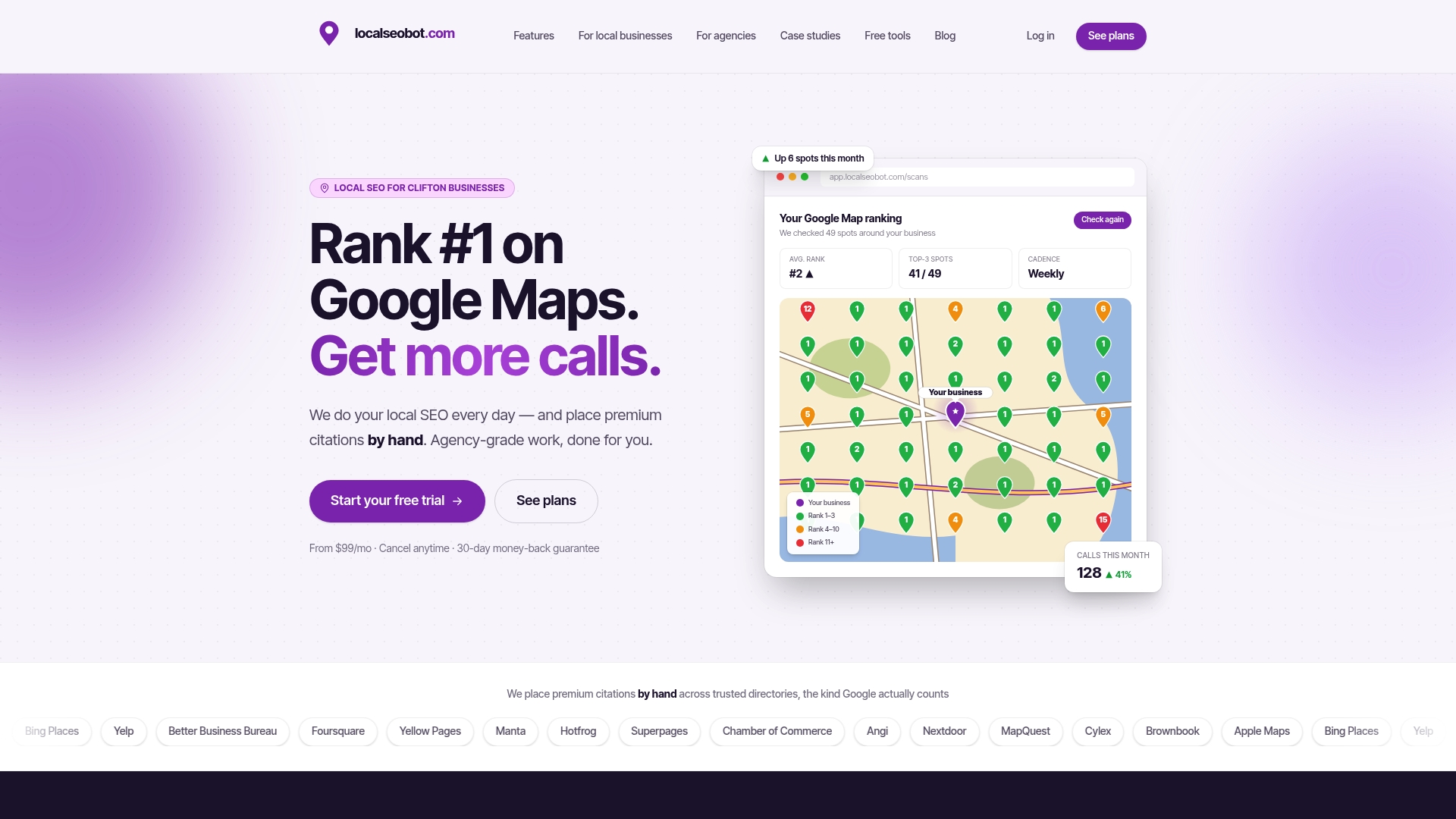
If you want to see what a campaign structured this way costs, our Foundation and Growth plans start at $99 and $199 per month per location, and we back every plan with a 30-day money-back guarantee if you don’t see a ranking increase.
FAQ
What makes a local SEO case study credible?
A credible case study documents baseline metrics, the specific tactics used, a clear timeline, and measurable before and after results like rank, calls, or traffic. The Moz address-change case study is a useful model because it names exact queries and locations used for rank checks instead of vague claims.
How long does it take to see local SEO results?
Early signals like profile views and calls often appear within 30 days, while ranking shifts and durable traffic gains typically show up between 60 and 90 days. Timelines vary by competition level and how consistently tactics like review generation and citation building are applied.
Do review replies actually affect local rankings?
Google states that replying to reviews helps a Business Profile’s performance and contributes to prominence, one of the three core local ranking factors. Consistent, prompt replies also signal to potential customers that a business is active and responsive.
What is the fastest tactic to improve local rankings?
For most single-location businesses, completing and correcting the Google Business Profile, accurate categories, hours, photos, and attributes, tends to produce the quickest visible movement. Pairing that with a steady review request process compounds the effect within the first 30 to 60 days.
What does Local SEO Bot cost?
Local SEO Bot offers three plans: Foundation at $99 per month, Growth at $199 per month, and a Pro plan at $399 per month built for agencies, each billed per location.
Sources
- Tips to improve your local ranking on Google - Google Business Profile Help
- Tips to improve your local ranking on Google - Google Business Profile Help
- Local SEO Case Study: The Diary of an Address Change - Moz
- Local Seo Case Studies