One Afternoon NAP Consistency Audit for Small Businesses
Published August 29, 2026
One Afternoon NAP Consistency Audit for Small Businesses

NAP consistency means your business Name, Address, and Phone number (often extended to NAP+W with your Website) appear identically across every online platform, so search engines can confirm you’re one real business rather than several conflicting ones. The single most important action: define a canonical NAP, publish it on your website, and match your Google Business Profile to it before touching anything else.
TL;DR:
- Most inconsistencies stem from conflicting business name, address, or phone number variations, which can cause confusion in search engine entity resolution.
- Prioritize fixing your canonical NAP on your website, Google Business Profile, Apple Maps, Bing Places, and Yelp, as these sources influence local visibility most.
- Use a spreadsheet to document discrepancies and focus on high-traffic, high-authority listings first for efficient correction.
- Avoid duplicate listings, inaccurate call tracking, keyword stuffing in names, and address formatting contradictions, as these are common pitfalls.
- Regular quarterly audits with citation management tools help maintain NAP consistency and prevent long-term visibility loss.
Table of Contents
- What NAP Consistency Means for Local SEO
- Where Your NAP Shows Up, in Priority Order
- The One-Afternoon NAP Audit and Cleanup Workflow
- Fixing the NAP Problems That Actually Trip Businesses Up
- Keeping NAP Consistent Across Multiple Locations
- How Often to Audit and What Tools Actually Help
- A Publisher’s Take on Managed Citation Work
- Fix Your Citations Without the Manual Grind
- Sources
What NAP Consistency Means for Local SEO
NAP stands for Name, Address, and Phone number. In advanced local SEO work, practitioners extend it to NAP+W, adding your website URL so every core identifier stays synchronized across directories, maps, and social profiles. That’s the standard industry term you’ll see in most technical guidance, and it’s worth knowing even if “nap consistency” is the phrase that brought you here.
Here’s where the framing gets misunderstood. NAP consistency isn’t a direct ranking factor Google grades on a checklist. It’s an input into entity resolution, the process search engines use to decide whether “Joe’s Plumbing on Elm Street” and “Joe’s Plumbing Inc. on Elm St.” are the same business or two different ones. When your citations agree, Google resolves your business into a single confident entity faster. When they conflict, you create ambiguity that can suppress visibility in Maps and local packs.

Consistency also shapes user experience directly. A customer who calls a disconnected number pulled from an old directory listing doesn’t blame the directory. They blame you.
Formatting tolerance matters here, and it’s the detail most guides skip:
- Minor variations (St. vs Street, Suite 200 vs Ste 200) are typically machine-readable as identical and cause no harm.
- Genuine contradictions (a different phone number, a different address) signal separate entities and cause real damage.
- Business name variants with added keywords (“Joe’s Plumbing Best Emergency Plumber”) confuse both algorithms and customers.
The risk isn’t punctuation. It’s contradiction.
Where Your NAP Shows Up, in Priority Order
Not every listing deserves equal urgency. Fix these in order:
- Your website. Your contact page, footer, and any location-specific pages should carry your canonical NAP in crawlable text, backed by localBusiness schema markup.
- Google Business Profile. This is the primary authoritative source feeding Maps and the local pack, so it needs to mirror your website exactly, per Google’s own guidance.
- Apple Maps. Claim and correct listings through Maps Connect, since Apple Maps is the default discovery surface on every iPhone.
- Bing Places. Often overlooked, but Bing Places data feeds other Microsoft ecosystems and some voice assistants.
- Yelp. Heavily trafficked for service businesses and restaurants, and frequently the source of stubborn old data.
- Major data aggregators (like Data Axle or Foursquare) that syndicate your listing to dozens of smaller directories automatically.
- Industry-specific directories (legal, medical, home services) plus social platforms and booking tools like OpenTable or Square Appointments.
Fixing the first five typically resolves most of your visible inconsistency. The aggregators and niche directories matter, but they’re leverage plays, not the main event.
The One-Afternoon NAP Audit and Cleanup Workflow
You don’t need a week for this. You need a focused afternoon and a spreadsheet.
- Lock your canonical NAP+W. Write down the exact legal or display business name, the exact address format, your primary local phone number, and your website URL. This becomes your single source of truth. Everything else gets compared against it.
- Make your website authoritative first. Add localBusiness schema to your homepage and any location pages, and confirm the NAP text is real, crawlable HTML, not an image or a PDF.
- Update primary listings before anything else. Fix Google Business Profile, Apple Maps, and Bing Places to match your canonical NAP. These carry the most weight and the most traffic.
- Search and document. Google your business name plus old addresses or old phone numbers. Check Yelp, aggregators, and any directory you can recall submitting to years ago. Log every inconsistency in a simple spreadsheet with the listing URL, current data, and correct data.
- Prioritize by traffic and authority. Fix high-domain-authority sites and anything showing up on page one first. Suppress or merge outdated duplicate listings rather than leaving them live.
- Correct aggregators and niche directories last, then re-verify your map pins and confirm any tracked phone numbers still route correctly.
Pro Tip: Before you submit a single correction, screenshot every listing as it currently exists. If a directory’s update tool breaks something, you’ll want proof of the original state to escalate a support ticket.
Once corrections go live, recheck each platform after 48 to 72 hours. Some directories batch updates overnight, and Google Business Profile changes can take a few days to reflect in Maps.
Fixing the NAP Problems That Actually Trip Businesses Up
Most citation cleanup projects stall on five recurring issues.
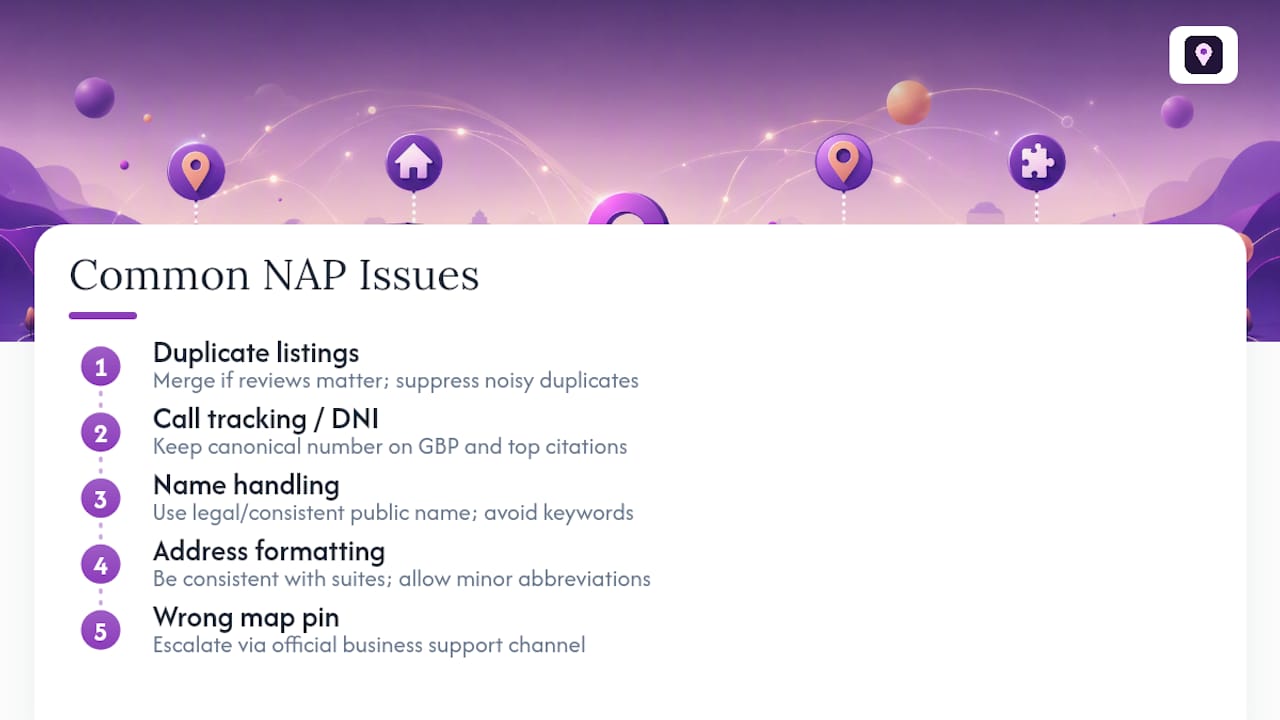
Duplicate listings happen when a business relocates, rebrands, or gets auto-generated by an aggregator that scraped old data. The fix depends on the situation: merge duplicates when both have reviews worth preserving, or suppress the outdated one entirely when it’s pure noise.
Call tracking and Dynamic Number Insertion (DNI) create a genuine dilemma. Marketing teams want tracking numbers to measure campaign performance, but citations need a stable, consistent number. The safest approach: preserve your canonical phone number on your Google Business Profile and top-tier citations, and reserve tracking numbers for paid ad campaigns and call-tracking software specifically, using call forwarding rather than replacement wherever a citation is involved.
Name handling trips up more businesses than you’d expect. Use your registered legal name or your consistently displayed public name, not a keyword-stuffed variant. “Joe’s Plumbing” beats “Joe’s Plumbing Emergency Drain Cleaning Repair” every time; algorithms flag the second as manipulation, and Google Business Profile guidelines explicitly prohibit it.
Address formatting deserves flexibility, not obsession. Suite and unit numbers should be consistent, but minor abbreviation differences rarely cause harm on their own, according to Ahrefs’ analysis of NAP practices. Save your strictness for genuine contradictions.
When a map pin sits in the wrong location or an aggregator won’t accept a correction, escalate through the platform’s official business support channel rather than resubmitting repeatedly. Repeated duplicate submissions often make aggregator confusion worse, not better.
Keeping NAP Consistent Across Multiple Locations
Multi-location and service-area businesses face a different problem: internal competition, not just external inconsistency.
- Give every location its own canonical NAP and a dedicated page with unique localBusiness schema, never a single generic “locations” page listing them all.
- Assign each location a distinct local phone number where possible, so calls route clearly and Google doesn’t merge or mask separate branches under one listing.
- Service-area businesses (mobile detailing, home repair, pest control) that don’t want a public storefront address should use Google Business Profile’s service-area setting rather than listing a residential address and hiding it later.
- Watch for location cannibalization, where two nearby branches compete for the same searches because their service areas overlap in Google’s eyes.
A multi-location management approach built around synchronized, location-specific NAP+W data prevents most of this before it starts.
How Often to Audit and What Tools Actually Help
Quarterly audits catch most drift before it compounds. Run an additional check any time you move, rebrand, change phone providers, or migrate your website to a new platform, since migrations are notorious for quietly breaking schema markup.
A few tool categories cover the real work:
- Citation management platforms that scan your listings across dozens of directories and flag mismatches automatically.
- Site crawlers that verify your schema markup is still valid after a redesign.
- Rank trackers that reveal whether inconsistency is actually costing you visibility, not just theoretical accuracy.
- Schema validators to catch markup errors before they go live.
For a minimal monthly workflow, search your business name and phone number in Google, spot-check your top five listings, and confirm your Google Business Profile still matches your website. Tools like the Citation Consistency Analyzer can automate that scan instead of you doing it by hand every 30 days. If you’re managing more than five locations or you simply don’t have the bandwidth, that’s the point where outsourcing citation management starts paying for itself. Some businesses also use rotating monitoring infrastructure, similar to what brand protection proxy services offer for large-scale listing surveillance, though most small businesses never need that level of tooling.
A Publisher’s Take on Managed Citation Work
Manual, hands-on citation building beats automated blasting because a person can catch the contradiction an algorithm waves through. Localseobot builds premium citations manually and uses a proprietary Citation Consistency Analyzer to flag mismatches before they fragment your entity. DIY works fine for a single location with a free afternoon. Once you’re juggling multiple branches, tracking numbers, and old directory ghosts, hire it out. Localseobot backs its work with a 30-day money-back guarantee if rankings don’t move.
— Local
Fix Your Citations Without the Manual Grind
Localseobot builds your citations by hand across high-authority directories instead of relying on the automated blasting most tools use, so the inconsistencies this article just covered don’t creep back in six months later.
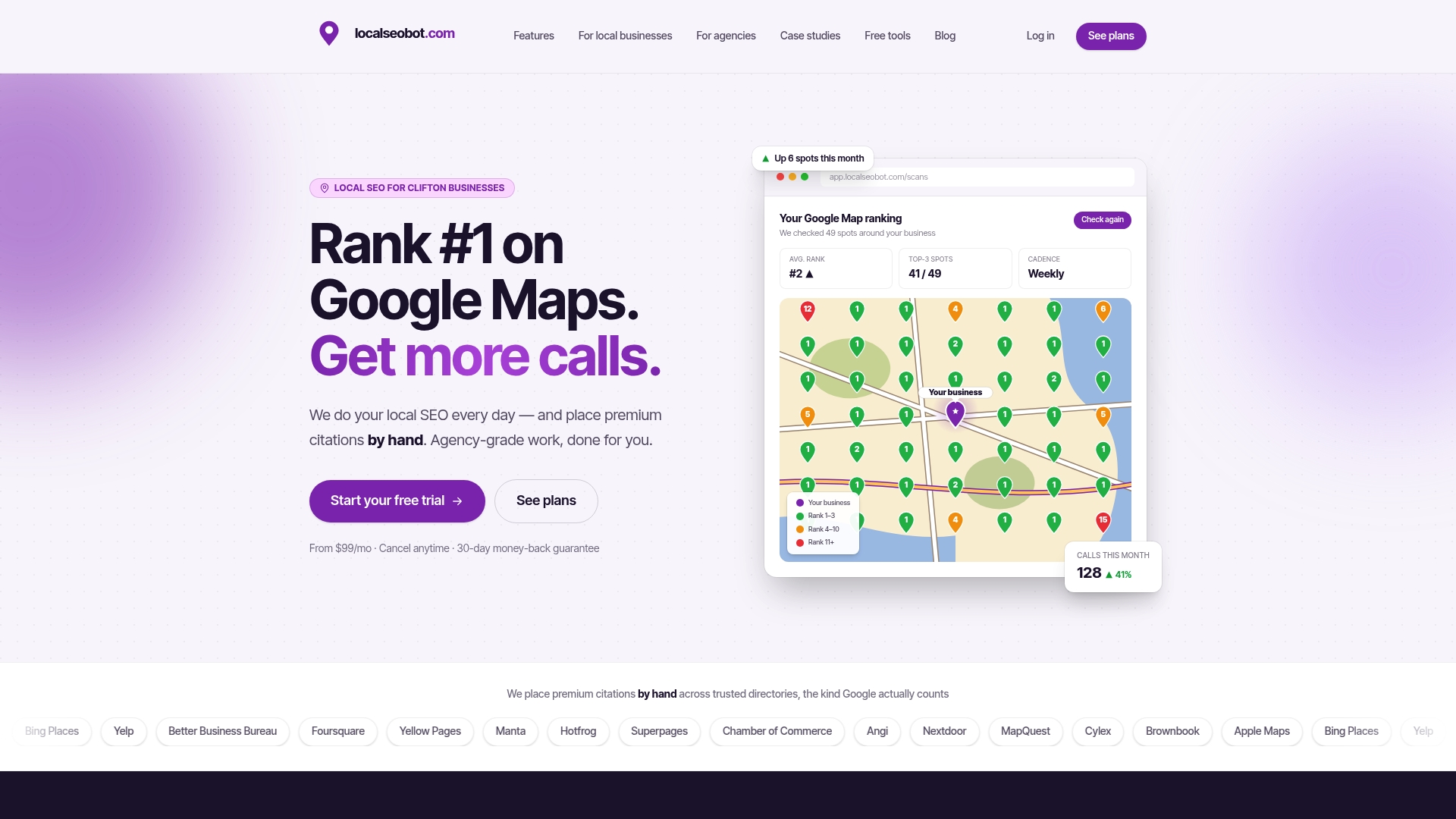
Rather than spending your afternoon cross-checking Yelp against Bing Places against your website footer, run your business through the Citation Consistency Analyzer to see exactly where your NAP+W breaks down right now. If the audit turns up more than a handful of contradictions, Localseobot’s managed citation service handles the cleanup and ongoing monitoring for you, backed by a 30-day money-back guarantee if your Maps ranking doesn’t improve. Start with the free audit and see what’s actually holding your listings back.