Niche Citation Sites: The Shortlist That Moves Rankings
Published August 21, 2026
Niche Citation Sites: The Shortlist That Moves Rankings

Niche citation sites are industry-specific directories, like Avvo for lawyers or Houzz for contractors, that list your business under a category Google already trusts. They matter because they tell Google your Google Business Profile category is accurate, which strengthens your odds of showing up in the Map Pack for the searches that actually convert.
The single best move you can make this week: claim the most relevant directories for your exact industry, then fix your records with the major data aggregators before you submit anywhere else. BrightLocal’s curated lists track over 1,000 niche citation sites across 41 business categories, and Localseobot’s own audits confirm the same pattern: businesses that focus on quality rather than quantity see potentially faster ranking movement.
Before you touch a niche directory, get the foundation right:
- Claim and verify Google Business Profile, Bing Places, and Apple Business Connect.
- Correct your listing with major data aggregators like Data Axle, Localeze, and Foursquare.
- Then move to your 10 to 15 top niche sites in order of topical relevance.
Key Takeaways
Niche citation sites strengthen local rankings by validating your business category to Google, and a focused shortlist of 10 to 15 high-relevance directories outperforms mass submission every time.
| Point | Details |
|---|---|
| Fix the foundation first | Verify Google Business Profile, Bing Places, and Apple Business Connect before touching niche directories. |
| Correct aggregator data | Update Data Axle, Localeze, and Foursquare to fix NAP errors across dozens of downstream sites at once. |
| Apply the 10 to 15 rule | Prioritize a short list of high-relevance niche sites over hundreds of low-value directory submissions. |
| Match your NAP exactly | Use one canonical name, address, and phone format on every single directory submission. |
| Expect results in 60 to 90 days | Track Map Pack position, calls, and referral traffic to measure real ranking movement. |
| Consider a hands-on service | Localseobot manually builds premium niche citations and fixes aggregator records with a 30-day money-back guarantee. |
Table of Contents
- What Are Niche Citation Sites and Why They Matter for Local Search
- Top Niche Citation Sites, Organized by Industry
- How to Prioritize Which Niche Sites to Target
- Submission Checklist: What to Fill and Common Pitfalls to Avoid
- Data Aggregators and the Distribution Layer
- Tools and Resources to Find and Audit Niche Citations
- Timeline, Expected Impact, and How to Measure Success
- Maintenance, Common Mistakes, and Pro Tips
- How We Approach Niche Citation Building
- A Hands-On Alternative to DIY Citation Hunting
- Sources
What Are Niche Citation Sites and Why They Matter for Local Search
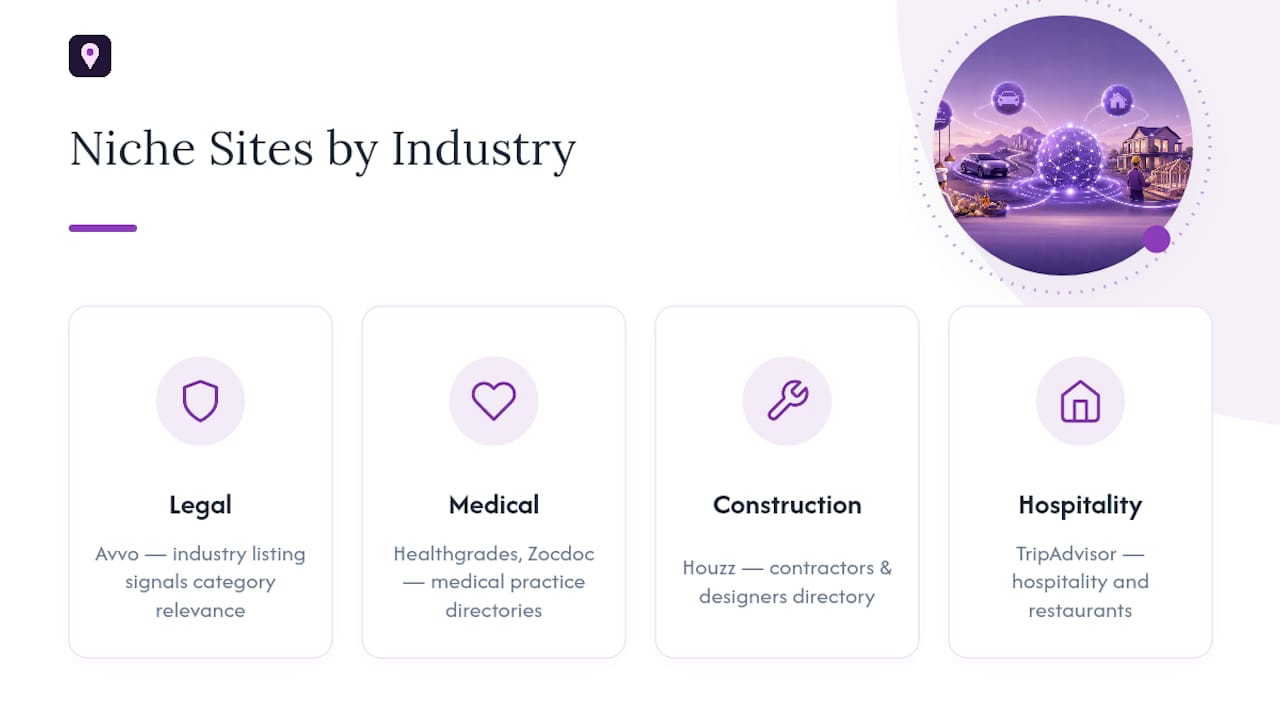
A niche citation site lists your business name, address, and phone number (NAP) under a directory built specifically for your industry. Avvo is built for attorneys. Healthgrades and Zocdoc serve medical practices. Houzz caters to contractors and designers. TripAdvisor is for hospitality and restaurants. These platforms differ from generic directories like general business listing sites in one critical way: they signal to Google that real people in your industry recognize you as a legitimate player in that category.
That distinction matters more than most business owners realize. A listing on a generic directory tells Google “this business exists.” A listing on an industry-specific directory tells Google “this business operates in this category, in this location, and has validation from relevant industry sources.” Google’s algorithm weighs that context when it decides which businesses deserve to rank for category-specific searches, like “family law attorney near me” or “emergency plumber open now.”
Industry commentary increasingly backs this up: niche directories often carry more topical trust than a high domain-authority directory that has nothing to do with your field. Local SEO guidance from 2025 argues that context now outweighs raw authority scores, particularly since many niche platforms include built-in review or credential systems that generic directories lack.
The practical takeaway: don’t chase every directory that will accept a free listing. A manual audit of your top three competitors’ citations will show you exactly which niche sites are already working in your category, and that’s a faster path to results than blind submission.
Top Niche Citation Sites, Organized by Industry
Every industry has a small set of directories that carry real weight, and chasing the rest wastes time. Here’s where to start, by vertical, based on industry-specific directory data that tracks 217 niche directory submission sites by category.
- Legal. Avvo remains the standard for attorney profiles, with peer ratings and client reviews that Google treats as category validation. Justia and FindLaw round out a solid three-site foundation for most law firms.
- Healthcare. Healthgrades and Zocdoc dominate this space, both loaded with patient reviews and provider credentials that generic directories simply don’t collect. Vitals is a solid third option for many specialties.
- Home services. Houzz is essential for contractors, remodelers, and designers, since it combines a portfolio showcase with a directory listing. Angi (formerly Angie’s List) still carries weight for general contractors and trade services.
- Hospitality and restaurants. TripAdvisor is close to mandatory for anything guest-facing, from hotels to tour operators. OpenTable matters specifically for restaurants that take reservations, since it feeds review data directly into search results.
- Automotive. Cars.com and RepairPal serve repair shops and dealerships with category-specific review systems that generic listing sites don’t replicate.
- Real estate. Zillow and Realtor.com function as both lead sources and citation platforms, giving agents a dual benefit that few niche sites in other categories match.
For every industry not listed above, the same logic applies: search “[your industry] directory” and “[your industry] near me” to see which platforms Google already surfaces. Those are your priority targets, because they’re the ones Google is already treating as authoritative for your category. If you run a home services business specifically, this SEO guide for trades breaks down lead-generation strategies tied to industry-specific listings worth reviewing before you submit anywhere.
How to Prioritize Which Niche Sites to Target
You don’t need 200 citations. You need the right 15.

Start with the rule of thumb that most experienced local SEO practitioners use: pick a focused group of niche sites with the highest relevance to your category and your city, and ignore the rest until those are locked in. BrightLocal’s directory of over 1,000 niche citation options makes clear the real challenge isn’t finding directories. It’s narrowing them down.
Use these four criteria to build your shortlist:
- Topical relevance. Does the directory exist specifically for your industry, or is it a broad catch-all with a category dropdown?
- Search visibility. Does the directory itself rank on page one for searches related to your business type and city?
- Verification and reviews. Can customers leave reviews on the platform, and does it verify business ownership?
- Referral potential. Will real people find and click through to your listing, not just search bots?
A quick competitor audit speeds this up considerably. Pull up three competitors who outrank you and check where they’re listed. That list is often your fastest path to a prioritized shortlist, since it shows you which niche directories are already contributing to rankings in your exact market.
Newer signals are worth watching too. Tools built around AI citation frequency track which directories AI answer engines like ChatGPT and Perplexity pull from most often when they answer category-specific questions. A niche site with strong AI citation presence can outperform a generic high-authority directory that AI tools never reference.
Pro Tip: Run your business name through Google alongside your top three competitors’ names. Whatever directories show up repeatedly in those results are the ones worth claiming first.
Submission Checklist: What to Fill and Common Pitfalls to Avoid
Consistency is what separates a citation that helps from one that quietly hurts you. Every field you populate should match your Google Business Profile exactly.
- Legal business name. Use the exact name on your GBP listing, not a shortened or marketing version.
- NAP fields. Match address formatting precisely, including suite numbers and directional abbreviations (St. vs. Street).
- Categories. Choose the closest match to your GBP primary and secondary categories.
- Website URL. Link to your homepage or a location-specific page, never a broken redirect.
- Hours, service areas, and photos. Fill every optional field the platform offers; incomplete listings rank worse than complete ones.
Common pitfalls that trip up even experienced teams:
- Abbreviating “Street” as “St” on one directory and spelling it out on another.
- Formatting phone numbers inconsistently, like (555) 123-4567 versus 555.123.4567.
- Leaving old suite numbers on file after an office move.
- Submitting duplicate listings on directories that already had an unclaimed profile.
Document every submission in a spreadsheet with the date, login credentials, and verification status, so you can track what’s live and what’s still pending review.
Data Aggregators and the Distribution Layer
Data aggregators feed business information to hundreds of smaller directories at once, which makes fixing them one of the highest-leverage moves in citation building. In the United States, the major players are Data Axle, Localeze (owned by Neustar), and Foursquare. Correcting your record with these three before expanding into niche directories prevents you from building new citations on top of outdated data that will keep resurfacing.
Here’s the practical sequence:
- Search each aggregator’s platform for your existing business record.
- Claim it, correct any NAP discrepancies, and submit the fix.
- Wait two to four weeks and recheck a sample of smaller directories to confirm the correction propagated downstream.
- If a specific niche directory doesn’t pull from an aggregator, submit to it manually, since not every platform sources its data automatically.
Fixing aggregator records often resolves dozens of downstream inconsistencies in one move, which is far more efficient than chasing each individual directory that inherited the wrong address.
Tools and Resources to Find and Audit Niche Citations
Finding the right niche directories and confirming your NAP is consistent across all of them requires the right tools, not guesswork. A few categories matter most: citation finders that surface industry-specific opportunities, consistency checkers that flag mismatched NAP data, and competitor citation analysis tools that reveal where rivals are already listed.
Localseobot’s own Local Citation Finder surfaces niche directory opportunities by category and location, while the Citation Consistency Analyzer flags NAP mismatches across your existing listings. Pair those with BrightLocal’s curated category lists and a manual competitor check, and you have a workflow that covers discovery, prioritization, and verification without wasting hours on directories that won’t move the needle.
Timeline, Expected Impact, and How to Measure Success
Most businesses that combine niche citation building with aggregator fixes and consistent GBP optimization see measurable ranking movement within 60 to 90 days. That’s not instant, but it’s fast enough to track against a quarter.
Track these signals before and after your citation push: Map Pack position for target keywords, your Google Business Profile visibility score, phone call volume through call tracking, and direct referral traffic from niche directories in your analytics. Tag your submissions by date so you can line up ranking movement with the actual work, rather than guessing which change caused which result.
Maintenance, Common Mistakes, and Pro Tips
Citations decay. Directories merge, change ownership, or quietly suppress duplicate listings, so a citation that helped you last year might be gone or wrong today.
Audit your niche citations every three to six months. Watch for platform consolidations (smaller directories frequently get absorbed by larger ones) and check that your NAP hasn’t drifted after any office move or phone number change.
Pro Tip: Pick one canonical NAP format and write it down. Use that exact format on every submission, every time, with zero exceptions.
- Claim review profiles on every niche site that offers them, since reviews compound their ranking value over time.
- Prioritize directories with active review systems over static listing-only platforms when your time is limited.
How We Approach Niche Citation Building
Manual, industry-first citation building beats automated blasting because relevance compounds. Localseobot backs that approach with a 30-day money-back guarantee if rankings don’t move.
A Hands-On Alternative to DIY Citation Hunting
Building a prioritized shortlist of niche citation sites, fixing aggregator records, and keeping NAP consistent across dozens of directories is real work, and most small business owners don’t have the hours to do it right. That’s the gap Localseobot fills.
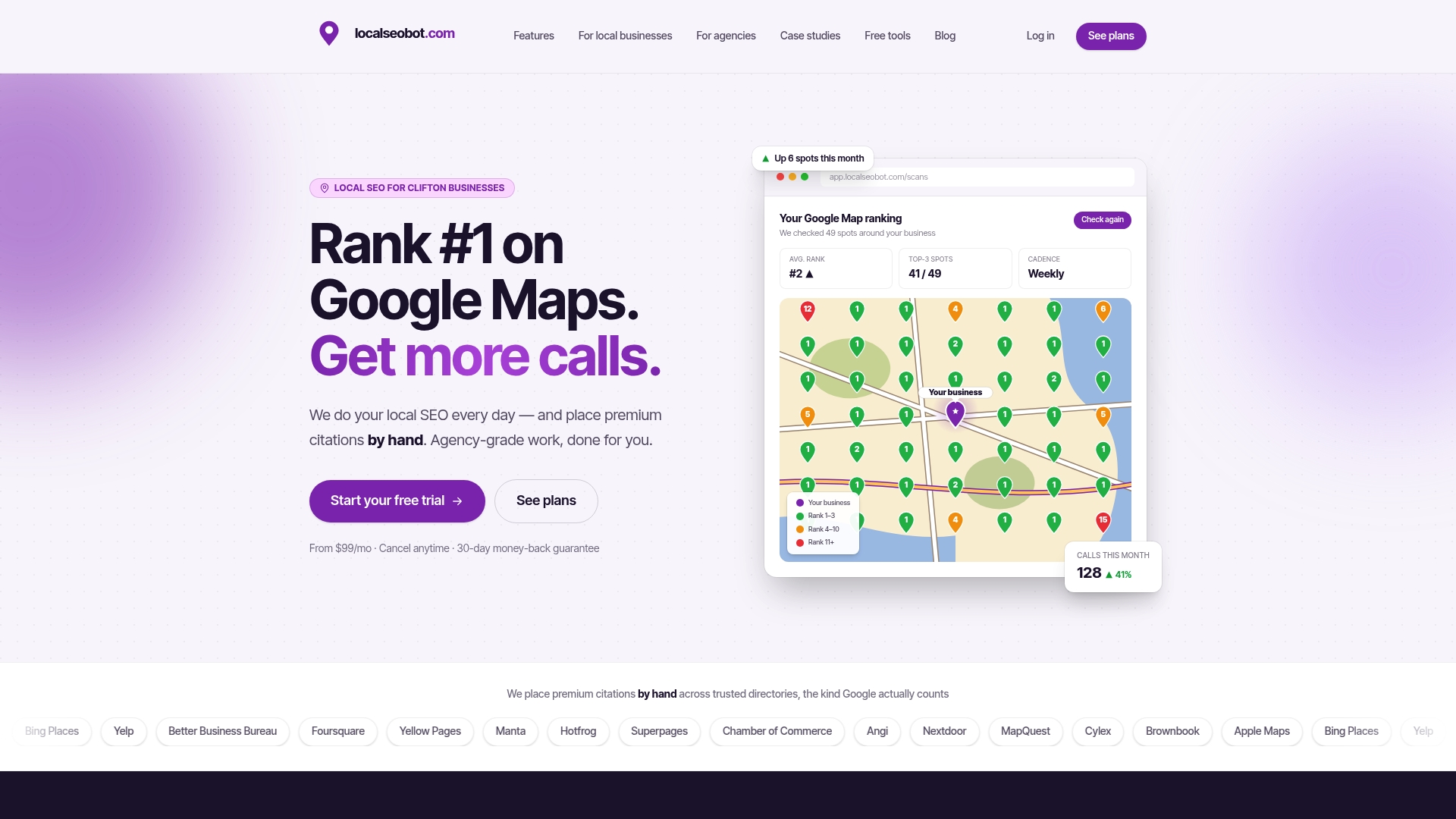
Localseobot manually builds premium citations on high-authority, industry-relevant directories, corrects your records with major data aggregators, and keeps your Google Business Profile optimized on an ongoing basis, without you touching a spreadsheet. It’s built for small business owners who want the accuracy of a hands-on approach without hiring an in-house specialist, and for agencies that want a white-label option to offer clients under their own brand. Every plan comes backed by a 30-day money-back guarantee if your rankings don’t improve.
If you want to see how your current citation profile stacks up before committing to anything, start with the Local Search Engine Optimization Service page to review what a done-for-you citation build actually includes for your industry.
Sources
BrightLocal’s niche citation lists and industry-organized directory guides offer deeper category breakdowns.
- 1000+ Niche Citation Sites for 41 Local Business Categories - BrightLocal
- How to Build Local Citations: Step-by-Step Guide for 2026 | Flento
- 217 Niche Directory Submission Sites by Industry
- Citation Sources | Find the Sites AI Cites in Your Category | Whaily