Review Gating Rules: What Google and the FTC Actually Prohibit
Published August 22, 2026
Review Gating Rules: What Google and the FTC Actually Prohibit

Review gating, filtering customers by sentiment before deciding who gets a public review link, is prohibited under both Google’s Maps content policy and the FTC’s Consumer Reviews and Testimonials Rule. If your review request flow asks customers to rate their experience privately first and only routes happy customers to Google or Yelp, you are gating, and it needs to stop today.
Here’s your immediate action list:
- Pause any campaign that filters customers by star rating before offering a public review link.
- Disable sentiment-based branching in your review software (the “if rating is 4+ stars, show public link” logic).
- Send the same public review link to every customer who completes a purchase or service, regardless of how they answered any pre-survey.
- Screenshot your current review request flow before you change it, so you have a record of remediation.
We’ll walk through the exact policy language, the penalties on the table, and how to rebuild a compliant system that still drives real review volume.
Key Takeaways
Review gating is prohibited under both Google’s Maps policy and the FTC’s 2024 rule, and the fix, routing every customer to the same public link, is simpler and safer than the workaround it replaces.
| Point | Details |
|---|---|
| Gating is explicitly banned | Google and the FTC both prohibit selectively soliciting reviews from a filtered, non-representative sample. |
| Penalties are real | Google can remove reviews and suspend profiles; the FTC’s 2024 rule adds civil penalty exposure. |
| Routing is the compliant fix | Send every customer the same public link, and offer private feedback as an optional extra, not a gate. |
| Audit your vendor | Ask if low scorers get the same one-tap public review path as satisfied customers by default. |
| Document your compliance | Keep dated screenshots and logs of your message templates as evidence if a platform questions your account. |
Table of Contents
- What Review Gating Rules Actually Mean for Your Business
- Google’s Policy and the FTC Rule, in Plain Terms
- Fines, Suspensions, and the Cost of Getting Caught
- Building a Review Flow That Passes Every Compliance Check
- How to Audit Your Own Review Requests for Gating
- Fixing a Gated Review Program Step by Step
- Why Compliance Protects Your Local Visibility
- Review Gating Looks Different Across Industries, But the Risk Is the Same
- What Gating Costs You in Customer Trust
- How Gating Rules Shift Across Legal Jurisdictions
- Review Gating Rules Don’t Stop at Google
- Get Your Review Program Audited by Local SEO Bot
- The Compliance Gap Most Businesses Get Wrong
- Sources
What Review Gating Rules Actually Mean for Your Business
Review gating happens when a business asks customers to rate their experience privately, then only sends the public review link (Google, Yelp, Facebook) to the people who gave a positive score. Customers who report a bad experience get quietly redirected to an internal feedback form or nothing at all. The public review page ends up seeing only your best moments.
A typical gated flow looks like this:
- Customer receives a text or email asking “How was your experience?” with a 1 to 5 star selector.
- Customers who select 4 or 5 stars are shown a button linking to the public review site.
- Customers who select 1 to 3 stars are shown a “Tell us more” form that never reaches Google or Yelp.
Fair solicitation looks different: every customer, regardless of how they feel, gets the same public review link. You might still offer a private feedback channel, but it sits alongside the public option, not instead of it. You’ll see gating disguised in SMS drip campaigns, post-checkout email sequences, and even in-store kiosks that ask “Did you enjoy your visit?” before printing a review card only for “yes” answers.
Google’s Policy and the FTC Rule, in Plain Terms
Google’s Maps user-generated content policy draws a hard line on manipulation. The policy prohibits businesses from discouraging customers from leaving negative reviews, selectively soliciting reviews only from customers likely to leave positive feedback, and offering incentives in exchange for reviews or review edits. Any of these can trigger rating manipulation enforcement.
The FTC’s Consumer Reviews and Testimonials Rule, finalized in October 2024, backs this up with federal weight. The rule prohibits businesses from soliciting reviews from a non-representative sample of past customers when the solicitation is designed to skew the visible reviews toward the positive. Violations can carry civil penalties, not just a platform warning.
Statistic Callout: The FTC’s rule took effect in October 2024, marking the first time selective review solicitation carries explicit federal civil penalty exposure rather than just a platform-level risk of removal.
Watch for these practical signposts that a program has crossed the line:
- Review requests sent only to customers flagged as “satisfied” in a CRM or post-service survey.
- Conditional links that only appear after a customer clears a star-rating threshold.
- Any offer, discount, or incentive tied to leaving a positive review or editing an existing one.
Additional FTC guidance for platforms reinforces that the obligation to solicit fairly applies to both the business collecting reviews and any software vendor built to automate the process.
Fines, Suspensions, and the Cost of Getting Caught
Gating is a worse bet than just living with the occasional bad review, because the downside is compounding. The FTC’s 2024 rule gives the agency explicit authority to pursue civil penalties for non-representative solicitation, which shifts the risk from a platform slap on the wrist to federal regulatory exposure.
Google’s enforcement side is just as unforgiving. The company can remove reviews it identifies as manipulated, and repeated or severe violations can lead to full Business Profile suspension, cutting off your Maps listing entirely. Recent policy updates in 2026 went further, explicitly banning review kiosks and on-premises pressure tactics, and leaning harder on AI-driven detection to catch manipulation patterns automatically.
Gating creates an artificially skewed review distribution, and modern detection systems are built specifically to flag that kind of unnatural pattern. Recovery after a suspension is rarely quick, and rebuilding trust with both the platform and your customers can take months.
The consequences stack up fast:
- Review removal: Google strips flagged reviews, often the good ones you worked to collect.
- Profile suspension: Your entire Maps listing can disappear from local search results.
- Ranking damage: Lost reviews and suspension time translate directly into lost local pack visibility, and rebuilding that position takes far longer than it took to lose it. Use a visibility estimator to see how exposed your current ranking is.
Building a Review Flow That Passes Every Compliance Check
The fix isn’t complicated. It’s called routing, and it works because it treats every customer the same way. A compliant routing flow has three properties: every customer sees the same public review option, private feedback is offered as an optional extra rather than a replacement, and the default behavior sends requests to your full customer sample, not a filtered slice.
Here’s how to build one that still converts:
- Send the public review link (Google, Yelp, whatever fits your business) to every customer who completes a transaction, no exceptions.
- Add a secondary, optional line inviting customers to share detailed feedback privately if they’d rather not post publicly.
- Time the request within 24 to 48 hours of service completion, when the experience is still fresh.
- Use more than one channel, an SMS follow-up and an email, since some customers respond better to one than the other.
- Respond publicly to negative reviews with a calm, specific reply rather than trying to prevent them from appearing.
GoodMarks’ analysis of the 2024 shift makes the case that offering private feedback as a genuine choice, not a diversion tactic, actually helps you catch actionable complaints before they go public, while keeping your solicitation compliant.
Pro Tip: Put the public review link in the first line of your message, not buried after a satisfaction question. Customers who have to scroll past a survey to find the link are far less likely to click it, and that survey step is exactly what regulators look for as evidence of gating.
How to Audit Your Own Review Requests for Gating
Run this quick audit on your current setup before assuming you’re clean:
- Confirm the public review link appears identically for every customer, with no conditional logic based on prior answers.
- Check whether your email and SMS platforms are set to send to 100% of completed-service customers by default, not a filtered segment.
- Pull logs from your review software showing that every customer in a given batch was presented with the same options.
If you use a third-party vendor or agency to manage requests, ask these three questions directly:
- Does a customer who gives a low score get the same one-tap path to the public review form as a happy customer?
- Are review requests sent to every customer who completed a service by default, or only to a filtered list?
- Can you produce logs proving identical public options were shown to everyone in a campaign?
Keep dated screenshots of your message templates and flow documentation. If a platform ever questions your account, having a paper trail showing consistent, non-selective solicitation is your best defense.
Fixing a Gated Review Program Step by Step
If your audit turns up gating, work through this sequence in order.
- Immediately pause any live campaign using sentiment-based filtering, and disable the logic that blocks public links from low-scoring customers.
- Within the week, rewrite your message templates so every customer receives the identical public review link, with private feedback offered as a clearly optional add-on rather than a gatekeeper.
- Within the month, update your customer service SLAs to reflect the new flow, and retrain any staff or agency contacts who manage review requests.
- On an ongoing basis, run the audit checklist quarterly and archive your compliant templates and logs as evidence.
Pro Tip: Don’t just fix the flow, document the fix. A dated record showing when you switched from gating to routing is exactly what you’ll want on hand if a platform or the FTC ever asks questions about historical practices.
Why Compliance Protects Your Local Visibility
Localseobot helps clients build and monitor review programs that stay inside Google’s policy while still generating real volume, pairing automated review generation with profile health monitoring so gating never creeps back in. Clients running compliant profiles have reported improved Google Maps positions and measurable increases in customer calls once their listings stabilize.
Consider bringing in professional help when:
- Your profile has already faced a suspension or formal warning.
- You’ve found repeated gating patterns across multiple locations.
- You’re managing review requests across too many locations to audit manually every quarter.
Review Gating Looks Different Across Industries, But the Risk Is the Same
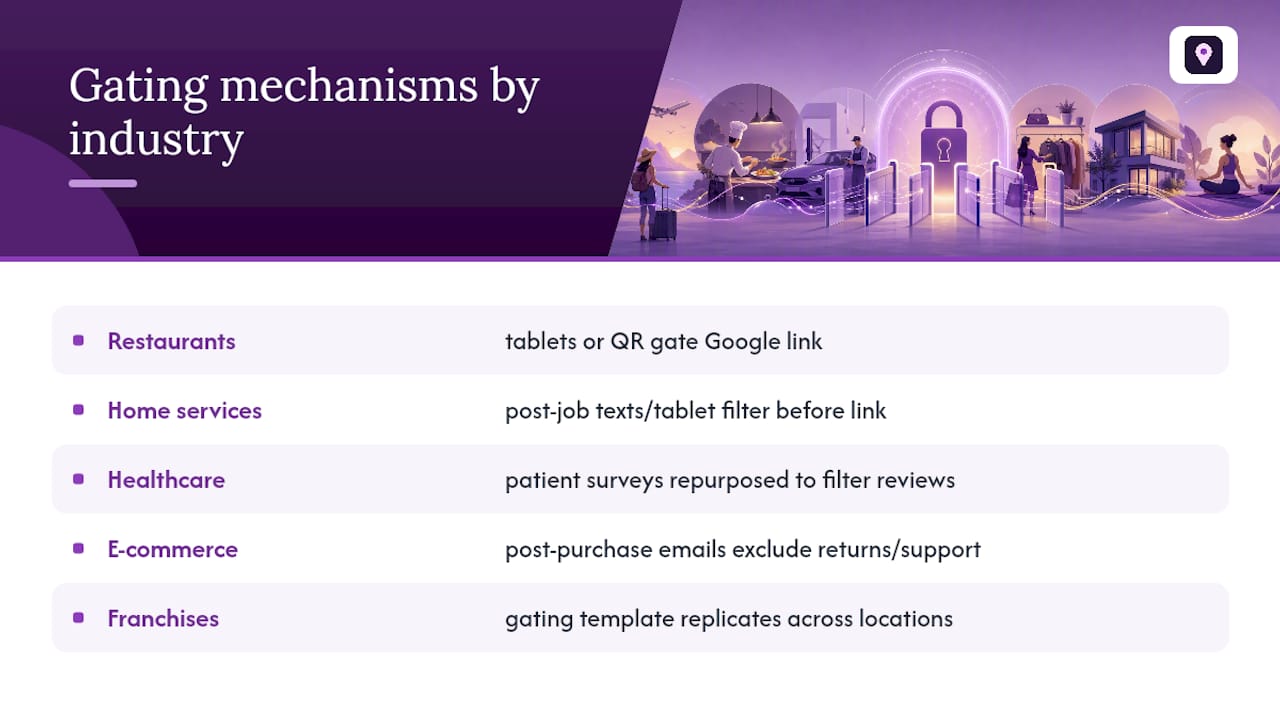
Restaurants often gate through table-side tablets or QR codes that ask “How was your meal?” before deciding whether to show the Google review link, a pattern that’s now explicitly named in Google’s 2026 policy update as a banned kiosk tactic.
Home service businesses (plumbers, HVAC techs, electricians) tend to gate through post-job text surveys, where a technician’s tablet or a follow-up SMS filters customers before the public link ever appears. Because these businesses depend heavily on the local map pack for lead generation, a suspension here often does more revenue damage than in industries with stronger brand-search traffic.
Healthcare and dental practices sometimes build gating into patient satisfaction surveys required for other purposes, quietly repurposing internal feedback tools to filter who sees a public review request. This carries extra risk since healthcare reviews already face tighter scrutiny for privacy reasons.
E-commerce brands frequently gate through post-purchase email sequences, sending the public review link only to customers who didn’t request a return or file a support ticket. Because e-commerce reviews often live on the retailer’s own site as well as Google, gated e-commerce programs risk violations on two fronts at once.
Franchises and multi-location businesses face a unique problem: a gating template built by one location or a shared vendor account can replicate across dozens of profiles before anyone notices, turning a single mistake into a chain-wide compliance issue.
What Gating Costs You in Customer Trust
A review section that’s suspiciously perfect (all five stars, glowing language, no complaints) reads as fake to modern consumers, even when every review is technically real. People have learned to distrust review pages that look curated, and gated profiles almost always look curated.

The irony is that gating undermines the exact goal it’s meant to serve. Businesses gate because they think a spotless rating drives more conversions, but a profile with a 4.9 average and zero critical feedback often triggers more skepticism than a 4.4 average with a handful of thoughtful negative reviews and calm, specific owner responses. Customers use negative reviews to gauge how a business handles problems, and removing that signal removes one of the most persuasive parts of the page.
There’s a reputational cascade effect, too. Once a gating pattern gets flagged, whether by a platform’s automated detection or a competitor’s complaint, review removal often clusters, stripping out legitimate positive reviews alongside the manipulated ones. Businesses can watch a review count drop overnight, which reads to prospective customers as a sudden reputation collapse even when the underlying service quality never changed. Trust, once visibly damaged in a review section, takes far longer to rebuild than it took to lose.
How Gating Rules Shift Across Legal Jurisdictions
United States businesses answer to two overlapping authorities: the FTC’s Consumer Reviews and Testimonials Rule at the federal level, and platform-specific policies like Google’s Maps content guidelines that apply regardless of where the business is located. The FTC rule gives regulators explicit civil penalty authority, which is a meaningfully sharper tool than the platform-removal consequences businesses faced before October 2024.
Businesses operating internationally need to recognize that consumer protection agencies in other countries often enforce similar principles around misleading commercial practices and review manipulation, even where no single rule uses the term “gating” by name. The safest posture for any business with customers outside the United States is to treat the FTC rule and Google’s policy as a baseline floor, not a jurisdiction-specific ceiling, since a compliant routing flow that satisfies U.S. rules will generally satisfy stricter standards elsewhere too.
What doesn’t vary by jurisdiction is the platform layer. Google enforces its content policy globally, which means a gating pattern flagged in one country’s business listings faces the same detection and removal risk anywhere else that business operates. Legal counsel familiar with your specific market is worth consulting if you operate in multiple countries, but the operational fix (send the same public link to everyone) holds regardless of where your customers are.
Review Gating Rules Don’t Stop at Google
Yelp has enforced its own solicitation restrictions for years, historically discouraging businesses from actively soliciting reviews at all, gated or not, which makes any filtered request flow doubly risky on that platform. TripAdvisor takes a similarly strict stance, with detection systems built to flag review clusters that arrive in patterns consistent with selective solicitation campaigns.
The practical challenge for multi-platform businesses is that a single review request tool often pushes customers toward several platforms at once, and a gating filter built into that tool doesn’t respect platform boundaries. If your software filters by sentiment before showing any review link, you’re violating Google’s policy, likely running afoul of Yelp’s solicitation guidelines, and risking TripAdvisor’s detection systems simultaneously, all with one flawed workflow.
This is exactly why the routing model matters beyond Google compliance alone. A flow that sends the same public link to every customer, regardless of platform, satisfies the core principle every major review site enforces: reviews should reflect a representative sample of real customer experiences, not a curated highlight reel. Building your review request process around that single principle, rather than platform-by-platform patches, is the most durable way to stay compliant as platforms keep updating their individual rules.
Reviews remain one of the strongest drivers of SMB revenue precisely because customers trust them as an unfiltered signal, and that trust only holds up when the collection process actually is unfiltered.
Get Your Review Program Audited by Local SEO Bot
Reviewing your own workflow for gating is a good first step, but catching subtle sentiment-based logic buried in a vendor’s automation settings is harder than it sounds. Localseobot’s local SEO service includes review program audits alongside citation building and Google Business Profile monitoring, so gating risk gets caught before it triggers a suspension.

If you manage listings across multiple locations, start with a diagnostic: run your profile through the Local SEO Checklist Tool to see where your current review and profile setup stands against policy requirements, then reach out through Localseobot’s information page to discuss a managed compliance review. Localseobot backs its work with a 30-day money-back guarantee if a business doesn’t see a ranking increase.
The Compliance Gap Most Businesses Get Wrong
Most advice on this topic treats review gating as a technical setting to flip off, and misses that it’s actually a mindset problem. Businesses gate because they’ve convinced themselves that a filtered rating average is a more accurate reflection of their quality than an unfiltered one. It isn’t. It’s a curated one, and curated ratings are exactly what both Google and the FTC built their 2024 and 2026 enforcement updates to catch.
The conventional advice, “just make sure your review software doesn’t have a gating feature,” undersells the real risk. Plenty of tools that don’t market themselves as gating software still ship with sentiment-branching logic buried in their default settings. The businesses that get flagged aren’t usually the ones deliberately gaming the system. They’re the ones who never checked what their vendor’s automation was actually doing.
If you take one thing from this: audit your vendor before you audit your own intentions. The fix costs you nothing but a template rewrite, and it closes off a risk that grows more expensive with every policy update Google and the FTC ship.
— Local
Sources
- Prohibited & restricted content - Maps User Generated Content Policy Help
- Review gating vs. review routing: what changed in 2024 (and why it matters) | GoodMarks
- Google Business Profile Review Policy 2026: What Changed — Three Chapter Media