When it comes to online reviews, both quantity and quality play a role in your business's success. Here’s the essence:
- Quantity: A higher number of reviews boosts your visibility in Google’s local search results. Businesses in the top three positions average 404 reviews, compared to 281 for lower spots. Consistently gathering 4-8 new reviews monthly signals reliability to Google.
- Quality: Star ratings and detailed feedback build trust. Ratings between 4.2 and 4.9 stars are seen as credible, while businesses with less than 4 stars often lose customers. Keywords in reviews also improve search relevance.
Key Takeaways:
- Visibility: More reviews = better local search rankings.
- Trust: Higher ratings and detailed reviews = better customer conversions.
- Balance: The most successful businesses focus on both - steady review growth and maintaining strong ratings.
Bottom Line: Quantity gets you noticed; quality gets you chosen.
Google Reviews: Does Quantity or Quality Matter Most?
Google's Local Ranking Algorithm: What It Considers
Google's local ranking algorithm places heavy emphasis on Prominence (60%), followed by Relevance (25%) and Proximity (15%), with reviews playing a critical role in Prominence - contributing 10–15% to this category. In simpler terms, your business's review profile significantly influences whether you land in the coveted top spots of local search results or get relegated to page two.
Interestingly, Google's priorities have shifted over the years. While Proximity used to carry more weight (about 25–30% in 2020), its importance is expected to drop to just 15% by 2025. This change reflects Google's preference for trusted, well-regarded businesses over those that are merely nearby. As explained in MapLift's Algorithm Guide:
"Google's machine learning systems recognize that the most valuable local business isn't necessarily the closest - it's the one most people choose, trust, and recommend".
How Review Quantity Affects Rankings
The sheer number of reviews your business has accumulated is a strong indicator of Prominence. On average, businesses in Google's top three local search positions boast 47 reviews, compared to an industry average of 39. A minimum of 10 reviews is typically needed to see any meaningful improvement in rankings, though the benefits begin to taper off once you hit 100 reviews.
For businesses aiming to break into the top 10, review quantity is even more critical. It accounts for 26% of predictive ranking power in these elite positions, compared to just 19.2% for lower-ranking spots. David Mihm, founder of Tidings, highlights how this trend has evolved:
"In mid-to-large metro areas, even industries where ranking in the 3-pack used to be possible with a handful of reviews... now feature businesses with dozens of reviews at a minimum".
However, it's not just about amassing reviews - the pace at which you collect them matters too. Google favors businesses that consistently gather 4–8 new reviews per month. A steady stream signals ongoing activity and reliability, while sudden spikes (e.g., 50 reviews in a week followed by months of inactivity) can raise spam alerts. This "review velocity" contributes about 25% of the Prominence category's weight.
How Review Quality Affects Rankings
Maintaining a high average rating is essential. Google generally requires a rating of 4.0 stars or higher for favorable placement in search results. In fact, businesses with ratings below 4.0 stars are often excluded from searches containing terms like "best" or "top". Consumer behavior backs this up - 43% of users avoid businesses with ratings under 4 stars, and 77% steer clear of those with less than 3 stars.
But review quality isn't solely about star ratings. Google uses Natural Language Processing (NLP) to analyze the text of reviews, looking for specific keywords, sentiment, and mentions of services or products. This detailed analysis helps Google determine how relevant your business is to specific search queries. For example, reviews mentioning phrases like "best Italian pasta" or "quick oil change" can boost your visibility for those terms.
The importance of keywords in review text has grown significantly, jumping from the #26 ranking factor to #14 in recent years. For businesses in the top 10, review keyword relevance now accounts for 22.8% of predictive ranking power. Google even highlights relevant snippets - known as "review justifications" - directly in the Local Pack to demonstrate your business's relevance to users.
| Review Factor | Estimated Weight within "Prominence" | Impact on Ranking |
|---|---|---|
| Review Quantity | 40% | High: Signals popularity and authority |
| Review Velocity | 25% | High: Signals current business activity |
| Average Rating | 15% | Moderate: Must stay above 4.1–4.2 |
| Review Keywords | 10% | Moderate: Enhances search relevance |
Next, we’ll explore the trade-offs between focusing on review quantity versus quality.
Quantity vs. Quality: A Direct Comparison
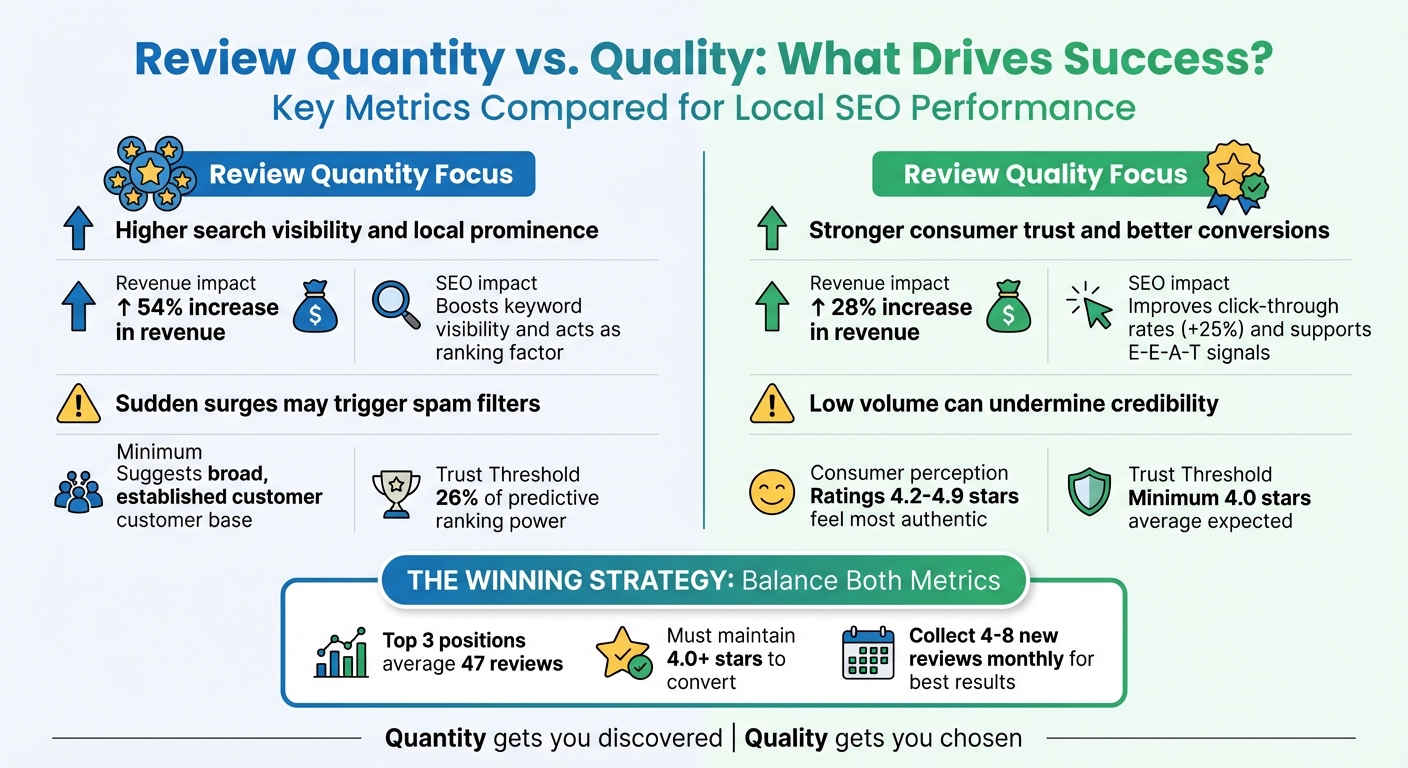
Review Quantity vs Quality: Impact on Local SEO Rankings and Revenue
Benefits and Drawbacks of Review Quantity
Having a high number of reviews can significantly boost local visibility and even lead to a 54% increase in revenue. This happens because a large volume of reviews signals customer engagement and builds social proof. However, there’s a catch - sudden spikes in reviews or inconsistent activity can trigger spam filters, potentially lowering your overall ratings. Plus, as competitors continue to collect reviews, maintaining steady growth becomes crucial. Sporadic bursts of reviews just won’t cut it in the long run.
Benefits and Drawbacks of Review Quality
When it comes to review quality, it’s all about trust. High-quality reviews not only enhance consumer confidence but also improve conversion rates. For instance, moving from 3 to 5 stars can increase click-through rates by 25% and push revenue up by as much as 28%. But perfection isn’t always ideal - a flawless 5.0 rating can sometimes come across as too good to be true. Research shows that reviews averaging between 4.2 and 4.9 stars hit the sweet spot for authenticity. That said, achieving both quality and quantity can be tough. Businesses with fewer than 10 reviews often struggle to gain credibility, as they lack the statistical backing needed to appear trustworthy.
These points highlight the trade-offs between focusing on review quantity and aiming for high-quality feedback.
Head-to-Head: Key Metrics Compared
Here’s a side-by-side look at how each approach impacts local SEO, consumer trust, and overall business performance:
| Metric | Review Quantity Focus | Review Quality Focus |
|---|---|---|
| Primary Benefit | Higher search visibility and local prominence | Stronger consumer trust and better conversions |
| Revenue Impact | Up to 54% increase in revenue | Up to 28% increase in revenue |
| SEO Impact | Boosts keyword visibility and acts as a ranking factor | Improves click-through rates and supports E-E-A-T signals |
| Risk Factor | Sudden surges may trigger spam filters | Low volume can undermine credibility |
| Consumer Perception | Suggests a broad, established customer base | Ratings between 4.2 and 4.9 feel more authentic |
| Trust Threshold | At least 10 reviews needed for legitimacy | A minimum average of 4.0 stars is expected |
The takeaway? Quantity helps you get discovered, but quality ensures you’re chosen. For example, businesses ranking in the top three local search positions typically have an average of 47 reviews. However, these reviews need to maintain a rating of 4.0 stars or higher to effectively convert searchers into paying customers. The most successful businesses don’t pick one over the other - they work to balance both metrics strategically.
sbb-itb-0e6533f
Data Insights from 2025: Which Matters More?
A study published in August 2025 by Search Atlas analyzed ranking factors for 3,269 local businesses across the food, health, and law sectors. Using machine learning, the research uncovered fascinating trends about what drives rankings - and it turns out, the key factors vary depending on where businesses are competing.
For general visibility (positions 1–21), proximity leads the pack, accounting for 55.2% of ranking influence. Following that, review count contributes 19.2%, while review keyword relevance plays a smaller role at 5.3%. However, when you narrow the focus to the top 10 positions, the dynamics change significantly. Proximity's influence drops to 36.2%, while review count rises to 26%, and review keyword relevance jumps to 22.8%. This shift highlights a critical pattern: while having more reviews helps with visibility, the quality and relevance of those reviews are what truly build trust and push businesses into elite positions.
Manick Bhan, CTO of Search Atlas, summarized the findings:
"The study done by Search Atlas in May 2025 and published in August 2025 proves proximity is the strongest universal driver, while reviews and relevance define competitive advantage".
Sector-Specific Insights
Different industries show unique trends when it comes to ranking factors. For example, in the Beauty and Personal Care sector, review volume and keyword alignment together account for over 65% of the ranking power for top-performing businesses. In this case, reviews outweigh location in importance. Additionally, businesses that respond to reviews see tangible benefits - every 25% increase in review responses leads to a 4.1% boost in conversion rates.
Shifting Consumer Behavior
Consumer habits in 2025 align with these findings. Sixty-seven percent of consumers now prioritize review recency over star ratings, and nearly half (48%) rely on AI-generated summaries of reviews. This shows that customers value detailed, up-to-date feedback just as much as the overall number of reviews, further emphasizing the importance of keeping reviews fresh and relevant.
The Balance Between Quantity and Quality
The data makes one thing clear: businesses can't afford to focus solely on either review quantity or quality - they need a balanced strategy. For those aiming for the top tier, semantic relevance in reviews becomes almost as critical as having a high volume. Interestingly, businesses in the top three positions typically maintain an average rating of 4.1 stars or higher while consistently collecting new reviews each month.
In short, the path to success lies in understanding where your business stands and tailoring your review strategy accordingly. Whether it's building volume for visibility or fine-tuning quality for competitive advantage, the right balance can make all the difference.
Balancing Quantity and Quality with Local SEO Bot
Striking the right balance between the number of reviews and their quality is critical for excelling in local SEO. Local SEO Bot offers a range of tools designed to help businesses achieve this balance effectively.
Using Local SEO Bot for Review Management
Local SEO Bot simplifies the process of managing reviews with its automated system. By sending review requests through email and SMS - channels preferred by 54% and 29% of customers respectively - it ensures outreach aligns with customer preferences. This dual-channel approach increases the likelihood of engagement.
The platform also consolidates review monitoring across multiple platforms, including Google, Facebook, and Yelp, into a single dashboard. This centralized view minimizes the risk of reputation gaps or inconsistencies that might appear inauthentic to search engines. Additionally, Local SEO Bot provides instant alerts for new reviews, enabling businesses to respond promptly. Research shows that businesses responding to over 80% of their reviews consistently outperform competitors.
These features create a solid foundation for improving both the quantity and quality of reviews.
How to Optimize for Both Quantity and Quality
With these tools in place, achieving the right mix of review quantity and quality comes down to timing and consistency. Local SEO Bot automates review requests within 24–48 hours of service completion, a proven sweet spot for capturing customer feedback. For restaurants, this window is even shorter - 2–4 hours after a visit - while e-commerce businesses benefit from waiting 3–5 days post-delivery. This timing strategy ensures higher response rates.
To improve review quality, the platform includes guided prompts that go beyond generic requests like "leave us a review." Instead, customers are encouraged to answer specific questions about services or products, which naturally results in keyword-rich reviews. These types of reviews help Google better understand your offerings. Additionally, Local SEO Bot ensures reviews are collected steadily - around 2–5 per month - avoiding sudden surges that could be flagged as spam.
"Reviews are not a race. Not only is it unnecessary to acquire large numbers of reviews quickly, it's actually probably unwise".
For just $49 a month, Local SEO Bot’s Basic plan offers features like one-click optimization, Google Business Profile management, and automated review responses. It’s a hassle-free way to build both the volume and quality of reviews without the need for constant manual input.
Conclusion: Finding the Right Balance
Striking the right balance between the quantity and quality of reviews is crucial for local SEO success. A higher number of reviews helps your business stand out on Google Maps and the Local Pack, making it easier for potential customers to find you. But once they do, the quality of those reviews - things like your star rating, detailed feedback, and how recent they are - becomes the deciding factor in turning those visitors into paying customers.
Here’s what the data says: businesses with a high volume of reviews generate 54% more revenue, while those with star ratings in the sweet spot of 4.2 to 4.9 stars see a 28% increase in revenue. Clearly, focusing on just one of these metrics isn’t enough to maximize results.
Another critical factor is maintaining a steady flow of new reviews. Consistency signals ongoing customer engagement, which Google values. Instead of occasional bursts of reviews, aim for a steady pace - around 2 to 5 reviews per month. This not only reassures search algorithms and potential customers but also helps you avoid triggering spam filters that might flag sudden spikes in activity.
To simplify this process, tools like Local SEO Bot can be game-changers. For $49 a month, it automates review requests, centralizes monitoring, and even uses AI to craft thoughtful responses. This allows you to focus on delivering top-notch service while the platform handles the heavy lifting of managing reviews.
FAQs
Why does the speed of getting new reviews matter for local search rankings?
The speed at which your business gathers new reviews - called review velocity - plays a big role in local search rankings. When you consistently receive fresh reviews, it tells Google that your business is active, relevant, and connected with its customers.
This steady stream of feedback does more than just enhance your reputation. It also signals to Google that your business deserves to stand out in local search results. By focusing on maintaining a regular flow of reviews, you can improve your visibility and draw in more potential customers.
Why is a 4.2 to 4.9 star rating ideal for businesses?
A star rating between 4.2 and 4.9 hits the sweet spot for most businesses. It shows customers are highly satisfied while still maintaining a sense of authenticity. A perfect 5.0 rating can sometimes raise eyebrows, making people question its credibility.
Research backs this up: businesses in this range often see more customers, higher revenue, and improved rankings in local search results. Striking this balance between quality and trustworthiness can make a big difference in building confidence and boosting online visibility.
How do keywords in reviews improve search relevance?
Keywords in customer reviews play a crucial role in helping Google grasp what your business is all about. They act as contextual hints that clarify your products or services, making your business listing more aligned with specific search queries. This alignment increases the likelihood of your business showing up for the right audience.
For instance, if customers mention services like "oil change" or "vegan bakery" in their reviews, Google uses those details to connect your business with similar searches. Encouraging customers to leave detailed and genuine reviews can have a significant impact on improving your local SEO visibility.