30 Day Remedy: U.S. Buyer Checklist to Spot Safe SEO Guarantees
Published September 28, 2026
30 Day Remedy: U.S. Buyer Checklist to Spot Safe SEO Guarantees

Rankings cannot be guaranteed by any agency, because no vendor controls Google’s algorithm, your competitors, or user behavior. What can be guaranteed are defined deliverables, transparent measurement, and a narrow remedy if the work does not happen as promised. The FTC requires that guarantees be substantiated and their limits disclosed, and providers like Local SEO Bot build their offers around that distinction. The sections below cover the risks, the legal rules, and how to evaluate a guarantee before signing.
TL;DR:
- Guarantees that promise specific rankings are unrealistic because Google’s algorithm, competitor activities, and user signals are outside an agency’s control.
- Ethical guarantees focus solely on controllable deliverables like technical audits, citation building, and reporting, not on ranking positions.
- Any guarantee must clearly define the metric, conditions, and remedies, with a focus on measurable, trackable results within a fixed timeframe, such as 30 days.
- Providers using manipulative tactics like link schemes or cloaking risk manual penalties that can permanently harm search visibility and bring long recovery processes.
- Always request written terms detailing measurement tools, success criteria, and refund policies before signing any guarantee agreement.
Table of Contents
- Why ranking guarantees are misleading or impossible
- How guarantees become dangerous: unethical tactics and penalties
- U.S. legal and advertising rules that affect guarantees
- What responsible SEO guarantees look like in practice
- Practical evaluation checklist: what to ask for before you sign
- Publisher example: how Local SEO Bot frames a deliverable-based remedy
- Why a narrow guarantee earns more trust than a big promise
- A deliverable-focused option for local rankings
- Sources
- FAQ
Why ranking guarantees are misleading or impossible
No agency can promise a specific position on Google because too many variables sit outside their control. An algorithm update, a competitor’s new content, or a shift in how people search can move rankings overnight, regardless of the work an agency puts in.
Short-term spikes are not the same as sustainable growth. A site can jump in visibility after aggressive tactics, then fall hard once Google’s systems catch up or a core update reshuffles results.
Consider what actually influences a ranking:
- Google’s algorithm changes, which no outside party controls or can predict with certainty.
- Manual actions taken by Google’s own reviewers when they find manipulative practices.
- Competitor activity, including their content, backlinks, and site improvements.
- User signals like click behavior and engagement, which shift with market trends and seasonality.
Google’s own guidance on manual actions confirms that violations of its spam policies can trigger penalties that lower rankings or remove pages from search results entirely. That risk exists no matter how confident a sales pitch sounds.
How guarantees become dangerous: unethical tactics and penalties
When an agency promises a ranking outcome, it sometimes leans on tactics that violate Google’s policies to make the number happen fast. Link schemes, cloaking, deceptive content, and mass-produced low-quality pages are common shortcuts tied to aggressive guarantees.
These tactics carry real consequences. A manual action can push a site out of search results, and recovery often takes months of cleanup, disavow requests, and rebuilt trust with Google.
Google’s spam policies describe manipulative practices such as cloaking, deceptive redirects, and link schemes as violations that can result in lower rankings or removal from search results.
Google’s manual-action guidance is the authoritative source for what happens to sites caught manipulating rankings. A violation of these policies can mean a site disappears from results with no visible warning to its visitors, only a quiet drop in traffic that the business owner discovers weeks later.
U.S. legal and advertising rules that affect guarantees
Guarantees are not just a marketing choice. In the United States, they fall under advertising law, and providers who ignore that exposure themselves to real liability.
The FTC’s advertising guidance requires that any performance claim be substantiated and that material conditions or limits be clearly disclosed. A guarantee that hides its fine print in a footnote does not meet that bar. Separately, 16 CFR § 239.3 governs how “satisfaction” or “money-back” guarantees must be advertised, requiring that limitations be disclosed prominently and that a full refund be available when one is promised.
Before you sign anything, request these terms in writing:
- The exact metric the guarantee measures and how it is tracked.
- Every condition or exclusion that could void the guarantee.
- The refund or credit amount and how it gets calculated.
- The claim process and deadline for requesting a remedy.
A provider unwilling to put these details on paper is telling you something important about how the guarantee actually works.
What responsible SEO guarantees look like in practice
A defensible guarantee covers what an agency actually controls, not what Google decides. That means audits performed, technical fixes completed, citation work finished, reports delivered on schedule, and full access to your own accounts throughout the engagement.

Forecasts and guarantees are two different things, and a trustworthy provider will label them separately. A forecast is a target built on assumptions, disclosed as such. A guarantee is a promise tied to a specific, measurable deliverable with a stated remedy if it is missed.
Acceptable remedies typically fall into a few categories:
- A partial or full refund tied to a defined, measurable shortfall.
- Service credit applied to a future month of work.
- Additional work performed at no charge to correct a missed deliverable.
Language you should expect to see reads something like “we guarantee the technical audit and priority fixes are completed within 30 days, or you receive a refund for that phase,” not “we guarantee a number one ranking.” Industry guidance from Ahrefs backs this approach, recommending controllable deliverables, clear reporting cadence, and account ownership as the basis for any guarantee worth signing. A 30-day guarantee tied to a specific metric can offer a real remedy within that window, but it says nothing about performance months later, so read the fine print on duration as carefully as the fine print on scope.
Pro Tip: Ask the vendor to define the guarantee in a single sentence with no jargon. If they can’t, the terms are probably too vague to enforce.
Practical evaluation checklist: what to ask for before you sign
Before you commit to any guarantee, get specifics in writing. Vague promises rarely survive a real dispute, and a provider confident in its work will not hesitate to put the details on paper.
Ask for a baseline date and the exact tools used to measure progress, such as Google Search Console or analytics platforms, along with a fixed reporting cadence. Confirm how “success” is defined in measurable terms, not general language like “improved visibility.”
Watch for these warning signs before you sign anything:
- A promise of a number one ranking or first-page placement for a specific term.
- No clear baseline date or starting metric to measure against.
- A guarantee tied to a single easy keyword rather than the terms that matter to your business.
- A long contract lock-in with cancellation terms that make the guarantee hard to actually claim.
Also confirm what happens if you cancel early, and how a refund gets calculated if the guarantee is triggered. Agencies that measure performance transparently tend to welcome these questions, a point echoed in broader guidance on SEO measurement for agencies working with client reporting standards.
Publisher example: how Local SEO Bot frames a deliverable-based remedy
Local SEO Bot’s approach illustrates the deliverable model in practice. Instead of promising a ranking position, the company manually builds premium citations on high-authority directories, tracks Google Maps positions through its Maprank tool, and offers a 30-day money-back guarantee tied to whether rankings improve during that window.
That structure keeps the guarantee inside what the company controls: the citation work performed, the tracking data reported, and the refund process if the defined metric does not move. It does not promise a specific rank or guarantee performance beyond the 30-day measurement period. Readers evaluating any provider’s claims should ask for the same level of specificity: what work gets done, how it is measured, and what happens if it falls short.
Why a narrow guarantee earns more trust than a big promise
A guarantee limited to deliverables and a defined remedy signals that a provider is willing to be held accountable for the work it controls. That is a more honest offer than a ranking promise dressed up in confident language.
When you evaluate a vendor, insist on data sharing from day one and get every guarantee term in writing before you pay anything. Ask to see the actual guarantee document, not just a summary on a sales page, and read it the way you would read any contract.
— Local
A deliverable-focused option for local rankings
If you want a provider whose guarantee matches its actual work, Local SEO Bot builds its service around exactly that principle. Rather than automating citation placements the way many tools do, the company manually builds premium citations across high-authority directories and tracks your Google Maps position through Maprank, its geo-grid rank tracking tool.
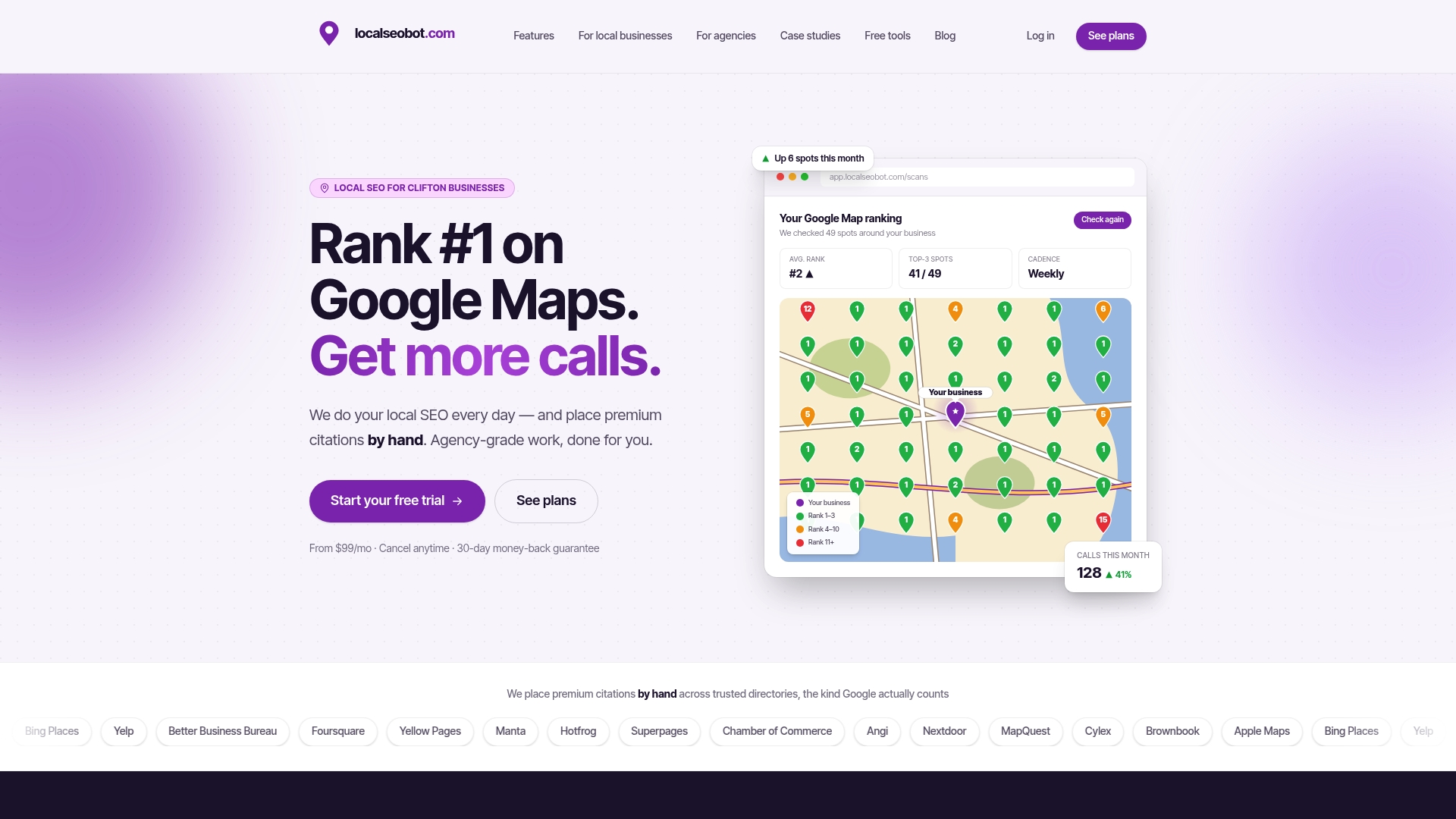
The company backs this work with a money-back guarantee if your Google Maps rankings do not improve within a specified period, a remedy tied to defined, trackable work rather than a promised position. Plans are structured for different needs:
- Foundation, a plan for small businesses starting with citation work and profile management.
- Growth, a plan for businesses wanting expanded reporting and review management.
- Pro, a plan designed for agencies managing multiple client locations with white-label reporting.
Full plan details are on the pricing page, and agencies can review seat-based options on the agency pricing page.
Sources
- Violations of the spam policies for Google web search - Search Console Help
- Advertising and marketing | Federal Trade Commission
- 16 CFR § 239.3 - “Satisfaction Guarantees” and similar representations in advertising; disclosure in advertising that mentions “satisfaction guarantees” or similar representations.
- Guaranteed SEO Services: Here’s the Only SEO Guarantee That’s Not a Scam
FAQ
What does SEO stand for?
SEO stands for search engine optimization, the practice of improving a website or business listing so it appears more prominently in search results. It covers technical site health, content quality, and for local businesses, factors like Google Business Profile optimization and citation consistency.
Is SEO still relevant heading into 2026?
Yes. Search remains one of the primary ways people find local businesses and services, and Google continues to refine how it ranks sites and map listings, which keeps ongoing optimization work relevant rather than a one-time task.
What is the 80/20 rule in SEO?
The idea in SEO is that a small share of your pages, keywords, or fixes tend to drive most of your results, so prioritizing the highest-impact work matters more than chasing every possible optimization. Definitions of exactly which factors qualify vary across practitioners.
Is Google Guaranteed still a thing?
Google Guaranteed is a separate program tied to Google’s Local Services Ads, not to organic SEO rankings, and it involves a background check and screening process for eligible service businesses. It should not be confused with an SEO agency’s own ranking guarantee, which covers different services entirely.
How do I know if an SEO guarantee is legitimate?
A legitimate guarantee names a specific, measurable deliverable, discloses its baseline and measurement method, and states a clear remedy such as a refund or extra work if that deliverable is missed. Under FTC advertising rules, any such claim must be substantiated and its limitations disclosed clearly, so ask to see the full written terms before you sign anything.