15–25 Keywords Local Businesses Should Track to Trust Local Rankings
Published October 4, 2026
15–25 Keywords Local Businesses Should Track to Trust Local Rankings

Track local keywords from defined location points, whether that’s a geo-grid, a set of ZIP codes, or key neighborhoods, and record the keyword, location, device, search surface, and date for every check. This beats a single unlocalized rank check because Google weighs distance from the searcher, so your rank three miles from your storefront can look nothing like your rank next door. Set up your first scan this week and connect it to your Business Profile and Search Console data.
TL;DR:
- Local keyword tracking must include location, device, search surface, and date to accurately reflect ranking differences caused by proximity.
- Consistent naming conventions for locations and keywords are essential to reliably compare data over time and avoid analysis errors.
- Weekly scans from fixed points, ideally on Mondays before business hours, are recommended for establishing a clear baseline and tracking trends effectively.
- Combining grid scans with Business Profile and Search Console data helps distinguish between visibility changes due to ranking shifts and profile or content updates.
- Manual checks work for single locations, but managing multiple areas or clients benefits from automated tools or managed services that streamline data reconciliation.
Table of Contents
- Why local keyword tracking matters and how local ranking works
- What to record for each local-rank check
- How to set up repeatable local tracking workflows
- Interpreting tracking results: tying rank changes to business signals
- Choosing a tracking method: APIs, geo-grid tools, or manual checks
- How a managed Maps tracking workflow actually runs
- Getting your tracking right from day one
- When self-managed tracking isn’t enough
- FAQ
- Sources
Why local keyword tracking matters and how local ranking works
Google’s own guidance lays out three factors behind local results: relevance, distance, and prominence. Google’s Business Profile documentation confirms these as the primary drivers of local ranking, with a complete profile and strong prominence signals like reviews and links playing a direct role. A national or unlocalized rank check skips the distance factor entirely, which makes it close to useless for a business that depends on nearby customers.
Picture a plumbing company two blocks from downtown. A search from inside that zip code might show them in the top three results. The same search run from a suburb six miles out might not surface them at all, even though nothing about their website or profile changed. That’s not a tracking error. That’s distance doing exactly what Google designed it to do.
The goal isn’t a single clean number you can report to a boss or a client. It’s knowing where you actually show up across the neighborhoods, zip codes, and commute routes where real customers are searching. A business that only checks its rank from headquarters is often flying blind everywhere else.

What to record for each local-rank check
Consistent fields are what turn a pile of screenshots into a usable dataset. Before running your first scan, decide on a schema and stick to it, because comparing checks with different fields is like comparing receipts from two different stores.
- Keyword: the exact search phrase, written the same way every time (no shorthand swaps between checks).
- Location ID: a city, ZIP code, or grid coordinate pair, each with a fixed name you reuse.
- Device: mobile or desktop, tracked separately since local results often differ between them.
- Search surface: Maps, Local Pack, or organic results, since these are distinct result sets with separate ranking behavior.
- Date and time: needed to correlate ranking shifts with algorithm updates, profile edits, or review activity.
- Ranking URL or Business Profile ID: the specific page or listing that appeared, not just “we ranked.”
Beyond these mandatory fields, a few optional ones add context without adding noise: a screenshot for visual proof, the browser or user-agent string, any SERP features you noticed (a knowledge panel, a local services ad), and quick notes on competitors appearing nearby or temporary promotions that might be skewing results.
The real payoff comes from naming conventions. If one week you log “Downtown” and the next you log “downtown-core,” your location comparisons break. Lock in your IDs early, and every later analysis gets faster and more reliable.
How to set up repeatable local tracking workflows
Building a tracking system that actually holds up over months starts with picking the right inputs, not the right software.
- Build your keyword set first. Start with core service terms, then add service-plus-location variations (“emergency plumber Midtown”), then layer in a handful of high-intent long-tail phrases, using top keyword discovery methods to boost SEO and organic growth. Fifteen to twenty-five keywords is a reasonable starting range for a single-location business; expand once you’ve confirmed the baseline is stable.
- Choose your location points. A simple approach uses city centroids or your three to five highest-traffic ZIP codes. A geo-grid approach places evenly spaced points across your service area, which gives a denser, more accurate picture for businesses competing across several neighborhoods or a wider metro footprint. Denser grids matter more for businesses with tight margins between competitors.
- Set your cadence. Weekly scans work well for most small businesses. Daily scans make sense around a site change, a new campaign, or a Google algorithm update you’re trying to measure. Align your broader reporting cycle with Business Profile’s monthly aggregation window so you’re not chasing noise that resolves itself.
- Split by device and surface. Run separate checks for mobile and desktop, and keep Maps or Local Pack results in a different column than organic results. These two surfaces can move independently of each other.
Pro Tip: Run your first full scan on a Monday morning before any business hours traffic can shift the data, so you have a clean baseline to compare every future check against.
Interpreting tracking results: tying rank changes to business signals
Grid data tells you where you rank. Business Profile Performance tells you what happened as a result. They’re not the same measurement, and mixing them up leads to wrong conclusions.
Google’s Business Profile Performance documentation explains that search and keyword data update on a monthly aggregated basis, sometimes with a lag of several days, and that the underlying API returns monthly totals rather than real-time counts. That makes Performance an outcome and discovery signal, useful for seeing which queries actually bring people to your listing, but not a substitute for a controlled rank check run on your own schedule.

Search Console fills a different gap. Its Performance report breaks organic data down by query, page, device, and search appearance, which helps you see whether a ranking shift is tied to your website content rather than your Business Profile. Running both side by side lets you separate a Maps visibility change from an organic content change, since a dip in one doesn’t always mean a dip in the other.
A few pitfalls trip up almost everyone starting out. Queries below a certain volume get anonymized and won’t show up in either report, aggregated monthly data can mask short-term swings your grid scan catches immediately, and the two systems update on different schedules. None of this is a bug. It just means you reconcile them rather than expecting them to match line for line.
Choosing a tracking method: APIs, geo-grid tools, or manual checks
The right tracking method depends on how many locations you manage and how much time you want to spend on setup. Three broad categories cover most situations.
Rank checker APIs suit developers or agencies building their own dashboards, since they return raw position data you can pipe into existing reporting. Geo-grid rank trackers automate multi-point scans across a service area and are built specifically for the kind of distance-sensitive tracking local businesses need. Manual spot checks, run from a phone or incognito browser at a few key locations, work fine for a single-location owner who just wants a monthly gut check.
Whichever category fits your situation, prioritize the same features:
- Location granularity: can you set exact coordinates or ZIP-level points, not just a city name.
- Separate Maps and organic tracking: Local Pack and organic results need their own columns, not a blended score.
- Device support: mobile and desktop results split out, not averaged together.
- Historical data: enough history to spot trends, not just a snapshot.
- Scheduling and exports: automated recurring scans and data you can pull into a spreadsheet or report.
- Multi-location controls: relevant the moment you manage more than one storefront or service area.
APIs demand developer time and ongoing maintenance. Manual checks cost nothing but your own hours and don’t scale past a handful of locations. Geo-grid tools sit in between: more setup than a manual check, far less overhead than building your own API pipeline. Once you’re managing several locations or you simply don’t have the internal time to run weekly scans and reconcile two different Google reports, that’s usually the point to look at a managed service instead of building the whole stack yourself.
How a managed Maps tracking workflow actually runs
For businesses that would rather hand off the tracking and optimization work entirely, we built our own answer to that gap. Our Maprank geo-grid tracker scans your service area at defined points, splits Maps and organic visibility, and reports results on a schedule, paired with citation building on high-authority directories rather than automated citation blasts. Our Business Profile optimization and monthly reporting run alongside the tracking data, so the same dashboard that shows your grid positions also shows the profile changes behind them.
This kind of managed workflow fits best once you’re running multiple locations, managing client accounts as an agency, or simply don’t have the hours to build and maintain your own tracking schema, scan cadence, and reconciliation process between Business Profile and Search Console every month.
Getting your tracking right from day one
Most beginners overcomplicate the keyword list and underinvest in location coverage. Start narrow on keywords, wide on geography. Your first week should include setting fixed location IDs, running a baseline scan across every surface and device, and connecting both Business Profile and Search Console.
Expect the first 30 to 90 days to be about pattern recognition rather than big wins: watch for consistent gaps between neighborhoods, not single-day swings. The three mistakes we see most often are comparing scans from inconsistent locations, treating Business Profile’s monthly numbers as real-time, and tracking organic rank while ignoring the Local Pack entirely.
— Local
When self-managed tracking isn’t enough
Everything in this guide works whether you build your own tracking spreadsheet or use dedicated software, and plenty of single-location owners run it well on their own with a weekly routine and a bit of discipline. The gap tends to show up once you’re juggling multiple service areas, several locations, or client accounts where manual reconciliation between tools eats hours you don’t have.
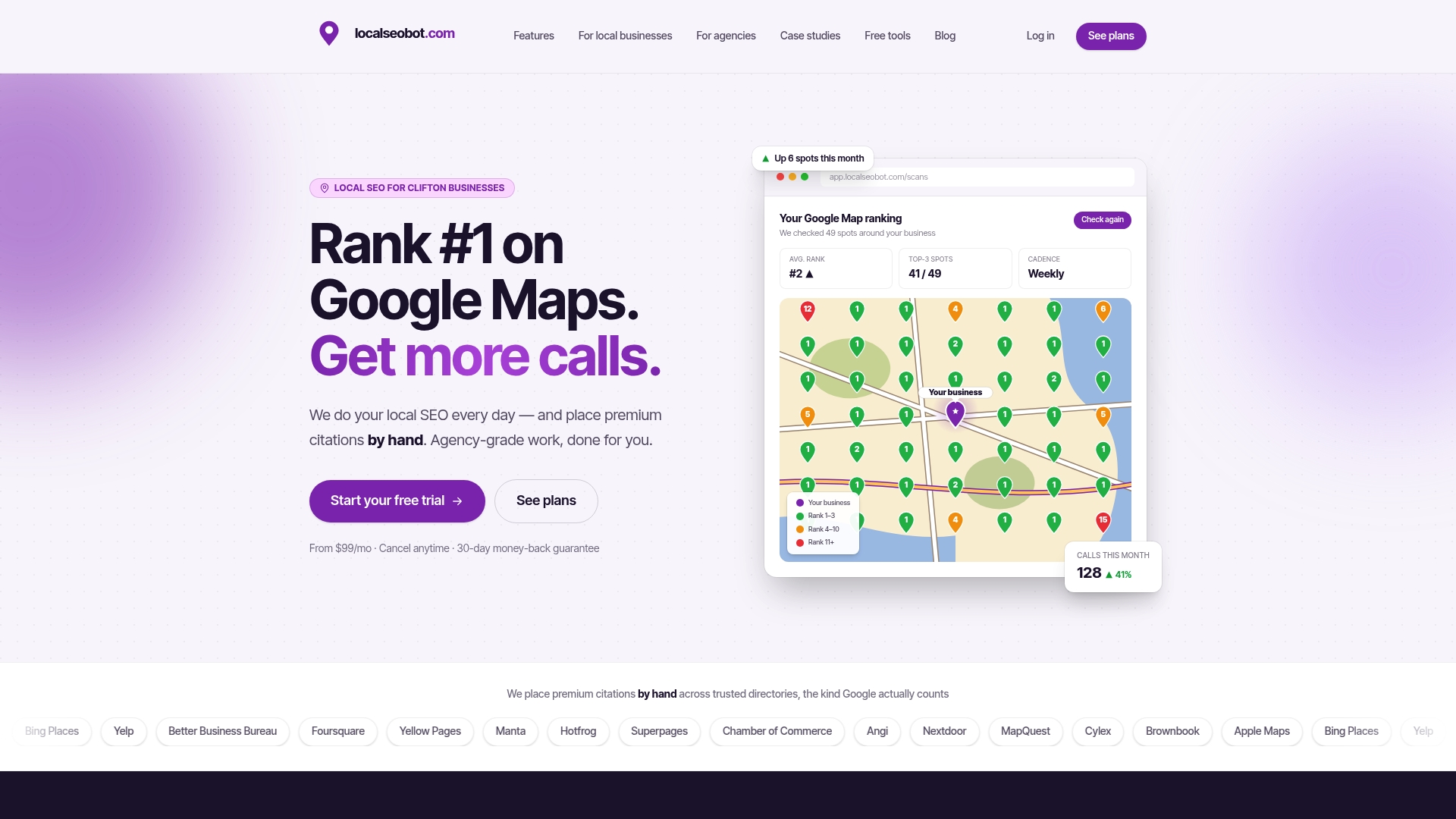
That’s the gap our Maprank geo-grid tracker and citation service are built to close: geo-grid scans across your service area, manual premium citation placements instead of automated blasts, Business Profile optimization, and monthly reporting in one place, backed by a 30-day money-back guarantee if your Maps ranking doesn’t improve. Plans run from our Foundation tier at $99 per month per location up through Pro at $399 per month per location for agencies managing several client accounts.
If you’re spending more time reconciling spreadsheets than acting on what they show, check our pricing page and see which plan matches your location count.
FAQ
What’s the difference between Maps rank and organic rank?
Maps and Local Pack results are a separate result set from standard organic listings, driven by your Business Profile and location signals rather than page content alone. Tracking them in the same column as organic rankings hides real shifts in either direction, so Google’s local ranking guidance and most tracking setups keep them in distinct fields.
Can I pay Google to improve my local ranking?
No. Google states directly that there’s no way to request or pay for a better local ranking, and that visibility comes from relevance, distance, and prominence signals you build over time, like a complete profile and genuine reviews, as confirmed in Google’s Business Profile Help.
How often does Business Profile Performance data update?
Business Profile Performance reports search and keyword data on a monthly aggregated basis, and the figures can take up to several days to appear after the month closes, according to Google’s own documentation. That lag is why a separate, more frequent grid scan is useful for catching short-term changes.
Why does my rank look different depending on the ZIP code I search from?
Distance from the searcher is one of the three core factors in Google’s local ranking model, so a business can rank well close to its address and drop off a few miles away. This is exactly why tracking from a single location point gives an incomplete picture, as outlined in Google’s local ranking guidance.
What should I track if I only have one location?
A single-location business can start with three to five nearby ZIP codes or neighborhoods rather than a full geo-grid, tracking the same core keywords on both mobile and desktop. Pairing those manual checks with your Business Profile Performance data gives a workable picture without the overhead of a full multi-point grid.