Yext vs Uberall: Best Listing Platform in 2026
Published August 4, 2026
Yext vs Uberall: Best Listing Platform in 2026

For most US small businesses and agencies, Localseobot is the recommended pick: it combines manual premium citation building with geo-grid rank tracking and Google Business Profile automation at a per-location subscription cost that sits well below enterprise platform pricing. If your team manages 25–100 locations and needs a polished operational workflow without a five-figure annual contract, Uberall is the strongest mid-market alternative. Choose Yext when your organization requires direct publisher integrations to 200+ networks, entity-based Knowledge Graph distribution, and enterprise-grade audit controls that justify its higher price band.
Table of Contents
- How does Yext vs Uberall compare across every key dimension?
- What are Yext, Uberall, and Localseobot at a glance?
- How do the platforms actually differ on features that matter?
- What does each platform actually cost?
- How should you choose between these platforms?
- What do verified reviewers say about each platform?
- Which platform fits your specific situation?
- Key Takeaways
- The case for manual citations over platform automation
- Localseobot: manual citations, geo-grid tracking, and real ranking results for US SMBs
- Useful sources for procurement and technical teams
How does Yext vs Uberall compare across every key dimension?
| Feature | Localseobot | Yext | Uberall | Search Atlas | GBPPromote |
|---|---|---|---|---|---|
| Best for | US SMBs and agencies wanting manual premium citations + SaaS automation | Enterprise multi-location brands needing deep publisher coverage and AI visibility | Regional chains (25–100 locations) wanting lower-cost operational management | Niche users evaluating additional listing tools | Organizations researching GBPO-focused vendor shortlists |
| Pricing model | Per-location monthly subscription | Enterprise contract; buyer-reported $15K–$30K/year for ~25 locations | Per-location; buyer-reported $3,600–$9,000/year for 25–100 locations | Not publicly listed | Not publicly listed |
| Publisher/listings coverage | High-authority manual citations + GBP direct | 200+ direct publisher integrations via Knowledge Graph | Multi-publisher network; strong mid-market coverage | Broad listing distribution | GBP-focused distribution |
| Listings management | Manual premium citations, bulk edits, autosync via GBP automation | Entity-based Knowledge Graph, autosync, duplicate suppression at scale | Autosync, bulk edits, duplicate detection | Standard listing management | GBP-centric management |
| Review management | Automated review generation, AI-driven replies, review widgets | Review monitoring and response tools | Unified review inbox, multi-location review workflows | Review monitoring | Review monitoring |
| Analytics & reporting | Geo-grid rank tracking, monthly SEO reports, local keyword tracking | Advanced dashboards, AI/LLM visibility (Scout), attribution reporting | Reporting dashboards, location-level analytics | Standard analytics | Basic reporting |
| Integrations & API | GBP, white-label agency dashboard | 200+ publisher APIs, CMS integrations, Google Analytics | API access, CMS, Google Analytics | API available | GBP integration |
| Ease of use / onboarding | Designed for SMBs; straightforward onboarding with 30-day guarantee | Steeper learning curve; enterprise onboarding SLAs | Praised for ease of use; responsive support | Moderate | Moderate |
| Scalability | Per-location model scales with agencies via white-label dashboard | Built for 50+ locations; enterprise-grade scalability | Strong for 25–100 locations; mid-market sweet spot | Limited public data | Limited public data |
| Security & compliance | Standard SaaS data handling | Audit logs, enterprise access controls, data governance | Role-based access; mid-market compliance features | Not publicly listed | Not publicly listed |
What are Yext, Uberall, and Localseobot at a glance?
-
Localseobot: A B2B SaaS platform for US SMBs and agencies. It manually builds premium citations on high-authority directories rather than relying on automated aggregator routing, pairs that with geo-grid Google Maps rank tracking, automated Google Business Profile optimization, and AI-driven review automation. Operates on a per-location monthly subscription with a 30-day money-back guarantee. No minimum location count. Suited to single-location businesses through mid-size agency portfolios.
-
Yext: An enterprise-grade Knowledge Graph platform. Yext stores business data as structured entities and distributes it directly to 200+ publishers without routing through aggregators. Its product suite includes AI visibility tools (Scout), Pages, and a mature duplicate-suppression and audit-log system. Buyer-reported pricing runs a significant amount per year for approximately 25 locations, making it a serious budget commitment. Best suited to brands with 50+ locations that treat structured data distribution as a strategic priority.
-
Uberall: A mid-market multi-location platform. Uberall focuses on ease of use, multi-site workflow management, and review management, with per-location pricing that typically runs $3,600–$9,000 per year for 25–100 locations. On G2 and Capterra, it scores higher than Yext for ease of use and support responsiveness. Its sweet spot is regional chains and franchise groups that need operational efficiency without enterprise-level complexity.
How do the platforms actually differ on features that matter?
Listings distribution: entity model vs. manual premium citations
Yext’s core architecture is its Knowledge Graph. Business data lives as a structured entity, and changes push directly to publisher APIs rather than passing through aggregators. That direct-pipe model means updates tend to propagate faster and with fewer data-quality gaps. Yext research shows that locations syncing to more than 75% of its publisher network saw a 186% increase in website clicks from Google, which gives you a sense of what full-network coverage can do. The trade-off is cost and complexity: the Knowledge Graph requires governance, and the enterprise contract locks you into a data-rental relationship where listings may revert if you cancel.
Uberall uses a multi-publisher network model that covers the major directories and maps platforms relevant to mid-market US businesses. It does not match Yext’s raw publisher count, but for most regional chains, the covered platforms represent the vast majority of consumer touchpoints.
Localseobot takes a different approach entirely: manual premium citation building on high-authority directories. A human reviews and places each citation rather than firing off automated aggregator submissions. That matters for data quality. Automated submissions can propagate errors at scale; manual placement catches inconsistencies before they go live. Pair that with the citation consistency analyzer and you have a tighter data-hygiene loop than most aggregator-based tools offer.
Duplicate suppression and data hygiene
Yext’s duplicate-suppression tooling is among the most mature in the category. At 100+ locations, automated duplicate detection and suppression is genuinely difficult, and Yext’s audit logs give compliance-minded teams a provable change trail. That auditability is one of the main reasons enterprise brands choose Yext despite higher cost, according to Yext’s own positioning.
Uberall handles duplicates adequately for mid-market scale. It does not offer the same depth of audit logging, but most teams managing under 100 locations do not need it.
Pro Tip: Before any platform demo, pull a sample of your existing listings through a citation consistency check to see how many duplicates and NAP inconsistencies you already have. That number will tell you how much suppression tooling you actually need.
Review management and AI-driven workflows
Localseobot automates review generation and uses AI to draft replies, with review widgets that can be embedded on business websites. For SMBs that lack a dedicated reputation management team, that automation covers the core workflow without requiring a separate tool.
Uberall’s unified review inbox is well-regarded by multi-location teams. Reviewers on Software Advice consistently cite its multi-site review management as a practical strength, particularly for franchise groups where individual location managers need access without seeing the full account.
Yext offers review monitoring and response tools, but its primary value proposition is distribution and structured data, not review automation depth.
Analytics, geo-grid tracking, and AI visibility
Yext’s Scout product and AI visibility features represent a meaningful differentiation for brands that care about appearing in AI-generated answers (ChatGPT, Perplexity, Google AI Overviews). If your organization is tracking share of voice in LLM responses, Yext is currently the only platform in this comparison with a dedicated product for it.
Localseobot’s geo-grid rank tracking gives location-level Google Maps visibility data that most enterprise platforms charge extra for or bundle into higher tiers. For an SMB or agency managing a handful of locations, seeing exactly where a business ranks across a geographic grid is more immediately useful than an AI-mention dashboard.
Uberall’s reporting covers location-level analytics and dashboard views that satisfy most mid-market reporting needs. It does not offer AI visibility tracking at Yext’s depth.
Integrations and implementation timelines
Yext integrates with CMS platforms, Google Analytics, and a wide range of enterprise tech stacks. Its API is mature and well-documented. Implementation for a 50-location enterprise typically runs several weeks to a few months, depending on data-governance requirements and internal stakeholder alignment.
Uberall’s API is solid for mid-market use cases. Teams managing 25–100 locations generally report faster time-to-value than Yext, partly because the platform is less complex and partly because its onboarding support is more hands-on at that scale.
Localseobot is designed for fast onboarding at the SMB level. The Google Business Profile optimizer and automated posting tools activate quickly, and most single-location businesses see their first citation placements within the first billing cycle.
What does each platform actually cost?
| Platform | Pricing model | Reported range | Notes |
|---|---|---|---|
| Localseobot | Per-location monthly subscription | Not publicly listed; contact for pricing | 30-day money-back guarantee; no long-term contract required |
| Yext | Enterprise annual contract | $15,000–$30,000/year for ~25 locations | Buyer-reported; varies by publisher tier and add-ons |
| Uberall | Per-location annual | $3,600–$9,000/year for 25–100 locations | Mid-market pricing; add-ons for review automation |
| Search Atlas | Not publicly listed | — | Contact vendor |
| GBPPromote | Not publicly listed | — | Contact vendor |
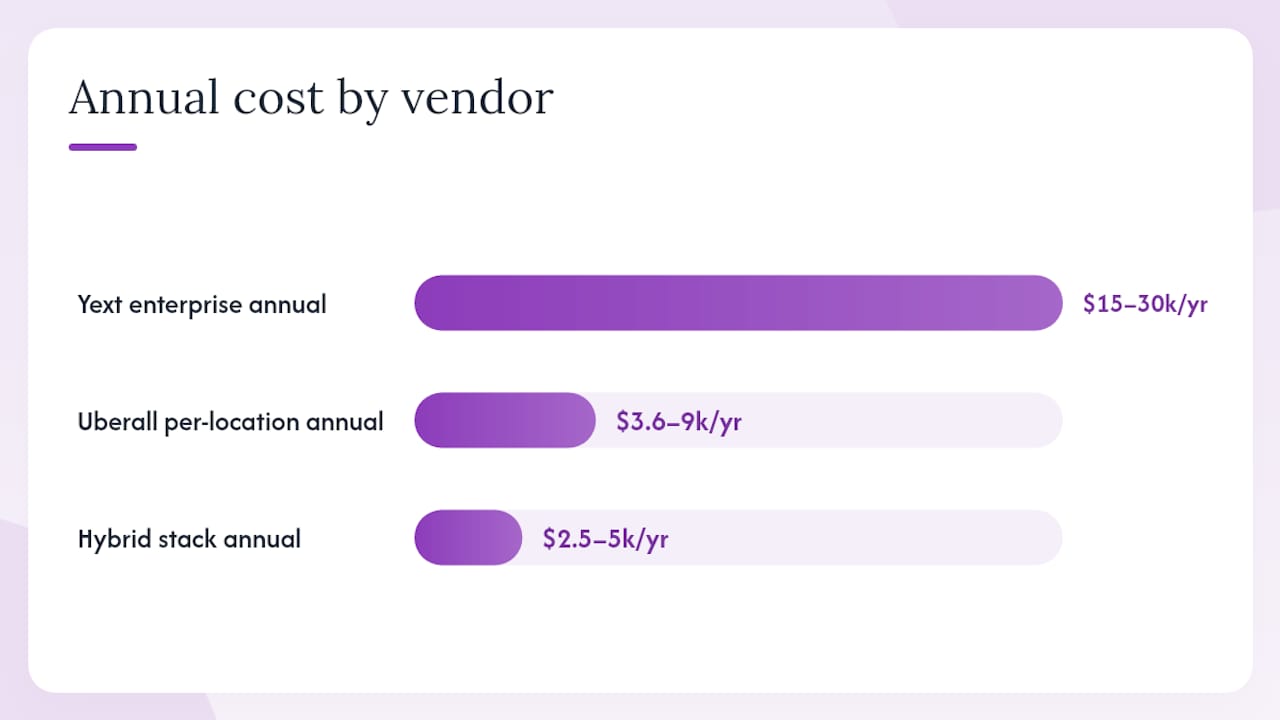
The pricing gap between Yext and Uberall is significant at mid-market scale. Analysis from Synapse Edge puts Yext at roughly $15,000–$30,000 per year for approximately 25 locations, while a comparable Uberall deployment runs $3,600–$9,000. A hybrid stack combining a lower-cost tool with manual citation work can come in at $2,500–$5,000 per year for similar core coverage.
Key cost drivers to budget for beyond the base subscription:
- Entity count vs. location count: — Yext bills on entities (each location can have multiple entities for different products or departments), which inflates cost at complex multi-location brands.
For teams evaluating affordable local SEO options, the hybrid-stack route often covers 80% of the ranking impact at 20% of the enterprise platform cost.
How should you choose between these platforms?
Selection checklist
- Count your locations and project 12-month growth — Under 10 locations: Localseobot or a hybrid stack. 10–100 locations: Uberall or Localseobot with agency white-label. 100+ locations: Yext or Uberall at scale.
- Set a realistic total budget. Software fee plus onboarding plus internal governance time. Use the local SEO checklist tool to map your current gaps before pricing any platform.
Questions to ask during vendor demos
- Show me a live duplicate-suppression example at my location count.
- What is your SLA for listing updates to propagate to Google and Apple Maps?
- Can you export our full listings data in a portable format at any time?
- Which publishers in your network are direct integrations vs. aggregator-routed?
- What does the audit log look like, and who can access it?
Red flags in proposals
- Vague language around data ownership at contract end.
- Publisher lists that include aggregators without disclosing which publishers are direct.
- Onboarding timelines quoted in weeks when your location count suggests months.
- Review automation described as a feature but buried in a higher pricing tier.
What do verified reviewers say about each platform?
On Capterra, Yext holds a 4.2-star average across 114 reviews, while Uberall scores 4.6 stars across 37 reviews. The sample sizes differ, so treat the gap as directional rather than definitive. Both platforms have meaningful reviewer bases on G2 and Software Advice as well.
G2 reviewer data shows a consistent pattern: Yext earns stronger marks for analytics depth and integration breadth, while Uberall earns higher scores for ease of use and support responsiveness. Teams without a dedicated technical SEO resource tend to find Uberall’s onboarding and day-to-day workflow more manageable.
On the Software Advice comparison page, Uberall reviewers frequently highlight multi-location management and API flexibility as practical strengths. Yext reviewers tend to focus on centralization and reporting as the primary value drivers.
One pattern worth noting: reviewer sentiment on both platforms correlates with company size. Smaller teams and regional operators rate Uberall higher; larger enterprise teams with dedicated SEO staff rate Yext higher. That split maps almost exactly to the pricing tiers above.
Which platform fits your specific situation?
| Buyer type | Recommended platform | Reasoning |
|---|---|---|
| SMB, 1–9 locations | Localseobot | Per-location pricing, manual premium citations, fast onboarding, 30-day guarantee |
| Regional chain, 10–50 locations | Uberall or Localseobot (agency tier) | Mid-market pricing, strong UX, solid review management without enterprise overhead |
| Enterprise, 50+ locations | Yext | Publisher depth, audit logs, AI visibility tools, and Knowledge Graph justify the cost at scale |
| Agency / white-label | Localseobot | White-label dashboard, per-location subscription model, geo-grid reporting for client accounts |
| Franchise group | Uberall or Yext | Depends on location count and compliance requirements; Uberall for under 100, Yext above |
A hybrid stack still makes sense for teams that need specific capabilities from multiple tools. For example, using Localseobot for manual citation building and geo-grid tracking alongside a lightweight review tool covers most SMB ranking needs without committing to an enterprise contract.
One practical caveat: switching platforms mid-contract is painful. Listings data migration, re-verification on publisher networks, and potential ranking fluctuations during the transition all carry real costs. Build a 12-month minimum commitment into your evaluation, and negotiate data-portability terms before you sign anything.
For a broader view of multi-location local SEO services and how platform choices compare to agency alternatives, that resource covers the trade-offs in detail.
Key Takeaways
For most US SMBs and agencies, Localseobot’s manual premium citation approach and per-location pricing deliver more practical value than enterprise platforms at a fraction of the cost.
| Point | Details |
|---|---|
| Pricing gap is substantial | Yext runs a high annual cost for around 25 locations; Uberall runs substantially lower annual costs for a similar scale. |
| Platform fit follows location count | Under 10 locations: Localseobot. 10–100 locations: Uberall or Localseobot agency tier. 100+: Yext. |
| AI visibility is Yext’s clearest differentiator | If LLM/AI search presence is a strategic priority, Yext’s Scout product is the only purpose-built option in this comparison. |
| Data portability matters at contract end | Yext’s data-rental model means listings can revert on cancellation; negotiate exit terms before signing. |
| Localseobot for SMBs and agencies | Manual premium citations, geo-grid tracking, GBP automation, and a 30-day money-back guarantee make it the strongest fit for US SMBs and agency portfolios. |
The case for manual citations over platform automation
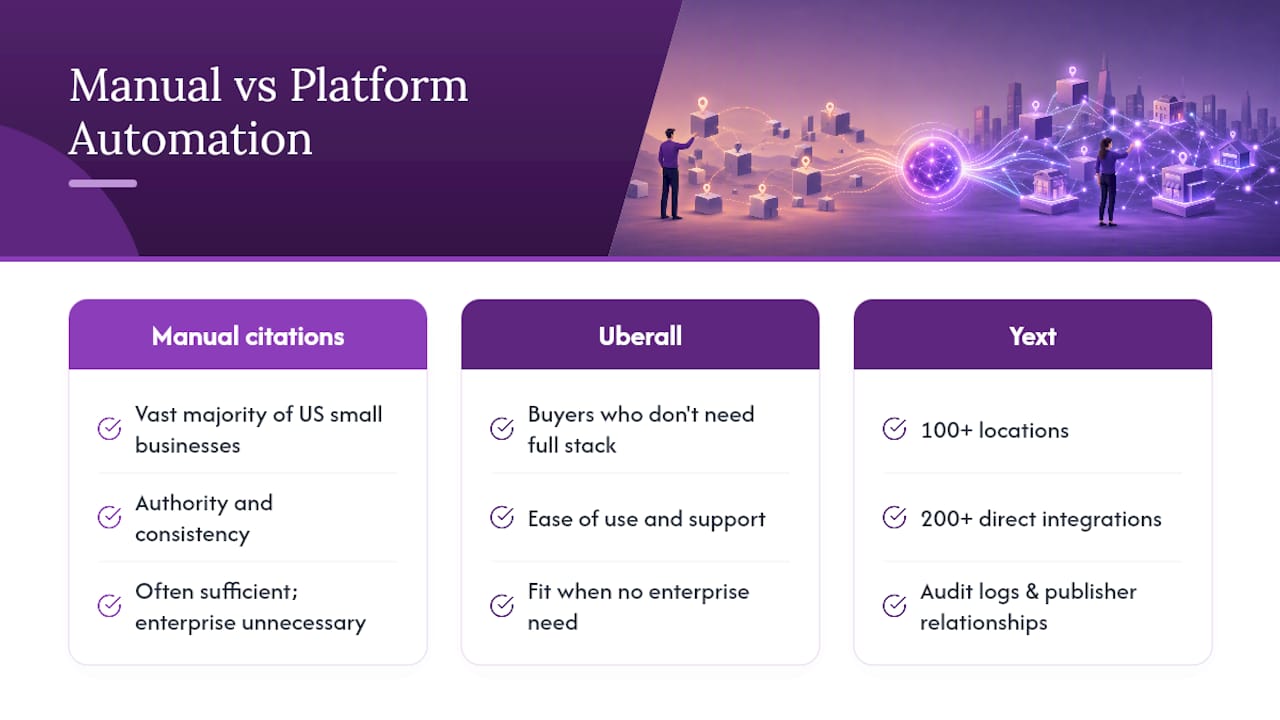
The conventional wisdom in local SEO is that bigger publisher networks always win. Pay for Yext’s 200+ direct integrations, push your data everywhere, and rankings follow. That logic holds at enterprise scale, where a brand with 500 locations genuinely cannot manually manage citation quality across every directory.
But for the vast majority of US small businesses, that argument collapses under its own cost. A $20,000 annual Yext contract for a 25-location regional chain is a significant budget commitment, and the ranking lift it produces over a well-executed manual citation strategy is rarely proportional to the price difference. The platforms that score highest on ease of use and support, like Uberall, exist precisely because most buyers do not need the full enterprise stack.
What often gets missed in the Yext vs Uberall debate is that the most important citation signals for Google Maps rankings are not about volume. They are about authority and consistency. A manually placed citation on a high-authority, category-relevant directory carries more weight than an automated submission to a directory Google barely indexes. That is the premise behind Localseobot’s approach, and it is grounded in how local search algorithms actually evaluate trust signals.
The recommendation here would shift for a brand at 100+ locations with a compliance mandate and an internal SEO team. At that scale, Yext’s audit logs and direct publisher relationships become genuinely hard to replicate. But that describes a narrow slice of the market. For everyone else, the smarter question is not “Yext or Uberall?” but “do I need an enterprise platform at all?”
Localseobot: manual citations, geo-grid tracking, and real ranking results for US SMBs
Yext and Uberall are solid platforms for the buyers they are built for. But if you are a US small business owner or agency managing under 50 locations, neither one is priced for your reality.
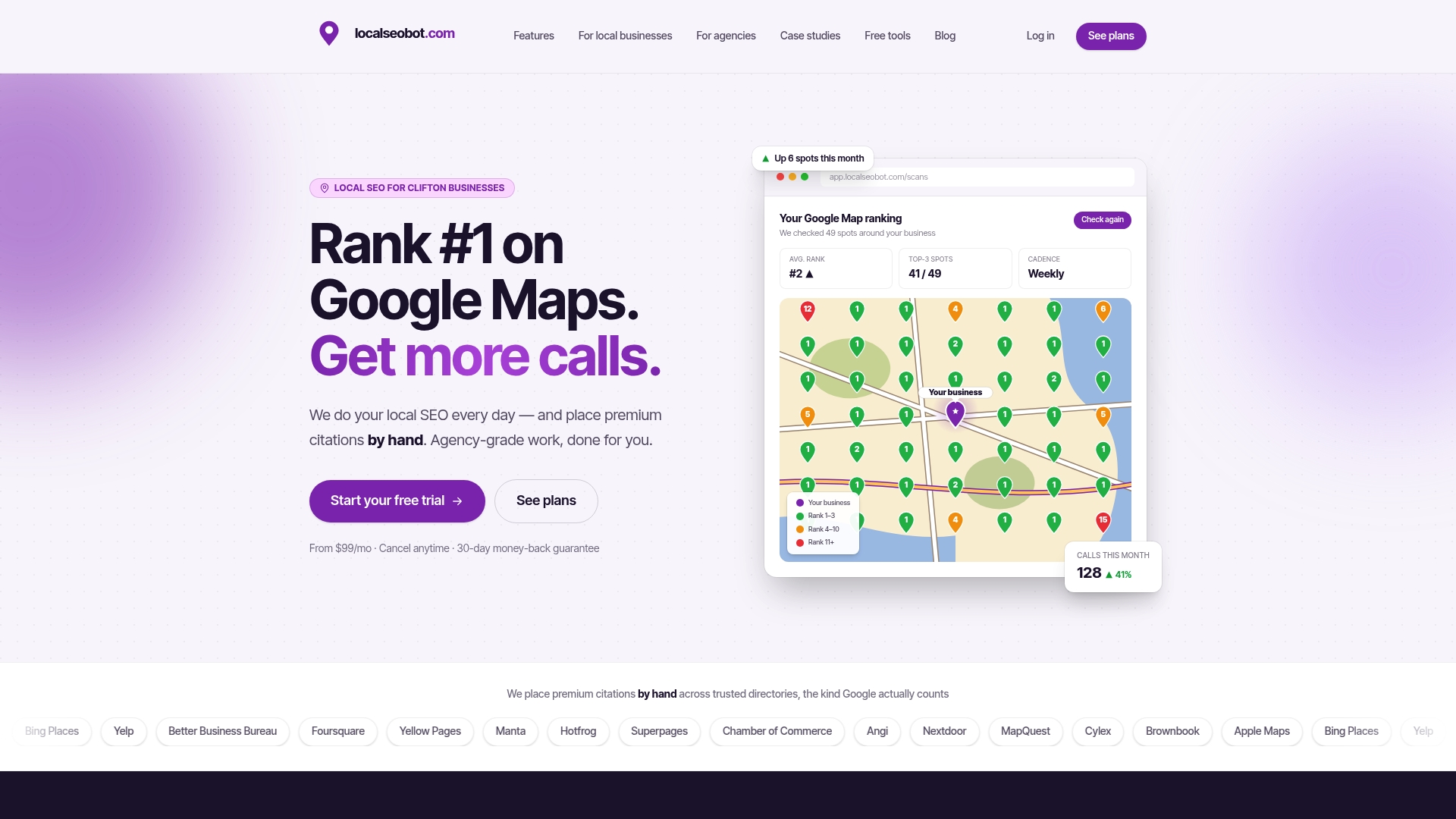
Localseobot takes a different route to the same goal: manual premium citation building on high-authority directories, automated Google Business Profile optimization and posting, geo-grid rank tracking so you can see exactly where you rank on Google Maps, and AI-driven review generation and replies. Everything runs on a per-location monthly subscription with no long-term contract requirement. Most SMBs see their first citation placements within the first billing cycle, and the 30-day money-back guarantee means you are not taking a risk to find out.
Agencies get a white-label dashboard that lets you manage and report on every client location under your own brand. Run your local search visibility analysis to see where your locations stand right now, then explore Localseobot’s full offering to see how manual premium citations and geo-grid tracking compare to what you are paying for today.
Useful sources for procurement and technical teams
- Local SEO platforms: Yext, Uberall, or a hybrid stack? | Synapse Edge
- Compare Uberall and Yext | G2
- Compare Yext vs Uberall | Capterra
- Yext vs. Uberall: Which Multi-Location Visibility Platform Should You Choose? | Yext
- Listings | Verified Direct Distribution — No Aggregator | Yext
- Uberall vs Yext - 2026 Comparison - Software Advice
- Local SEO Bot — brand landing page