Checklist-First 30-Day Onboarding for Local SEO Agencies
Published September 18, 2026
Checklist-First 30-Day Onboarding for Local SEO Agencies

The right onboarding turns a signed contract into measurable local SEO momentum inside 30 days, not 90. That means a repeatable process that secures access, runs baseline audits, fixes the highest-impact errors, and hands the client a clear 90-day roadmap. For a single-location client, expect the core setup work to take a few working days; multi-location accounts take longer per batch but scale faster once your SOPs are built.
TL;DR:
- A standardized onboarding process can turn a signed contract into measurable SEO results within 30 days by focusing on quick access, baseline audits, and a clear 90-day plan.
- Request and verify ownership of all client assets early, especially Google Business Profile ownership, to prevent delays caused by access issues.
- Conduct five key audits—citations, GBP, reviews, rank tracking, and schema—before making any live changes to establish a measurable baseline.
- Break down the 30-day onboarding into weekly targets, prioritizing impactful fixes like GBP optimization, citation corrections, and schema deployment for quick wins.
- Use an integrated tool stack to reduce manual errors, streamline data flow, and prepare clear deliverables and proof points for the client at the 30-day mark.
Table of Contents
- Why Agency Onboarding for Local SEO Needs a Fixed Process
- What to Collect Before Kickoff: A Field-Tested Intake
- Access Checklist and How to Verify Credentials
- Run These Audits First and Produce a Baseline Report
- Week-by-Week 30-Day Plan: Quick Wins Then Fixes
- The Compact Agency Tool Stack That Speeds Onboarding
- What You Must Hand the Client at Day 30
- Repeatable SOPs, Handoff, and Multi-Location Scaling
- Agency Credibility and Client Proof Points
- What Ten Years of Onboarding Mistakes Teach You
- How Localseobot Fits Into Your Onboarding Workflow
- Templates and Official Resources Worth Bookmarking
- Sources
- FAQ
Why Agency Onboarding for Local SEO Needs a Fixed Process
Most account managers lose the first two weeks of a new engagement to avoidable friction: chasing login credentials, re-asking questions the sales team already answered, or discovering the client doesn’t actually control their own Google Business Profile. None of that is a local SEO problem. It’s a process problem, and it’s the reason so many agencies feel like they’re always “getting started” with a client instead of showing results.
A standardized onboarding workflow fixes this. When the intake, access requests, and audit templates are already built, a single-location client can move from signed contract to full baseline report within a few hours of focused work spread across a couple of days, according to Authoritystack. Compare that to the days-long scramble that happens when every onboarding starts from a blank page.
The standard industry term for this is a client onboarding SOP (standard operating procedure), and it’s worth using that phrase internally even if “onboarding checklist” is what you call it in client-facing materials. A documented SOP is what lets you hand a new account to a junior strategist without lowering quality, and it’s what makes local SEO agency setup something you can scale instead of something that depends on one person’s memory.
The rest of this guide walks through that SOP step by step: what to collect before kickoff, what access to request and verify, which audits to run first, and how to structure the 30-day timeline so quick wins show up before the client starts asking questions.
What to Collect Before Kickoff: A Field-Tested Intake
Send the intake questionnaire promptly after contract signing, and set a clear deadline for the client to return it. Nexalgrowth’s research on onboarding questionnaires found this single habit prevents most of the scope creep and back-and-forth that stalls new accounts in week one. A vague or open-ended request invites delay; a form with a deadline gets answered.
Your intake form needs to capture more than contact information. Structure it around five categories:
- Legal and location details — exact NAP (name, address, phone) as it should appear everywhere, plus the legal business name, any DBA history, and every physical or service-area location the account covers.
- Contacts and authority — who signs off on published content, who has final say on GBP changes, and what communication channel and response-time expectation the client actually wants (email, Slack, a shared doc, weekly call).
- Business model and service area — is this a storefront with walk-in traffic, a service-area business with no public address, or a hybrid? This single classification changes how you configure grid tracking and GBP categories later.
- Priority services — which offerings drive the most revenue, so your content and citation work emphasizes the right pages instead of spreading effort evenly across everything the client sells.
- Required assets — high-resolution photos, logo files, a full export of existing reviews, and a list of active social accounts.
Ask for assets in the same message as the questionnaire. Waiting until week two to request photos or logo files is one of the most common causes of onboarding delay, mostly because clients assume you’ll ask “when you need them,” and you need them by day three.
Pro Tip: Build the intake form once as a reusable template, not a document you recreate per client. A locked structure with conditional fields for service-area versus storefront businesses saves more time over a year than any individual audit shortcut.
Access Checklist and How to Verify Credentials
Request access to six systems in the same kickoff email: Google Business Profile, Google Search Console, Google Analytics 4, CMS admin, hosting or DNS control, and an invitation to your team’s shared password vault. Don’t wait to discover you need DNS access when you’re three weeks into a schema deployment.
Verifying access matters more than requesting it. A client can “grant” you GBP access that turns out to be a manager role with no posting permission, or share a GA4 property ID that points to the wrong account entirely. Confirm each connection with a real task, not a login screen:
- Pull the GBP location’s CID and confirm it matches the physical address on file.
- Publish a test post or respond to one review to confirm write access, not just view access.
- Check GSC property type (domain vs. URL prefix) matches how the site is actually structured.
- Verify GA4 property and stream IDs against the live site, especially for clients who’ve migrated platforms before.
- For multi-location clients, confirm access exists at the location level, not just the brand account level.
One access issue outranks all the others: verify the client actually owns their Google Business Profile before you do anything else. Nexalgrowth’s onboarding template flags this as priority zero, and for good reason. A client who lost GBP ownership to a former marketing vendor or an employee who left the company can stall an entire engagement while you work through Google’s recovery process. Check ownership status in the intake call, not in week three.
Store every credential in a dedicated password vault with per-client access scopes, never in a shared spreadsheet or email thread. Assign vault access by role so a strategist leaving the account doesn’t mean rotating every password the client owns.
Run These Audits First and Produce a Baseline Report
Five audits form the foundation of every local SEO onboarding, and they need to happen before you touch anything live. Fixing an inconsistent citation before you’ve documented what it originally said destroys your ability to prove improvement later.
Citation audit. Scan 50 to 80 or more directories and log every NAP inconsistency you find before correcting a single one. AuthorityStack.ai’s citation research recommends field-level documentation, meaning you record exactly which field (name, phone, category) is wrong on which directory, not just a pass/fail count.
GBP audit. Score profile completeness, category selection, photo count and recency, post frequency, and unanswered Q&A.
Review audit. Document current rating, review volume by platform, the date of the most recent review, and your response rate to existing reviews. This becomes your review benchmark for the next 90 days.
Grid-based rank tracking setup. Configure grid density to match actual service coverage rather than defaulting to a generic radius. A dense urban service area needs tighter grid points than a rural business covering three counties. Maprank’s geo-grid tracking is built around this kind of coverage-matched configuration.
Schema audit. Check for existing LocalBusiness, Service, and FAQ JSON-LD, and validate what’s there. Most local businesses have none of this correctly implemented, and structured data is one of the higher-leverage technical fixes available during onboarding, according to AuthorityStack.ai.
| Audit area | What you measure | Baseline output |
|---|---|---|
| Citations | Accuracy across 50–80+ directories | Citation accuracy rate |
| Google Business Profile | Completeness, categories, photos, posts | GBP completeness score |
| Reviews | Rating, volume, response rate, recency | Review benchmark vs. competitors |
| Rank tracking | Grid-based position across service area | Grid rank snapshot |
| AI visibility | Presence in AI-generated answers | AI citation share |
Together, these five measurements make up the baseline report, and AuthorityStack.ai identifies them as the standard set every onboarding bundle should include. Skip one and you lose your ability to show the client exactly where they started.
Week-by-Week 30-Day Plan: Quick Wins Then Fixes
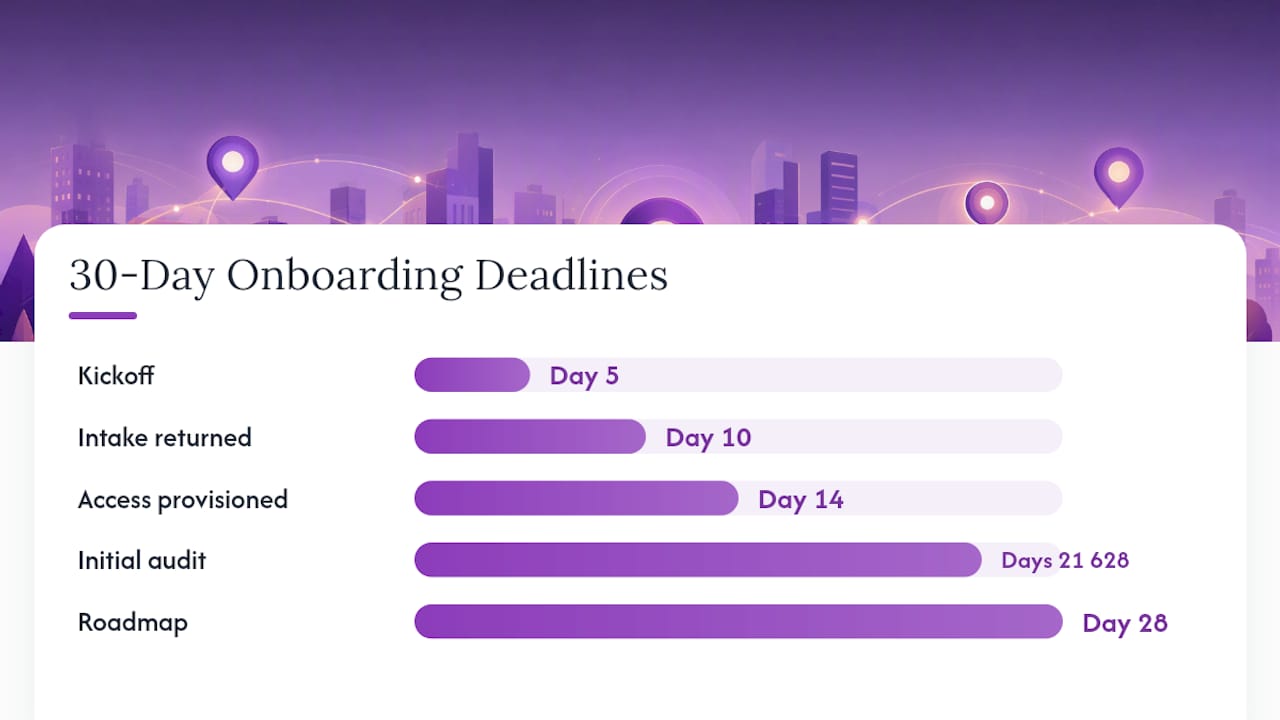
Structure onboarding as a 30-day project with weekly checkpoints, not an open-ended ramp. ThatDevPro’s onboarding framework sets a useful default cadence: kickoff within 5 business days of signing, intake returned within 10 days, access provisioned within 14 days, the initial audit delivered within 21 to 28 days, and a roadmap by day 28.
- Days 0 to 2: Run all five audits, capture baseline metrics, and configure your tracking and reporting templates. This is also when you confirm GBP ownership and lock down vault access.
- Week 1: Push the highest-impact GBP fixes live (categories, hours, missing services), correct the top citation errors you found in the audit, and patch obvious on-site meta issues like missing title tags on core service pages.
- Week 2: Continue reconciling citations across the remaining directories, launch the review-generation workflow so new reviews start accumulating against your benchmark, and deploy LocalBusiness and Service schema.
- Weeks 3 and 4: Run the content-gap analysis to identify missing service pages and neighborhood-specific queries, publish the first one or two local pages or FAQ sections, and finalize the reporting cadence you’ll use going forward.
A single-location client can realistically move through all four stages inside the 30-day window using four to eight hours of hands-on work per week. Multi-location clients need proportionally more time per location for the audit and citation stages, but the content-gap and schema work often batches efficiently once you group locations by brand.
One scheduling detail agencies underestimate: complex engagements benefit from a four-call discovery sequence instead of one long kickoff call. ThatDevPro’s onboarding data found that spreading discovery across four shorter calls produces clearer scope and fewer misunderstandings than trying to cover everything in a single 90-minute session. Use the extra calls to separate technical access setup from strategy discussion. Trying to do both in one meeting is where scope gets muddy.
The Compact Agency Tool Stack That Speeds Onboarding
Six tool categories cover everything a local SEO onboarding needs: citation management, rank and grid tracking, GBP management, review monitoring, schema generation, and AI visibility tracking. Running each of these as a separate disconnected subscription is the single biggest source of manual errors during onboarding, because every handoff between tools means someone is copying data by hand.
Agencies that consolidate these functions into an integrated stack can significantly reduce onboarding time, according to AuthorityStack.ai’s tool-stack research. That’s not a marginal efficiency gain. It’s the difference between onboarding taking two days and onboarding taking a full week.
A practical workflow looks like this:
- Pull the citation scan and GBP audit from the same platform so NAP data flows into both without re-entry.
- Configure grid-based rank tracking once you know the service area classification from intake, then let it run in the background while you handle citations and schema.
- Generate schema markup from the same business data used in the citation audit, rather than typing NAP details a third time into a separate schema tool.
- Route new reviews into a single monitoring dashboard so the response workflow starts immediately instead of waiting for a weekly check-in.
The fewer places client data lives, the fewer chances there are for a typo in a phone number to propagate across 40 directories. That’s the real argument for consolidation. It isn’t about saving a subscription fee; it’s about not introducing your own inconsistencies while you’re trying to fix the client’s.
What You Must Hand the Client at Day 30
By day 30, the client should have three concrete deliverables in hand, not a vague update call. The baseline report covers the five metrics from your audits: citation accuracy rate, grid rank snapshot, GBP completeness score, review benchmark, and AI citation share. Each number exists so the client (and you) can point back at it in 90 days and measure exactly what moved.
The 90-day roadmap builds on that baseline with three components:
- A prioritized fix list ranked by impact, not by how easy each item is to complete.
- A content cluster plan built from the gap analysis, targeting missing service pages and neighborhood queries first.
- Defined measurement windows so the client knows when to expect the first visible rank or citation movement, typically somewhere in the 60 to 90 day range once priorities are executed, per AuthorityStack.ai’s content research.
Quick fact: the same research identifies 60 to 90 days as the realistic window for measurable rank and citation improvement once a prioritized content plan is actually executed, not just written down.
Set the reporting cadence before you leave day 30 behind. Weekly updates during the active fix phase, shifting to monthly reporting once the account stabilizes, keeps the client informed without turning every touchpoint into a status meeting. Present early wins specifically: name the GBP fix, the citation corrected, the schema deployed. Vague progress language is what makes clients nervous about local SEO timelines. Specific, dated fixes are what build trust.
Repeatable SOPs, Handoff, and Multi-Location Scaling
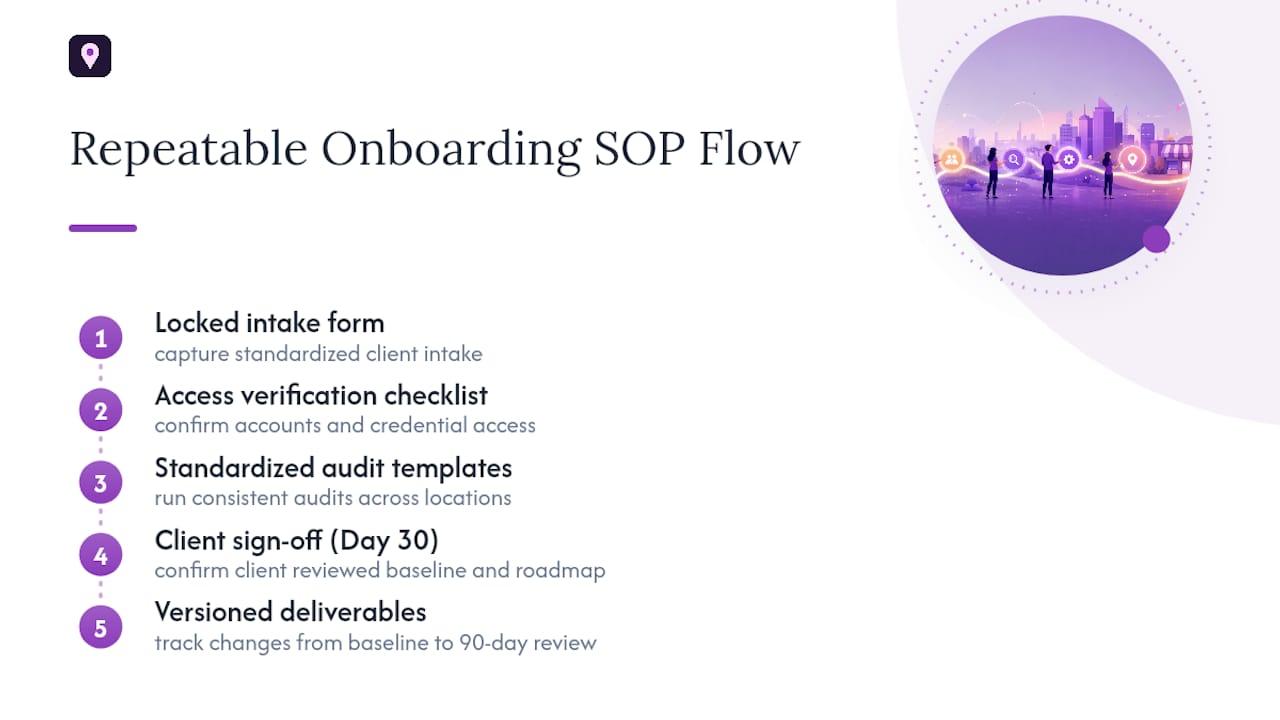
Four components make an onboarding SOP genuinely repeatable: a locked intake form, a verification checklist for access, standardized audit templates, and versioned deliverables so you can track what changed between the baseline and the 90-day review. Skip the versioning step and you’ll eventually lose the ability to prove what you actually fixed.
Multi-location clients need one more layer: location grouping. Bundling locations into groups and running grid scans across the group at once, rather than location by location, prevents the repetitive setup that otherwise multiplies onboarding time linearly with location count, according to AuthorityStack.ai’s scaling research. Treat brand-level tasks (schema templates, reporting structure) separately from location-level tasks (NAP data, individual grid points) in your SOP documentation, so your team isn’t rebuilding brand assets for every new address.
Pro Tip: Add a client sign-off gate at day 30, not just an internal checklist. A short form where the client confirms they’ve reviewed the baseline report and roadmap prevents disputes three months later about what was actually agreed to.
If you white-label parts of your fulfillment, review BabyLoveGrowth’s guidance on transitioning signed clients into active campaigns before you build your own handoff checklist from scratch.
Agency Credibility and Client Proof Points
Onboarding materials should include real proof points, but the standard for what counts as proof matters more than the impulse to sound impressive. A results claim tied to a client-reported number and a guarantee, is defensible in a way that a vague “we get results” claim is not.
A service that offers a 30-day money-back guarantee if a business doesn’t see a ranking increase is making a specific, checkable claim about confidence in its methods, not a marketing slogan.
That’s the model worth following in your own onboarding materials:
- Link case studies to the specific baseline and 90-day metrics they reference, not just a before/after screenshot.
- Note staff credentials where they’re genuinely relevant (a former in-house marketer, a certification), and skip generic titles that don’t tell the client anything.
- Leave a placeholder in your template for the client’s own reported outcome (a specific call volume increase, a ranking move) rather than writing generic testimonial copy before you have real numbers.
Overclaiming during onboarding sets an expectation you’ll spend the next 90 days trying to walk back. Specific, sourced numbers do the opposite.
What Ten Years of Onboarding Mistakes Teach You
The most common onboarding failure isn’t a missed audit. It’s skipping the access verification step and discovering in week three that the “GBP access” the client granted was a manager role with no posting rights. That single gap can cost an agency two weeks of stalled work on an account that should have been showing quick wins by then.
The fix isn’t more process. It’s a shorter, stricter one: verify every access grant with a real task inside 48 hours, and refuse to schedule the first strategy call until that’s confirmed. Agencies that standardize their intake and audit templates report cutting their setup time from days to hours, and the account managers running those templates consistently spend less time chasing logins and more time delivering the work clients are actually paying for.
— Local
How Localseobot Fits Into Your Onboarding Workflow
Localseobot is the alternative to building your citation and rank-tracking stack from scratch for every new account. Instead of manually working through 50 to 80 directories per client or stitching together three separate rank-tracking subscriptions, you plug premium citation building and geo-grid rank tracking straight into the onboarding timeline outlined above.
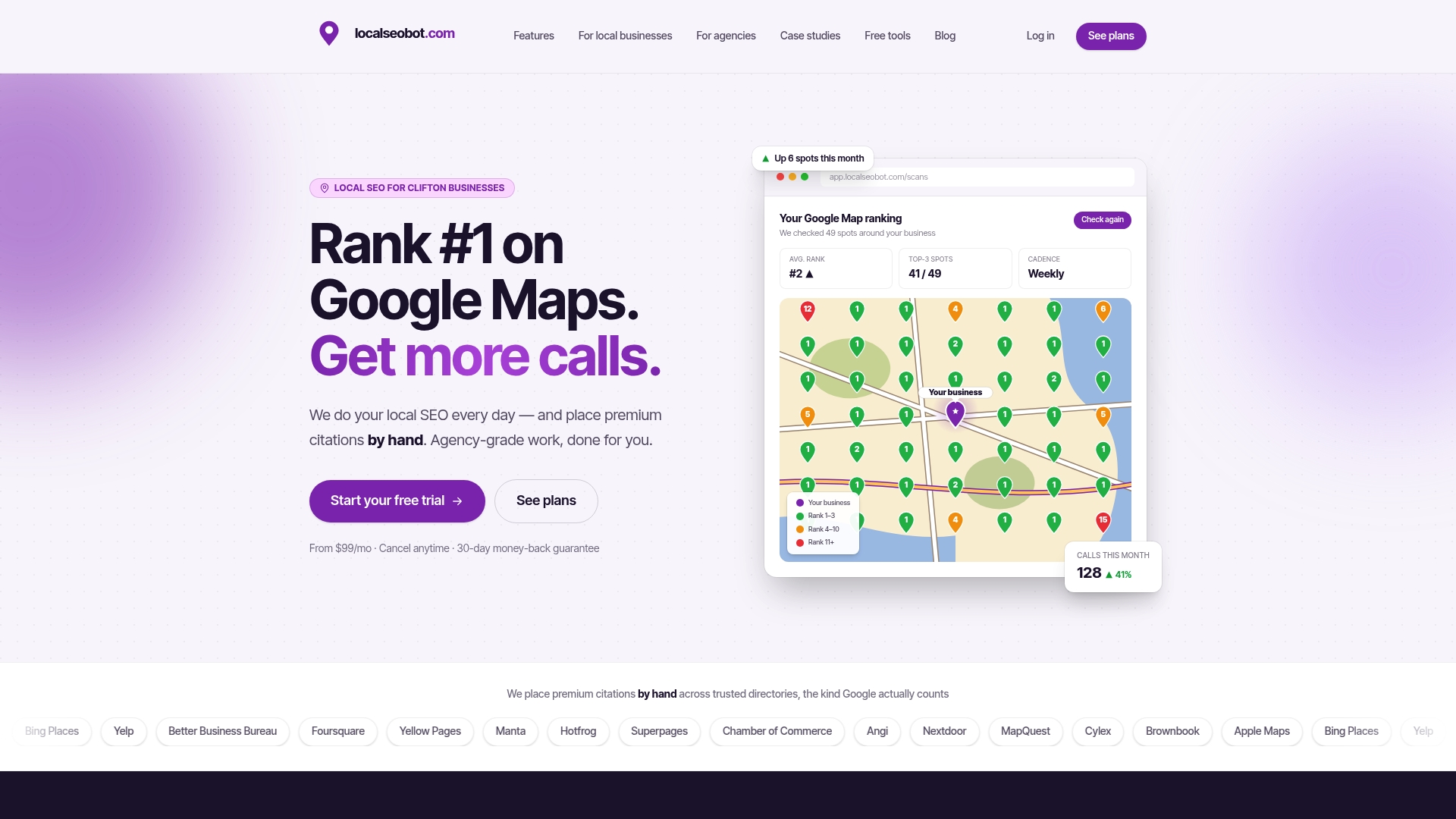
The fit is specific: use Localseobot during Week 1 and Week 2 of the 30-day plan, right where citation reconciliation and baseline rank capture happen. Instead of citation blasts that dump low-quality listings across directories your client’s customers never visit, a platform that manually builds premium citations on high-authority directories can matter most in that early baseline period when accuracy is what you’re being judged on. Maprank’s geo-grid tracking configures to the exact service-area classification you captured in intake, so your grid snapshot in the baseline report reflects real coverage instead of a generic radius guess.
For agencies managing multiple client accounts, the white-label agency plan lets you deliver this work under your own brand without hiring a citation specialist. Localseobot’s Foundation and Growth plans start at $99 and $199 per month per location, and the 30-day money-back guarantee means you’re not asking a new client to gamble on results while you’re still proving your value in month one. Check the pricing page and add it to your next onboarding checklist before your next kickoff call.
Templates and Official Resources Worth Bookmarking
A handful of resources are worth keeping open while you build or refine your own SOP. Each one addresses a different piece of the onboarding puzzle covered above.
- Nexalgrowth’s onboarding questionnaire template gives you a ready-made intake form structure to adapt for your own agency’s process.
- ThatDevPro’s client onboarding framework breaks down the 30-day cadence and discovery call structure in more operational detail.
- Authoritystack covers the six-category stack and consolidation math in full.
- Localseobot’s local SEO audit tool is useful for running a fast first-pass check before your full baseline audit.
Sources
- Authoritystack
- SEO Client Onboarding Guide | Process and Checklist
- Free local seo client onboarding questionnaire template 2026
FAQ
How much should I pay for local SEO?
Local SEO pricing depends heavily on scope, location count, and whether you’re hiring an agency or running it in-house with software. Localseobot’s own plans run $99 to $199 per month per location for Foundation and Growth tiers, with a $399 per month per location Pro tier for agencies at Localseobot.
What is the 80/20 rule in local SEO onboarding?
Applied to onboarding, the principle means a small set of fixes (GBP completeness, top citation corrections, and core schema) drive most of the early ranking movement, while dozens of smaller tweaks matter far less in the first 30 days. Prioritizing the highest-impact fixes first, as outlined in the week-by-week plan above, is what makes early wins visible to the client.
How much does an SEO agency typically cost?
Agency retainers for local SEO vary widely by market and scope, and most agencies price per location or per package rather than a flat industry rate. Software-driven alternatives like Localseobot’s per-location plans give agencies and small businesses a lower-cost way to run the citation, rank-tracking, and GBP management work without a full custom retainer.
What will local SEO look like in 2026?
Expect AI-generated answers and AI Overviews to keep playing a bigger role in how customers find local businesses, which is why AI citation share now sits alongside citation accuracy and GBP completeness as a baseline metric. Agencies that build AI visibility tracking into their onboarding audits from day one will have a clearer read on this shift than those tracking rankings alone.
How long before a client sees ranking results after onboarding?
Most agencies should expect visible rank and citation improvement in the 60 to 90 day range once the prioritized fix list and content plan are actually executed, according to AuthorityStack.ai’s content research. Setting that expectation clearly during onboarding, rather than promising faster results, is part of what keeps clients confident during the first reporting cycle.