Avoid GBP Rejections: AI Local Content with Human Review for Agencies
Published September 27, 2026
Avoid GBP Rejections: AI Local Content with Human Review for Agencies

AI local content means using AI tools to draft Google Business Profile posts, location pages, and citation text, then verifying and editing that draft with real local facts before it goes live, leveraging AI content optimization techniques to boost SEO results. Used this way, AI speeds up production without breaking Google’s rules. Used carelessly, generating city pages or profile posts without human review or local specifics, it produces the kind of thin content Google’s guidance treats as spam. The safest path pairs AI drafting with a human fact check, or a managed service that builds both content and citations by hand.
TL;DR:
- AI assists with creating local search content like Google Business Profile posts and templated location pages, but human verification of local details remains essential.
- Using AI to generate city pages or posts without local facts or proper review risks producing spammy, low-quality content that Google may penalize.
- Best suited for routine, structured copy such as FAQ snippets and citation descriptions, while avoiding unique narratives or unverified claims about expertise.
- A strict workflow includes building prompts with exact local info, verifying facts before publishing, and continuously tracking ranking and visibility changes.
- Managed services can streamline the process for multiple locations, ensuring compliance and improving local rankings through expert oversight and rank monitoring tools.
Table of Contents
- What AI local content is, and what it is not
- Best use cases: which local assets are good candidates for AI assistance
- Step-by-step workflow to create safe, high-performing AI local content
- Google Business Profile posts and content policy: what to watch for
- Quality safeguards and measurement: how to verify impact and stay compliant
- How we build AI-assisted local content responsibly
- Let a managed team handle AI local content and citations for you
- Sources
- FAQ
What AI local content is, and what it is not
AI local content, in this context, refers to AI-assisted copy built for local search: Google Business Profile posts, location-specific landing pages, and the descriptions that accompany business citations across directories. It has nothing to do with running AI models on a local device or private server. That is a separate technical topic, and confusing the two leads business owners toward the wrong tools entirely.
Google’s guidance on people-first content applies just as much to a single-location GBP post as it does to a national blog. The guidance warns that content produced mainly to attract search traffic, rather than to help a real visitor, tends to get treated as low quality. Google also recommends disclosing automation when it substantially generated the content and a reader would reasonably expect to know that.
At the local level, this shows up as city landing pages stuffed with a business name and a swapped-out city name, with no address, no local services, and no evidence the business actually operates there. That pattern is easy for both readers and Google’s systems to spot, and it is the fastest way to turn an AI efficiency gain into a ranking liability.

Best use cases: which local assets are good candidates for AI assistance
AI works best on structured, repeatable copy, not on anything that claims unique local experience or credentials it cannot back up.
- Good fits: GBP post drafts, routine citation descriptions, templated location pages built from a consistent format, and FAQ snippets answering common service questions.
- Poor fits: unique local narratives, claims about staff certifications or years of experience, and anything implying a physical presence the business does not actually have.
- Volume versus specificity: a business with one location can afford deep, specific pages; an agency managing fifty locations needs templates with mandatory local fields (address, hours, service area) filled in per site.
Tools like the Local SEO Content Idea Generator can produce a starting draft, but the fields that make it local, not generic, still need a human to confirm.
Pro Tip: Build one strong template per content type, then treat every AI output as a fill-in-the-blank draft rather than a finished page.
Step-by-step workflow to create safe, high-performing AI local content
A repeatable process protects you from both wasted effort and policy problems. Follow these steps for any GBP post, location page, or citation batch.
- Build a prompt template that requires local facts. Include the exact address, current hours, service area, and named services; never let the AI invent these.
- Generate the first draft. Use the template to produce copy for the specific location or post, not a generic version to be copied across every listing.
- Verify the facts. Check name, address, and phone number (NAP) against your Google Business Profile, confirm hours and categories match, and correct anything that drifted.
- Edit for people-first usefulness. Rewrite anything that reads generic, add a genuine local detail, and cut filler that adds nothing for a visitor deciding whether to call.
- Schedule and publish. Space out GBP posts rather than batch-publishing dozens at once, since irregular volume spikes can trigger review delays.
- Monitor outcomes. Track visibility with a geo-grid tool such as Maprank, along with calls and clicks, to see whether the content actually moves rankings.
- Log every edit and set a refresh cadence. Keep a simple record of what changed and when, and revisit posts and pages on a set schedule rather than leaving them untouched for a year.
Guardrails matter as much as the steps themselves. Set a rate limit on how many GBP posts you publish per day per location, since Google reviews each post for compliance and can mark it live, pending, or not approved. Build a rejection-handling step into the workflow: when a post is not approved, someone should read the rejection reason before resubmitting a near-identical draft. For agencies managing many locations at once, batch approval, where a human reviews a set of drafts before any of them publish, catches copy-paste errors before they become NAP mismatches.
Pro Tip: Never let an automated pipeline publish directly to a live GBP profile without at least one human checkpoint between draft and publish.
Google Business Profile posts and content policy: what to watch for
GBP posts support text, photos, videos, and an action button linking to a call, booking page, or website. Every post goes through review, and visibility depends on both that review and your profile’s verification status.
- Posts can appear as live, pending, or not approved, and unverified profiles may not be able to publish at all.
- Certain post types, including featured posts, are not available to every business category, so check availability before planning a campaign around one format.
Before publishing, run through a short checklist:
- No keyword stuffing in the business name or address fields, since Google’s guidelines on representing your business require accurate, real-world information.
- A professional tone rather than an obvious auto-generated feel; Google’s help documentation repeats that posts should add value, not read like filler text.
- Action links that point to a real, working page, not a placeholder URL.
- Verification status confirmed before scheduling a post series, since an unverified location can stall an entire campaign.
Quality safeguards and measurement: how to verify impact and stay compliant
Consistency and verification matter more for local content than clever copy does.
- Keep your business name, address, phone number, and categories identical across your site, your Google Business Profile, and every citation, following Google’s guidelines for representing your business.
- Track ranking movement with geo-grid rank tracking, since local visibility often varies by micro-location rather than moving uniformly across a city.
- Set a human review schedule for anything touching sensitive categories, medical or legal claims, or pricing, and escalate those drafts before they publish.
- Establish stop criteria: if AI-assisted GBP posts are repeatedly marked not approved, or a location page shows no visibility change after a full review cycle, pause and rebuild the template rather than repeating the same draft.
Geo-grid tracking, such as Maprank, shows exactly where a location ranks across a map grid. Without that view, it is easy to mistake one improved keyword for a broader ranking gain that never actually happened.
How we build AI-assisted local content responsibly

Local SEO Bot treats AI as a drafting assistant, not a publisher. Tools like the Local SEO Content Idea Generator produce starting templates for GBP posts and location copy, but every citation we build goes through manual placement on high-authority directories rather than automated blasts. That combination, AI for speed, human hands for accuracy, is why we back our work with a 30-day money-back guarantee if Google Maps rankings do not improve.
A typical client workflow looks like this: draft GBP posts from a template, verify NAP and category details against the live profile, publish on a steady cadence, then track position changes location by location. The proof point we care about is whether calls and map visibility actually rise, not whether content shipped quickly.
— Local
Let a managed team handle AI local content and citations for you
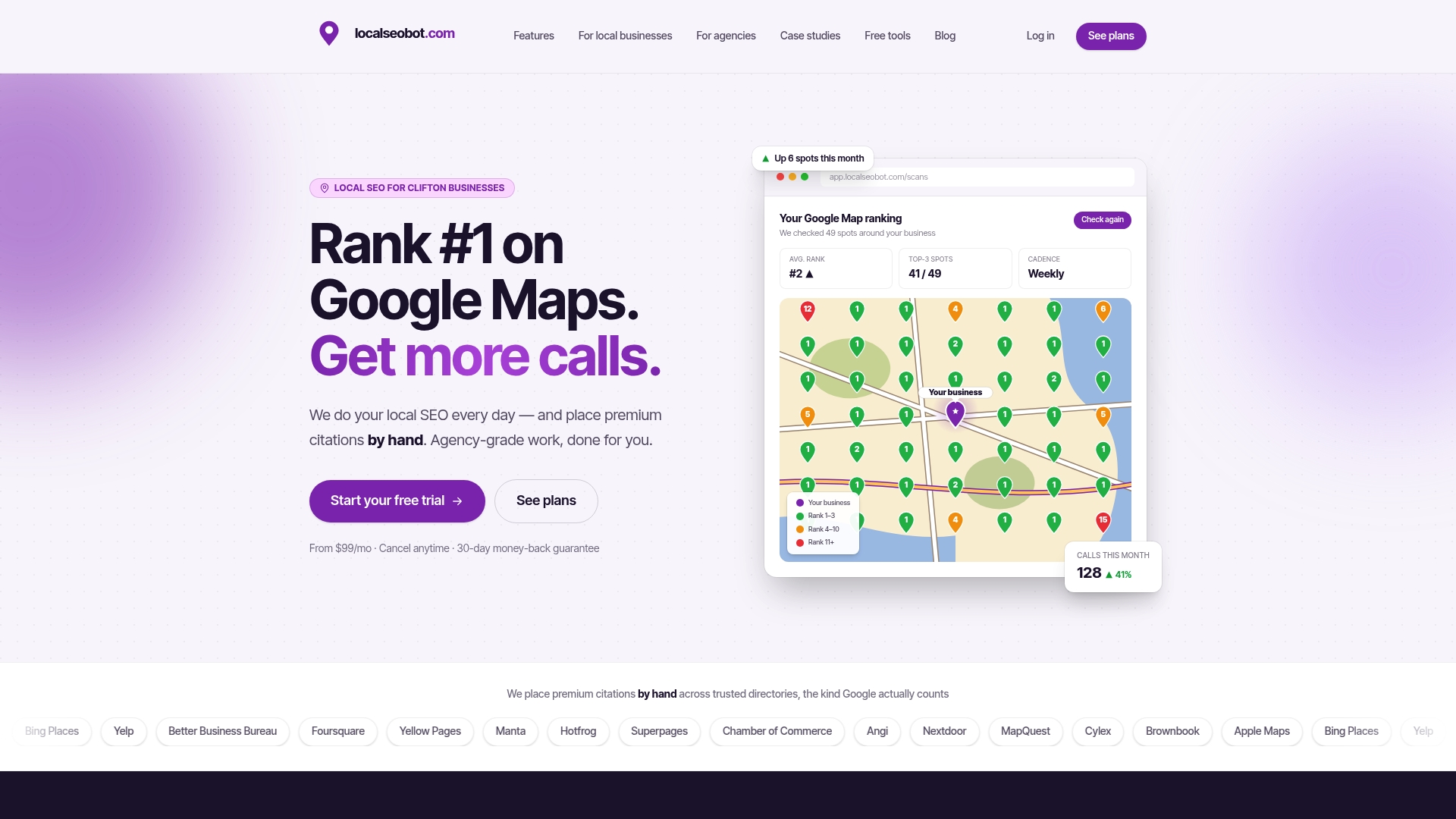
Building the workflow above takes time most small business owners do not have, and getting it wrong risks a rejected post or a suspended profile. Local SEO Bot runs that process for you: AI-assisted content drafting paired with manually built premium citations, plus geo-grid rank tracking through Maprank so you can see the result instead of guessing at it.
What is included depends on your plan, which can be found on the pricing page of the company’s website.
If you run a single location and have time to manage prompts and reviews yourself, DIY can work. If you manage several locations or client accounts, a managed approach removes the review bottleneck entirely. Check current plan details on the pricing page or see Pro pricing for agencies, backed by the 30-day money-back guarantee if your Maps ranking does not improve.
Sources
- Creating Helpful, Reliable, People-first content | Google Search Central
- Create & manage posts on your Business Profile - Google Business Profile Help
FAQ
Is AI-generated content against Google’s local SEO rules?
No single rule bans AI content outright. Google’s people-first content guidance focuses on whether content actually helps a reader, and it recommends disclosing substantial automation when a visitor would reasonably expect that.
What happens if a Google Business Profile post gets rejected?
A rejected GBP post is marked “not approved” and never goes live for searchers. Read the rejection reason before resubmitting, since resending the same draft unchanged usually produces the same result.
How much does Local SEO Bot cost?
Local SEO Bot’s Foundation plan starts at $99 per month per location, Growth is $199 per month per location, and Pro for agencies is $399 per month per location. Full details are on the pricing page.
Can AI write location pages for multiple cities at once?
AI can draft a template quickly, but each page still needs the correct address, hours, and service details confirmed before publishing, per Google’s guidelines for business representation. Publishing identical pages with only the city name swapped is a common cause of thin, spam-like content.
How do I know if my local content is actually working?
Track ranking position with geo-grid tools like Maprank, since local visibility can shift by micro-location even when overall traffic looks stable. Pair that with call and click tracking to confirm the content is driving real customer action, not just a ranking number.