Local Citation Audit: Prioritized Order and Copyable Checklist
Published September 7, 2026
Local Citation Audit: Prioritized Order and Copyable Checklist

A citation audit is the process of finding, verifying, and correcting every online mention of your business name, address, and phone number, plus related fields like website URL and categories. The first move is simple: lock a canonical NAP format and confirm your Google Business Profile matches it exactly. Most businesses see measurable movement in Map Pack visibility within a few weeks to a couple of months of fixing the core platforms.
TL;DR:
- Correcting inconsistent NAP data across core platforms and aggregators typically shows Map Pack improvements within two to six weeks.
- Prioritize fixing Google Business Profile, your website schema, and data aggregators before addressing niche directories to ensure solid foundational trust signals.
- Multi-location businesses benefit from automated tools, which help track and correct dozens of listings faster than manual searches, especially when addressing longstanding errors.
- Systematic monitoring, including weekly checks initially and quarterly re-audits, is necessary because aggregators can silently restore outdated or incorrect information.
- Hiring a citation cleanup service with a guarantee can save time for complex or extensively rebranded operations versus DIY efforts.
Table of Contents
- What a Citation Audit Checks and Why It Matters
- How to Conduct a Citation Audit: The Step-by-Step Process
- Manual Spreadsheets or Automated Citation Tools?
- Fixing Listings, Duplicates, and Aggregator Errors
- Reporting Your Findings and Tracking Long-Term Impact
- Your Copy-and-Paste Citation Audit Checklist
- Tools and Support From Local SEO Bot
- When to Handle It Yourself vs. Bring in Help
- How Local SEO Bot Handles Citation Cleanup For You
- Sources
What a Citation Audit Checks and Why It Matters
A citation audit examines every place your business information appears online and flags where it disagrees with itself. That includes your name, address, and phone number (NAP), plus secondary fields that carry weight with local search engines: website URL, business category, hours, and description.
Consistency across these fields is the primary trust signal local search engines use to confirm your business is real and stable, according to LocaliQ’s citation guide. When your phone number on Yelp doesn’t match the one on your website, or an old address lingers on a directory you forgot existed, that inconsistency chips away at the confidence Google places in your listing.
Data aggregators make this worse. Services like Data Axle, Localeze (Neustar), and Foursquare feed information to dozens of smaller directories automatically. Fix a listing manually, and an aggregator can push the old, wrong data right back out within weeks. That’s why aggregator checks belong in every audit, not just the visible directories.
Here’s what typically goes wrong when nobody has checked citations in a while:
- Old suite numbers or previous business addresses still showing on secondary directories
- Multiple duplicate listings competing against each other for the same location
- A tracking phone number on the website that doesn’t match the one on Google Business Profile
- Inconsistent category selection that confuses which searches you should rank for
Fixing the core issues rarely produces overnight results. Expect initial movement within two to six weeks, with the fuller impact on Map Pack rank landing closer to the two-month mark, based on the recheck patterns LocaliQ recommends.
How to Conduct a Citation Audit: The Step-by-Step Process
This is the part most guides gloss over: order matters as much as effort. Fixing a directory nobody visits before locking your Google Business Profile wastes time you don’t have. Work through these steps in sequence.
1. Lock your canonical NAP.
Before touching a single listing, decide the exact format for your name, address, and phone number. Spell out “Street” or abbreviate it to “St.”? Include a suite number or not? Pick one version and write it down. This becomes your source of truth for every comparison that follows. Free checklists built around this exact principle consistently recommend committing to one canonical format and never deviating, even when a directory’s form field tempts you to shorten something.
2. Discover where your business currently appears.
Search your business name plus city, search your phone number in quotes, and search your old addresses if you’ve moved. Check the obvious platforms first: Google Business Profile, Bing Places, Apple Maps, Yelp, and Facebook. Then widen the net to industry-specific directories relevant to your business type. A tool built for this, like the Local Citation Finder, speeds up discovery considerably compared to manual searching, especially once you’re past a dozen or so listings.
3. Document everything in one place.
Build a spreadsheet or use a dedicated tracking tool. For every listing you find, record the platform name, the URL, current NAP as listed, whether it matches your canonical version, and a status column (correct, needs fix, duplicate, unclaimed). This document becomes your working map and your proof of progress later.
4. Prioritize fixes in the right order.
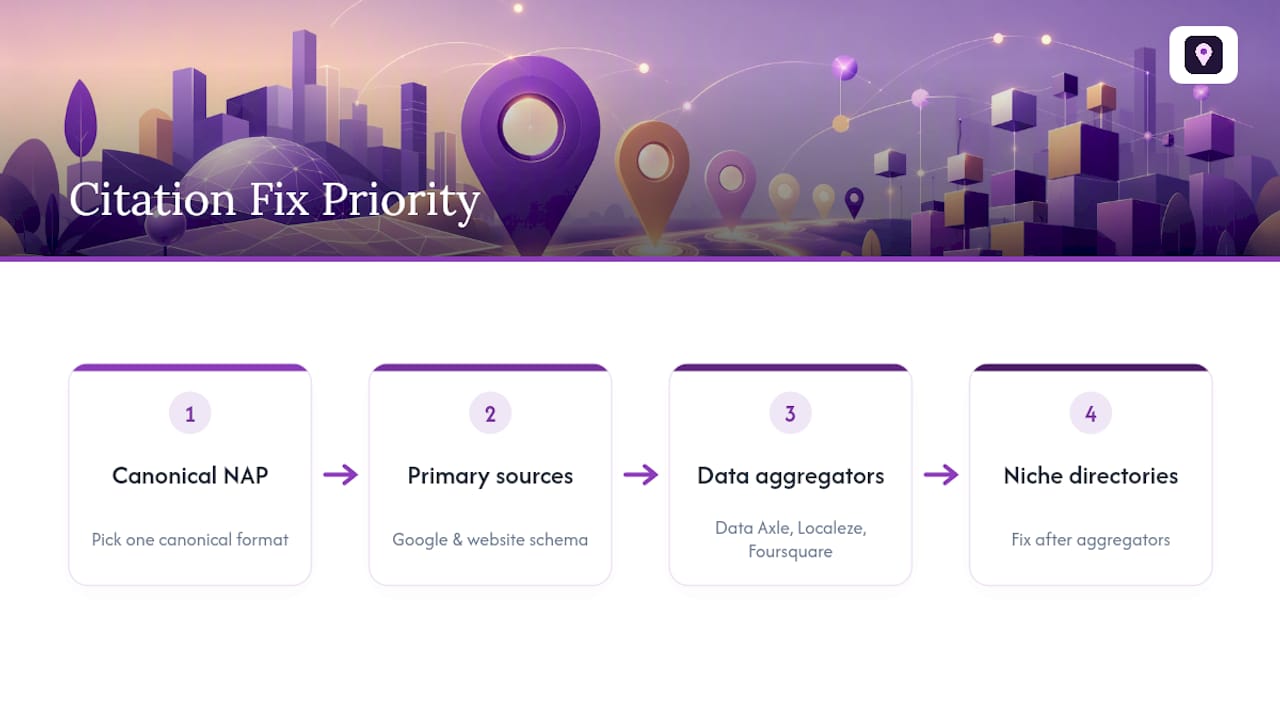
Not every listing deserves equal urgency. Fix Google Business Profile and your website’s structured data (schema markup) first, since these are the two sources search engines check most directly, a sequencing approach Flento’s citation guide backs up explicitly. After that, move to the data aggregators (Data Axle, Localeze, Foursquare) because correcting them prevents old errors from resurfacing on smaller sites downstream. Only after aggregators are clean should you turn to niche or industry directories.
5. Execute the fixes with a clear owner and log.
For each item on your spreadsheet, note who is responsible for the fix and the date it was submitted. Claiming and verifying a listing, merging duplicates, or requesting removal each take different amounts of time, and some platforms take weeks to process a change. A log prevents the same listing from getting “fixed” twice by two different people, which happens more often than you’d expect on teams juggling multiple local locations.
6. Set a monitoring cadence.
Once the priority fixes are live, check weekly for the first month to confirm changes stuck, then shift to monthly reviews, then quarterly full re-audits. Aggregators can silently overwrite a fix, so a listing that looked correct in March can drift by June without any oversight.
Pro Tip: Screenshot every listing before you request a change. If a directory reverts your edit or a merge request stalls, you’ll have dated proof of what the correct information looked like, which speeds up any appeal or support ticket significantly.
The order above isn’t arbitrary. Skipping straight to niche directories while your Google Business Profile still shows a defunct phone number means you’re polishing furniture in a house with a cracked foundation. Get the foundation right first.
Manual Spreadsheets or Automated Citation Tools?
A single-location business with a handful of listings can run a full audit with nothing more than a spreadsheet and a few focused search sessions. If you operate one storefront and haven’t moved or rebranded, a manual pass covering the core platforms plus the major aggregators is usually enough.
Multi-location businesses face a different math problem entirely. Five locations means five NAP records to track, five sets of duplicates to hunt down, and five times the chance that one franchise location got listed under a slightly different name. This is where automated scanning tools earn their keep, catching inconsistencies across dozens of listings faster than any manual search session could.
A workable toolkit typically covers three roles:
- Discovery: finding every place your business is currently listed, including forgotten or duplicate entries
- Consistency checking: comparing what’s live against your canonical NAP, which a tool like the Citation Consistency Analyzer handles automatically
- Ongoing tracking: monitoring for drift after fixes go live, so a reverted listing doesn’t sit wrong for months unnoticed
Whichever method you choose, your spreadsheet template should collect the same core fields: platform name, listing URL, current NAP, canonical match (yes/no), category listed, claim status, and date last checked.
Fixing Listings, Duplicates, and Aggregator Errors
Claiming and verifying Google Business Profile, Bing Places, Apple Maps, Yelp, and Facebook comes first, since these core platforms carry the most weight with search engines and often feed data to smaller sites downstream.
Duplicate listings need a merge request, not a second correction. Submitting a new “correct” listing next to an old wrong one just creates two competing signals. Most platforms have a dedicated duplicate-report flow. Document the URLs of both listings before you submit.
- Claim and verify GBP, Bing, Apple Maps, Yelp, and Facebook before anything else
- Request merges for duplicates rather than adding a new listing on top
- For call-tracking numbers, list the tracking number as secondary and keep your canonical number in the primary NAP field
- Keep dated screenshots as evidence if a directory refuses to update or ignores a support request
Pro Tip: If a directory has no visible edit option, search for its business “claim” or “suggest an edit” flow specifically. Many platforms bury the correction path several clicks deep from the main listing page.
Service-area businesses without a public storefront should list a service radius instead of a street address wherever the platform allows it, to avoid conflicting address data across listings.
Reporting Your Findings and Tracking Long-Term Impact
A useful audit report has three parts: an executive summary of how many listings were checked and how many needed fixes, a prioritized action list showing what got fixed first and why, and before-and-after evidence, ideally screenshots, for the highest-impact corrections.
Once fixes are live, shift into a monitoring rhythm rather than a one-time check:
- Weekly for the first month, confirming fixes have stuck and nothing has reverted
- Monthly for the next quarter, watching for aggregator drift
- Quarterly full re-audits going forward, treating citation hygiene as ongoing maintenance rather than a one-time project
Track Map Pack rank position, Google Business Profile impressions, phone calls, and website visits from your listing as your core KPIs. Give the fixes two to six weeks before your first re-measure, since that’s the window when initial Map Pack movement typically appears, with fuller results often taking closer to two months to settle.
Your Copy-and-Paste Citation Audit Checklist
Save this as a working template. Every row below maps to a step in the audit process, and the table format works well pasted directly into a spreadsheet.
| Audit stage | Action | Status tracking |
|---|---|---|
| NAP lock | Write the exact canonical name, address, phone format | Locked / Not locked |
| Core platforms | Claim and verify GBP, Bing, Apple Maps, Yelp, Facebook | Claimed / Pending / Mismatch |
| Website schema | Confirm structured data matches canonical NAP | Matches / Needs update |
| Aggregators | Check and correct Data Axle, Localeze, Foursquare | Correct / Submitted / Pending |
| Directories | Review remaining niche or industry listings | Correct / Duplicate / Needs fix |
| Monitoring | Re-check weekly, then monthly, then quarterly | Scheduled / Overdue |
Keep the canonical NAP format visible at the top of the sheet so anyone updating a row references the same source of truth, not their memory of what the address should look like.
Tools and Support From Local SEO Bot
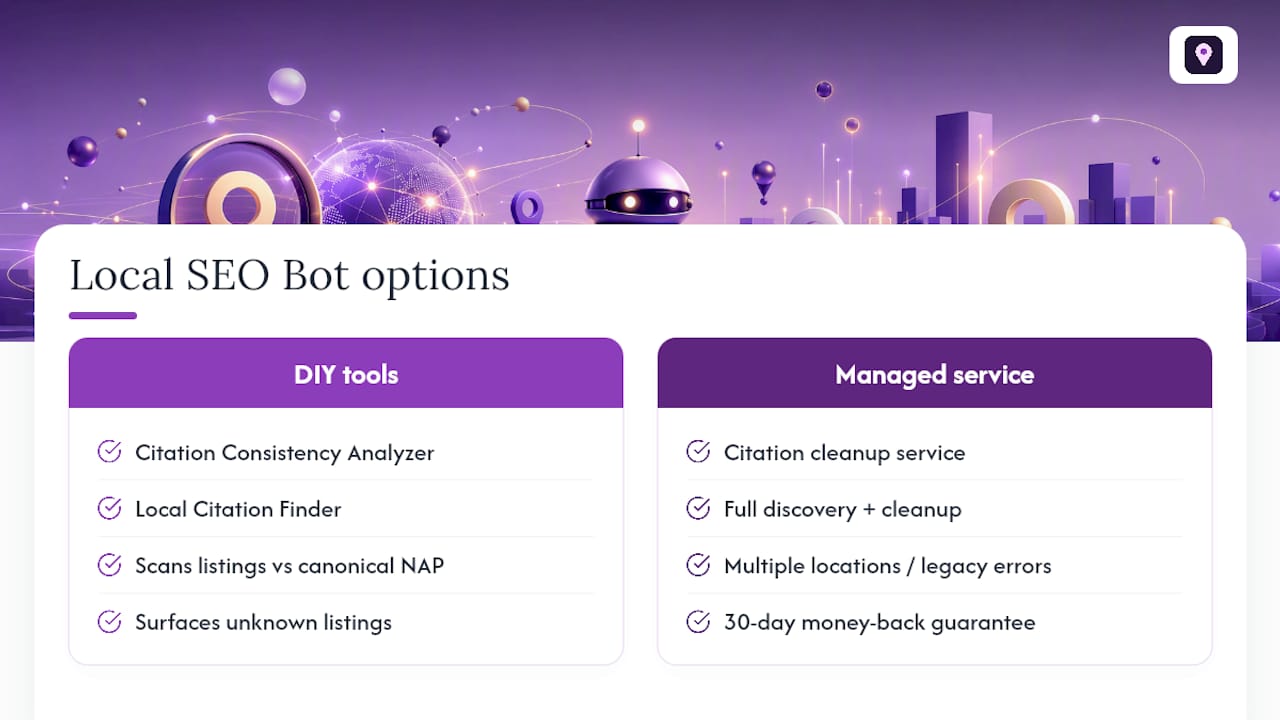
Running this process by hand works, but it takes time most owners don’t have lying around. Local SEO Bot’s Citation Consistency Analyzer scans your existing listings against your canonical NAP and flags mismatches automatically, covering the documentation step in a fraction of the manual time. The Local Citation Finder handles discovery, surfacing listings you may not know exist.
For businesses managing several locations or years of accumulated listing errors, a managed cleanup service often makes more sense than a solo spreadsheet project. The citation service backs its work with a 30-day money-back guarantee if rankings don’t improve. If you’re weighing DIY against hiring help, that guarantee is worth factoring into the decision.
When to Handle It Yourself vs. Bring in Help
The volume trap catches more businesses than bad data does: chasing citation count instead of fixing the handful of listings that actually move rankings. A single-location business with clean history can usually DIY this in a weekend.
Multi-location operations, or any business with years of address changes and rebrands, tend to hit errors that compound faster than one person can track. That complexity is when hiring makes sense. Whoever you bring in, expect a minimal service agreement to include a documented before/after audit, a prioritized fix list, and a defined re-check date, not just a promise that “citations are handled.”
— Local
How Local SEO Bot Handles Citation Cleanup For You
The service offers a dashboard that covers discovery, consistency checking, and ongoing monitoring for every location you manage.
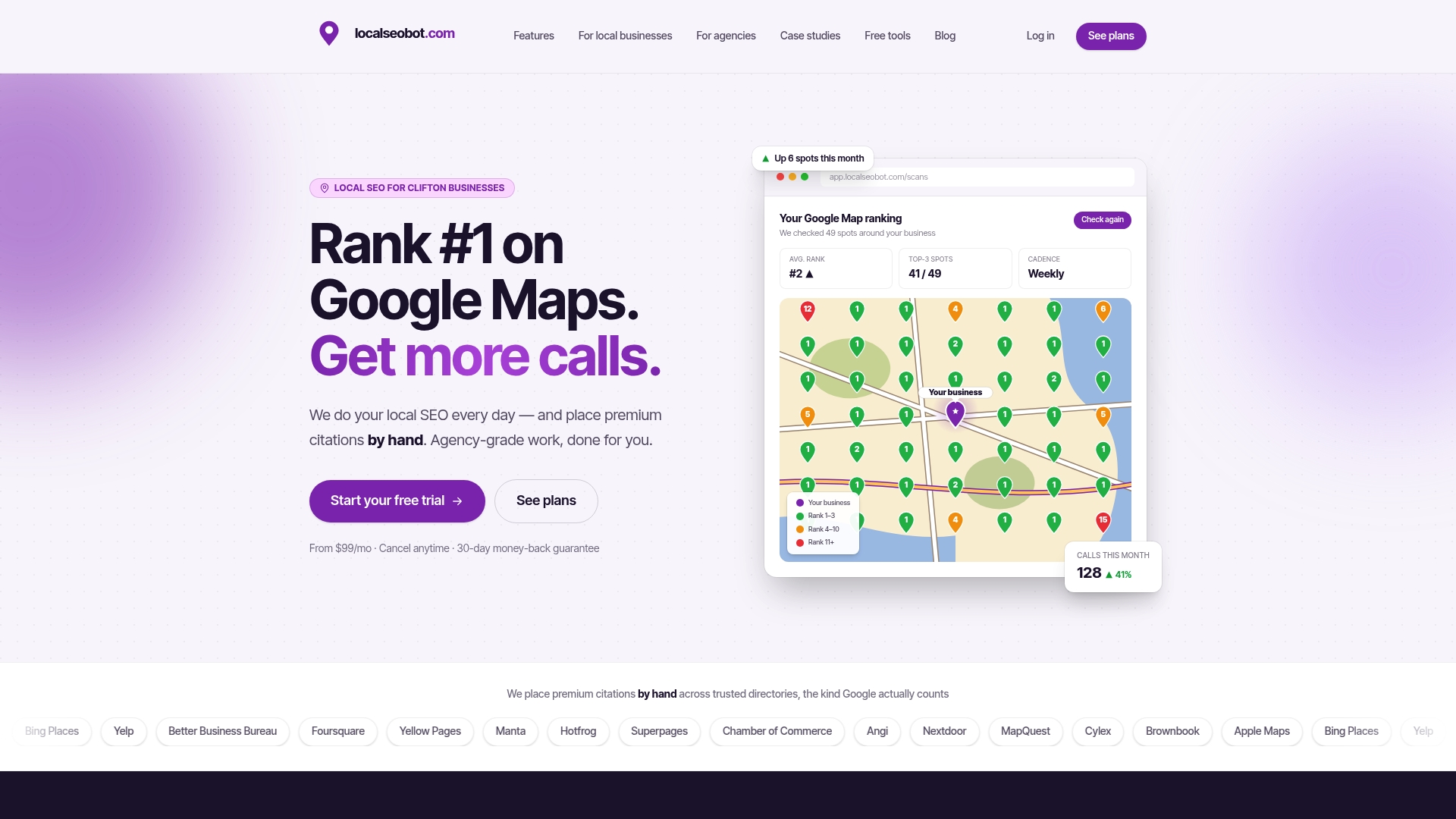
The Citation Consistency Analyzer flags NAP mismatches the moment they appear, and the Local Citation Finder maps every existing listing before you commit to a fix order. For businesses that would rather hand off the cleanup entirely, the Local Citations Services team builds and corrects listings manually across high-authority directories, backed by a 30-day money-back guarantee if your ranking doesn’t move. If you manage multiple locations, pair the audit with the NAP Management for Multi-Location Businesses guide before you start. Start a free trial or request a citation audit through your Local SEO Bot account to see where your listings currently stand.
Sources
For deeper workflow detail, see LocaliQ’s citation guide, Flento’s step-by-step citation process, and Redshaw Consulting’s audit checklist. For audit reporting frameworks that translate well to citation work, Baby Love Growth’s SEO audit workflow guide is worth a read.
- The Complete Guide to Local Citations (+A Handy Checklist) | LocaliQ
- How to Build Local Citations: Step-by-Step Guide for 2026 | Flento
- Free Local Citation Checklist (2026)