Google's Vicinity Update: What Changed and How to Adapt
Published November 1, 2026
Google’s Vicinity Update: What Changed and How to Adapt

The Vicinity update was a local search change that ran from November 30 to December 8, 2021, and it made physical distance count for more in Google Maps and the local pack. Businesses that had ranked across a whole city on strong SEO alone found their visibility shrinking toward the blocks around their address. Nearly five years later, distance is still the first thing to understand when your rankings look uneven. This guide explains what happened, what it means today, and what you can do about it.
TL;DR
- Vicinity was a local ranking rebalance that ran Nov. 30 to Dec. 8, 2021. Google confirmed a local update but did not publish details.
- Local SEO experts saw proximity gain weight, business-name keywords lose some impact, and map packs show a wider mix of businesses.
- Google’s own guidance says local results rest on relevance, distance and prominence. Distance is the one factor you cannot optimize directly.
- Your goal is no longer to rank for a whole city from one address. It is to win the neighborhoods you can actually reach, then widen them with relevance and prominence.
- Grid-based rank tracking shows where you win and where you vanish, which a single rank number hides.
Table of Contents
- What the Vicinity update was
- What changed in the map pack
- Who felt it most
- Relevance, distance and prominence after Vicinity
- Does Vicinity still matter in 2026?
- How to see your real visibility with grid scans
- What a small business can do when distance limits reach
- Reporting honestly when you manage client locations
- Our perspective
- Put the work on autopilot
- A simple 30-day plan
- FAQ
- Sources
What the Vicinity update was
In late 2021 Google ran a local search update that it described as a rebalancing of various factors used to generate local results. According to Search Engine Roundtable’s coverage of the confirmation, it began November 30 and finished December 8, 2021. Local SEO specialist Joy Hawkins named it the Vicinity update because of what she saw in the results.
Google gave no list of changed signals. Everything we know about the specifics comes from practitioners who watched thousands of searches shift at once. That is why you will see slightly different descriptions depending on who you read. The pattern most agree on is simple: closeness to the searcher mattered more afterward.
What changed in the map pack
Hawkins reported several shifts in the same coverage:
- Proximity seemed to gain weight. Businesses nearer the searcher moved up, and businesses farther away moved down, even if their profiles were stronger.
- Keyword impact may have dropped. She believed keywords placed in business names may have been devalued. Stuffing a service term into a profile name became a weaker shortcut.
- Packs changed shape. Map packs shrank, zoomed in and showed a wider variety of businesses.
In practice, a plumber with a great profile and a downtown address could lose the suburbs he used to hold. A competitor located in that suburb, with a weaker profile, could now appear above him for searchers standing there.
This is the part many owners find frustrating. Nothing about your business got worse. The map just got more literal about where you are.
Who felt it most
Google did not publish which categories were hit hardest, so any claim about winners by industry is guesswork. What follows is the logic that follows from the change, not a measured finding.
If distance weighs more, the businesses with the most to lose are those that relied on reaching customers far from their address:
- Service-area businesses such as plumbers, electricians and cleaners, whose customers sit across a whole metro area.
- Businesses located on the edge of a city that used to win central searches.
- Businesses with a single location trying to rank city-wide for broad terms like lawyer or dentist.
Businesses that gained were often those physically close to where searchers were standing, including smaller competitors with less polished profiles. If you want to see how this plays out for your own address and category, our local ranking calculator gives you a starting estimate, and our breakdown of proximity in local SEO covers the mechanics.
Relevance, distance and prominence after Vicinity
Google’s guidance on improving your local ranking says local results are based mainly on relevance, distance and prominence. Those three factors are the framework, and Vicinity is best read as a shift in how they balance.
| Factor | What it means | Can you change it? |
|---|---|---|
| Relevance | How well your profile matches what the person searched | Yes: categories, services, description, content |
| Distance | How far you are from the searcher or the location in the query | Not directly: it depends on your address and the searcher |
| Prominence | How well known your business is, online and offline | Yes, over time: reviews, mentions, citations, links |
After Vicinity, the distance column carries more of the result. That does not make relevance and prominence pointless. They decide who wins among the businesses that are close enough to qualify. A strong profile does not rescue you three miles out, but it decides who takes the top spot in the neighborhood you do own.
Does Vicinity still matter in 2026?
Yes, as a way of thinking. The update itself is long finished, and Google has changed local results many times since. But the lesson, that location in relation to the searcher shapes the pack, has held. Many local SEO practitioners still describe proximity as a dominant factor, particularly in dense cities where a few blocks can change who appears.
We would be careful with exact figures floating around about how small the competitive radius has become. Google does not publish them, and the numbers in industry write-ups come from varying samples. Treat them as directional. The practical point is the same either way: you can rank first on one street and not appear at all a mile away.
That is exactly why a single “I rank #3” report is misleading. Rankings are a map, not a number.
How to see your real visibility with grid scans
A standard rank check tells you where you appear from one point, usually your own address or a city center. Because distance now shapes results so strongly, that single point can be very flattering or very pessimistic.
A geo-grid scan checks your ranking from dozens of points across your service area and colors each point by position. You see the shape of your visibility: strong around the shop, fading toward the edges, or lopsided because a competitor sits on one side.
Here is how to read one:
- Run the scan for your money keyword. Pick the service that brings you the most revenue, not the broadest term.
- Find the green zone. This is where you reliably appear in the top three. It is usually centered on your address.
- Find the gaps. Look for areas where you should be visible, such as neighborhoods with many of your customers, but you are missing.
- Compare over time. Repeat monthly. Growth in the grid matters more than a one-day position.
Our Google Maps rank tracker runs these scans, and you can compare options in our guide to the best Google Maps ranking tools.
What a small business can do when distance limits reach
You cannot move your building. You can, however, make the most of where it is and widen the area where you qualify. These are the moves we see matter most.
Lock down the basics of your profile
Relevance is the factor you control fastest. Check that your primary category is the most specific one that fits, that your services are listed fully, and that your description reads like a real business and not a keyword list. Since keyword-stuffed names lost some of their effect, the clean name that matches your signage is also the safer one. A Google Business Profile audit will show what is missing, and the Google Business Profile optimizer helps fill it in.
Build location-specific relevance
If customers in a neighboring town are out of your green zone, give Google a reason to connect you to that town. Publish a dedicated page for each area you really serve, with real details: the neighborhoods, the jobs you have done there, the questions customers ask. One page per place keeps the signal focused instead of spreading a thin claim over an entire county. Our city landing page examples show what this looks like when it works, and the local SEO content idea generator helps you find topics for each area.
These pages must also work on phones, since most local searches happen there. Our mobile local landing page practices cover the details.
Strengthen prominence
Prominence is the long game, and it is what separates you from the other businesses sitting equally close to the searcher. Three things feed it:
- Reviews: steady, recent, genuine reviews that mention the service and the area. Responding to each one shows activity. A review management tool saves the daily effort.
- Citations: consistent name, address and phone number on trusted directories. Inconsistent data weakens trust, which you can test with the citation consistency analyzer.
- Local mentions: sponsorships, chamber of commerce listings, local press and partnerships with nearby businesses. For more ideas on becoming known in the communities you serve, these local SEO visibility lessons are a good next step.
Keep posting and stay active
Regular posts, fresh photos and current hours tell Google, and customers, that the business is open and engaged. None of this overrides distance, but it improves your odds in every contested spot.

Reporting honestly when you manage client locations
Agencies face an extra problem. A client who sees a #1 ranking from their own office assumes they rank #1 everywhere. When the phone does not ring from the other side of town, you take the blame.
The fix is to set expectations with the grid from day one:
- Show the starting scan and explain that distance limits reach.
- Report the share of grid points in the top three, not just one average position.
- Name the realistic target area for each location, based on where the business sits.
- Tie the work to leads where you can: calls, direction requests and form fills from the profile.
This keeps promises inside what optimization can honestly deliver, and it makes progress visible even when one keyword does not move. Our agency pricing page covers the white-label dashboard built for this kind of reporting.
Our perspective
Vicinity changed how we think about the job. For years, local SEO was sold as a race to the number one spot. After this update, the better question is where you hold that spot and where you do not, because the answer is different on every street.
That is why we built our service around work, not reports. A report can tell you that you disappear two miles from your shop. It cannot fix the profile, publish the posts, answer the reviews or build the citations that widen your reach. Our AI agent handles the profile optimization, regular posting, review replies and grid scans across your service area, so nothing depends on you finding spare hours.
Behind the automation, our team builds premium citations by hand on high-authority directories. We do that manually because prominence signals are only worth having when they are real and consistent. Our approach is designed to give a business the strongest possible position in the area it can legitimately win, and to grow that area month by month.
We back it with a 30-day money-back guarantee if you do not see a ranking increase, because we would rather earn your trust with results than with promises.
Devyn H
Put the work on autopilot
If you would rather not run all of this yourself, Local SEO Bot does it for you. Our plans are priced per location: Foundation is $99 per month per location and Growth is $199 per month per location, both on our pricing page.
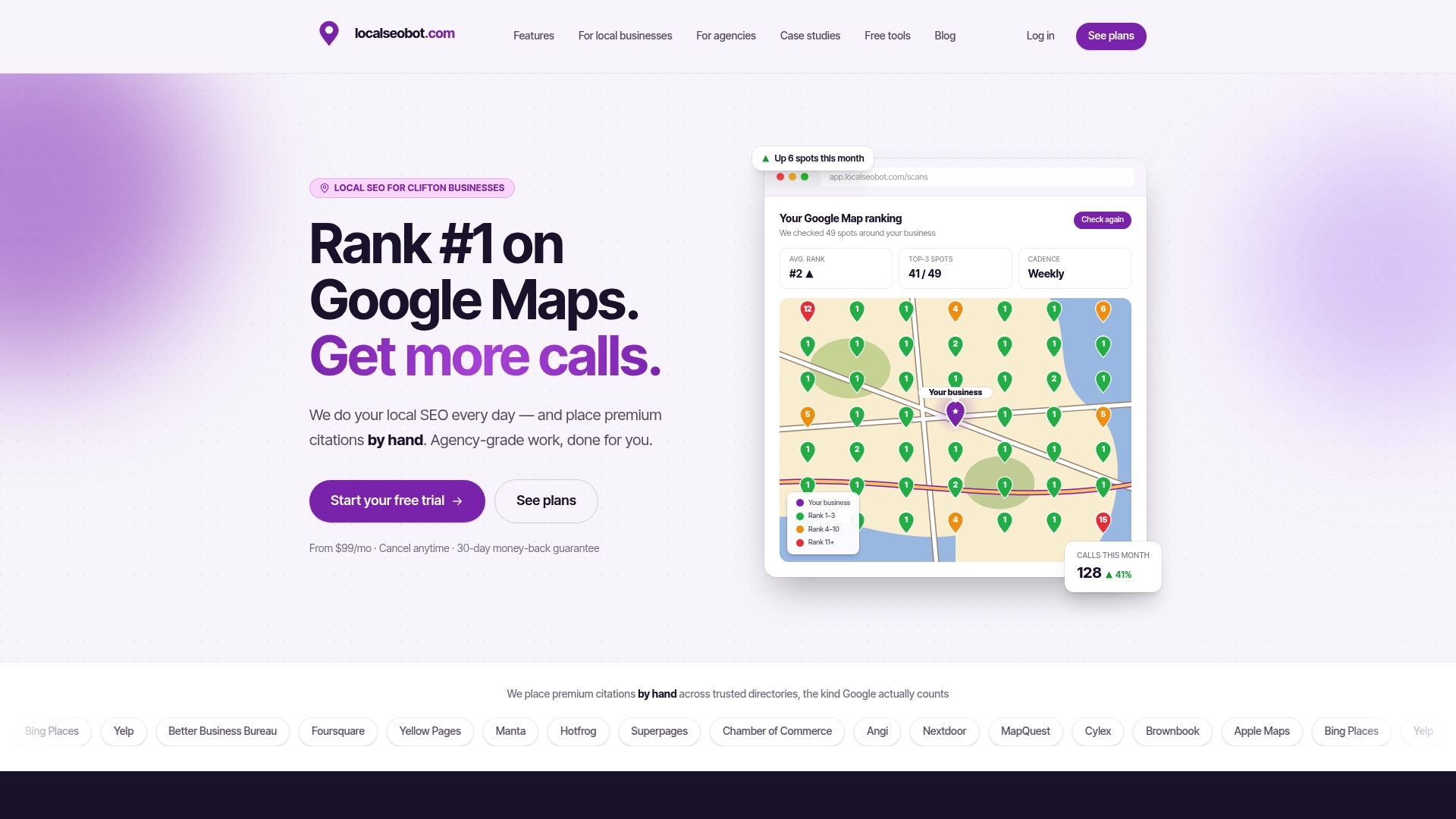
Every plan is built around the same idea: profile optimization, posting, review handling and grid-based rank tracking handled for you, with hand-built citations behind it. See how it fits your business through our Google Maps SEO service, or start from the Local SEO Bot homepage.
A simple 30-day plan
If you want to act on this today, here is a sequence that fits into a month.
- Week 1: run a grid scan for your top service and note your green zone and gaps. Audit your profile and fix categories, services and name.
- Week 2: check citation consistency and correct mismatches. Start answering every review, new and old.
- Week 3: publish one location page for the highest-value area outside your green zone, written with real local detail.
- Week 4: post to your profile, add fresh photos, ask recent customers for reviews and run the grid again to compare.
Repeat the cycle. Small gains in the grid add up, and you will see which areas respond to which effort.
FAQ
When was the Google Vicinity update?
It rolled out from November 30 to December 8, 2021. Google confirmed a local search update during that window and described it as a rebalancing of factors, and Joy Hawkins gave it the Vicinity name. You can read the details in Search Engine Roundtable’s report.
Did the Vicinity update make proximity the only factor?
No. Google’s official guidance still names relevance, distance and prominence as the main factors. Proximity appeared to carry more weight after the update, but profile quality, reviews and prominence still decide who ranks first among nearby businesses.
Can I rank across my whole city from one location?
For a few searches, yes. For most competitive ones, you should expect strong visibility close to your address and weaker visibility farther out. A grid scan shows exactly where that edge falls for your business, and location pages, reviews and citations help push it outward.
Should I put keywords in my business name?
No. Practitioners reported that name keywords seemed to lose impact after Vicinity, and Google asks that your profile name reflect your real-world name. Use your actual name and put your services in the categories, services list and description instead.
Sources
- Google November 2021 Local Search Update Confirmed, Search Engine Roundtable
- Tips to improve your local ranking on Google, Google Business Profile Help
- Local SEO visibility lessons, BabyLoveGrowth