3 Official Maps Ranking Factors Small Businesses Can Fix in 2–4 Weeks
Published September 12, 2026
3 Official Maps Ranking Factors Small Businesses Can Fix in 2–4 Weeks

Google ranks map results on three official factors: relevance, distance, and prominence. Most businesses will get more traction from building prominence, meaning reviews, citations, and local links, once their Business Profile is fully accurate. The first move for any owner reading this: pull up your Google Business Profile right now and check that your category, hours, and address are correct. Everything else builds on that foundation.
TL;DR:
- Prominence, which is heavily influenced by reviews, citations, and backlinks, offers the most potential for small business improvements over time.
- Ensuring your Business Profile details—category, hours, address, and consistency across directories—are accurate and complete is the foundational step for ranking.
- Building a steady stream of genuine reviews and fixing citation inconsistencies should be prioritized before pursuing more advanced or risky tactics.
- Measuring progress with geo-grid testing and visibility scores provides a reliable way to track ranking improvements, rather than relying on single-location searches.
- Quick hacks like keyword stuffing or fake reviews are ineffective and risk account suspension, emphasizing the importance of organic, well-sequenced optimization efforts.
Table of Contents
- The 3 Maps Ranking Factors Google Actually Confirms
- Which Signals Actually Feed Relevance, Distance, and Prominence?
- What Should You Fix First? A Prioritized Action Plan
- How Do You Measure Whether Your Map Ranking Is Improving?
- Which Maps SEO Tactics Are Myths or Risky Hacks?
- How Localseobot’s Toolset Maps to This Plan
- What This Article Gets Right That Most Advice Misses
- Get Your Maps Visibility Measured, Not Guessed At
- Sources
- FAQ
The 3 Maps Ranking Factors Google Actually Confirms
Forget the long lists of “200 ranking signals” you see floating around marketing blogs. Google itself only names three official factors behind local ranking: relevance, distance, and prominence. Every signal you have ever heard about, from review count to backlinks, sorts into one of those three buckets. Understanding the buckets matters more than memorizing a signal list, because it tells you where your time actually pays off.
Relevance measures how well your Business Profile matches what someone typed into the search bar. Google pulls this from your primary category, secondary categories, business description, services list, product list, attributes (things like “wheelchair accessible” or “outdoor seating”), and the words on your website. A plumber who lists “emergency plumbing repair” as a service and mirrors that phrase on a dedicated website page is more relevant to that search than one who just picked “Plumber” as a category and stopped there.
Distance measures how far your business sits from the location implied by the search, whether that is a typed city name or the searcher’s actual GPS position. This is the one factor you cannot directly manipulate. You cannot move your storefront to rank for a neighborhood three miles away, and you should be suspicious of anyone who tells you they can “fix” distance with a trick. The only legitimate remediation is opening a second, genuinely staffed location, or in some cases running geo-targeted ads to reach searchers outside your organic distance radius.
Prominence measures how well known and how well regarded your business is, both on Google and across the wider web. This is where reviews, citations, and links come in, and it is the factor with the most room for a small business to actually move the needle over time.
Here’s how the three factors typically show up in practice:
- Relevance shows up as category accuracy, service/product list completeness, and keyword alignment between your profile and your website.
- Distance shows up as your physical proximity to the searcher or the searched location, adjusted by Google’s confidence in your listed address.
- Prominence shows up as review volume and quality, citation consistency, local backlinks, and general brand recognition online.
Architecture reporting on how Google Maps actually works confirms this isn’t one tidy formula behind the scenes. Multiple systems, including a canonical business database called Geostore and a ranking system reportedly nicknamed Oyster Rank, feed into what you see in the results. That is precisely why single-point rank checks and one-off “hacks” so often fail. You are not gaming one algorithm. You are trying to align your business’s identity across dozens of inputs that multiple systems cross-reference.
Which Signals Actually Feed Relevance, Distance, and Prominence?
Once you know the three factors, the next question is which specific, checkable items on your profile and website actually move them. Here is the breakdown by category.
Google Business Profile completeness drives relevance directly. Your primary category carries the most weight, so pick the narrowest accurate option rather than a broad catch-all. Secondary categories add nuance but should never contradict what you actually do. Beyond categories, Google looks at:
- Services and products lists, filled out with specific, searchable names rather than vague labels
- Business attributes relevant to your industry (accessibility, payment options, amenities)
- Accurate hours, including holiday hours, since mismatches erode trust signals
- Recent, geotagged photos that reinforce what the listing claims
Review mechanics drive prominence more than almost anything else a small business controls. Count matters, but so does velocity (are new reviews arriving steadily, or did you get twelve in one week three years ago and nothing since), recency, average rating, and whether review text naturally mentions your services or location. Reviewer diversity matters too. A wall of five-star reviews posted the same week, from accounts with no other review history, reads as suspicious to both Google’s filters and to a skeptical customer.
Citations and NAP consistency (your name, address, and phone number appearing identically across directories) are a prominence signal Google treats as a trust check. When your listed phone number on Yelp does not match the one on your website footer, that inconsistency introduces doubt into the exact system that is trying to confirm you are real. A citation consistency check across your top directories is one of the fastest ways to catch this.

Local backlinks and editorial mentions carry more weight than bulk directory submissions. A mention in a local news write-up or a link from a chamber of commerce page tells Google something a generic directory listing cannot: that a real local entity considers you worth referencing.
On-site signals matter too, though they are the most overlooked. Dedicated location pages, structured data (schema markup) that matches your Business Profile exactly, and landing pages that speak directly to the services you list all reinforce relevance.
Behavioral signals, meaning clicks, calls, and direction requests generated from your listing, appear to function as an inferred quality signal, rewarding listings that searchers actually engage with once they see them.
Pro Tip: Before touching anything else, run your business name through five directories by hand and compare the phone number field character by character. Inconsistent formatting (a missing area code, “Street” versus “St.”) is the single most common, most fixable prominence problem.
What Should You Fix First? A Prioritized Action Plan
Not every fix pays off on the same timeline, and treating a two-year link-building push with the same urgency as a five-minute profile edit wastes your limited hours. Here is how to sequence the work.
- Verify your profile and correct any inaccurate NAP data. This takes under an hour and removes the trust penalty that inconsistent information creates.
- Set your primary category with precision, and add every relevant secondary category that genuinely applies. Fifteen minutes, done.
- Upload current, geotagged photos covering your storefront, team, and products. Do this monthly, not once.
- Respond to every recent review, especially anything from the last 90 days. This is fast, and unanswered negative reviews sitting in your queue signal neglect.
- Clean up your top 10 to 20 citations for consistency. This takes longer, often a few weeks if you are doing it manually across directories with different submission processes.
- Build a steady review-generation habit rather than a one-time push. Aim for a predictable trickle, not a spike.
- Fill out your complete services and products lists, and start using the Q&A section on your profile to preemptively answer what customers actually ask.
- Pursue local editorial links and mentions through sponsorships, local news, and community involvement. This is a multi-month project with no shortcuts.
- Align your website content to match your Business Profile’s entity, using the same service names, same location language, and consistent schema markup.
Industry research backs the sequencing logic here. Practitioner surveys compiled by Moz’s overview of local ranking factors consistently show reviews and Business Profile completeness sitting among the most actionable levers available to a small business, ahead of harder-to-earn signals like high-authority backlinks.
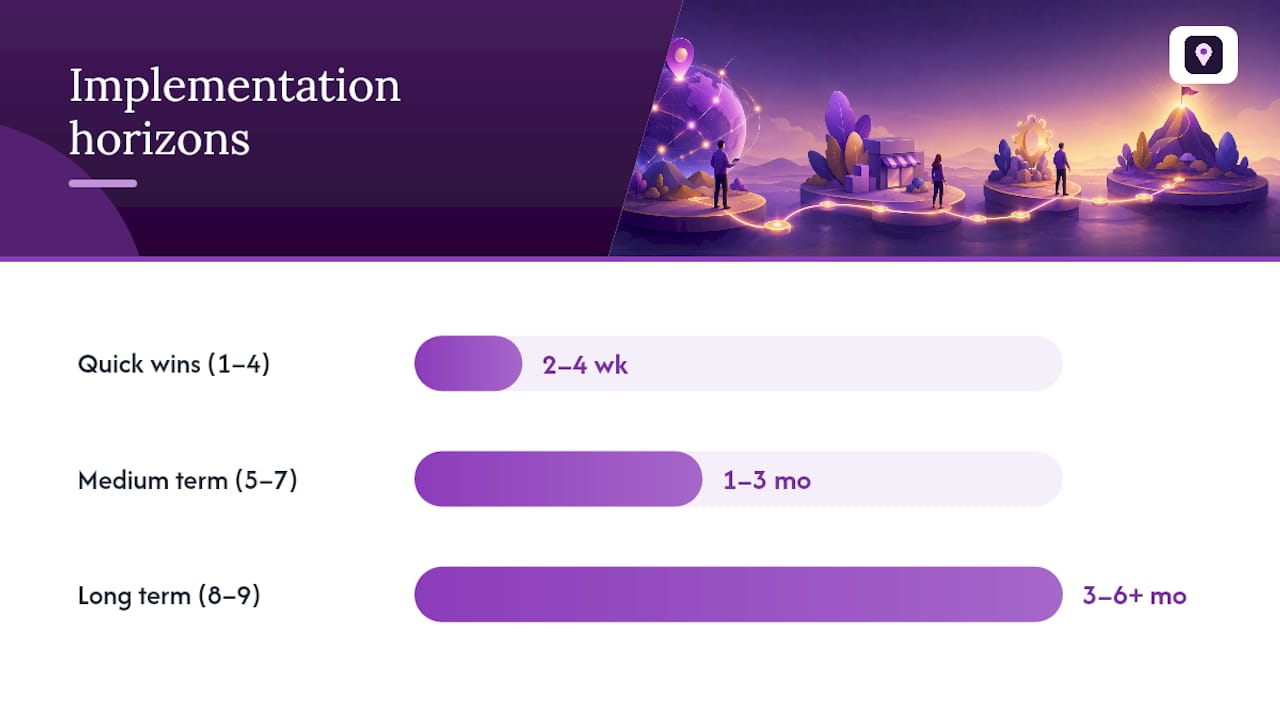
Quick wins (items 1 through 4) typically show some movement within two to four weeks. Medium-term work (items 5 through 7) tends to take one to three months before it visibly shifts your position. Long-term investments (items 8 and 9) often take three to six months or longer, but they build a durable advantage that citation spam and quick hacks never will. If you want a shortcut to knowing where you stand before committing to any of this, a Google Business Profile optimization pass is the natural starting point.
How Do You Measure Whether Your Map Ranking Is Improving?
Checking your rank from your own laptop tells you almost nothing useful, because Google localizes results to your exact position. You might rank third from your office and eighth from a neighborhood four miles away, and a single search tells you neither.
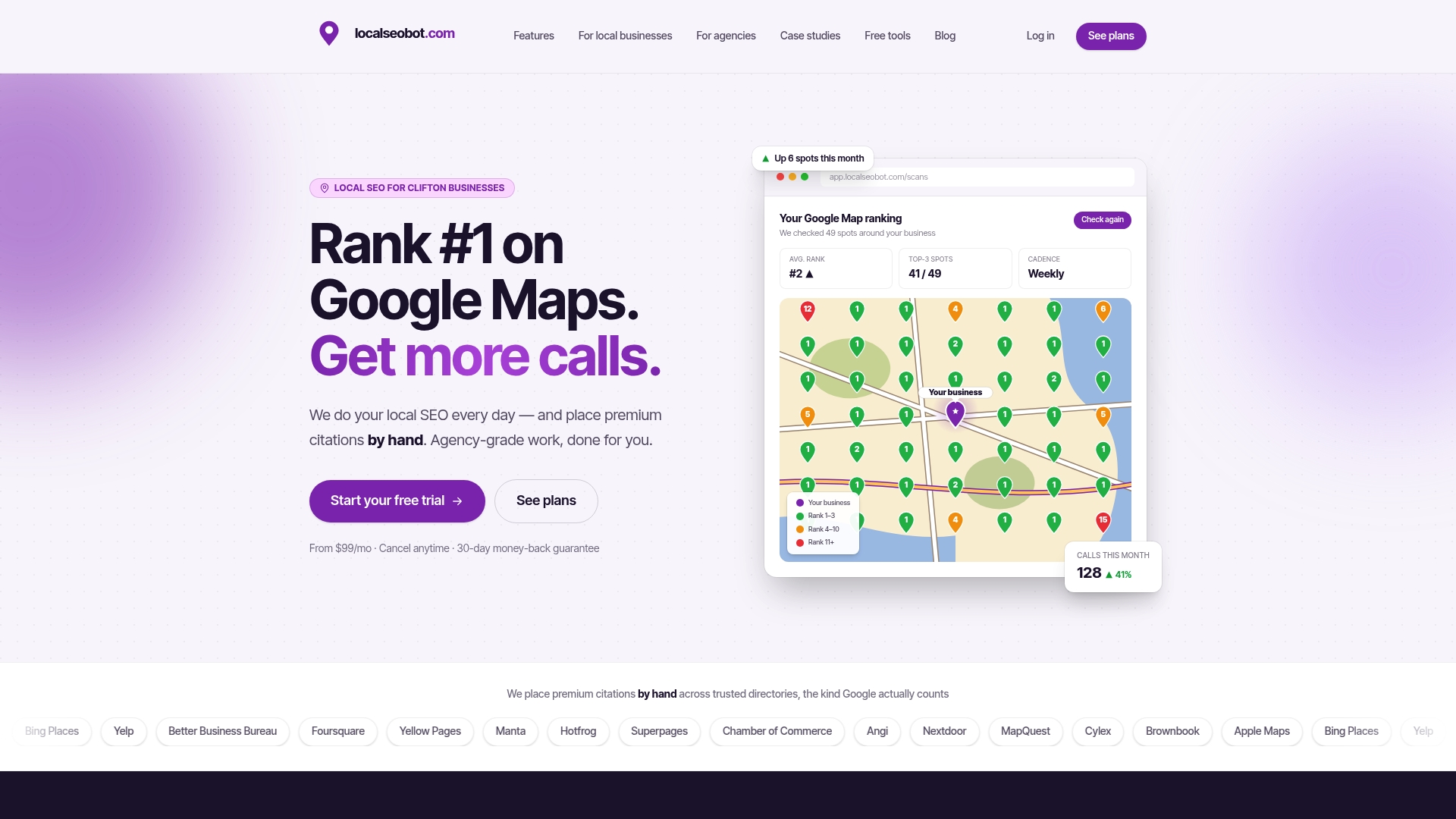
Geo-grid testing solves this. It queries your target keywords from a grid of coordinates spread across your service area, then aggregates the results into a visibility score. A practical setup for most local businesses uses a grid of 9 to 25 points across the city or neighborhood you serve, run at multiple times of day, since ranking can shift with time and query context.
Track these metrics over each testing cycle:
- Rank at each individual coordinate, not just an average
- Overall visibility score across the full grid
- Review growth rate month over month
- Direction requests and call clicks reported in your profile insights
For cadence, run a full grid test monthly at minimum, and weekly if you are actively working through a citation cleanup or review campaign and want to catch changes fast.
| Test type | What it reveals | Recommended frequency |
|---|---|---|
| Geo-grid scan (9 to 25 points) | Rank variation by micro-location | Monthly, weekly during active campaigns |
| Rank tracker (single or few keywords) | Trend over time for core terms | Weekly |
| Visibility score aggregation | Overall map presence relative to competitors | Monthly |
When you see an anomaly, a sudden drop at three coordinates but not the rest, check for a recent profile edit, a competitor’s new listing, or a review cluster before assuming an algorithm update caused it. A visibility score calculator can give you a fast baseline if you have never run a formal test before.
Which Maps SEO Tactics Are Myths or Risky Hacks?
Bad advice about map rankings spreads fast because some of it sounds plausible. Here is what does not work, and often backfires.
- Stuffing keywords into your business name (“Joe’s Plumbing - Emergency 24/7 Best Plumber Near Me”) violates Google’s guidelines outright. Google explicitly states there is no way to pay or trick your way into a better position, and misrepresenting your business risks suspension, not a ranking boost.
- Fake or incentivized reviews get filtered by Google’s detection systems more often than owners expect, and a pattern of suspicious reviews can trigger a manual review of your entire profile.
- Mass directory submissions to low-authority sites add citation noise without adding prominence. Ten listings on authoritative, relevant directories outperform two hundred on sites nobody trusts.
- Photos and Google Posts alone will not close a real gap in reviews or citation consistency. They help relevance and engagement, but they cannot substitute for the prominence work underneath.
The pattern across all four: manipulating the wrapper without fixing the substance underneath either does nothing or actively damages the account.
How Localseobot’s Toolset Maps to This Plan
Everything in this action plan requires actual execution, not just knowledge of what to do. That gap is where most small business owners get stuck, and it is the reason Localseobot exists as a practitioner-built toolset rather than a generic dashboard.
Manual premium citation building addresses the “authoritative directories over volume” point directly. Rather than blasting your NAP data to two hundred low-value sites, the work goes into high-authority directories where the citation actually carries prominence weight.
Geo-grid rank tracking answers the measurement question raised earlier. Instead of guessing whether last month’s review push moved anything, a geo-grid report shows rank change across the coordinates that actually matter to your service area.
The visibility score calculator gives you the same baseline metric described in the measurement section, aggregated into one number you can track over time instead of a scattered set of single searches.
Because ranking improvement is never guaranteed by any legitimate provider, some companies back their work with a 30-day money-back guarantee if a business does not see a ranking increase. If you have made it this far and still are not sure where your profile stands, a visibility audit is the logical next step before you invest another hour guessing.
What This Article Gets Right That Most Advice Misses
Most local SEO content treats the three official factors as trivia, then pivots immediately to a generic checklist that ignores sequencing entirely. That is backwards. Relevance and prominence are not equally urgent for every business. A brand-new listing with zero reviews needs prominence work far more urgently than it needs a tenth secondary category added.
The conventional advice oversells quick fixes and undersells measurement. Owners chase individual tactics, a burst of reviews here, a photo upload there, without ever checking whether their visibility score actually moved. Geo-grid testing exists precisely because Google’s multi-system architecture makes single-point checks unreliable, yet most businesses never test beyond their own office.
If there is one place to start, it is verifying your Business Profile is accurate, then building a real citation and review baseline before chasing anything more advanced. Everything downstream depends on that foundation being solid first.
— Local
Get Your Maps Visibility Measured, Not Guessed At
Localseobot exists for exactly the gap this article keeps circling back to: knowing the three ranking factors is only useful once you can act on them and measure the result. The visibility score calculator gives you a real baseline instead of a guess, showing where your profile stands before you spend another hour on citations or reviews.
If you would rather hand off the execution entirely, the Google Maps SEO service covers manual premium citation building on high-authority directories, ongoing profile optimization, and review generation, backed by a 30-day money-back guarantee if your ranking does not improve. Manual citation work means checking that your listing on each directory matches, rather than using automated scripts to submit your data broadly. Run your visibility score first, then decide whether you want to do the fixes yourself or have Localseobot handle the citation and tracking work for you.
Sources
- Tips to improve your local ranking on Google - Google Business Profile Help
- Inside Google Maps: 72 ranking signals and the architecture behind local search - Search Engine Land
- Local Search Ranking Factors - What Are They? - Moz
FAQ
What Are the Top 3 Maps Ranking Factors?
Google names relevance, distance, and prominence as its three official local ranking factors, with prominence (built from reviews, citations, and links) offering the most room for improvement for most small businesses.
What Is the 80/20 Rule for Local SEO?
There is no official Google statistic behind this, but in practice, a large share of ranking movement for most businesses comes from a small set of actions: a complete and accurate Business Profile plus steady, genuine review generation.
How Can I Increase My Google Maps Ranking?
Start by verifying your Business Profile for accuracy, correcting any NAP inconsistencies across directories, and building a steady flow of genuine reviews, then track progress with geo-grid testing rather than a single search from your own location.
Are Google Maps Ranking Factors the Same in Every Category?
No. Industry surveys note that signal weighting varies by market and business category, so a restaurant and a law firm won’t see identical results from the same fixes, even though the same three official factors apply to both.
Does Localseobot Guarantee a Ranking Improvement?
Some services offer a 30-day money-back guarantee tied to seeing a ranking increase, reflecting confidence in their manual citation and profile optimization approach.