Service Businesses: Scale Service Area Pages Without Doorway Penalties
Published October 3, 2026
Service Businesses: Scale Service Area Pages Without Doorway Penalties

If your business serves customers at their location rather than a storefront, you need service area pages: they tell Google and your customers exactly which cities and neighborhoods you cover, and they consistently outperform a single generic “areas we serve” list for local visibility.
TL;DR:
- Service area pages should include unique local proof, specific service details, and geographically relevant content to avoid being seen as doorway pages.
- A maximum of 20 service areas per Google Business Profile is recommended, with areas within roughly a two-hour drive to stay effective and compliant.
- To scale without penalties, vary proof points and landmarks on each page, and link internally to establish site authority for multiple city-specific pages.
- Proper setup of NAP data, schema markup, and consistent listings across directories support local SEO performance and trust signals.
- Outsourcing management becomes more efficient when covering more than five service areas to handle citation updates, rank tracking, and profile optimization.
Table of Contents
- What are service area pages (SAPs)?
- Service area pages vs. location (storefront) pages
- Why service area pages matter for local SEO
- Must-have elements for an effective service area page
- Technical setup: Google Business Profile, schema, and listings
- Doorway risk and scale: how to create many SAPs without triggering penalties
- Examples and quick templates you can adapt
- Practitioner perspective and proof from Local SEO Bot
- When to DIY vs. when to hire an expert
- How Local SEO Bot can help you manage service area pages
- FAQ
- Sources
What are service area pages (SAPs)?
A service area page is a dedicated page built around one service and one geographic market, like “emergency plumbing in Riverside” or “house cleaning near Dayton.” You’ll also see them called area pages, city pages, or “areas we serve” pages, but they all do the same job: pairing what you do with where you do it.
SAPs exist because plenty of businesses never let customers through the front door. A mobile locksmith, a roofing crew, a traveling pet groomer: none of them have a storefront worth showcasing, so a page about their physical address would be useless to searchers. Instead, the page needs to prove the business actually works in that town.
Typical use cases include:
- Home service trades like HVAC, plumbing, electrical, and pest control that travel to job sites.
- Mobile professionals such as dog trainers, tutors, and personal trainers who serve clients at home or nearby.
- Cleaning and maintenance companies covering a metro area with no public-facing office.
- Multi-location franchises that need one page per branch’s coverage zone.
Each of these pages works best when it reads like it was written for that specific place, not copied from a template and renamed.
Service area pages vs. location (storefront) pages
A location page describes a physical place customers can visit: an office, a showroom, a clinic. An SAP describes a zone the business travels to. The intent behind each differs too. Someone searching “dentist near me” expects an address; someone searching “gutter cleaning in Tempe” expects a company that will show up at their house.

Google treats these as separate business types. According to Google’s guidelines for representing your business, a storefront business gets one profile tied to its visible address, while a service-area business should generally hide that address and list the regions it covers instead. Hybrid businesses, meaning those with both a public storefront and a travel radius, can show both at once, according to Google’s guidance on service-area and hybrid businesses.
A few practical rules follow from this:
- Keep a storefront page if customers can walk in or you want foot traffic from local searches.
- Use SAPs when you travel to customers and a visible address would mislead or confuse them.
- For hybrid setups, publish one storefront page plus separate SAPs for the outlying areas you serve.
Why service area pages matter for local SEO
A single homepage can realistically target one or two geographic terms before the copy turns generic and stops ranking for either one. SAPs solve that by giving each city or ZIP code its own dedicated page, which multiplies the number of local queries you can compete for without diluting any one page’s relevance.
They also feed Maps visibility. Google’s local algorithm weighs relevance, distance, and prominence, and a page built specifically around a service and a place gives clearer relevance signals than a vague “serving the tri-county area” sentence buried on your homepage.
There’s a conversion angle too. A visitor who searches “water heater repair in Normal” and lands on a page that mentions Normal by name, references nearby streets or neighborhoods, and shows local reviews trusts that business faster than one that reads like boilerplate. Specificity reads as competence, and competence gets the phone call.
Must-have elements for an effective service area page
A service area page earns its ranking by proving two things at once: that you serve this specific place, and that you’re worth hiring once you get found. Here’s what belongs on every page:
- A geo-specific headline and opening line that name the city or neighborhood in the first sentence, not buried three paragraphs down.
- An explicit service list so visitors and search engines both know exactly what you do in that area, not just that you “serve” it.
- Local proof, whether that’s a review mentioning the neighborhood, a completed job example, or a note about how long you’ve worked in that market.
- Accurate NAP details (name, address, phone) that match your Google Business Profile and other listings exactly, down to abbreviations and suite numbers.
- Structured data using the Schema, which give search engines a machine-readable way to confirm your business name, service area, and the specific services offered on that page.
- A map embed showing the service zone or your base of operations, which helps both users and crawlers confirm geographic relevance.
- Conversion elements like a click-to-call button, a booking link, and a CTA that references the local area rather than a generic “contact us.”
The hardest part of scaling SAPs is avoiding near-duplicate content. If your Riverside page and your Fontana page differ only by city name, you’re building thin pages that will eventually get filtered out or suppressed. Vary the proof points, reference different neighborhoods or landmarks, and let service details shift based on what that market actually needs (a page targeting a coastal town might mention salt-air corrosion for HVAC work; an inland suburb wouldn’t).
Pro Tip: Write the local proof paragraph first for each page. If you can’t find anything specific to say about that city, you probably shouldn’t be targeting it yet.
Tools that check listing accuracy, like a local citation finder, can help confirm your NAP data stays consistent before you publish a new batch of pages.
Technical setup: Google Business Profile, schema, and listings
Getting the technical foundation right matters as much as the page copy. Start with your Google Business Profile.
- Set your service area under the business profile’s service area settings and hide your street address if you don’t serve walk-in customers, per Google’s business representation guidelines.
- Specify areas by city, postal code, or named region. Google Business Profile does not allow a freeform radius around your pin, according to discussion in Google’s Business Profile community.
- Stay within the platform’s cap: a maximum of 20 service areas per location, confirmed in that same Google Business Profile community guidance. Beyond 20, you’ll need a second profile or location.
- Keep those areas within roughly a two-hour drive of your business base; Google’s own guidance on representing your business states service-area boundaries shouldn’t extend much farther than that.
For schema markup, add LocalBusiness as your base type and a Service entry for each distinct offering, including the service area and contact details directly in the markup. A Google Business Profile optimizer can help you audit whether your profile settings and on-page markup actually agree with each other.
If you manage listings through a platform like Yext, add service areas at the entity level and favor named cities with state names over vague regions. Yext’s documentation notes that some directories, including Bing, accept city-based service areas and that hiding your address is an option across most listing platforms, which makes consistency between your website, GBP, and third-party listings worth checking regularly.
Doorway risk and scale: how to create many SAPs without triggering penalties
Google has warned for years about doorway pages: pages built solely to rank for a city or region, with content that’s otherwise nearly identical to dozens of sister pages. Google’s own developer guidance on doorway pages describes exactly this pattern as something to avoid, and it’s the single biggest risk when scaling SAPs past a handful of cities.
A few practices keep you on the right side of that line:
- Write a real quality checklist per page: unique local proof, specific service details, and a reason a visitor from that city should trust you, not just a renamed template.
- Template the structure, not the substance. Keep your headline format, layout, and schema consistent, but swap in local landmarks, specific services relevant to that climate or region, and distinct review excerpts.
- Build internal links deliberately from your homepage, service pages, and a central “areas we serve” hub page, so crawlers and users can find every SAP without relying on thin cross-links between city pages alone.
- Consolidate low-traffic pages. If a city page gets no search volume after several months, merge it into a broader regional page instead of letting it sit as duplicate-feeling filler.
Search Engine Land’s guide to service area pages echoes this balance directly: template for structure, but never skip the unique local details, proof points, and specifics that separate a real page from a doorway.
Agencies managing SAPs across many clients face this scale problem constantly, and resources on implementing location pages at scale for agencies cover the architecture decisions in more depth.
Examples and quick templates you can adapt
A single-service SAP for a plumber might follow this shape: headline naming the city and service, a two-sentence intro referencing a local detail (older housing stock, hard water, whatever’s relevant), a bulleted service list, a short local review, and a click-to-call CTA.
A multi-service SAP for a cleaning company would add a short services grid (residential, move-out, deep clean) before the proof section, since visitors need to confirm you offer their specific service before they care where you’re located.
Useful micro-copy to adapt:
- Headline: “[Service] in [City]: Same-Day Appointments Available”
- Intro line: “We’ve handled [specific local detail] for homes across [City] since [timeframe].”
- CTA: “Call now for a free [City] estimate.”
- FAQ prompt: “Do you serve [neighborhood] or [nearby suburb]?”
Vary the local detail, the proof source, and the FAQ question on every page so no two cities read like copies of each other.
Practitioner perspective and proof from Local SEO Bot
Everything in this guide lines up with how we approach local SEO day to day. We build citations manually on premium, high-authority directories rather than relying on automated blasts, because consistent NAP data across listings is one of the quieter factors that determines whether your SAPs get trusted. We also track rankings with Maprank’s geo-grid system, which shows how a page actually performs across a spread of points inside a service area rather than a single averaged position.
That combination matters because the technical steps in this guide only pay off if you can see whether they’re working: citation consistency supports the trust signals your pages need, and geo-grid tracking shows whether your service area claims match what Google is actually surfacing in each part of that zone.
— Local
When to DIY vs. when to hire an expert
If you cover two or three cities and have time to write genuinely local content for each, DIY is reasonable. Past five or six service areas, or once GBP setup, citation cleanup, and rank tracking start eating hours you don’t have, outsourcing usually pays for itself faster than the learning curve would. Citation audits and geo-grid tracking in particular are tedious enough that most owners hand them off first, often through a local SEO agency once the page count grows beyond what a solo owner can maintain.
How Local SEO Bot can help you manage service area pages
Once you’re running SAPs across more than a few cities, the manual upkeep (citation consistency, GBP service area settings, and tracking whether each page actually ranks where it claims to) becomes the real bottleneck, not the writing. That’s the part we built our service around.
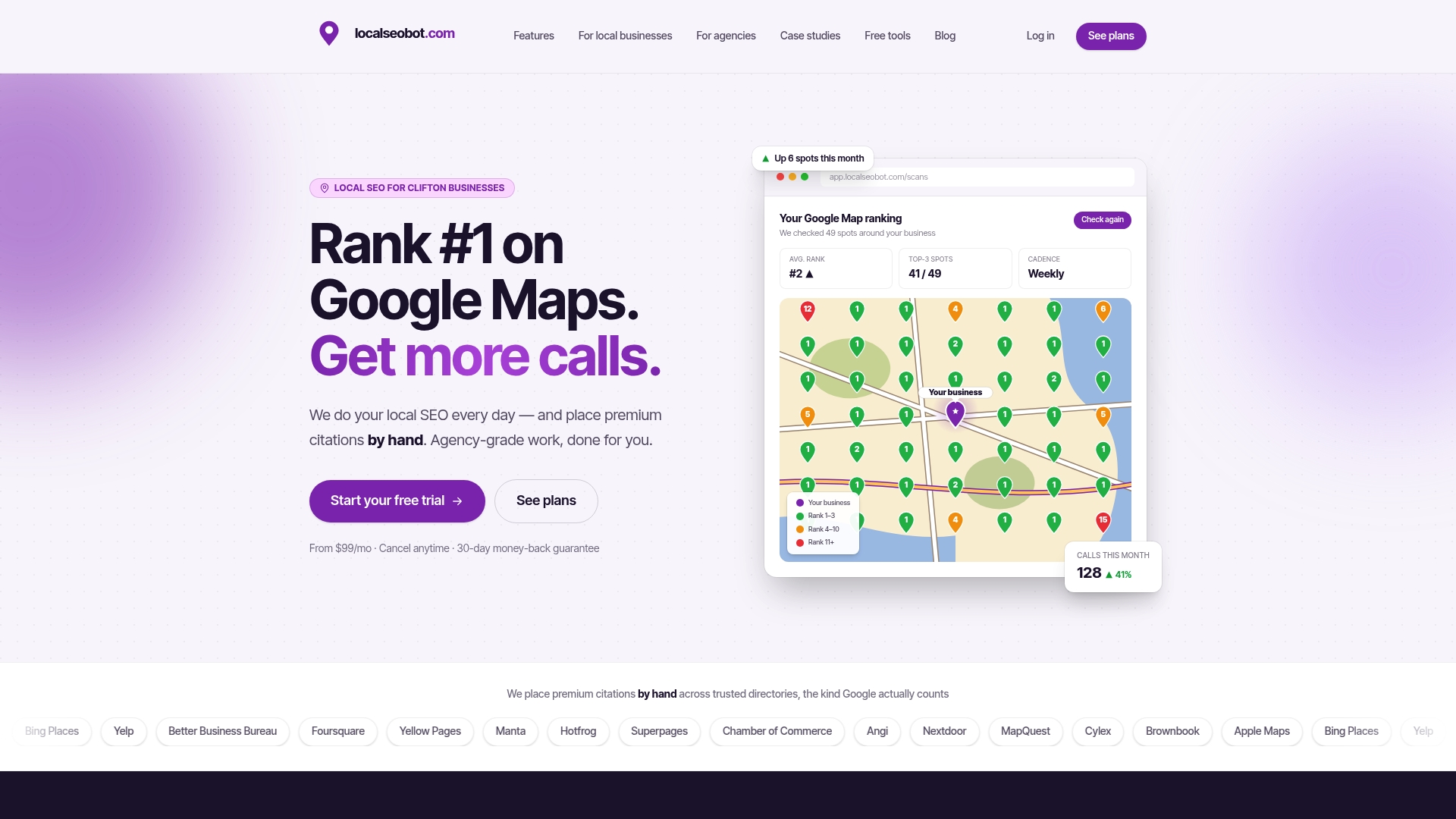
We focus on building premium citations manually across high-authority directories to help keep your NAP data consistent across listings. Maprank tracks rankings with geo-grid scans, so you can see how each city or ZIP page performs rather than relying on an averaged position. If rankings don’t improve, the work is supported by a money-back guarantee period.
Plans start with Foundation at $99 per month per location, with Growth at $199 per month for businesses managing more service areas, and agencies can review Pro at $399 per month per location for white-label management across client accounts. Check Maprank directly if geo-grid tracking is the piece you need most right now.
FAQ
What are service area pages?
Service area pages are website pages built around one service and one specific city, neighborhood, or ZIP code, designed for businesses that travel to customers rather than operate a storefront. They help search engines and visitors confirm that a business actually covers a given location.
What should a service page include?
A strong service area page needs a geo-specific headline, an explicit list of services offered in that location, local proof such as reviews or completed jobs, accurate NAP details, and LocalBusiness and Service schema markup. It should also include a clear local call to action, like a click-to-call button or a booking link.
What is an example of a service area?
A service area is typically a city, a cluster of ZIP codes, or a defined region around a business’s base of operations, such as “serving Riverside, Corona, and Moreno Valley.” Google Business Profile caps this at a maximum of 20 service areas per location and recommends staying within roughly a two-hour drive of your base.
What is the 80/20 rule of SEO?
In SEO, a small share of pages, keywords, or fixes often drive most of the ranking and traffic gains, so prioritizing the highest-impact service areas or pages matters more than covering every possible city at once. Definitions vary by practitioner, so treat it as a prioritization principle rather than a fixed formula.
Do service area pages cause duplicate content issues?
They can, if each page only swaps out the city name and leaves the rest of the copy identical, which Google’s doorway page guidance specifically warns against. Avoiding this means adding unique local proof, varied service details, and distinct examples to every page you publish.
Sources
- Guidelines for representing your business on Google - Google Business Profile Help
- Schema
- Service Area Pages: Boost Local SEO Across Locations - Search Engine Land