30–90 Day Manual Yelp Listing Optimization for Local Businesses
Published September 9, 2026
30–90 Day Manual Yelp Listing Optimization for Local Businesses

The fastest way to lift Google Maps visibility is to pick one canonical NAP (name, address, phone), complete and verify your Google Business Profile, then execute a disciplined, manual Tier 1 and vertical citation build. Yelp listing optimization plays a supporting role in that build, not the lead. Most businesses see measurable Map Pack movement within 30 to 90 days once the foundation is clean, and manual premium citation work consistently outperforms bulk automated submissions when done carefully.
TL;DR:
- Most local SEO success relies on a consistent, verified canonical NAP across Google, Yelp, and key directories, not on bulk automation.
- Manual, selective citation building targeting Tier 1 and vertical sources delivers noticeable Map Pack improvements within 30 to 90 days.
- Regular monthly audits focused on top listings prevent citation drift and duplicate profiles that harm search rankings.
- Optimizing Yelp fields such as categories, photos, and business attributes enhances local visibility beyond basic NAP information.
- Positive Yelp reviews and engagement signals contribute to broader trust signals, but incentivized reviews and bulk submissions can cause long-term ranking harm.
Table of Contents
- What Does Yelp Listing Optimization Actually Fix?
- A 60 to 90 Day Manual Citation Build Plan
- Google Business Profile: The Anchor of Your Citation Strategy
- How Often Should You Audit Your Listings?
- Should You Build Citations Manually or Automate Them?
- Why Bulk Submissions Wreck Your NAP Consistency
- Optimizing Yelp Fields Beyond Your Basic NAP
- Do Yelp Reviews Actually Influence Local Rankings?
- How Do You Get More Authentic Yelp Reviews Without Breaking the Rules?
- Are Yelp Ads and Yelp Deals Worth the Spend?
- Making Yelp Part of a Consistent Citation System
- Local SEO Bot’s Take: What Actually Moves the Needle
- Get a Free Audit and See Where Your Citations Stand
- Sources
What Does Yelp Listing Optimization Actually Fix?
Yelp listing optimization means treating your Yelp profile as one high-authority citation in a coordinated local SEO system, not as a standalone marketing channel. The goal is consistency: the same business name, address, and phone number appearing on Yelp, your Google Business Profile, and every other directory that carries weight with local search algorithms. When those signals line up, Google’s local algorithm has less reason to doubt your business’s legitimacy.
That distinction matters because most small business owners approach Yelp backward. They chase reviews and ad spend before they’ve even confirmed their address is formatted the same way across five other directories. Fix the foundation first.
Run a citation and GBP audit in one week
Start with an inventory. You cannot fix what you haven’t found, and most businesses discover during this step that they have profiles they never claimed sitting live on the web.
- Search your business name plus city on Google to surface unclaimed or duplicate listings.
- Check Google Business Profile, Bing Places, and Apple Business Connect for claim status.
- Pull a citation report from a tool like the Local Citation Finder to see where you already exist.
- Cross-check every listing against your website’s schema markup for the address format it publishes.
- Flag any listing where the suite number, phone format, or business name spelling differs even slightly.
Before you touch a single directory, document one canonical NAP format and write it down. If your storefront is “Suite 4B,” don’t let half your citations say “Ste. 4B” and the other half say “#4B.” Pick one format, put it in a shared document, and treat it as the master reference for every submission that follows.
- Business name: Legal name only, no keywords stuffed in (“Riverside Dental” not “Riverside Dental Best Dentist Downtown”)
- Address: Match USPS abbreviation standards exactly (St., Ave., Ste.)
- Phone: Local number, never a call-tracking number
A Citation Consistency Analyzer speeds this audit up considerably, especially for multi-location businesses juggling dozens of listings at once. For a single location, a manual sweep across the top 15 to 20 directories takes most owners under a week.
A 60 to 90 Day Manual Citation Build Plan
Citations still move rankings in 2026, but the playbook has narrowed considerably. Bulk directory blasts that dump your business into 500 low-quality sites are largely wasted effort now. The modern approach prioritizes Tier 1 sources, vertical citations, and local directories in that specific order, and businesses that follow this narrower footprint typically see Map Pack movement within 30 to 90 days after a disciplined NAP cleanup.
Here’s the build order that produces results without wasting a submission:
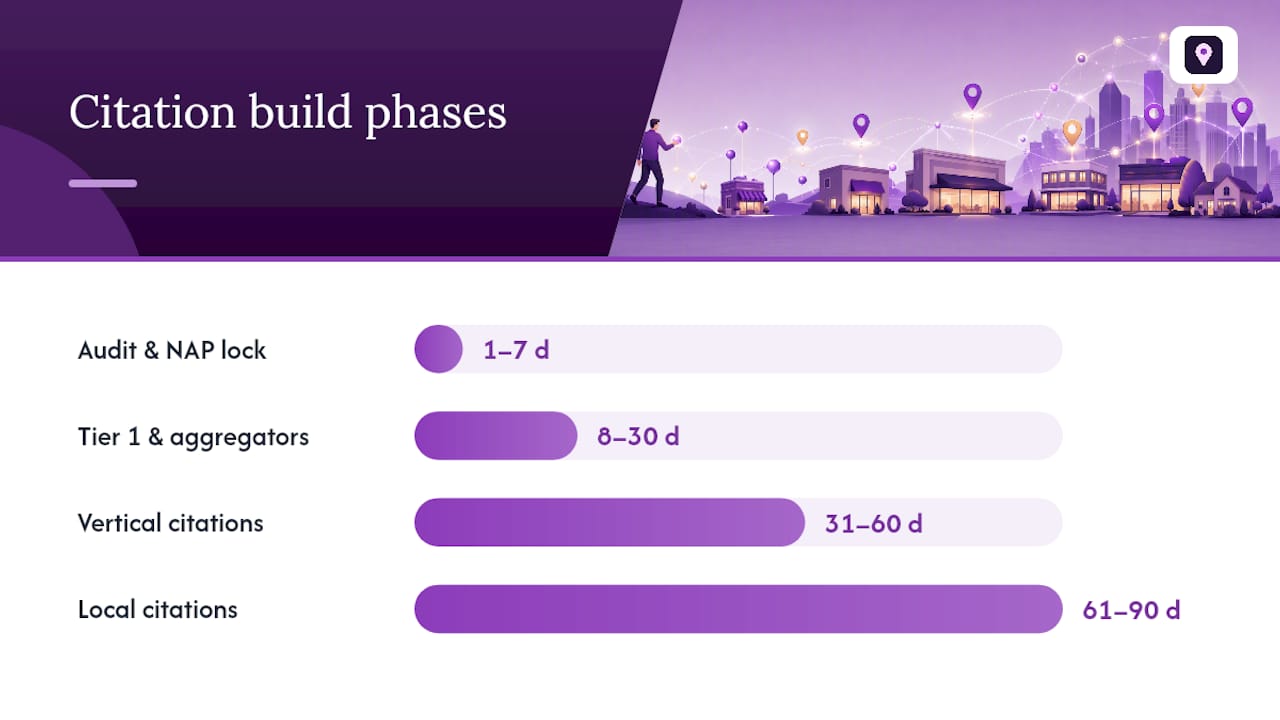
- Days 1 through 7: Finish your audit and lock the canonical NAP document.
- Days 8 through 30: Submit manually to Tier 1 platforms and major aggregators like Foursquare and Data Axle. These feed dozens of downstream directories, so errors here multiply.
- Days 31 through 60: Build 5 to 10 vertical citations specific to your industry (a contractor directory, a medical board listing, a restaurant guide).
- Days 61 through 90: Add local and geographic citations, including your chamber of commerce and city business associations.
- Ongoing: Run a monthly audit to catch drift and new duplicates.
This 90-day roadmap works because it front-loads the sources with the widest downstream reach and saves narrower, lower-volume listings for later, when your canonical NAP is already proven consistent.
Pace the work at a moderate number of manual high-value actions per week. For each submission, fill out every available field: exact business category, complete hours, your real website URL, and a canonical phone number, never a call-tracking line. Tracking numbers on public citations break NAP consistency and often cost more in ranking damage than they return in call attribution data.
Avoid two common mistakes. First, don’t pay for bulk 500+ directory packages. Second, don’t let a different team member submit the same listing twice with slightly different formatting. Both create duplicate and inconsistent listings that take months to unwind.
Pro Tip: Keep a single spreadsheet with every directory URL, submission date, and login credential. When you hit month three and need to verify a listing, you’ll thank yourself for not having to hunt through old email confirmations.
Google Business Profile: The Anchor of Your Citation Strategy
Every citation you build points back to one hub: your Google Business Profile. Google states plainly that complete, accurate profiles rank on relevance, distance, and prominence, and businesses with fully completed profiles generate more direction requests and website clicks than sparse ones. That single fact should reorder your priorities if GBP completion isn’t already at the top of your list.
Claim and verify ownership first if you haven’t. Then work through every field methodically:
- Match your business name, address, and phone exactly to your canonical NAP document.
- Choose the most precise primary category available, then add relevant secondary categories.
- Set service-area boundaries accurately if you don’t serve walk-in customers at a fixed address.
- Upload fresh photos monthly. Stale image libraries signal an inactive business to both users and the algorithm.
- Use GBP posts, product listings, and booking links whenever your business model supports them.
Reviews deserve their own discipline. Responding to every review within 24 to 48 hours signals to both customers and Google that the business is active and engaged. That window is tight enough to matter but loose enough that a solo owner can manage it without a dedicated staffer.
One warning: resist the temptation to stuff keywords into your legal business name field (“Denver Plumbing Repair Experts LLC” instead of “Ace Plumbing”). Google has flagged and suspended profiles for exactly this tactic, and it undermines the NAP consistency you just spent weeks building.
How Often Should You Audit Your Listings?
Monthly, at minimum, once your initial 90-day build is complete. Citations decay. Directories get acquired, merge their databases, or auto-generate duplicate listings from old data scrapes, and a NAP that was perfectly consistent in March can drift by June without anyone touching it.
A workable monthly checklist covers three things: recheck your top 25 listings for accuracy, run a duplicate detection sweep, and confirm core fields (hours, phone, category) still match your canonical document. Ongoing governance, not a one-time cleanup, is what keeps rankings from sliding back down after the initial push.
Assign one owner to this process, even in a small agency. Split ownership across two or three people and NAP drift creeps back in within a quarter.
When your monthly audit starts taking more than two or three hours, or you’re managing more than five locations, that’s the signal to move from a spreadsheet to dedicated tooling or a managed service.
Should You Build Citations Manually or Automate Them?
Manual work is non-negotiable for Tier 1 platforms and vertical listings. Each of these sites has unique verification quirks, custom fields, and submission logic that automated tools routinely misread, and manual Tier 1 submission is considered essential for quality control precisely because of that variability.
Automation earns its place further down the stack:
- Use manual submission exclusively for Tier 1 sources and your 5 to 10 vertical citations.
- Reserve automated tools for high-volume Tier 2 and Tier 3 directories, always with human quality-assurance review after submission.
- Run a hybrid sequence: manual first for the foundation, automated second for scale, human-checked third.
- Budget sufficient time per manual Tier 1 submission when fields and categories require research.
Pro Tip: If you’re evaluating a managed service, ask specifically how they handle Tier 1 submissions. A provider that automates everything, including your Google Business Profile and top aggregator listings, is optimizing for volume over accuracy.
Full automation without human review carries real risk: mismatched categories, truncated addresses, and duplicate profiles created by bots that can’t tell your business already exists under a slightly different name.
Why Bulk Submissions Wreck Your NAP Consistency
Bulk citation services that promise hundreds of directory placements for a flat fee are the single most common cause of NAP drift. Those services often auto-fill your business information into low-authority, rarely visited sites using scraped or outdated data, and once your name, address, and phone are wrong on 200 sites, correcting them becomes a much bigger job than the original build ever was.
The damage compounds in a specific way. Search engines cross-reference citation data to build confidence in your business’s legitimacy. When they encounter conflicting addresses or phone numbers across dozens of sources, that confidence score drops, even if your primary listings on Google and Yelp are perfectly accurate. Quantity does not offset inconsistency. Quality citations with consistent NAP correlate with stronger local rankings, while a scattered footprint of mismatched data actively works against you.
Prevent drift with three habits. First, maintain that single canonical NAP document as the only source of truth, and require anyone submitting a listing to reference it directly rather than typing from memory. Second, avoid any service that can’t tell you exactly which directories it submits to and doesn’t hand-verify each listing. Third, schedule a recurring quarterly search for your business name to catch auto-generated duplicates before they multiply.
If you inherited a messy citation footprint from a previous agency or a bulk submission service, expect the cleanup to take longer than a fresh build. Suppressing or correcting an incorrect listing on a low-authority aggregator can take anywhere from a few days to several weeks, depending on how responsive that platform’s support team is.
Optimizing Yelp Fields Beyond Your Basic NAP
Your business name, address, and phone number are table stakes on Yelp. The fields that actually move the needle for local visibility sit one layer deeper, and most owners never touch them after initial setup.
Category selection deserves real attention. Yelp allows a primary category plus several additional ones, and picking the most specific option available (rather than a broad umbrella category) helps the platform match your listing to more relevant search queries. A general contractor who only selects “Contractors” is leaving visibility on the table if “Kitchen & Bath Remodeling” or “Roofing” applies just as well.
Hours need to match your Google Business Profile exactly, including holiday hours and any seasonal adjustments. A mismatch here doesn’t just confuse customers who show up to a closed door, it also creates the same kind of inconsistency signal that hurts citation quality elsewhere.
Photos matter more than most owners assume. Listings with recent, varied photography (interior shots, completed work, staff at work) tend to hold user attention longer and generate more profile clicks than listings running on five-year-old images. Update your photo library on the same cadence you use for your Google Business Profile, ideally monthly.
Fill out every secondary field Yelp offers: service area, price range, amenities, and business attributes like accessibility features or payment types accepted. An incomplete profile reads as neglected, both to customers scrolling through options and to the algorithm deciding which businesses to surface first.
Do Yelp Reviews Actually Influence Local Rankings?
Review volume and rating quality on Yelp function as trust signals that ripple outward into your broader local SEO position, even though Yelp and Google run separate ranking systems. A business with a strong, consistent review profile across multiple platforms builds the kind of prominence signal that search engines reward.
The mechanism is straightforward. Search engines and AI-driven local results increasingly cross-reference review sentiment and volume across platforms as one input among many for local trust. A Yelp profile with 40 reviews and a 4.5-star average, next to a Google profile showing the same pattern, reinforces the picture that this is a real, actively patronized business.
Ratings below a certain threshold create the opposite effect. A business hovering around 3 stars, regardless of platform, tends to see lower click-through and conversion rates from searchers who are comparing multiple options, which indirectly affects the engagement signals search engines pick up on. Consistency between your Yelp rating and your Google rating matters here too. A business with 4.8 stars on Google and 3.2 stars on Yelp raises questions for anyone doing a quick cross-check before booking.
Treat your Yelp review count and rating as one more data point in your overall local trust picture, not an isolated metric to optimize in a vacuum. The businesses that handle this well are the ones running the same review-response discipline across every platform where customers can leave feedback, replying to both praise and complaints with the same 24 to 48 hour window recommended for Google reviews.
How Do You Get More Authentic Yelp Reviews Without Breaking the Rules?
Yelp’s policies prohibit directly asking customers for reviews in exchange for incentives, and the platform’s recommendation algorithm actively filters out reviews it suspects were solicited or purchased. Businesses that try to game this system often end up with fewer visible reviews than before, since Yelp hides suspicious activity rather than removing it outright, which can look worse to anyone who digs into your review history.
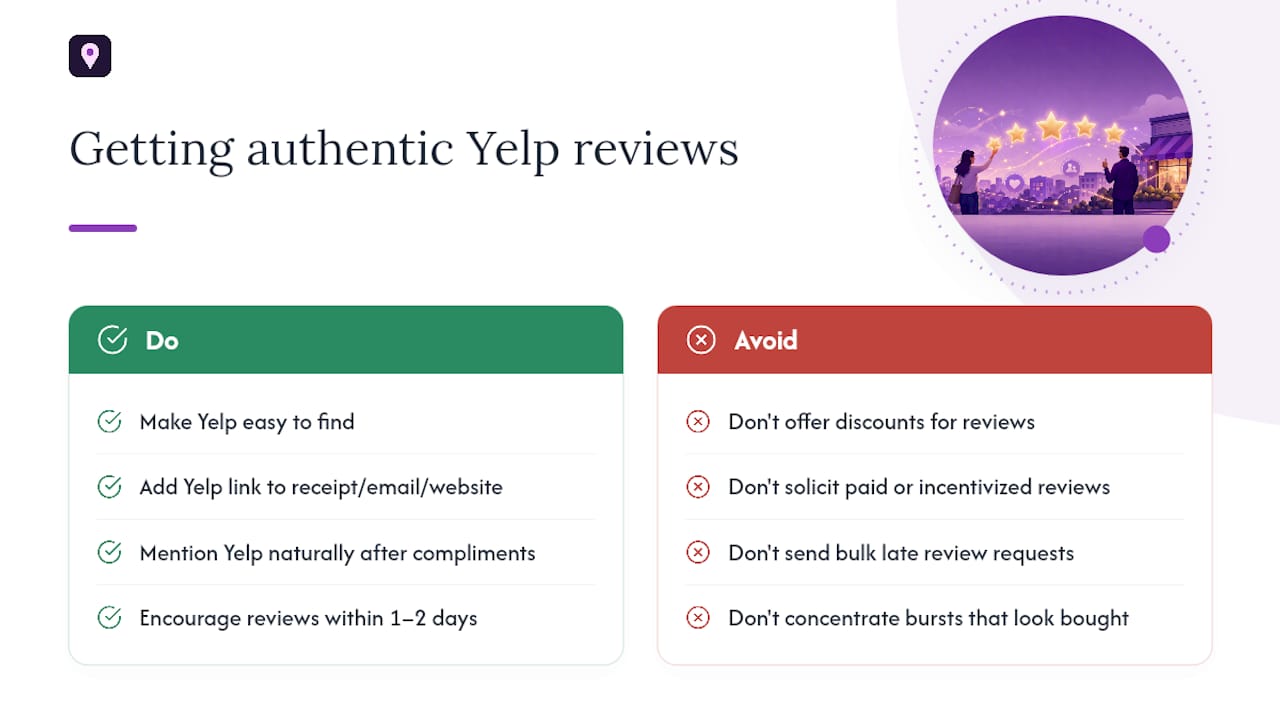
The compliant path is slower but far more durable. Focus on making it easy for satisfied customers to find your Yelp profile organically, through a link on your receipt, your email signature, or your website, without explicitly requesting a review in that same message. A simple “find us on Yelp” note performs better long-term than a direct ask tied to a discount or freebie.
Timing matters more than most owners realize. Reviews left within a day or two of a positive service interaction tend to read as more genuine and detailed than ones solicited weeks later through a bulk email blast. Train staff to mention your Yelp presence naturally at the point of a positive interaction, right after a compliment or a successful resolution, rather than as a scripted ask at checkout.
Never offer discounts, free products, or any other incentive tied to leaving a review on Yelp specifically. This violates platform policy and, if caught, can result in a filtered or suspended profile that undoes months of citation and review work. Build the same organic habit across every review platform your business uses, so your review growth pattern looks consistent rather than concentrated in short bursts that suggest an incentivized campaign.
Are Yelp Ads and Yelp Deals Worth the Spend?
Yelp’s advertising and Deals products can boost visibility within Yelp’s own search results and category pages, giving a business more placement above organic competitors for a given search term. Whether that spend is worth it depends heavily on your industry and how much of your customer acquisition already flows through Yelp specifically.
Yelp Ads work best for service categories where customers actively browse and compare businesses on the platform before deciding, home services, restaurants, and personal care among them. If your industry sees low organic Yelp search volume to begin with, paid placement there won’t manufacture demand that doesn’t exist.
Yelp Deals function as a promotional tool that can drive a short-term spike in bookings or visits, particularly useful for filling off-peak hours or introducing new customers to a service at a reduced price. Treat Deals as a customer-acquisition tactic separate from your core citation and ranking strategy rather than a local SEO lever in itself. The organic ranking benefit of running a Deal is limited; the direct revenue and new-customer benefit is the real draw.
Before committing budget, check your current Yelp profile views and click-through data if available. A business with a fully optimized profile, complete categories, fresh photos, and a healthy review count, gets more value out of paid placement than one still working through basic NAP consistency issues. Spend on ads only after the foundational optimization work is done, since paid visibility pointing to an incomplete or inconsistent profile wastes the budget.
Making Yelp Part of a Consistent Citation System
Yelp doesn’t operate in isolation, and treating it that way is the biggest strategic mistake business owners make. Every field you optimize on Yelp needs to mirror the canonical NAP document you built during your audit, the same document governing your Google Business Profile, Bing Places, and every vertical citation in your build plan.
The practical workflow looks like this: whenever you update your hours, address, or phone number anywhere, update your canonical document first, then propagate that change to Yelp, Google Business Profile, and your other high-priority listings within the same week. Letting Yelp lag behind a Google update, even for a month, reopens the exact inconsistency gap your original citation build was designed to close.
Vertical citations carry disproportionate weight in this system because they’re harder to fake and signal genuine topical authority, and Yelp functions partly as a vertical citation depending on your industry. A restaurant’s Yelp presence carries different weight than a B2B consulting firm’s, since Yelp’s own algorithm and user base skew heavily toward consumer-facing service categories.
Run your monthly audit across Yelp alongside your other core listings rather than treating it as a separate task on a separate schedule. A Local SEO Checklist that includes Yelp as one line item among your top 25 listings keeps the platform from falling through the cracks between bigger priorities like Google Business Profile management. Consistency across every platform, checked on the same cadence, is what actually compounds into Map Pack movement over 60 to 90 days.
Local SEO Bot’s Take: What Actually Moves the Needle
Client results consistently point to the same pattern: NAP consistency fixes produce the fastest visible wins, often before a single new citation goes live. Businesses correcting mismatched addresses across major directories tend to see ranking shifts within a couple of months of a full build. Case studies bear this out repeatedly.
The temptation is always to chase volume, more citations, more reviews, more platforms. Resist it. Quality control on a smaller footprint of manually verified listings beats a sprawling, error-prone one nearly every time. If you’re vetting a managed provider, ask how they handle Tier 1 submissions specifically. Their answer tells you everything.
— Local
Get a Free Audit and See Where Your Citations Stand
Everything covered above, the audit, the canonical NAP document, the tiered build order, the monthly governance cycle, is part of a manual citation building process for local businesses and the agencies that manage them. Instead of a bulk submission tool that scatters your data across low-quality directories, Localseobot’s team manually builds premium citations on the same high-authority platforms this guide walks through, with a Citation Consistency Analyzer and Google Business Profile Optimizer to keep the whole system verified between builds.
Case studies from existing clients show meaningful Google Maps position improvement and more customer calls following a disciplined citation cleanup, with full qualifying conditions listed on the Local Citations Services page. If your listings haven’t been audited in the last quarter, that’s the place to start. Request a free audit today and find out exactly where your NAP is drifting before it costs you another month of Map Pack visibility.
Sources
- Tips to improve your local ranking on Google - Google Business Profile Help
- Local SEO Citations in 2026: What Still Works, What Doesn’t & The Right Build Order | MaxGrowth Agency
- Citation Building for AI Local SEO: The Systematic Approach to Maximizing AI Citations
- Google Business Profile optimization (Shopify blog)