Citations vs Backlinks: What Local Businesses Should Do
Published August 13, 2026
Citations vs Backlinks: What Local Businesses Should Do

Citations are NAP (name, address, phone) mentions that verify your business location for Google Maps; backlinks are clickable links from other websites that build your domain’s authority. For a small business starting out, citations come first — they are the gating signal for local pack eligibility — then backlinks layer on top to grow broader organic reach.
Start here before anything else:
- Audit your NAP across Google Business Profile, Yelp, and your top three directory listings for consistency.
- Claim and fully complete your Google Business Profile if you have not already.
- Check whether your business appears on the top local directories relevant to your industry and city.
Key Takeaways
Citations verify your business location for Google Maps; backlinks build the domain authority that drives broader organic rankings — and the sequence matters.
| Point | Details |
|---|---|
| Citations come first | Fix NAP consistency and claim major directories before investing time in backlink outreach. |
| Backlinks build on the foundation | A few relevant editorial links from local press, partners, or trade associations outperform bulk low-quality links. |
| Measurement drives decisions | Track NAP consistency score, referring domains, and local pack position monthly to know what is working. |
| Mistakes compound quickly | Inconsistent NAP and purchased links are the two most common errors — both have clear fixes if caught early. |
| Localseobot accelerates the process | Manual citation building, GBP optimization, and geo-grid rank tracking in one platform, backed by a 30-day guarantee. |
Table of Contents
- What are citations vs backlinks in local SEO?
- Structured vs unstructured citations: which type matters most?
- Why citations matter for Google Maps visibility
- Why backlinks still matter — and where they fit in your strategy
- How to build and audit citations: a step-by-step workflow
- Practical backlink tactics for small businesses without big budgets
- How citations and backlinks work together
- How to measure and track citations and backlinks
- Common citation and backlink mistakes to fix now
- A real example: how citation fixes moved a local business up the map
- Where small businesses should actually focus first
- Localseobot handles the citation work so you can focus on running your business
- Sources
- FAQ
What are citations vs backlinks in local SEO?
The word “citation” means something different depending on who is using it. In academic research, a citation is a formal reference that credits a source and lets readers locate the original material. In local SEO, a citation is something far simpler: any online mention of your business name, address, and phone number, whether or not it includes a link back to your site.
A backlink, by contrast, is a hyperlink from one website to another. Backlinks act as votes of confidence and are a core ranking signal for organic search. They help Google discover pages and assess how authoritative a domain is.
A citation tells Google where your business is and that it exists. A backlink tells Google how trusted your website is. Both signals matter, but they answer different questions.
Here is how the two compare at a glance:
| Dimension | Citation | Backlink |
|---|---|---|
| Format | NAP text mention (may or may not include a link) | Clickable hyperlink from an external site |
| Primary purpose | Local verification and trust for Maps/local pack | Domain/page authority and referral traffic |
| Where it appears | Directories, GBP, review sites, local blogs | Editorial sites, news, blogs, resource pages |
| How you get one | Submit to directories or earn organic mentions | Earn through content, outreach, or partnerships |
| SEO impact | Local pack eligibility, map visibility | Organic rankings, broader visibility |
| Time to impact | Weeks to a few months | Several months to a year or more |
Structured vs unstructured citations: which type matters most?
Not all citations are created equal. The two main types serve slightly different purposes, and knowing the difference helps you prioritize where to spend time.
Structured citations appear in directory-style platforms where fields are predefined: business name, address, phone number, website URL, and sometimes category or hours. Google Business Profile is the most important structured citation you will ever build. Beyond that, platforms like Yelp, Apple Maps, Bing Places, Yellow Pages, and industry-specific directories (Houzz for contractors, Healthgrades for medical practices, Avvo for attorneys) all qualify. A priority list of local citation sites can help you identify which directories carry the most weight for your category and region.
Unstructured citations are mentions of your business in editorial content: a local news article naming your restaurant, a blogger recommending your plumbing service, a Yelp review that includes your address. These do not follow a template. Google still reads them, and they contribute to what SEOs call “entity recognition” — the process by which Google builds confidence that your business is a real, established presence in a specific location.
For most local businesses, the priority order looks like this:
- Google Business Profile (non-negotiable, highest weight)
- Core data aggregators (Data Axle, Neustar Localeze, Foursquare)
- Major general directories (Yelp, Apple Maps, Bing Places, Facebook)
- Industry-specific directories relevant to your niche
- Local chamber of commerce and city/neighborhood directories
- Unstructured mentions in local press and community blogs
The complete guide to local citations for beginners walks through each tier in more detail if you want to go deeper on classification.
Why citations matter for Google Maps visibility
Google uses citation signals to verify that a business is legitimate, located where it claims to be, and consistently represented across the web. When your NAP data matches across dozens of directories, Google’s confidence in your listing rises — and that confidence directly influences whether you appear in the local three-pack.
Inconsistent NAP is one of the most common reasons a business stalls in local rankings. A phone number formatted differently on Yelp versus your website, or an old address still live on a data aggregator, introduces doubt into Google’s verification process. That doubt costs rankings.
Citations also contribute to several specific local ranking factors:
- Local pack eligibility: Google cross-references directory data to confirm a business’s physical presence in a search area.
- GBP trust signals: A fully built-out GBP backed by consistent citations across the web signals that the listing is authoritative, not a duplicate or spam entry.
- Map visibility radius: Citation volume and consistency can influence how far from your physical address your listing appears in map results.
- Review platform presence: Being listed on review-heavy platforms (Yelp, Healthgrades, TripAdvisor) generates both citation signals and social proof simultaneously.
The Google Maps SEO citation guide covers the specific ranking mechanics in detail, including how citation signals interact with proximity and relevance.
Why backlinks still matter — and where they fit in your strategy
Backlinks remain a core ranking signal for organic search. A link from a credible, relevant website tells Google that another publisher trusts your content enough to send their audience to it. That trust accumulates into domain authority over time, which lifts your pages in non-local organic results and strengthens the overall profile of your website.
The key word is relevant. A backlink from a local news outlet covering your industry carries far more weight than ten links from unrelated directories or generic blog networks. Backlinks form a credibility record that both search engines and AI systems draw on, and quality consistently outperforms volume.
For small businesses, the realistic picture looks like this:
- Time to impact: Backlink gains typically take three to twelve months to show up in rankings, depending on your domain’s starting authority.
- Effort and cost: Earning editorial links requires content creation, outreach, or relationship-building — none of which is free, even if you do it yourself.
- Referral traffic: Unlike citations, backlinks can send real visitors to your site immediately, before any ranking movement occurs.
- AI visibility: AI citations and traditional backlinks serve related but different roles — backlinks help pages enter AI retrieval candidate pools, while structured, answer-shaped content determines which page gets cited in the actual AI response.
Pro Tip: A handful of editorial backlinks from locally relevant, high-authority sources (a regional newspaper, a trade association, a well-read local blog) will outperform fifty links from generic directories. Avoid any service promising bulk links quickly — Google’s spam systems are effective, and a manual penalty is far harder to recover from than a slow start.
How to build and audit citations: a step-by-step workflow
The citation-building process breaks cleanly into four phases: audit, fix, build, and monitor. Skipping the audit phase is the single most common mistake — submitting new listings on top of inconsistent existing ones compounds the problem rather than solving it.
Phase 1: Audit your current citations
- Search Google for your business name plus city to find existing listings.
- Use a local citation finder to pull a full report of where your business is currently listed.
- Record every variation of your NAP you find: old phone numbers, previous addresses, name abbreviations.
- Flag duplicates, incorrect categories, and listings with missing hours or photos.
Phase 2: Fix inconsistencies
- Standardize your NAP format (decide on “St.” vs “Street,” suite formatting, and phone number style) and apply it everywhere.
- Claim and merge duplicate listings on Google Business Profile through the GBP dashboard.
- Update outdated information on data aggregators first — they feed dozens of downstream directories.
- Add business descriptions, categories, photos, and hours to any listing that is missing them.
Phase 3: Build new citations
- Claim your GBP and complete every available field, including attributes and Q&A.
- Submit to the core data aggregators (Data Axle, Neustar Localeze, Foursquare).
- Work through major general directories, then industry-specific ones.
- Add LocalBusiness schema markup to your website so Google can read your NAP directly from your own pages.
Phase 4: Monitor ongoing
- Set a monthly reminder to spot-check your top ten listings for accuracy.
- Watch for auto-generated edits on GBP — Google and users can suggest changes that override your data.
Pro Tip: Batching citation submissions in one focused session per week is more efficient than doing them one at a time. Localseobot’s manual citation-building service handles high-authority directory submissions for you, which saves the hours most business owners spend on repetitive form-filling.
Use the local SEO checklist tool to track which directories you have claimed and which still need attention.
Practical backlink tactics for small businesses without big budgets
Backlink building does not require a PR agency or a large content team. The tactics below are realistic for a single-location small business with limited time and budget.
Earn links through local relationships:
- Sponsor a local event, youth sports team, or charity — most will link to sponsors from their website.
- Join your local chamber of commerce; membership almost always includes a directory link.
- Partner with complementary local businesses for cross-promotional content or resource pages.
Earn links through content:
- Publish original local data: a survey of your customers, a neighborhood guide, or a seasonal trend report. Original local data and free utilities attract editorial backlinks because they create extractable facts other writers want to reference.
- Create a genuinely useful free tool or resource relevant to your industry and city.
- Use the local keyword generator to find question-based local searches you can answer with a dedicated page, then pitch that page to local bloggers and journalists.
Earn links through outreach:
- Pitch local news outlets with a story angle tied to your business (a milestone, a community initiative, a data point).
- Offer to write a guest post for a local industry blog or trade association site.
- Find resource pages in your niche (“best [city] contractors”) and request inclusion.
The role of backlinks in scalable SEO covers sustainable link-building tactics in more depth for businesses ready to move beyond the basics.
Red flags to avoid:
- Link farms and private blog networks — Google’s spam detection catches these, and the penalty is severe.
- Bulk paid link packages from freelance marketplaces — quantity without relevance adds no value and carries real risk.
- Over-optimized anchor text (using your exact keyword phrase as anchor text on every link) — vary anchor text naturally.
If you discover you already have low-quality links pointing to your site, use Google Search Console’s Disavow Tool to flag them, and request removal directly from the linking site where possible.
How citations and backlinks work together
Citations and backlinks are not interchangeable — they operate at different stages of how Google evaluates and ranks a local business.
Think of it as a two-stage process. Backlinks help your website clear the authority threshold required to enter Google’s candidate pool for a given search. Citations and structured content then determine whether your business gets selected from that pool for the local pack or an AI-generated answer. Backlinks help pages enter retrieval pools; citations and structured passages determine which candidate is chosen at retrieval time.
For AI search specifically, the dynamic is worth understanding. Unlinked brand mentions and co-citations correlate strongly with AI visibility — once a domain clears a basic authority threshold, structured answer-ready content and brand mention density often matter more than raw backlink counts for getting cited inside an AI-generated response.
Here is how the two signals compare across the dimensions that matter most to a local business:
- Format: Citations are text-based NAP mentions; backlinks are clickable hyperlinks.
- Primary purpose: Citations verify location and existence; backlinks build domain trust and authority.
- Where they appear: Citations live in directories and review platforms; backlinks come from editorial sites, blogs, and news.
- How you get them: Citations are submitted; backlinks are earned through content and relationships.
- SEO impact: Citations drive local pack and map visibility; backlinks drive organic rankings and broader reach.
- Time to impact: Citations show results in weeks to months; backlinks typically take months to a year.
- Cost and effort: Citations require time and consistency; backlinks require content investment or outreach.
Pro Tip: Run your citation audit and your backlink outreach in parallel, not sequentially. Fixing NAP inconsistencies while you are also earning new links means both signals improve together, compressing the timeline to visible ranking movement.
Check local citation strategies for recent algorithm updates to see how the weighting between these signals has shifted.
How to measure and track citations and backlinks
Tracking progress keeps you from guessing whether the work is paying off. The metrics below give a clear picture of both citation health and backlink growth.
Citation metrics to track:
- Total citation count across major directories
- NAP consistency score (percentage of listings with matching name, address, and phone)
- Number of duplicate listings found and resolved
- GBP completeness score (all fields filled, photos added, Q&A answered)
- Local pack ranking position for your primary keywords
Backlink metrics to track:
- Total referring domains (not raw link count)
- Domain authority or domain rating as a proxy for overall link profile strength
- Referral traffic from linked pages (visible in Google Analytics)
- New vs lost links month over month
Tools that cover both:
- Citation Consistency Analyzer — checks NAP accuracy across listings and flags discrepancies
- Google Maps Visibility Score Calculator — estimates your current local visibility and tracks movement after fixes
- Google Business Profile Insights — shows search impressions, direction requests, and call clicks
- Google Search Console — tracks organic impressions, clicks, and which pages earn links
- Ahrefs or Moz — for referring domain counts, domain authority, and link profile analysis
- Moz Local or BrightLocal — for citation audits and NAP consistency scoring across directories
Timing expectations matter. Citation fixes typically show up in local rankings within four to eight weeks, assuming the data aggregators have updated. Backlink gains are slower: expect three to six months before a new editorial link meaningfully moves organic rankings, and longer for competitive terms. AI citations are an additional visibility channel that rewards structured, answer-ready content — track AI Overview appearances in Search Console as a separate metric from traditional organic clicks.
What AI search engines prioritize when selecting citations is worth understanding separately; the Ranksector breakdown of AI citation criteria covers content structure and brand mention density in practical terms.
Common citation and backlink mistakes to fix now
Most local businesses make the same handful of errors. Each one has a straightforward fix.
Citation mistakes:
- Inconsistent NAP across listings: Standardize your format once, then update every listing to match. Start with data aggregators since they push data downstream.
- Duplicate GBP listings: Use the Google Business Profile dashboard to request removal of duplicates, or flag them as closed/moved if they represent old locations.
- Low-quality citation sources: A listing on a spam directory with no real traffic or authority does nothing and can hurt. Audit your citation sources and request removal from any that look like link farms.
- Missing or incomplete listings: An unclaimed listing with wrong hours or no photos is worse than no listing at all — claim it and fill it out completely.
Backlink mistakes:
- Purchased spammy links: Use Google Search Console’s Disavow Tool and contact the linking site to request removal. Document your outreach in case you need to submit a reconsideration request.
- Over-optimized anchor text: If every backlink to your site uses the exact same keyword phrase as anchor text, that pattern looks manipulative. Vary anchor text to include your brand name, partial phrases, and natural language.
- Ignoring link losses: Backlinks disappear when sites restructure or go offline. Monitor referring domains monthly and reach out to reclaim lost links where possible.
Monthly review checklist:
- Check GBP for suggested edits or user-submitted changes that may have overridden your data
- Verify your top five directory listings for NAP accuracy
- Review Search Console for any new manual actions or link warnings
- Check referring domain count for unexpected drops
- Confirm your local pack position for your two or three primary keywords
The complete citation building guide includes a more detailed error-correction workflow if you are dealing with a heavily inconsistent citation profile.
A real example: how citation fixes moved a local business up the map
A single-location HVAC company had been operating for six years but was ranking outside the top ten in Google Maps for its primary service keywords. The business had accumulated listings across more than forty directories, but the NAP data was fragmented: three different phone number formats, two address variations (one with a suite number, one without), and a GBP listing that had never been fully completed.

The fix was methodical. First, a full citation audit identified every listing and flagged every inconsistency. The NAP was standardized to a single format, data aggregators were updated first, and then each major directory was corrected in order of authority. The GBP was completed with photos, service descriptions, and a full attribute set. No new backlinks were built during this phase.
Within eight weeks of the aggregator updates pushing through, the business moved from outside the top ten to a consistent top-three position in the local pack for its primary keyword.
The ranking shift happened before a single new backlink was earned. Citation accuracy alone was the gap between invisible and top-three on Google Maps.
That result is consistent with the two-stage model: citations verified the business’s location and legitimacy first, creating the foundation that backlinks can then build on. A business that skips the citation phase and jumps straight to link building is trying to earn authority for a listing Google has not yet fully verified.
Where small businesses should actually focus first
The conventional advice is to “do both” — citations and backlinks simultaneously. That is technically correct but practically useless for a business owner with limited time and budget.
The more honest recommendation: spend your first 30 days entirely on citation accuracy and GBP optimization. Get your NAP consistent, claim every major directory, and complete your GBP to 100%. That work has the highest return per hour for local visibility and costs almost nothing beyond time. Once your citation foundation is solid, shift attention to earning three to five genuinely relevant local backlinks per quarter. A local press mention, a chamber of commerce link, and a sponsor credit from a community event will outperform a hundred directory submissions on a site nobody visits.
When should you bring in professional help? If you are managing more than two locations, if you have seen no organic growth after three months of consistent citation work, or if your citation audit reveals more than twenty inconsistent listings, the time cost of manual fixes outweighs the savings of doing it yourself.
Localseobot handles the citation work so you can focus on running your business
Getting citations right is time-consuming. Auditing dozens of directories, standardizing NAP data, fixing aggregator records, and monitoring for auto-generated GBP edits can easily consume hours every month — hours most business owners do not have.
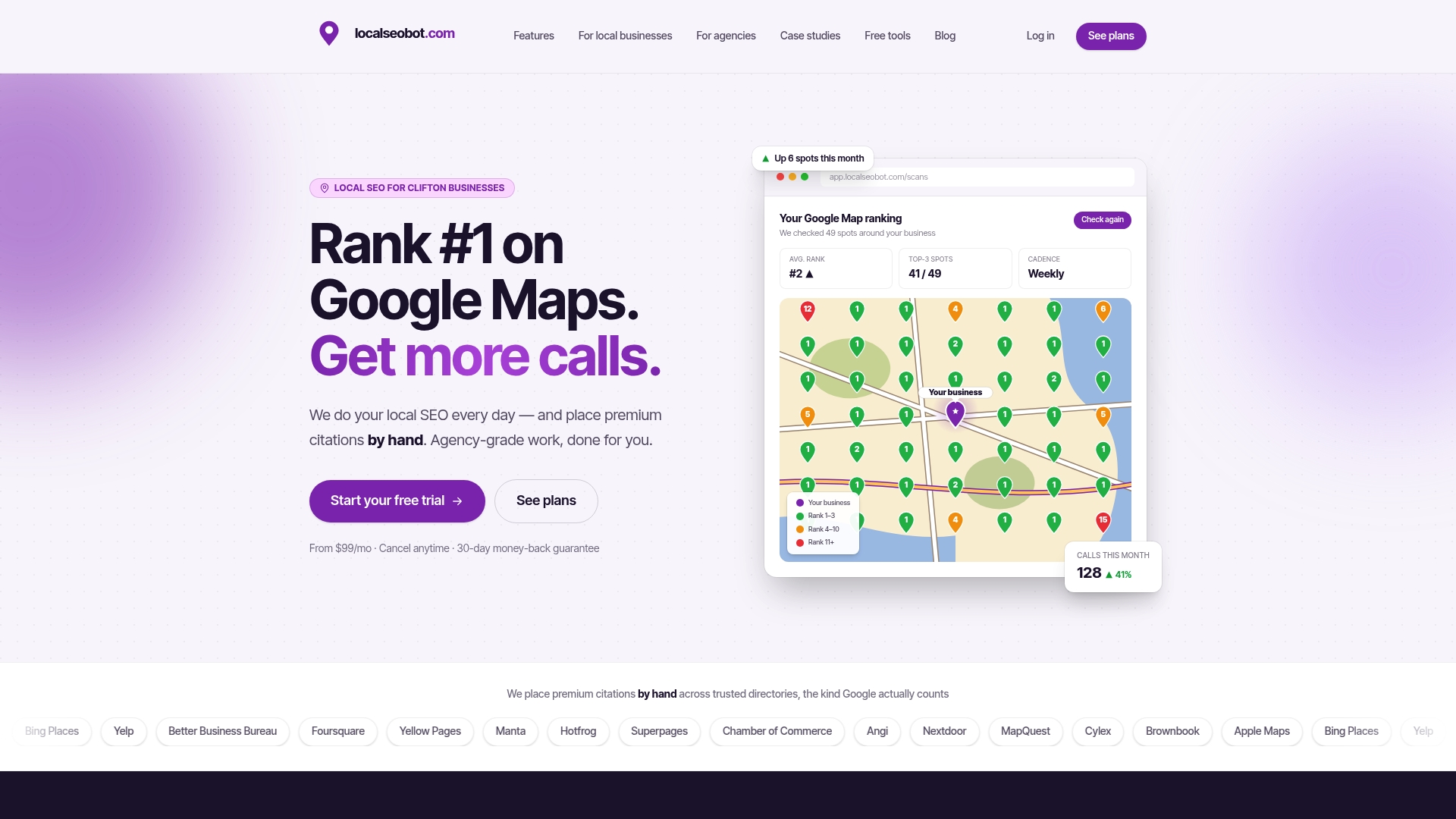
Localseobot builds premium citations manually across high-authority directories, tracks your Google Maps ranking with geo-grid precision, and optimizes your GBP automatically. The Citation Consistency Analyzer gives you an immediate read on where your NAP data is broken and which listings need priority attention. The platform also handles review generation, automated GBP posting, and monthly local SEO reporting — everything in one place, without the agency retainer.
Localseobot backs every citation-building engagement with a 30-day money-back guarantee if your Maps ranking does not improve. Start with the local SEO services for small businesses page to see the full feature set, or run your free citation audit now.
Sources
Reference sources:
Tools to execute the checklist:
FAQ
What is the difference between a citation and a backlink? A citation is a mention of your business name, address, and phone number on another site — it may or may not include a link. A backlink is a clickable hyperlink from another website to yours. Citations verify your location for local search; backlinks build domain authority for organic rankings.
Do citations count as backlinks? Not necessarily. A citation that includes a link to your website is also a backlink. But most directory citations are text-only NAP mentions with no followed link, so they function as citations without passing link authority.
Which matters more for Google Maps rankings — citations or backlinks? Citations carry more direct weight for Google Maps and local pack rankings. Consistent, accurate NAP data across authoritative directories are one of the clearest signals Google uses to verify a business’s location and legitimacy.
How many citations does a local business need? There is no universal number. Coverage of the core data aggregators, major general directories, and the top five to ten industry-specific directories relevant to your niche is a solid foundation. Quality and consistency matter more than raw count.
Can I build citations myself or should I hire help? A single-location business with a clean NAP history can handle citation building manually. If you have multiple locations, significant NAP inconsistencies, or more than twenty directories to correct, a managed service like Localseobot saves meaningful time and reduces the risk of introducing new errors.
How long does it take for citations to improve my rankings? Citation fixes typically show up in local rankings within four to eight weeks, once data aggregators have pushed updated information to downstream directories. GBP improvements can appear faster.
What is the fastest backlink a small business can earn? A chamber of commerce membership link is often the fastest legitimate backlink available to a local business — it is earned through a real relationship, comes from a trusted local domain, and is usually live within days of joining.