Local SEO Myths: 9 Beliefs That Waste Time and Budget
Published November 10, 2026
Local SEO Myths: 9 Beliefs That Waste Time and Budget

The most expensive local SEO myths all lead to the same place: money spent on things Google Maps does not reward. You can’t buy a Maps ranking, no business holds one fixed #1 spot, and stuffing keywords or publishing more blog posts rarely moves the map pack. What does move it is a accurate profile, steady reviews, consistent listings and ongoing attention. Below are nine myths we see business owners act on, what the evidence says, and what to do instead.
TL;DR
- Google says there is no way to request or pay for a better local ranking. Anyone selling a guaranteed #1 is selling something Google does not offer.
- Local rankings depend on the searcher’s location, so “#1” means different things on different blocks. Measure across your service area, not from one spot.
- Keyword stuffing in your profile and piling up website pages are weak levers. Accurate categories, fresh reviews and consistent listings are stronger ones.
- Local SEO is ongoing work, and it still matters as AI search grows, because AI answers draw on the same local data.
- Automation helps most when it handles the routine work and a human still checks the details.
Table of Contents
- Myths about how rankings work
- Myths about content, reviews and links
- Myths about time, AI and automation
- Where automation fits, and where people still matter
- How to spend your first 90 days instead
- Our perspective
- Put the right work on autopilot
- FAQ
- Sources
Myths about how rankings work
These first three myths are about the ranking itself: who controls it, what it means and what feeds it.
Myth 1: You can pay for a top Google Maps spot
You can’t. Google’s Business Profile Help states that there is no way to request or pay for a better local ranking on Google. Local results are based mainly on three factors: relevance, distance and prominence.
- Relevance is how well your profile matches what someone searches for.
- Distance is how far you are from the searcher, or from the location named in the search.
- Prominence is how well known your business is. Google says it draws on information such as how many websites link to you and how many reviews you have, and that more reviews and positive ratings can help.
So when a vendor promises a guaranteed position, treat it as a red flag about the promise, not a reason to hunt for the vendor with the boldest number. What a vendor can honestly offer is work on the factors you can influence: profile quality, reviews, listings and monitoring.
That is also how we think about our own offer. We do not claim to control Google. Our 30-day money-back guarantee applies if a business doesn’t see a ranking increase, which puts the risk on us rather than on you, and the work behind it is the work Google describes: a complete profile, active reviews and trusted citations.
Myth 2: There is one #1 ranking for your business
Many owners check their ranking once, from their own shop or office, see themselves at the top and assume the job is done. Others see themselves at position six and panic. Both are reading a single data point.
Search Engine Land’s local SEO guide makes the point directly: there are no #1 local search rankings, because results are customized to the physical location of the searcher when they search. Its author adds that being #1 for all searchers is not a realistic goal unless you face little or no local competition.
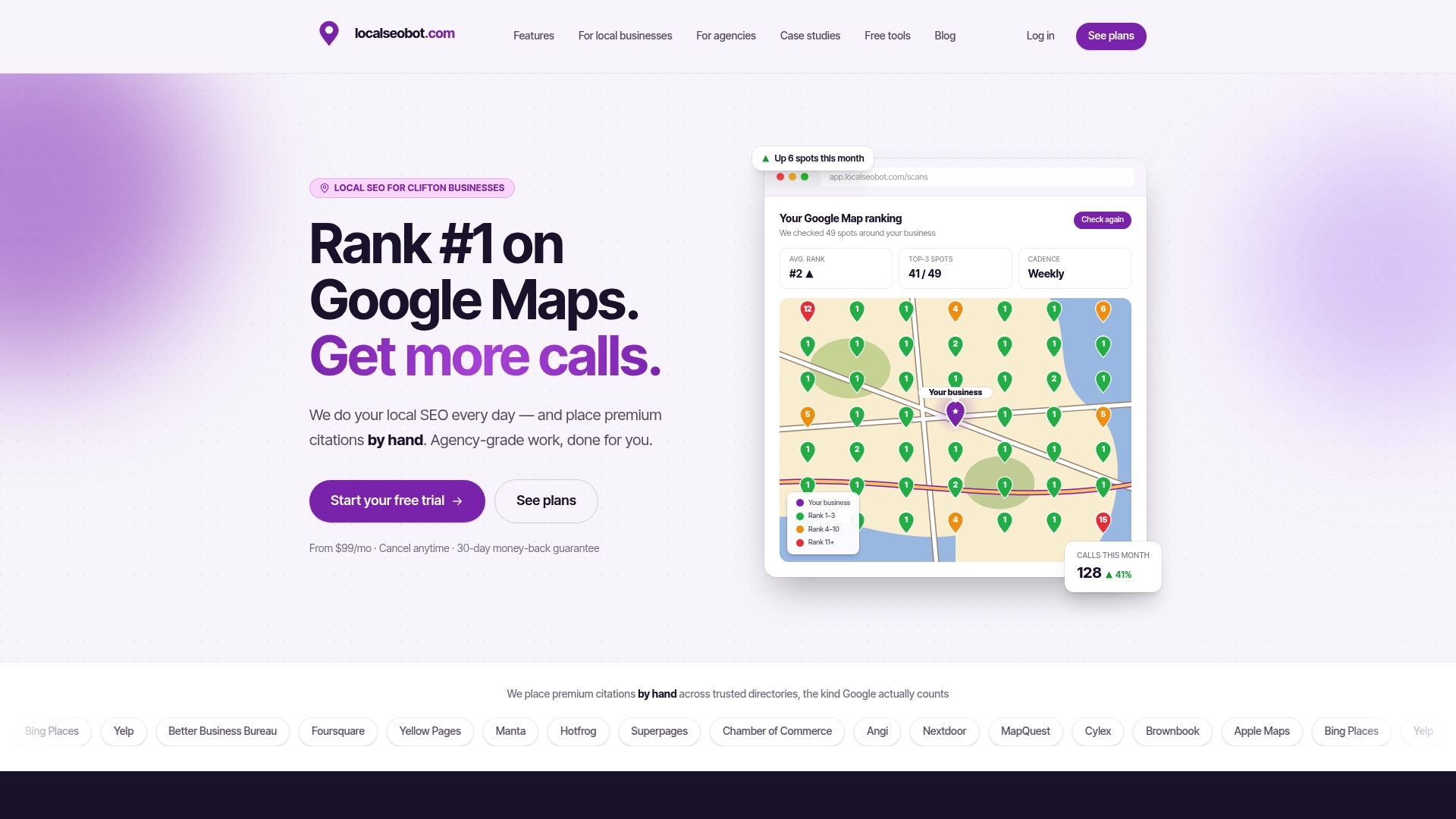
In practice, a plumber may show first for someone standing two blocks away and sixth for someone across town. That is why we track rankings with map grid scans: a grid of points across your service area, each showing where you appear for a keyword. The picture that comes back shows strong zones, weak zones and the neighborhoods where a competitor owns the map. Our Google Maps rank tracker runs those scans, so you can set goals like “cover the whole service area” instead of “be number one”.
Myth 3: Stuffing keywords into your profile helps you rank
The temptation is real. A profile name or category list packed with search terms looks like free relevance. Google’s guidelines push the other way. They tell businesses to use as few categories as possible to describe the core business, not to use categories solely as keywords, and not to put keywords in address lines.
The business name is the sharpest example. Search Engine Land’s profile audit notes that keywords in a business name can be a powerful ranking signal, but also warns that Google can verify your legal name and then remove the keywords, require reverification or suspend the profile. A short-term gain is not worth a suspended listing, and a suspension takes your calls with it.
What to do instead:
- Pick the primary category that best describes your core business.
- Add secondary categories only when they describe real services you offer.
- Use your real business name, exactly as it appears on your signage and legal documents.
- Describe your services in plain language in the services and description fields.
If you want a quick read on where your profile stands, our Google Business Profile Optimizer checks the fields that matter.
Myths about content, reviews and links
This group covers where owners tend to spend hours: the website, the blog and the review count.
Myth 4: More blog posts and location pages will lift your Maps ranking
Good website content does plenty for your business: it answers questions, supports your website’s own search visibility and helps visitors decide. The myth is narrower: that more pages directly raise your Google Maps ranking.
Search Engine Land reported in 2025 that adding keyword-rich website content does not create keyword relevance for a Business Profile, and that creating location pages will not help a profile appear more often in searches from those locations. The same piece describes heavy spending on blogging and new pages, done in the hope of ranking in Maps, as wasted budget.
That changes where a small budget should go first. Before you commission ten suburb pages, make sure of the following:
- Your categories, services and description are complete and accurate.
- You have a steady flow of new reviews.
- Your name, address and phone number match across the major directories.
- You post regular updates to the profile itself.
Those are the surfaces Maps reads most directly. Our Local SEO Bot handles the profile optimization and publishes regular posts for you, so the profile stays active without a weekly chore on your calendar.
Myth 5: The total number of reviews is all that counts
Reviews matter. Google lists review count and ratings among the things that feed prominence, and Search Engine Land’s guide notes that over 99% of consumers read reviews in local listings before visiting a business. But the total is only part of the story.
The March 2026 audit from Search Engine Land reports that review velocity and recency often outweigh total review count for map pack positions. Its example: a competitor with 100 fresh reviews from the last month will likely beat a business with 500 reviews and nothing new since 2024. The author describes Google’s attitude as “what have you done for me lately?”
The practical lesson is to treat reviews as a habit, not a campaign:
- Ask every customer, at the moment they are happiest, with a direct link.
- Keep the ask short. Our Google review template gives you wording you can adapt.
- Reply to every review, positive or negative, promptly.
- Aim for a steady monthly pace rather than a burst followed by silence.
Local SEO Bot automates the review request flow and drafts AI-powered replies, so the cadence holds even in a busy month.
Myth 6: Publishing more often, or on a schedule, is the secret
Posting is useful for keeping a profile current and giving customers fresh information: offers, projects, seasonal hours. It becomes a myth when owners treat a daily posting streak as a ranking lever on its own. Google’s ranking explanation lists relevance, distance and prominence, and posting frequency is not among them.
Think of posts as maintenance and customer communication. A profile with current photos, accurate hours and recent updates gives customers confidence and gives you more to show when they land on it. Consistency matters more than volume, and automation is a good fit here because the task is repetitive and easy to forget.
Myths about time, AI and automation
The last myths are about how long this takes, whether it still matters and who should do the work.
Myth 7: Local SEO is a one-time setup you finish and forget
The top-ranking guides for this keyword agree on this one: SEO is not a one-off process. Local search is a contest. Competitors collect reviews, update their profiles and add listings, and Google changes how results are displayed. A profile you set up two years ago and never touched is being compared with profiles that were updated last week.
The recency point from the previous section is itself an argument against set-and-forget. If fresh reviews outweigh old ones, then a stalled profile slides even if nothing about it is wrong.
Timing is the other half. Results build over weeks and months rather than overnight, and the pace depends on your market, your starting point and how many competitors are working the same map. We would rather you plan for steady progress than expect a switch to flip. Monitoring helps you see that progress, which is why our reporting is monthly and the scans keep running between reports.
Myth 8: AI search has made local SEO obsolete
It is a fair worry. If people ask a chatbot for the best electrician nearby, do profiles and listings still matter? The evidence so far points the other way. Search Engine Land reports that Google’s AI Mode cites Business Profile links much more often than external websites, and that the local fundamentals of reviews, directory listings and profile accuracy still matter in the AI era.
The reasoning is straightforward. AI models do not generate original local knowledge. They aggregate and summarize structured data from platforms such as Google, Yelp and TripAdvisor. The work you put into your profile, your listings and your reviews is the raw material those answers are built from, whichever search platform people choose. For a wider look at how the role of AI search engines fits with established SEO practices, that is a good next read.
This is a reason to keep your listings consistent. Our team builds premium citations by hand on high-authority directories, so the same accurate business details show up in the places that machines and people read. You can see how that works on our local citation services page.
Myth 9: Any address works, and changing it is a simple edit
Three address mistakes come up repeatedly.
Using a mailbox or P.O. box. Google’s guidelines say P.O. boxes and mailboxes at remote locations are not acceptable as a Business Profile address. The same guidelines say there should be only one profile per business.
Assuming the address text is what ranks you. Search Engine Land’s July 2026 piece explains that when you enter an address, Google’s geocoding reads the text and assigns a physical coordinate to the listing. That coordinate, not the typed text, anchors your rankings.
Assuming a move is a one-field update. The same article reports that when a service-area business hides its address in the dashboard, the map pin can revert to the original address the profile was created with. So updating the address alone may not re-anchor the listing to a new location. If you are moving, plan the change, check the pin afterward and re-run your grid scan to see how your coverage shifted.

Where automation fits, and where people still matter
A reasonable question after nine myths is whether software can simply handle all of this. Software can handle a lot, and handling it consistently is what most small businesses struggle with. It is still worth knowing how Google builds a profile.
Google explains that profile information is compiled from crawled web content, licensed third-party data, user contributions and its own interactions with a business. Your profile is a mix of what you enter and what other sources say about you. That is why consistent listings across directories matter, and why a tool that only reports problems leaves you with the job of fixing them.
Our approach splits the work this way:
| Task | Who does it |
|---|---|
| Google Business Profile optimization | Local SEO Bot, automated |
| Regular profile posts | Local SEO Bot, automated |
| Review requests and AI-drafted replies | Local SEO Bot, automated |
| Rank tracking with map grid scans | Local SEO Bot, automated |
| Premium citations on high-authority directories | Our dedicated team, built manually |
| Final say on your business facts | You: services, hours, address |
The facts about your business always come from you. The repeatable work is what we take off your plate.
How to spend your first 90 days instead
If the myths above have been steering your budget, here is a simple order of operations.
- Audit the profile. Check name, categories, address, hours, services and photos against Google’s guidelines. Our Google Business Profile audit is a place to start.
- Fix your listings. Make your name, address and phone number consistent across the main directories. The Local Citation Finder shows where you are listed.
- Start a review rhythm. Set a monthly target and a standard ask.
- Baseline your rankings. Run a grid scan so you know your strong and weak zones before you change anything.
- Post and reply on a schedule. Keep it short and regular.
- Re-scan monthly. Compare against your baseline and adjust.
Agencies managing several clients can run the same process through our white-label local SEO software.
Our perspective
Most local SEO advice fails for one reason: it ends with a report. An owner gets a list of fifty things to fix, a score, and no time to act on any of it. The myths in this article survive because they offer a shortcut around that work: pay for a ranking, stuff a keyword, publish a page.
We built Local SEO Bot on the opposite view. Google tells us what drives local results, which is relevance, distance and prominence, so the job is to do the unglamorous things consistently. Keep the profile accurate. Keep reviews arriving and answered. Keep listings consistent on directories Google trusts. Watch rankings across the whole service area, not from one pin.
That is why the product does the work instead of describing it, and why a team of people builds premium citations by hand behind the automation. Software is good at repetition. People are good at judgment, and local SEO needs both. Our clients regularly report higher Google Maps rankings and more inbound calls, and we stand behind the approach with a 30-day money-back guarantee if a business doesn’t see a ranking increase.
Devyn H
Put the right work on autopilot
If you recognize your current plan in this list of myths, the fix does not have to mean a bigger workload. Local SEO Bot optimizes your Google Business Profile, publishes regular posts, replies to reviews, tracks your rankings with map grid scans and adds hand-built citations, all billed per location per month. Plans start with Foundation at $99 per month per location, with Growth at $199 per month per location, both on our pricing page. Agencies can see Pro at $399 per month per location on the agency pricing page.
Not ready to commit? Try the Local Ranking Calculator or browse our local SEO guides first.
FAQ
Can anyone guarantee a #1 Google Maps ranking?
No. Google states that there is no way to request or pay for a better local ranking, and results change with the searcher’s location. A trustworthy provider promises work on relevance, distance and prominence factors, and may back it with a refund policy like our 30-day money-back guarantee.
How many categories should I add to my Google Business Profile?
Use as few as it takes to describe your core business. Google’s guidelines say not to use categories solely as keywords. Choose the best primary category, then add secondary ones only for services you really provide.
Do I still need local SEO if people are using AI search?
Yes. Search Engine Land reports that AI results lean on local data sources and that Google’s AI Mode cites Business Profile links often. Reviews, listings and an accurate profile are the inputs those answers rely on.
Is it better to get many reviews or recent reviews?
Both help, but recency and pace carry a lot of weight. Search Engine Land’s audit guidance says fresh, regular reviews can outweigh a larger total that has gone stale. Build a monthly habit of asking and replying.
Sources
- Tips to improve your local ranking on Google
- Guidelines for representing your business on Google
- Understand how Google sources and uses info in Business Profile
- What Is Local SEO? Guide to Ranking in Local Search Results
- 5-step Google Business Profile audit to improve local rankings
- Why website content won’t boost your Google Maps keyword rankings
- Why local SEO is thriving in the AI-first search era
- Why Google Business Profile address changes can disrupt local rankings