No Guessing: Proximity in Local SEO for Small Businesses
Published October 8, 2026
No Guessing: Proximity in Local SEO for Small Businesses

Proximity, the physical distance between a searcher and your business, ranks among the strongest signals Google uses to decide who shows up in the local pack and on Maps. It can also lose to relevance and prominence in plenty of real searches, which means distance alone never guarantees a ranking. The smart move is to tighten your Google Business Profile and test the effect across your own service area rather than guess.
TL;DR:
- Broad searches, especially near me queries, favor nearby businesses, while branded or highly specific searches can reward stronger profile relevance and prominence over distance.
- Service area businesses must list cities or postal codes, not a radius, and Google recommends coverage within about two hours’ drive of their base.
- If a closer business still loses, improve categories and reviews first; farther competitors can win through relevance, backlinks, and consistent citations.
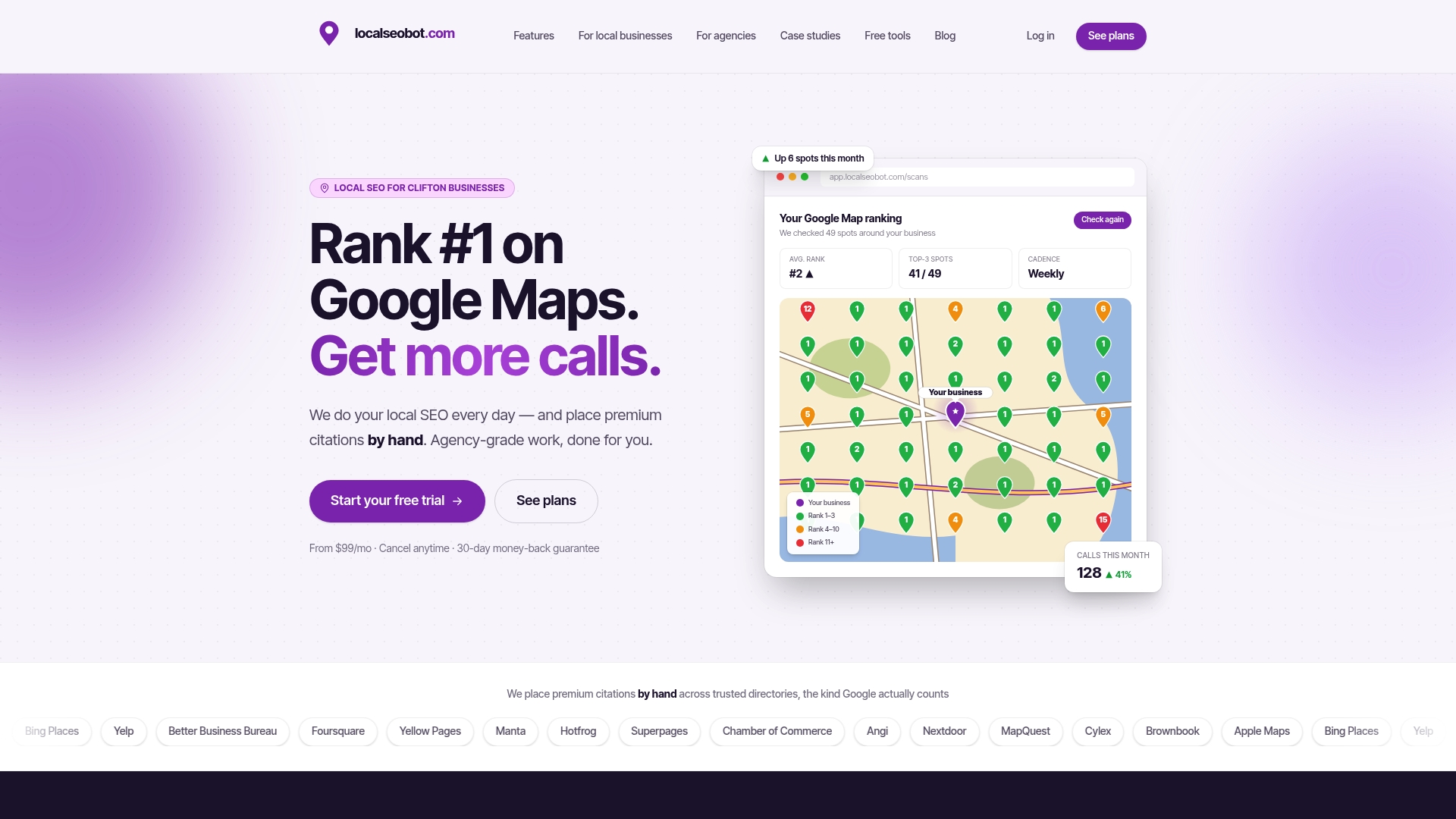
- Map grid scans show how rankings change across service areas; track calls and direction requests by cell, then test one profile change at a time.
Table of Contents
- What proximity means in local SEO and why it matters
- How Google measures proximity and service-area nuances
- How proximity interacts with relevance and prominence
- Actionable optimization checklist to improve visibility despite distance
- How to measure and test proximity’s effect across your service area
- How automation and managed services can scale proximity-sensitive tasks
- Why steady prominence-building usually beats chasing small proximity gains
- A hands-off way to handle proximity-sensitive local SEO work
- FAQ
- Sources
What proximity means in local SEO and why it matters
Proximity is simply how far a business sits from the person doing the search at the moment they search. Google weighs this alongside two other factors, relevance (how well your profile matches the query) and prominence (how well known your business is based on reviews, links, and citations). Google’s own guidance describes local ranking as a mix of relevance, distance, and prominence, with distance defined as how far each business sits from the customer who’s searching.
These three factors do not carry equal weight in every search. A generic “near me” query leans hard on proximity because the searcher has already signaled that location is the priority. A query with strong brand or service intent, like “emergency plumber licensed and insured,” can pull in a business several miles farther away if its profile answers that intent more precisely.
A few patterns show up consistently:
- Broad category searches (“coffee shop,” “hair salon”) tend to favor whichever qualified business sits closest.
- Branded or highly specific searches (“24 hour emergency locksmith”) give more room for relevance and prominence to outweigh distance.
- Searches typed without a specified location almost always default to proximity as the deciding factor.
Understanding which bucket your typical customer search falls into tells you where to spend your effort first.
How Google measures proximity and service-area nuances
Google does not use a single fixed point to measure distance. It builds a location estimate from several signals and applies it differently depending on how your business is set up.
- When a searcher has location services turned on, Google uses GPS data from their device for a precise read on where they stand.
- When GPS is unavailable, Google falls back on IP address, Wi-Fi networks, and account settings to approximate location.
- When a searcher has not shared any location at all, Google uses what it knows about their past behavior and context to infer where they likely are.
This matters more on mobile, where GPS tends to produce a tighter, more accurate location fix, than on desktop, where IP-based estimates are often broader and can place a searcher in the wrong neighborhood or even the wrong part of a city.
Service-area and hybrid businesses add another layer. A storefront business has one fixed address Google can measure distance from directly. A service-area business, think a mobile dog groomer or a plumber who drives to clients, has no public storefront, so Google instead relies on the service areas you configure in your profile. According to Google’s documentation on service-area and hybrid businesses, you define coverage by city or postal code rather than a radius, you can list several service areas, and Google recommends keeping that footprint to about two hours of driving time from your base. Setting a radius is explicitly not allowed: service areas must be defined by place names or postal codes, not a circle drawn around your address.
Hybrid businesses, those with a storefront that customers can visit and a service area they also cover, can show both the address and the service radius on their profile. That combination gives Google more precise signals to work with, which tends to produce more consistent placement across the territory you actually serve. Getting this setup wrong, listing service areas far beyond where you realistically work, for instance, can dilute relevance and waste the proximity advantage you’d otherwise have close to home.
How proximity interacts with relevance and prominence
A business two miles farther away can still outrank a closer competitor, and this happens more often than most owners expect. Strong prominence signals, a deep library of positive reviews, authoritative backlinks, and consistent citations across trusted directories, can offset a distance disadvantage. Industry analysis consistently places proximity alongside prominence and relevance as part of the “Big Three” local ranking factors, and no single one of the three operates in isolation.

Relevance works similarly in reverse: a profile with precise categories, clearly listed services, and content that matches what the searcher typed will often amplify whatever proximity advantage already exists, closing distance gaps that would otherwise work against you.
A few practical signals worth tracking:
- Review volume and recency carry real weight in prominence calculations.
- Citation consistency across directories reinforces that Google can trust your listed location and details.
- Backlinks from locally relevant, authoritative sites build prominence over time.
- Accurate primary and secondary categories sharpen relevance for the searches you actually want to win.
Pro Tip: If you’re already the closest qualified business for a search term and still losing the ranking, the gap is almost always relevance or prominence, not distance. Fix your categories and reviews before you touch anything else.
Knowing which lever to pull saves time. If you’re consistently beaten by a farther competitor, prominence work usually pays off faster than any proximity-related change you can make.
Actionable optimization checklist to improve visibility despite distance
You cannot move your business closer to every searcher, but you can control the signals that determine whether distance works for or against you. Work through these in order:
- Complete every field on your Google Business Profile: address, service categories, individual services, hours, and attributes. Google notes that complete, accurate profile information improves the odds of surfacing in local results.
- Set service areas correctly if you’re a service-area or hybrid business, using cities or postal codes rather than guessing at a radius.
- Build citations consistently across high-authority directories so your name, address, and phone number match everywhere they appear.
- Generate reviews on an ongoing basis and respond to each one, since both volume and engagement feed prominence.
- Publish local landing pages for each city or neighborhood you serve, with content specific to that area rather than duplicated boilerplate.
- Add schema markup to your website so search engines receive unambiguous, machine-readable location data.
A few of these deserve more detail:
- Google Business Profile completeness is the foundation. Every missing field is a missed opportunity for Google to match your business to a relevant query.
- Citations function like votes of confidence. The more consistent they are across directories, the more Google trusts the location data you’ve provided.
- Reviews signal both prominence and ongoing relevance, especially when responses mention specific services or neighborhoods.
- Local content gives Google textual evidence that you genuinely serve the areas you claim to, which matters most for service-area businesses without a visible storefront.
Schema markup deserves a specific mention because it’s often skipped. Schema exists specifically to convey location and contact details to search engines in a structured, unambiguous format. It will not change how Google calculates distance, but it removes guesswork about your address or service area, which reduces the odds of a mismatch between what Google sees and what you’ve told it. Pairing clean schema with a Google Business Profile Optimizer that checks these fields automatically closes most of the gaps small businesses leave open.
For step-by-step guidance on turning a complete profile into map pack visibility, see our guide to optimizing Google Business Profile for the map pack.
How to measure and test proximity’s effect across your service area
Guessing at proximity’s impact wastes effort. Measuring it directly tells you exactly where your visibility drops off and why.
Set up a map-grid rank scan, a series of simulated searches run from multiple coordinates across your service area, to see how your ranking shifts as the search point moves farther from your address. Grid scans turn a vague sense of “we don’t show up on the east side of town” into a precise picture of where your coverage starts and ends.
Once you have a grid in place, track more than just rank position:
- Impressions and clicks by grid cell show which zones are generating visibility at all.
- Calls and direction requests tied to specific cells reveal which areas convert, not just which ones see you.
- Rank changes after a specific optimization (a new category, a batch of reviews, added citations) show whether that change actually moved the needle in the cells where you were weak.
Map-grid scans and per-cell rank tracking are the standard method practitioners use to quantify how proximity affects visibility across a service area, since a single-point check from your own address tells you nothing about how you rank three miles away.
Run controlled experiments where you change one variable, say, optimizing your profile’s categories, while holding everything else constant, then compare grid results before and after. This isolates what actually moved your rankings instead of attributing gains to the wrong fix. A tool like Maprank or our guide to comparing your Business Profile against competitors gives you a starting framework for building this kind of test.
How automation and managed services can scale proximity-sensitive tasks
Several of the tasks that influence proximity outcomes are repetitive by nature, which makes them strong candidates for automation. Regular Google Business Profile posting, review replies, recurring grid scans, and citation distribution across directories all need to happen consistently over months, not as a one-time project.
- Automated GBP posting keeps your profile active, which supports the relevance signals Google rewards.
- Automated review replies maintain engagement without requiring daily manual attention.
- Scheduled rank grid scans catch proximity shifts before they turn into lost customers.
- Citation distribution across directories reinforces the consistency that feeds prominence.
The strongest setups pair automation with manual work where it counts most. Automated systems handle the recurring tasks at scale, while a human team manually builds premium citations on high-authority directories, the kind of placement that carries more trust weight than a mass-submitted listing ever will.
Pro Tip: When evaluating any tool or service for this work, ask specifically how citations get built. Automated-only citation tools often submit to low-quality directories that add noise rather than trust.
If you’re comparing options, look for clear per-location pricing, transparent reporting on grid results, a track record of manual citation work rather than pure automation, and some form of performance guarantee. Those four criteria separate a tool that reports problems from one that actually fixes them.
Why steady prominence-building usually beats chasing small proximity gains
A common misconception among small business owners is that a slightly better address, or some minor hack to appear closer to searchers, will fix a visibility problem. It rarely does. Distance is one of three factors, and it’s the one you have the least ability to change after your business is already established.
What actually moves the needle is disciplined, boring consistency: complete profile data, steady review generation, accurate citations, and measurement that tells you where you’re actually losing ground instead of where you assume you are. Businesses that treat proximity as fixed and prominence as the lever they control tend to see more durable gains than those chasing small positional tricks.
The trade-off is patience. Prominence signals build over months, not days, and grid-based measurement only gets useful once you have a baseline to compare against.
— Devyn H
A hands-off way to handle proximity-sensitive local SEO work
We built our system around a simple observation: most local SEO tools hand you a report and leave the fixing to you. We do the fixing. Our system optimizes your Google Business Profile, publishes regular posts, runs map-grid scans across service areas to track rankings, and responds to reviews, all running on autopilot.
Behind the automation, manual premium citations on high-authority directories are built to feed the prominence signals that offset distance disadvantages. For a broader look at how ranking factors interact in modern search, including the backlink and prominence side of the equation, our partners at Babylovegrowth cover the framework in more depth.
If you’re ready to see where your rankings actually stand across your service area, check our pricing and plans starting with the Foundation plan at $99 per month per location, or explore our Google Maps rank tracker to run your first grid scan.
FAQ
What is meant by local SEO?
Local SEO is the practice of optimizing a business’s online presence so it appears in location-based searches, particularly in Google’s local pack and Maps results. It centers on three factors Google weighs together: relevance, distance, and prominence.
What is the 80/20 rule in SEO?
The principle that a small share of your efforts, like fixing core profile completeness or a handful of high-authority citations, tends to produce most of your visibility gains. It’s a prioritization principle rather than a fixed Google ranking rule, so results vary by business and market.
What do you mean by keyword density?
Keyword density refers to how often a specific keyword or phrase appears relative to the total word count of a piece of content. In modern local SEO, matching searcher intent and covering a topic clearly matters more than hitting any particular density target.
What does SCO mean in marketing?
SCO is not a standard or widely recognized term in local SEO or digital marketing. If you encountered it in a specific context, the surrounding material would clarify what it refers to, and it’s worth confirming the definition at the source before applying it.
Sources
- Tips to improve your local ranking on Google — Google Business Profile Help
- Schema
- What local SEO is and how to improve your local ranking — Sprout Social