Review Velocity on Google: How Review Pace Affects Maps
Published November 26, 2026
Review Velocity on Google: How Review Pace Affects Maps

Review velocity is the rate at which your business earns new Google reviews over time, for example four a month or twelve a quarter. Google does not publish a velocity or recency factor, but it does say review count and rating feed into local prominence. Practitioners also report that a steady flow outperforms long gaps. The practical goal is simple: ask every happy customer, every week, in a way Google allows, and track whether your map rankings respond. Local SEO Bot automates review generation and AI-written review replies, so the flow does not depend on someone remembering to ask.
TL;DR
- Review velocity is your pace of new Google reviews. It is a practitioner’s term, not a named Google ranking factor.
- Google says more reviews and positive ratings can help your local ranking. It publishes no target pace.
- Practitioner case studies describe rankings slipping when review requests stop and recovering when they resume. The sample is small, so treat it as a pattern to watch, not a rule.
- Build the flow with a review link or QR code, a repeatable routine and replies to every review. Never offer incentives or pick who you ask.
- Measure velocity monthly, then compare it with grid-based rank scans for your service area.
Table of Contents
- What review velocity means
- What Google actually says
- What the evidence shows about pace and recency
- Why steady beats spiky
- How many reviews, and at what pace?
- How to build a steady flow without breaking the rules
- What Google does not allow
- How to measure review velocity
- For agencies: velocity across many locations
- Our perspective
- Put review velocity on autopilot
- FAQ
- Sources
What review velocity means
A Google review is a star rating plus optional text that a customer leaves on your Business Profile, the listing that appears in Google Maps and local search. Velocity describes how quickly those reviews pile up. Two businesses can both have 80 reviews. One earned them over four years and has had none in the last eight months. The other earned five last month. Customers and Google’s systems see two very different businesses.
Three related ideas often get blended together:
- Volume: the total number of reviews.
- Recency: how long ago the latest reviews were posted.
- Velocity: how many arrive per week, month or quarter.
For a small business owner, the useful way to hold them is this: volume shows history, recency shows you are still operating well, and velocity is the habit that keeps both healthy.
What Google actually says
Google’s Business Profile help page says local results are mainly based on relevance, distance and prominence. Prominence draws on information such as how many websites link to a business and how many reviews it has. More reviews and positive ratings can improve your local ranking, according to the same page.
The page does not give a minimum number of reviews, a monthly pace or a recency window. It also says there is no way to request or pay for a better local ranking. So any article that gives you an exact velocity number, such as “four reviews a month”, is offering a rule of thumb, not a Google rule. Use those numbers as a starting target and adjust them to your industry and your competitors.
What the evidence shows about pace and recency
The best-known public observation comes from local SEO practitioner Joy Hawkins. In a 2022 case study reported by Search Engine Roundtable, one client’s local rankings dropped after the business paused review requests and recovered once requests resumed. A second client, which had gone more than three years without a new review, appeared to be filtered out of some keywords.
The sample was small and not statistically significant. Still, the pattern was repeated, and it matches what many local SEOs describe in the field. If you want more practitioner context on how review activity and ranking movement line up, this local SEO learning resource is worth a look.
The sensible reading for a business owner:
- Reviews matter to Google’s prominence picture, and Google says so.
- A long silence is a risk worth avoiding, because it can read as an inactive business to customers as well as to algorithms.
- A steady flow is cheaper to maintain than a rescue campaign after a gap.
Why steady beats spiky
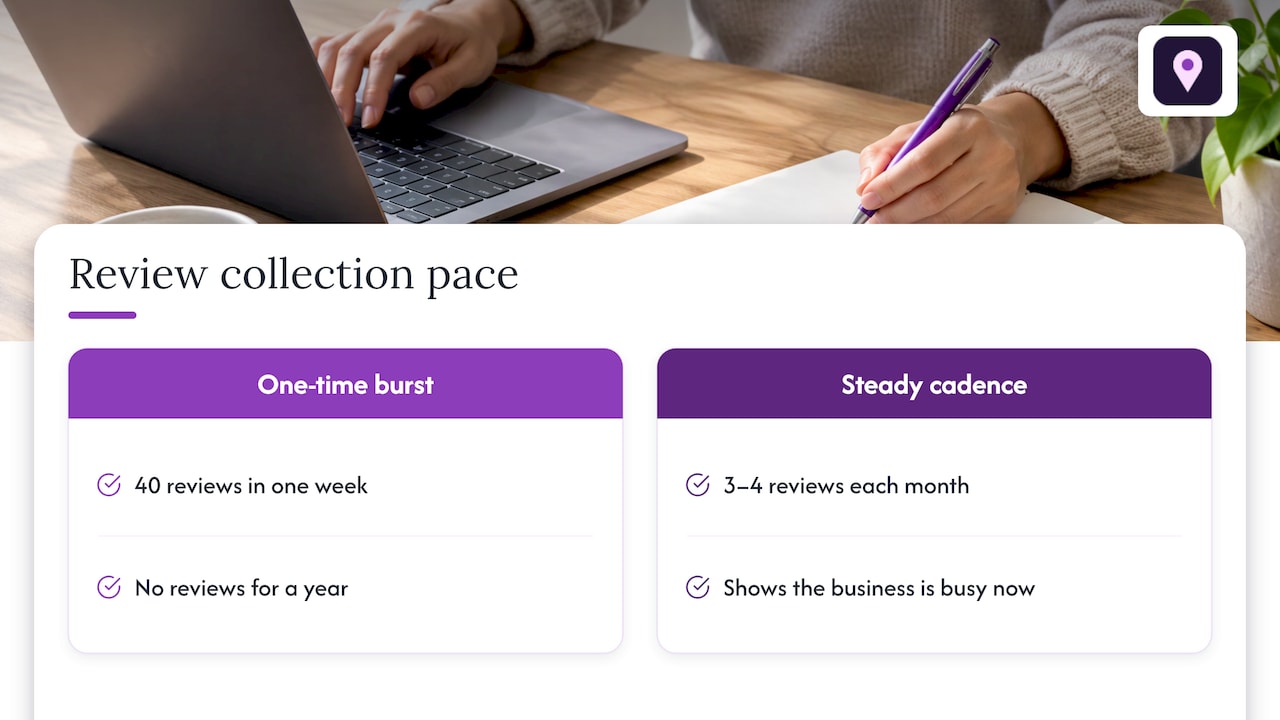
Imagine a plumber who sends a one-time blast to 200 past customers and collects 40 reviews in a week. Then nothing for a year. That profile has a strong total but a flat recent record. Compare it to a plumber who gets three or four reviews every month from jobs just completed. The second profile shows customers the business is busy now, and the review text tends to mention current services and neighborhoods.
Spikes also carry a risk. Google’s April 2026 post on Maps protections says that after a sudden spike in spam reviews, it will remove the fake content, pause new reviews on the profile, alert the owner and show a public notice to consumers. Genuine customers can be caught in a pause like that, so a gradual cadence is both more natural and safer than a burst.
Scale of enforcement is worth knowing too. Google reported that in 2025 its systems and analysts blocked or removed over 292 million policy-violating reviews. The filters are active, so shortcuts are not worth it.
How many reviews, and at what pace?
Google gives no official answer, so build your target from your own market:
- Open Google Maps and search the main service you want to rank for, from a few points in your service area.
- Note the review count and the date of the most recent reviews for the top three businesses.
- Set a monthly target that lets you match their recent pace first, then pass it.
A useful baseline for a service business with steady jobs is one review request per completed job. If you finish 30 jobs a month and 15 to 25 percent of customers respond, you will earn roughly five to seven reviews a month. That is an illustrative calculation, not a benchmark from a study. Your own response rate is the number that matters, so track it.
How to build a steady flow without breaking the rules
Google’s guidance is to create a review link or QR code from your Business Profile and place it on receipts, in thank-you emails, at the end of chat conversations or in your store. Requests can also go out by email, WhatsApp or a Facebook post. Reviews must reflect a genuine experience.
1. Get a link or QR code that opens the review box
The shortest path for a customer is one tap or one scan. Our guides on getting a Google review QR code and on the Google review QR code generator walk through the setup. Print the code on invoices, truck cards, counter signs and appointment reminders.
2. Ask at the moment of satisfaction
The best time to ask is right after a result the customer can see: the leak is fixed, the haircut is done, the keys are handed over. Send the link within a few hours by text or email while the experience is fresh. Keep the message short and personal, with the staff member’s real name as sender.
3. Make asking part of the job
Velocity fails when asking depends on memory. Add the request to the job-closing checklist or the invoice workflow, so it happens every time. This is where automation pays off: Local SEO Bot offers automated review generation, which turns the ask into a standing routine rather than an occasional push.
4. Reply to every review
Replies show future customers that someone is listening, and they keep the profile active. Google says reviews from genuine experiences are what count, and a prompt reply to each one reinforces that. Local SEO Bot includes AI-driven review replies, and our guide explains how to respond to a Google review. Our Google review guides cover tone for both praise and complaints.
5. Keep the cadence going in slow months
Seasonal businesses are most exposed to gaps. Keep asking in the off-season with whatever work you do complete, and keep the QR code visible so walk-in customers can respond.
What Google does not allow
Speeding up velocity the wrong way costs more than it gains. Google’s Maps User Generated Content policy prohibits merchants from offering incentives such as payment, discounts or free goods for posting, changing or removing reviews. It also prohibits discouraging negative reviews, selectively soliciting positive ones, and requiring staff to collect a set number of reviews or reviews with specific content, including mentions of a staff member by name.
The rules go beyond Google. The FTC’s rule on consumer reviews and testimonials, 16 CFR Part 465, was published in the Federal Register on August 22, 2024 and took effect on October 21, 2024. It prohibits buying or selling fake reviews, buying reviews conditioned on sentiment, undisclosed insider reviews, company-controlled fake review sites and review suppression practices.
In practice that means:
- Ask every customer, not only the ones you expect to be happy.
- Do not give discounts, gifts or entries in a draw for reviews.
- Do not set staff quotas for review counts or required wording.
- Do not buy reviews from anyone.
How to measure review velocity
You do not need special software to start. A spreadsheet is enough for the first quarter.
| Metric | How to calculate it | Why it matters |
|---|---|---|
| Reviews per month | New Google reviews in the calendar month | Your core velocity number |
| Request-to-review rate | Reviews received divided by requests sent | Shows whether your ask method works |
| Days since last review | Today minus date of newest review | Flags a gap before it grows |
| Share in last 90 days | Reviews from the last 90 days divided by total | Shows how fresh the profile looks |
| Reply rate | Replies divided by reviews | Shows whether you are keeping up |
Then connect the numbers to visibility. A single ranking check from your office tells you little, because Maps results change from block to block. Grid scans check your position from many points across your service area and show the picture as customers see it. Our Google Maps rank tracker runs those scans, and the local rank tracker page explains how to read them across a service area.
Compare month over month: did the share of grid points where you rank in the top three move after a steady quarter of reviews? Remember that reviews are one input among several, alongside category choice, profile completeness, citations and distance. A Google Business Profile audit helps you check the rest, so you do not credit or blame reviews for a change that came from something else.
For agencies: velocity across many locations
Agencies face the same problem multiplied by every client location. One client’s asks happen weekly and another’s never. Reporting velocity per location per month makes the gaps visible quickly. Local SEO Bot offers a white-label agency dashboard, review generation and monthly SEO reporting, so the routine and the report can run for each client location under your own brand. Agency pricing is on the Pro plan page.
Our perspective
Most local SEO tools give an owner a report that says “your review pace is low” and stop there. The owner already knows they are busy, and the report adds a task to a long list. Review velocity is a consistency problem, and consistency is exactly what software should handle.
That is why we built Local SEO Bot to do the work, not only describe it. It generates review requests, replies to reviews, optimizes the Business Profile, publishes regular posts and scans rankings across the service area with map grids. Behind the software, our team builds premium citations by hand on high-authority directories, so the profile earns more than review signals alone.
Our advice to any owner: aim for a steady, genuine flow, stay inside Google’s rules, and judge the results on the map, not on a feeling. We offer a 30-day money-back guarantee if a business does not see a ranking increase, because we are confident in the approach.
Devyn H
Put review velocity on autopilot
If you would rather not run the asking, replying and tracking by hand, Local SEO Bot handles it per location. The Foundation plan is $99 per month per location and the Growth plan is $199 per month per location, both on the pricing page. Pro is $399 per month per location for agencies, on the agency pricing page. Our review management tool page shows how the review side works, and the Google Maps SEO page covers the full approach.
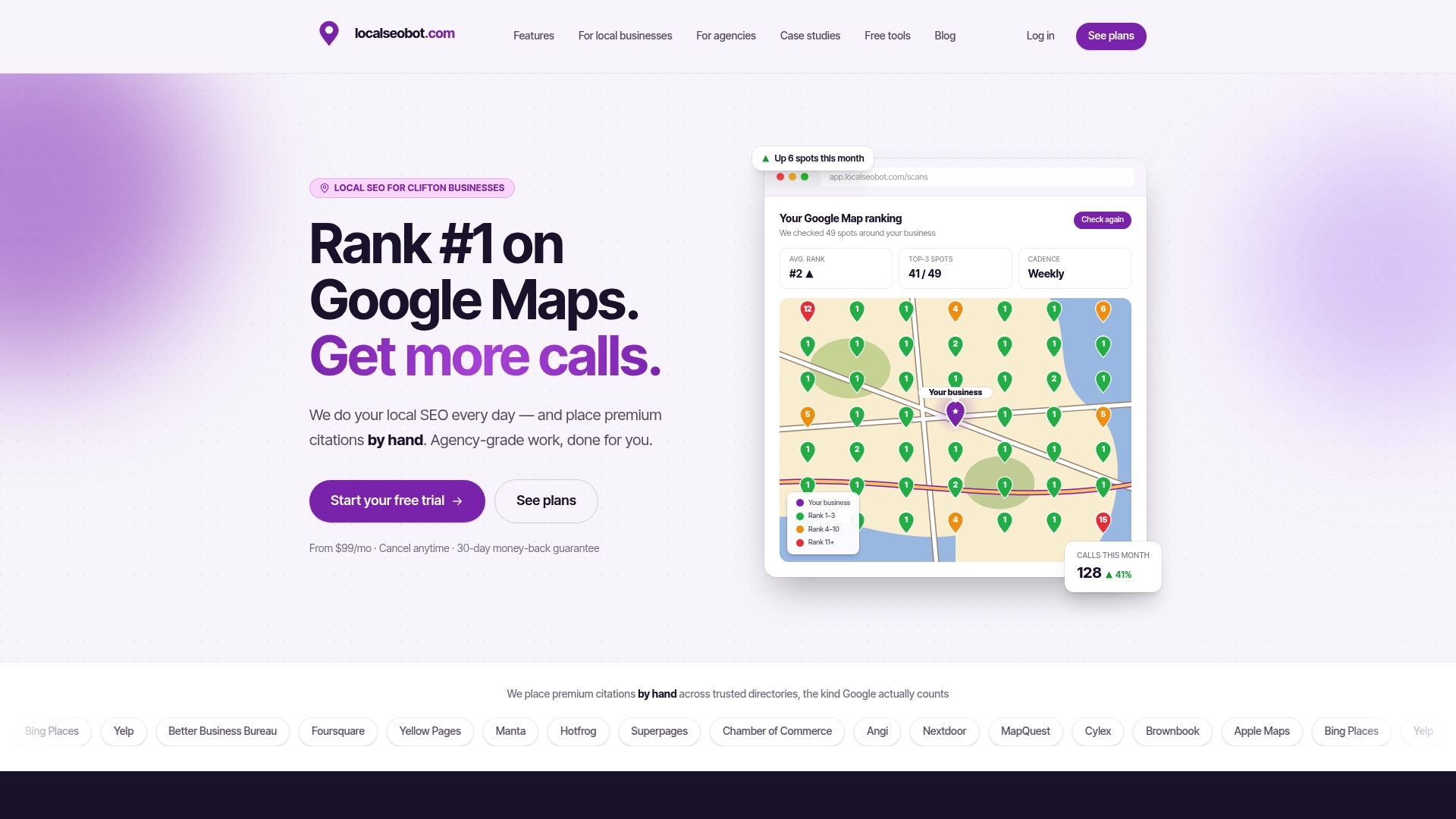
Every plan comes with the 30-day money-back guarantee if you do not see a ranking increase.
FAQ
Is review velocity an official Google ranking factor?
No. Google names relevance, distance and prominence, and says reviews and ratings can help prominence. It does not publish a velocity or recency factor. Velocity is a practitioner’s way of describing a steady review habit.
Can getting too many reviews too fast hurt my profile?
Genuine reviews are welcome, but sudden bursts can look unnatural. Google says that after a spike in spam reviews it can pause new reviews on a profile and show a notice to consumers. Spreading requests across your normal jobs avoids the pattern.
How often should I ask for reviews?
Ask after every completed job or visit. That ties your velocity to real business activity and keeps the flow steady. Use your own request-to-review rate to see what monthly count that produces.
Can I give a discount for a review?
No. Google’s policy prohibits offering payment, discounts or free goods or services in exchange for posting, changing or removing a review. The FTC’s 2024 rule also targets review manipulation, so keep every request incentive-free.
Sources
- Tips to improve your local ranking on Google, Google Business Profile Help
- Local Study Says Review Recency Impacts Local Rankings, Search Engine Roundtable
- Create a Google link or QR code to request reviews, Google Business Profile Help
- Prohibited and restricted content, Maps User Generated Content Policy
- New ways we’re protecting businesses on Maps, Google blog
- Trade Regulation Rule on the Use of Consumer Reviews and Testimonials, Federal Register