How Reviews Impact Google Maps Rankings in 2026
Published November 8, 2026
How Reviews Impact Google Maps Rankings in 2026

Reviews do influence where you show up on Google Maps, but they are one input among several, and nobody outside Google knows the exact weight. Google confirms that review count and positive ratings can help your local ranking. Third-party studies put the share anywhere from the mid-teens to the mid-twenties, depending on method and how far up the results you look. This guide separates what Google says from what studies suggest, then shows what to do about it.
TL;DR
- Google says more reviews and positive ratings can improve local ranking, because they feed the “prominence” part of its formula. Relevance and distance count too.
- Studies estimating review weight (roughly 15% to 26%) are correlations, not Google’s formula. Use them as direction, not as a rulebook.
- Quantity, rating, recency, review text and owner replies all play a role. A steady flow beats a one-time burst.
- Ask every customer through a review link or QR code. Never pay, discount or cherry-pick who you ask.
- Track your rankings on a map grid so you can see whether new reviews move you in the neighborhoods that matter.
Table of Contents
- What Google officially says about reviews and ranking
- What the studies suggest about review weight
- How to read these numbers without being misled
- The review signals that can affect your rankings
- Reviews versus distance and relevance
- How to earn more reviews without breaking the rules
- A simple monthly routine
- Our perspective: reviews are a routine, not a campaign
- Put reviews, replies and rank tracking on autopilot
- FAQ
- Sources
What Google officially says about reviews and ranking
Google’s own guidance is short. According to Google Business Profile Help, local results are based mainly on three things: relevance, distance and prominence. Prominence is how well known a business is, and Google lists review count and positive ratings as inputs to it. More reviews and good ratings can help your local ranking.
The same page makes two limits clear:
- There is no way to request or pay for a better local ranking.
- Google keeps the details of its ranking systems confidential.
So the honest summary is this: reviews matter, Google says so, and it will not tell you how much. Everything beyond that comes from experiments and expert opinion.
If you want the wider context on why ranking position itself pays off, this explainer on why Google rankings matter for visibility covers the basics. For the local angle specifically, our own breakdown of why Google reviews matter for local businesses goes deeper.
What the studies suggest about review weight
When you search for this topic, you will see percentages everywhere. Here is what the better-documented ones actually say.
| Finding | What it covers | What it means |
|---|---|---|
| Proximity influenced 55% of decisions for positions 1 to 21, while review count accounted for 19% | An analysis of 3,269 U.S. businesses in food, health, law and beauty | Distance dominates across the full list, with reviews second |
| In the top ten, proximity’s modeled influence fell to 36%, review count rose to 26%, and review-keyword relevance reached 22% | Same analysis | Once businesses are all nearby, reviews help separate them |
| Average star rating stayed close to 4.2 across positions 1 to 20 | About 8.6 million local search results | Ratings among ranked businesses are similar, so rating alone does not sort the list |
The first two rows come from a Search Engine Journal report on the 3,269-business analysis. The third comes from Street Fight’s report on roughly 8.6 million local results.
The pattern is useful. Reviews are rarely the factor that gets a business into the results from far away. They are more often the factor that decides who wins among businesses that are already close and relevant.

How to read these numbers without being misled
Three cautions keep you from overreacting to a headline percentage.
Correlation is not causation. The authors of the 3,269-business analysis say their feature importance scores show correlation, not causation. They also describe the results as a snapshot, and note that collecting data on a fixed grid may affect the proximity estimates (source).
Review count can be confounded by relevance. Street Fight explains that highly prominent businesses can be shown for searches they match less well, which creates an apparent link between rank and review volume that is partly explained by query relevance (source). Put simply, a business with 800 reviews that ranks first may be there for more than its reviews.
Average ratings do not move in a straight line with rank. A 4.9 does not automatically beat a 4.6. Past a reasonable threshold, other factors take over.
The practical conclusion: treat reviews as a reliable lever you can pull every week, not as a switch that guarantees position one.

The review signals that can affect your rankings
Reviews are not one signal. They are several, and each one is something you can influence.
Quantity
Google names review count as a prominence input. More reviews give Google more evidence that real customers know your business. They also give shoppers more to go on. A steady build matters more than a number: local SEO experts consider steady review acquisition, rather than sudden bursts, among the top 20 local-pack ranking factors, though that is expert opinion and not a Google-confirmed weighting (Search Engine Land).
Star rating
Google lists positive ratings as part of prominence. But Google also says honest, balanced reviews help customers decide, and that a mix of positive and negative feedback can feel more trustworthy. It adds that negative reviews are not necessarily evidence of poor business practices (Google Business Profile Help). You do not need a perfect 5.0. You need a strong, believable rating and a response to the critical ones.
Recency
Fresh reviews show a business is active. In a GatherUp study reported by Search Engine Land, 67% of consumers called review recency the most influential factor when choosing a local business, ahead of average star rating (Search Engine Land). Whether or not Google weighs recency heavily in ranking, your customers clearly do, and that affects the calls and clicks you get once you appear.
Review text and keywords
The 3,269-business analysis found review-keyword relevance reached 22% in the top ten (source). That is correlation, but it fits common sense: when customers mention “emergency water heater repair” or “deep tissue massage” in their own words, the text reinforces what your business is relevant for.
You cannot script this. Google prohibits requesting specific ratings or specific review content (Google Maps user contributed content policy). What you can do is make it easy to remember the details: ask a customer to describe what you did for them, and let the words be theirs.
Owner replies
Google says replying to reviews shows that you value feedback, and that positive reviews and helpful replies can help your business stand out (Google Business Profile Help). Google does not say replies are a direct ranking factor, so frame them as a trust and conversion signal that may also support prominence.
Google’s guidance on how to reply is specific: be professional, polite, concise, helpful and conversational, avoid promotional language, and address the specific feedback instead of posting identical thank-you messages (Google Business Profile Help). Our guide to review replies and SEO for small businesses gives examples of how to apply it.
Reviews versus distance and relevance
You can improve reviews, but you cannot move your building. That is why the weight of distance in the studies above matters. If a competitor sits two blocks from the searcher and you sit five miles away, reviews alone may not close the gap for that searcher.
This is where a map grid helps. A grid scan shows your position at many points across your service area, so you can see where you already win, where distance beats you, and where reviews and relevance could tip the result. A single “I rank #3” number hides all of that.
A realistic way to think about it:
- Relevance gets you considered. Your categories, services and Business Profile content do this work.
- Distance decides which neighborhoods you can realistically win.
- Prominence, including reviews, citations and general reputation, decides who comes out ahead among similar nearby options.
Reviews sit in the third group, but as the top-ten data shows, that group carries more weight the closer the competition gets.
How to earn more reviews without breaking the rules
Review tactics are where businesses get into trouble. Google’s rules are clear, and so is the law.
Do this
- Use a review link or QR code. Google recommends asking customers to review through a link or QR code, including on receipts, thank-you emails, chat interactions or in-store displays (Google Business Profile Help). Our Google review template helps with the wording of the request.
- Ask every customer. Not just the happy ones.
- Ask soon after the job. The experience is fresh and the details are specific.
- Reply to every review, with specifics.
Never do this
- Offer payment, discounts, free goods or free services for a review, a revision or the removal of a negative review. Google prohibits all of these (Google policy).
- Selectively solicit only positive reviews, discourage negative ones, or pressure people to review on your premises. Same policy.
- Ask staff, family or friends to review without disclosing the relationship, or ask people who have not used your service. The Federal Trade Commission lists these among the practices to avoid (FTC guide for marketers).
- Buy reviews. The FTC says marketers remain responsible for deceptive review activity done on their behalf, and that fake-review services can lead platforms to remove reviews or suspend accounts and listings (same FTC guide).
The penalty is real. Google says fake or incentivized review activity can lead to reviews being removed and profile restrictions, including temporarily blocking new reviews, unpublishing existing ones, or showing a warning that fake reviews were removed (Google Business Profile Help). A shortcut that costs you your existing reviews is not a shortcut.
If you spot a review you believe violates Google’s policies, flag it. For handling and tracking at scale, see our overview of a Google Business Profile reviews management tool.
A simple monthly routine
Consistency is the whole game, so build a routine you can keep.
- Set up one review link and put it in your invoice emails, receipts, texts and a counter QR code.
- Send the request at the same point in every job, for example the day after completion.
- Reply to each new review within a few days. Mention something specific from the review, thank the person, and keep it free of sales pitches.
- Answer critical reviews calmly. Acknowledge the issue, state what you can do, and offer to continue offline. Future customers read these replies too.
- Re-scan your map grid monthly. Compare the same keywords and the same grid so you see real movement.
- Keep the rest of your profile current. Reviews work best on a complete profile with correct categories, services, photos and regular posts. Our Google Business Profile audit shows what to check.
Then judge the effort by calls, direction requests and grid position over a few months, not by one week’s change.
Our perspective: reviews are a routine, not a campaign
We see the same pattern with small business owners again and again. They know reviews matter, they ask for a few in a burst after reading an article like this one, and then the habit fades. Three months later the newest review is old, and no one has replied to the last four.
That is why we built Local SEO Bot to do the work, not just report on it. It helps generate reviews, replies to them with AI, optimizes the Business Profile, publishes regular posts and tracks rankings with map grid scans, all on autopilot. Reviews are only one part of prominence, so behind the AI our team manually builds premium citations on high-authority directories to add signals Google trusts.
Our view is simple: nobody can promise you a ranking from reviews alone, because Google does not publish its formula. What you can control is consistency, and consistency is exactly what an owner running a busy shop has the least time for. We stand behind the approach with a 30-day money-back guarantee if a business does not see a ranking increase.
Devyn H
Put reviews, replies and rank tracking on autopilot
If you would rather not run this routine by hand, Local SEO Bot handles the review requests, the replies, the profile optimization and the rank tracking for each location. Plans are billed per location, per month: Foundation is $99 per month per location, and Growth is $199 per month per location. You can compare them on the pricing page. Agencies managing client locations can use the Pro plan at $399 per month per location, with white-label options, on the agency pricing page.
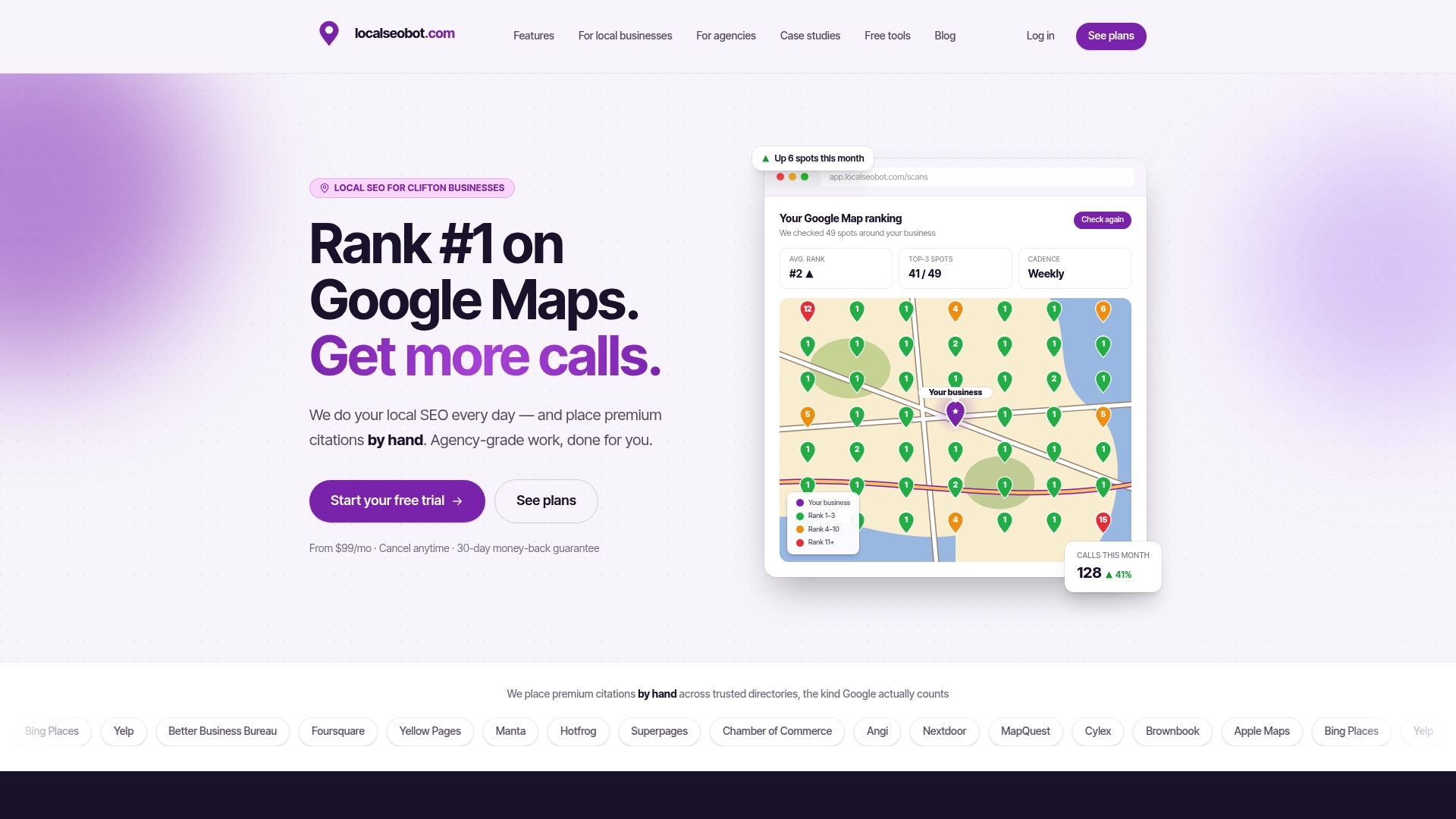
Want to see where you stand before you commit? Our Google Maps rank tracker runs grid scans across your service area, so you can see exactly which neighborhoods your reviews are helping you win.
FAQ
Do Google reviews help you rank higher?
Yes, they can. Google says more reviews and positive ratings can help your local ranking, because they contribute to prominence. Reviews work alongside relevance and distance, so they improve your chances rather than guarantee a position.
How many reviews do I need to rank?
There is no official number. The right target is a steady flow that matches or beats the competitors in your category and area. Check the top three businesses on your main keyword, note their review counts and how recent their latest reviews are, and aim to keep pace month after month.
Do replies to reviews affect rankings?
Google says replying shows you value feedback and that helpful replies can help your business stand out. It does not say replies are a direct ranking factor. Write specific, polite, non-promotional replies, since customers read them when deciding who to call.
Will a few negative reviews hurt my ranking?
Google says a mix of positive and negative feedback can feel more trustworthy, and that negative reviews are not necessarily a sign of poor practices. Reply professionally, address the specifics, and keep collecting reviews from every customer so the overall picture stays strong.
Is it safe to buy Google reviews?
No. Google prohibits paying for reviews and can remove reviews, block new ones or restrict your profile. The FTC also holds marketers responsible for deceptive review activity done on their behalf. Earn reviews with a review link or QR code instead.
Sources
- Tips to improve your local ranking on Google, Google Business Profile Help
- Tips to get more reviews, Google Business Profile Help
- Create a Google link or QR code to request reviews, Google Business Profile Help
- Prohibited and restricted content, Maps user contributed content policy
- Business Profile restrictions for policy violations, Google Business Profile Help
- Soliciting and Paying for Online Reviews: A Guide for Marketers, Federal Trade Commission
- Review Signals Gain Influence In Top Google Local Rankings, Search Engine Journal
- Ranking Correlations with Other Reputation and Search Metrics Are Not Linear, Street Fight
- Google Reviews & SEO: Advanced Strategies That Scale, Search Engine Land