BBB Listing SEO: How to Optimize Your Profile for Growth
Published August 14, 2026
BBB Listing SEO: How to Optimize Your Profile for Growth

A BBB listing helps local visibility and conversions, but it works as an indirect signal, not a direct Google ranking factor. Google representatives, including Danny Sullivan, have confirmed BBB ratings play no role in ranking algorithms. That doesn’t make the listing pointless. It makes it a different kind of asset.
Here’s what a BBB profile actually does for you:
- Adds a consistent NAP (name, address, phone) citation that helps search engines confirm your business identity
- Gives trust-sensitive buyers a reason to convert once they’ve already found you through other channels
- Improves your odds of surfacing in voice search and “near me” results when the profile is complete, per BBB’s own optimization guidance
Quick stat check: Search Engine Journal’s reporting confirms Google has stated plainly that BBB accreditation and rating scores don’t factor into its ranking systems. Any lift you see from a BBB profile comes from citation consistency and conversion psychology, not algorithmic favoritism.
If you already have a BBB profile sitting unclaimed or half-filled out, that’s your first move. Claim it, verify every field, and only then think about whether paying for accreditation makes sense. Get your core local SEO fundamentals (Google Business Profile, site content, citations) in order before you spend a dollar on BBB accreditation.
Key Takeaways
A BBB listing delivers indirect SEO value through citation consistency and conversion trust, not through direct ranking influence, so treat it as one part of a broader local SEO strategy.
| Point | Details |
|---|---|
| Not a ranking factor | Google has confirmed BBB ratings and accreditation don’t influence its ranking algorithms directly. |
| Claim and normalize first | Verify your BBB profile exists, then match your NAP exactly to your Google Business Profile. |
| Build a review cadence | Consistent review generation and fast responses matter more than the BBB badge alone. |
| Accreditation is conditional | Pay for it in trust-sensitive, high-ticket categories; skip it if your core SEO foundation isn’t solid yet. |
| Measure before assuming impact | Use tools like Localseobot to track citation consistency and Google Maps rank changes alongside BBB updates. |
Table of Contents
- Free BBB Profile vs. BBB Accredited Business: What’s the Difference?
- Does a BBB Listing Actually Move Your SEO Needle?
- How to Optimize Your BBB Listing for Maximum Impact
- Managing BBB Reviews and Complaints Without Losing Sleep
- Connecting Your BBB Profile to the Rest of Your Local SEO Stack
- Is BBB Accreditation Worth Paying For?
- Mistakes That Quietly Undermine Your BBB Listing’s Value
- Your Step-by-Step BBB Listing Action Plan
- What Happens When Citation Work and BBB Optimization Combine
- What BBB Listings Are Actually Good For
- Let Localseobot Handle the Citation Work You Just Read About
- Frequently Asked Questions
- Sources
Free BBB Profile vs. BBB Accredited Business: What’s the Difference?
Every business can get a free BBB Business Profile just by existing in their system or claiming a profile through the BBB directory. Accreditation is a separate, paid tier that adds a badge and a few operational perks. Knowing which one you actually need saves you money and protects your marketing budget from a purchase that won’t move the needle.
What comes with a free BBB Business Profile:
- Basic NAP listing (business name, address, phone number)
- Ability to display and respond to customer reviews
- A public complaint history, whether you want one or not
- The ability to claim the profile and edit basic details
What accreditation adds on top of that:
- The BBB Accredited Business Seal, which you can display on your website and marketing materials
- Access to BBB’s dispute resolution process for handling customer complaints formally
- Placement in BBB’s accredited-only category pages, which some buyers filter by specifically
- A membership fee that varies by business size and local BBB chapter, typically billed annually
The BBB homepage walks through accreditation and the seal directly, and it’s worth reading before you commit. For context on where this fits into the broader market, BBB’s own category page for accredited SEO services lists dozens of marketing firms that have paid for accreditation, which tells you something: in industries where trust is the product, competitors are already using this as a differentiator.
The practical difference shows up in three places: how discoverable you are (both tiers get indexed and searchable), how much trust signal you project on your own site (only accreditation gives you the seal), and how you can talk about it in proposals or pitches (an accredited status is a credibility line item; a free profile isn’t).
Does a BBB Listing Actually Move Your SEO Needle?
No, not directly. Google has said outright that BBB ratings and accreditation status don’t factor into its ranking algorithms, a point Search Engine Journal documented clearly using statements from Google’s own Danny Sullivan. If you’ve read blog posts claiming a BBB badge will push you up the map pack, that advice is outdated at best.
What a BBB listing does instead is support a handful of indirect mechanisms that add up over time:
- NAP citation consistency. Your BBB profile is one more data point search engines use to confirm your business name, address, and phone number match across the web. It’s one citation among many, not a standalone strategy on its own.
- Branded search presence. When someone searches your business name, a well-optimized BBB profile is more likely to appear alongside your Google Business Profile and website, filling more of the results page with your own trusted content.
- Answer Engine Optimization (AEO). BBB explicitly advises that complete, accurate profiles improve your odds of appearing in voice search results and AI-generated answer snippets, which matters more each year as more searches happen through assistants rather than a traditional results page.
- Review volume signals. A steady stream of reviews on your BBB profile, alongside Google reviews, contributes to the overall prominence signal search engines use when weighing local businesses.
One caution worth flagging: older SEO advice treated BBB listings as a link-building tactic, chasing the “authority” of a bbb.org backlink. In practice, most directory links, including many from BBB, are nofollowed or configured to pass little direct ranking equity. Treat your BBB listing as a trust and citation asset, not a backlink play.
The realistic expectation for your SERP is this: you won’t outrank a competitor because you’re BBB accredited and they’re not. But you will show up more often in branded searches, voice queries, and trust-driven comparison moments, which tends to lift click-through rate and conversion even when your organic position hasn’t budged an inch.
How to Optimize Your BBB Listing for Maximum Impact
Once you’ve decided to invest time in your profile, the fastest wins come from getting the fundamentals airtight before you touch anything else. Work through this in order:
- Normalize your NAP across every platform first. Your BBB address format, phone number format, and business name need to match your Google Business Profile and other directories exactly. Even a “Suite 200” versus “Ste. 200” difference creates a mismatch that search engines have to reconcile. A local citation finder can flag these inconsistencies faster than a manual audit.
- Write a clear, non-promotional business description. Aim for two to four sentences describing what you do, who you serve, and your service area. Skip the superlatives. BBB’s own local guidance warns that overly promotional or keyword-stuffed copy can get flagged or rejected during review.
- Choose accurate categories, not aspirational ones. Pick the category that matches your primary service. If you’re a plumber who occasionally does HVAC work, list plumbing first.
- List your service areas explicitly. Name the cities or neighborhoods you actually serve, rather than a vague regional claim.
- Upload three to five photos minimum. Storefront shots, team photos, and completed work all help. Profiles with visual proof tend to convert better than text-only listings, even though photos aren’t a direct ranking input.
- Add your accreditation seal to your website, if applicable. Place it near your contact form or in the footer, where trust signals do the most work at the point of decision.
- Set a recurring audit schedule. Check your profile quarterly for consistency drift, especially after any address change, rebrand, or new service area.
Pro Tip: Don’t update your BBB description the week before a big campaign launch. Edits are reviewed by BBB staff and aren’t always published instantly, so changes to your description, photos, or categories can sit in a moderation queue for days.
Managing BBB Reviews and Complaints Without Losing Sleep
Customer reviews and BBB complaint records are two different things, and prospects read them differently. A review is a star rating and a comment, similar to what you’d see on Google. A complaint is a formal record run through BBB’s dispute resolution process, and it stays visible on your profile whether or not it gets resolved. A pile of unanswered complaints does more reputation damage than a handful of three-star reviews ever will.
The instinct with a negative review or complaint is to get defensive or ignore it. Resist both. Here’s what actually works:
- Respond within 48 hours whenever possible; slow responses read as indifference to anyone reading later.
- Keep your public response short, professional, and focused on resolution, not on litigating who was right.
- Move detailed back-and-forth to a private channel (phone or email) once you’ve acknowledged the issue publicly.
- Escalate to BBB’s formal dispute resolution process only when direct communication with the customer has stalled.
- Never argue with a reviewer in the comments. It’s visible to every future customer who reads that thread.
A response like “We’re sorry this didn’t meet your expectations. We’ve reached out directly to make it right and would welcome the chance to discuss a resolution” does more for your reputation than a five-paragraph defense ever could. Short, calm, and resolution-focused responses outperform long ones almost every time.
Don’t skip the accreditation seal on your site just because you handled a complaint well. The seal and a clean, responsive review history work together. One shows a third party vouched for you; the other shows you actually behave that way in practice.
Connecting Your BBB Profile to the Rest of Your Local SEO Stack
A BBB listing that contradicts your Google Business Profile is worse than no BBB listing at all, because it hands search engines a reason to doubt which version of your business information is accurate. Treat integration as a checklist, not an afterthought:
- Match your business name, address, and phone number exactly across BBB, Google Business Profile, and every other directory you’re listed in.
- Copy the same business description and operating hours to both platforms, adjusting only for character limits.
- List identical service areas on BBB and Google Business Profile; don’t claim five cities on one and two on the other.
- Add links to your social profiles where BBB’s platform allows it, reinforcing the same brand identity everywhere.
- Use structured data on your own website, specifically LocalBusiness schema, and AggregateRating schema if you’re referencing customer ratings, to help search engines connect the dots between your site and your directory listings.
For monitoring, track a small set of metrics rather than obsessing over everything:
- Branded search visibility (how often your business name triggers your own listings in results)
- Referral clicks and traffic coming specifically from your BBB profile
- Google Maps rank changes over the same period you’re doing citation work
Tools like a citation consistency analyzer or a Google Business Profile optimizer can catch mismatches before they compound. For a deeper look at how AI-driven search is reshaping what “visibility” even means, this breakdown of AI-driven search strategy is worth a read alongside your citation work.
Is BBB Accreditation Worth Paying For?
This comes down to a straightforward cost-versus-benefit question, and the answer changes depending on your industry and your existing trust footprint. Run through this checklist before you pull out a credit card.
Signals that accreditation is likely worth it:
- You’re in a trust-sensitive category (home services, financial services, moving, legal) where buyers actively research credibility before hiring
- Your average transaction value is high enough that one converted lead covers the annual fee many times over
- Your target customers are known to research vendors on BBB specifically before making contact, which is common in categories like moving and contracting, per SBTDC’s analysis of accreditation ROI
Signals that accreditation is a lower priority right now:
- You already have a strong, high-volume review presence on Google and other platforms
- Your local market has limited BBB search demand, meaning customers just aren’t checking there
- Your marketing budget is tight and would deliver more return spent on service pages, citations, or review generation
If you’re on the fence, run a simple experiment before committing to a full year:
- Track how many leads or inquiries reference finding you through BBB over a short window of time.
- Compare your branded search click-through rate before and after adding the seal to your website, if possible.
- Measure any differences in conversion rate between pages with the accreditation seal visible and those where it is not.
Accreditation is primarily a reputation and trust expense. If your core SEO foundation, meaning your site content, technical health, and review volume, isn’t solid, accreditation won’t compensate for those gaps.
Mistakes That Quietly Undermine Your BBB Listing’s Value
Most of the SEO value a BBB profile could deliver gets lost through avoidable errors, not through anything BBB itself does wrong. Watch for these specifically:
- Subtle NAP inconsistencies. “123 Main St” on BBB versus “123 Main Street” on Google Business Profile looks like a minor style choice to you and a data conflict to a search engine.
- Keyword-stuffed descriptions. Cramming “best plumber near me, emergency plumbing, 24/7 plumber” into your description doesn’t help discoverability and risks rejection during BBB’s editorial review.
- Ignoring reviews and complaints for weeks at a time. A stale profile with unanswered complaints signals neglect to anyone doing due diligence before hiring you.
- Never using the accreditation seal you’re paying for. If you’ve paid for accreditation but the seal isn’t on your website, you’re paying for a credibility signal your prospects never see.
- Treating the profile as “set it and forget it.” Business details change: hours, service areas, phone numbers. A profile that goes stale for a year actively works against you.
Every one of these has a five-minute fix. The problem is that none of them feel urgent until a prospect notices the mismatch first.
Your Step-by-Step BBB Listing Action Plan
Here’s how to sequence the work so you’re not trying to do everything at once:
Days 0 to 7:
- Claim your BBB profile if it exists unclaimed, or submit a request to add one through the BBB directory.
- Verify and correct your NAP to match your Google Business Profile exactly.
- Upload three to five photos showing your storefront, team, or completed work.
- Add your business hours and confirm your website URL links correctly.
Weeks 1 to 4: 5. Complete your services and product fields with specific, accurate descriptions. 6. Set up a consistent review generation habit, asking satisfied customers for feedback on a regular cadence. 7. Add the accreditation badge to your homepage and key service pages, if you’ve decided to pursue it.
Ongoing, monthly: 8. Audit NAP consistency across BBB, Google Business Profile, and other directories for drift. 9. Respond to any new reviews or complaints within 48 hours. 10. Monitor branded search visibility and referral traffic coming from your BBB profile.
Budget for moderation delays throughout this process. Profile edits go through BBB staff review and don’t always publish instantly, so don’t plan a campaign launch around a description change you submitted yesterday.
What Happens When Citation Work and BBB Optimization Combine
A pattern that shows up consistently in local SEO work: businesses that tighten their citation consistency and fill out a complete BBB profile at the same time as improving their Google Business Profile and site content tend to see better branded search real estate and higher conversion rates than businesses that touch only one of those levers.
The lift rarely comes from BBB alone. It comes from removing every small inconsistency, across your website, your Google Business Profile, and your BBB listing, at the same time, so search engines and prospective customers see one coherent version of your business everywhere they look.
The honest caveat here matters: when a business improves citations, adds review generation, and updates its BBB profile all in the same quarter, you can’t cleanly attribute the resulting SERP or conversion gains to BBB in isolation. Site speed fixes, new service pages, and review volume are all happening simultaneously. What you can say with confidence is that the combination works, and profile completeness, a steady review program, and visible badge placement are the three elements worth replicating regardless of which lever gets the most credit. A similar pattern shows up in this case study on local SEO tools driving bookings for EV service centers, where coordinated citation and profile work moved metrics that no single tactic could move alone.
What BBB Listings Are Actually Good For
Treat your BBB profile as a credibility play, not a ranking hack. In trust-sensitive categories, home services, financial products, anything with a long consideration cycle, a clean BBB profile removes a small amount of friction at exactly the moment a prospect is deciding whether to call you or the next name on their list. That’s real, measurable value. It’s just not the value most business owners assume they’re buying when they sign up.

Where I’d push back on conventional advice: too many small businesses treat BBB accreditation as a checkbox they can buy their way past, then wonder why nothing changed. The businesses that actually see a return are the ones that already have their fundamentals in order, consistent citations, a real review cadence, service pages that answer buyer questions, and use BBB as one more consistent, complete touchpoint layered on top. If your citations are a mess or your Google Business Profile is half-finished, accreditation fees are better spent fixing those first.
The budget allocation question I get asked most often has a fairly boring answer: reviews, service page content, and citation consistency usually deliver more lift per dollar than an accreditation fee. That doesn’t mean skip BBB. It means sequence it correctly, and don’t expect a badge to do work that your core SEO foundation hasn’t earned yet.
Let Localseobot Handle the Citation Work You Just Read About
Everything in this guide, normalizing your NAP, auditing for consistency drift, tracking whether your visibility actually improves, is exactly the kind of work that eats an afternoon every single month if you’re doing it by hand. Localseobot builds premium citations manually across high-authority directories instead of relying on automated placements that generate the same subtle NAP mismatches this guide just warned you about.
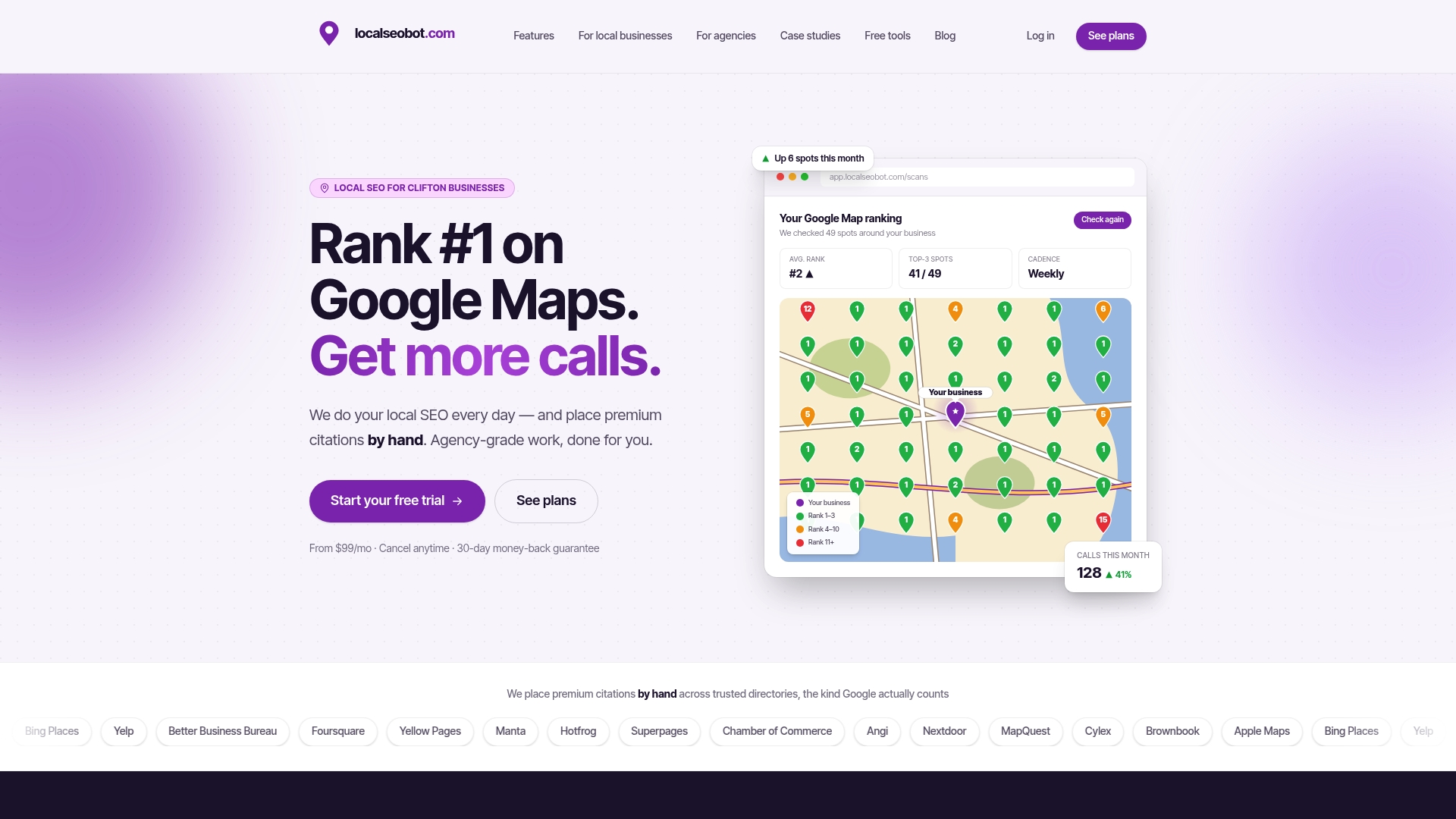
That manual approach matters specifically because BBB profiles and other directory listings only pay off when your business information matches everywhere, and one auto-generated citation with the wrong suite number can undo weeks of profile optimization. Localseobot also tracks your Google Maps rank with geo-grids, so you can measure whether your BBB and citation work is actually translating into better local visibility, not just guess. If you’ve ever wondered whether your citation work is paying off, run your business through the Local SEO Checklist Tool to see exactly where your profile stands today, and start from there.
Frequently Asked Questions
Does a BBB listing directly improve my Google ranking? No. Google has stated plainly that BBB ratings and accreditation status aren’t used in its ranking algorithms. Any benefit comes from citation consistency and conversion trust, not a direct ranking boost.
How much does BBB accreditation typically cost? Fees vary by business size and local BBB chapter, and they’re billed annually. Check with your regional BBB office for exact pricing rather than relying on a flat number, since it differs by market.
How long does it take for BBB profile edits to go live? Edits go through staff review and aren’t always published instantly. Budget for a delay of a few days when updating your description, photos, or categories.
Is a free BBB profile enough, or do I need accreditation? For most small businesses outside trust-sensitive, high-ticket categories, a complete free profile with consistent NAP and active review management delivers most of the available benefit. Accreditation makes more sense when your buyers actively research credibility before purchasing.
What’s the single biggest mistake businesses make with their BBB listing? Letting NAP details drift out of sync with their Google Business Profile and other directories. Even small formatting differences create conflicting signals that undercut the citation value the listing is supposed to provide.
Sources
- BBB Rating: Is It A Google Ranking Factor? — Search Engine Journal
- BBB accreditation: worth the cost or just another business expense — SBTDC
- Bbb
- Maximize your accreditation benefits — BBB Local