Local SEO Audit Checklist for Small Businesses: Fix High Impact Gaps
Published October 11, 2026
Local SEO Audit Checklist for Small Businesses: Fix High Impact Gaps

A complete local SEO audit checks Google Business Profile accuracy, review health, citation consistency, local backlinks, on-page signals, technical performance, keyword coverage, and ongoing monitoring. Start by verifying your Google Business Profile and confirming your name, address, and phone number match everywhere online. These two steps alone catch the issues that most often block local pack visibility.
TL;DR:
- Google Business Profile signals account for roughly 32% of local pack rankings; verify ownership, remove duplicates, and keep categories, hours, photos, and service areas current.
- Reviews carry about 16% of ranking weight, so reply within 48 hours with details from each visit and report suspected fake or incentivized posts.
- Match your business name, address, and phone number exactly across Google Business Profile, your website, and directories; remove duplicate or outdated listings first.
- Use unique location pages with local metadata, visible contact details, and validated schema; ensure canonical tags point to themselves and pages remain crawlable.
- Local rankings vary by search location, so scan a geo grid across your service area rather than checking only near your business.
Table of Contents
- Google Business Profile audit: verify, complete, and optimize your profile
- Review and reputation audit: measure, respond, and plan review growth
- Citations and local listings audit: find and fix NAP inconsistencies
- Backlink and local authority audit: assess local link signals and toxic links
- On-page local SEO audit: location pages, metadata, schema, and internal linking
- Technical SEO audit for local: performance, crawlability, indexation, and structured data health
- Keyword research and local rankings audit: map keywords and verify map-pack visibility
- Analytics, Search Console, and monitoring: KPIs to track and dashboards to build
- Prioritization and action plan: convert findings into an impact vs. effort roadmap
- What local SEO audits miss most often
- How Local SEO Bot turns audit findings into ranking gains
- FAQ
- Sources
Google Business Profile audit: verify, complete, and optimize your profile
Google Business Profile signals carry the single largest weight in local pack rankings, at roughly 32% of the ranking formula, which makes this the first stop in any audit. Before touching anything else, confirm your profile is verified and that you are not managing a duplicate or an unclaimed listing competing against your main one.
Google’s own guidance on representing your business requires accurate, real world information: one profile per location, a business name that matches your signage and legal name, and a primary category that reflects what you actually do, not what you wish you ranked for. Local rankings run on relevance, distance, and prominence, so every field you leave blank or mismatched works against you on all three.
Work through these fields in order:
- Business name matches your storefront and legal filings exactly, with no keyword stuffing.
- Primary and secondary categories reflect your core service, checked against competitors in the map pack.
- Address, service area, phone number, and website link all point to verified, current channels.
- Hours, including holiday and special hours, are current for the next 90 days.
- Photos, products, services, and attributes are filled in and updated quarterly.
Google’s guidance on improving local ranking also points to review replies and fresh photos as supporting signals for prominence, which ties this section directly into the review audit that follows. If verification fails or shows “pending,” check for a duplicate listing first: that is the most common blocker. Our Google Business Profile Optimizer flags these conflicts automatically during a scan.
Pro Tip: Re-verify your service area radius every time you add a new location or technician route; a stale radius quietly shrinks your map pack reach.
Review and reputation audit: measure, respond, and plan review growth
Review signals account for about 16% of local pack ranking weight, and they double as the trust signal customers see before they ever click through. Start by pulling your current volume, average star rating, review recency, and the spread across platforms, not just Google.
Look at how fast you reply and whether replies read as generic or specific. A templated “thank you for your feedback” on every review signals neglect, while a specific reply that references the service performed signals an active, attentive business, which Google’s own guidance names as a factor supporting prominence.
Scan for suspicious patterns: a cluster of five-star reviews posted the same week, reviews from accounts with no other activity, or language that sounds incentivized. Google’s Maps content policy prohibits fake or incentivized reviews and can remove content or penalize accounts that violate it, so flag and report anything that looks manipulated rather than ignoring it.
Priority actions for this section:
- Reply to every review within 48 hours, referencing specifics from the visit or job.
- Build a simple request cadence: ask happy customers at the moment of service completion, not days later.
- Audit for and report fake or incentivized reviews rather than disputing them individually in comments.
Pro Tip: Ask for reviews with a direct link to your Google review form, not a generic “leave us feedback” message. Specificity in the ask produces specificity in the reply.
Citations and local listings audit: find and fix NAP inconsistencies
Your business name, address, and phone number need to match, character for character, across every directory that lists you. A mismatched suite number or an old phone number on a high-authority directory confuses the algorithms that cross-reference your identity, and it confuses customers trying to find you.
- Compile a citation inventory: search your business name and old addresses, then check the major aggregators (Data Axle, Foursquare, Neustar) and top vertical directories for your industry.
- Cross-check every listing against your verified GBP data, since GBP is the source of truth the rest of your citations should match.
- Fix or remove duplicate, closed, or outdated listings first, since duplicates actively compete with your main profile for visibility.
- Correct mismatched NAP fields on the highest authority directories before moving to smaller or niche sites.
- Confirm your website’s contact page and footer match your GBP data exactly, then check that your structured data reflects the same name, address, and phone number.
Manual cleanup across dozens of directories is tedious, which is why we built a Citation Consistency Analyzer that scans your listings and surfaces mismatches in one pass instead of one directory at a time.
Backlink and local authority audit: assess local link signals and toxic links
Link signals make up roughly 15% of local ranking weight, and for local businesses, the quality bar looks different than it does for national sites: a link from your local chamber of commerce often carries more relevance than a generic directory link from a national aggregator.
Pull your referring domains and flag which ones are genuinely local versus national or irrelevant. A backlink audit tool will show referring domain counts and a spam score, but the real work is sorting those domains by local relevance, not just raw authority.
- Identify your current local referring domains: chambers of commerce, local news coverage, sponsorships, and partner businesses.
- Flag spammy or clearly irrelevant links for disavow consideration, reserving disavow requests for links that are actively harmful, not just low value.
- Reach out to local organizations you already sponsor or partner with and ask for a link where one does not already exist.
- Pitch local news outlets or community blogs with a newsworthy angle tied to your business, not a generic press release.
Converting existing relationships into links is almost always faster than cold outreach. If you sponsor a youth league or sit on a local business association, that is a link waiting to be asked for.
On-page local SEO audit: location pages, metadata, schema, and internal linking
On-page signals represent about 19% of local ranking weight, the second-largest share after GBP, which means your title tags, headers, and location page content carry real weight beyond user experience.
Map each target keyword to a specific page, then check that page’s title tag, meta description, and H1 for local intent. A page titled “Services” with no city or neighborhood mention is a missed opportunity every time someone searches with a location modifier.
- Each location page has unique content, not a copy-pasted template with the city name swapped.
- NAP data appears visibly on the page, not just in the footer in small type.
- Service details, pricing ranges where appropriate, and a clear call to action appear above the fold.
- LocalBusiness schema is implemented and validated, with correct
openingHoursSpecificationformatting as Schema. - Internal links from your homepage and blog posts point to relevant location and service pages.
This partner checklist on essential on-page SEO steps covers metadata structuring in more depth if you want a broader on-page reference beyond the local-specific items here. For the schema piece specifically, our guide to LocalBusiness schema markup walks through the exact properties and common formatting mistakes.
Pro Tip: Duplicate content across location pages is one of the most common on-page failures we see: write at least 150 words of genuinely unique copy per location, covering neighborhoods served and location-specific details.
Technical SEO audit for local: performance, crawlability, indexation, and structured data health
A beautifully optimized GBP and a flawless citation profile will not save a location page that search engines cannot crawl or that loads too slowly for mobile visitors to wait around for.
- Run a mobile usability and Core Web Vitals check on your location and service pages, then prioritize fixes that affect loading speed and layout stability over cosmetic issues.
- Check your robots.txt file and XML sitemap to confirm location pages are not accidentally blocked or excluded.
- Review canonical tags on every location page to make sure each one points to itself, not to a single catch-all page that would cause duplicate content problems.
- Confirm indexation status in Google Search Console for each location page individually, since a page can exist and still sit unindexed.
- Validate structured data for errors using the fields Schema.org’s LocalBusiness type documents, paying particular attention to date and time formatting in hours specifications.
A single misconfigured canonical tag or an accidentally blocked directory in robots.txt can quietly remove an entire set of location pages from search results, which is why this check belongs early in every audit cycle, not as an afterthought.
Keyword research and local rankings audit: map keywords and verify map-pack visibility
Start by building a local keyword set that covers your core services, “near me” variations, neighborhood names, and intent modifiers like “emergency,” “same-day,” or “affordable.” A plumber auditing their own keyword coverage should see city-wide terms, neighborhood-specific terms, and service-specific long-tail phrases all represented, not just one category.
Map each keyword to the page best suited to rank for it, and flag gaps where a valuable keyword has no dedicated page at all. This is often where audits uncover the biggest content opportunity: a service you offer with no page describing it.
- Build your keyword list from services offered, neighborhoods served, and common intent modifiers.
- Map each keyword to an existing page or flag it as a content gap to fill.
- Run geo-grid scans across your full service area rather than checking rank from a single point, since map pack results shift by location.
- Document your ranking baseline today so future audits can measure actual movement.
Rankings for “near me” searches vary meaningfully depending on exactly where the search happens, which a single rank check from your office address will not capture. Our Google Maps Rank Tracker runs grid scans across a full service area so you see how rankings actually shift by neighborhood.
Analytics, Search Console, and monitoring: KPIs to track and dashboards to build
Once the fixes are in place, you need a way to confirm they worked. Start by auditing your Google Search Console property settings and your Analytics configuration to make sure both are actually tracking the right domain and properties, since a misconfigured property will quietly undercount everything that happens afterward.
- Track calls, direction requests, map views, and website clicks from your GBP insights, not just website sessions.
- Monitor Search Console for drops in impressions or clicks on location pages, which often signal a technical or indexation issue before rankings visibly move.
- Set up an alert for any change in GBP verification or listing status, since a suspended profile can go unnoticed for days otherwise.
- Build a simple monthly reporting cadence that compares the current period against your audit baseline.
Our Local Search Visibility Analyzer pulls these visibility metrics into one view so you are not stitching together GBP insights, Search Console, and Analytics by hand every month.
Prioritization and action plan: convert findings into an impact vs. effort roadmap
An audit with fifty findings and no order of operations gets ignored. Sort every issue into an impact versus effort matrix so the highest-value, lowest-effort fixes get done first.
| Priority | Example fixes | Typical effort | Timeline |
|---|---|---|---|
| Quick win | GBP field completion, hours correction, photo uploads | Low | Days |
| Quick win | Title tag and meta description fixes on location pages | Low | Days |
| Medium project | Citation cleanup across directories, review reply workflow | Medium | 2 to 4 weeks |
| Long-term project | Local link building, site architecture changes, new location pages | High | 60 to 90 days |
Assign an owner and a deadline to each item instead of leaving the list as a shared document nobody touches. A 30/60/90-day follow-up cadence works well in practice: recheck GBP and citation fixes at 30 days, review and backlink progress at 60 days, and full ranking movement at 90 days, since local ranking changes rarely show up overnight.
What local SEO audits miss most often
The same blind spots show up across almost every audit we run: duplicate GBP listings nobody realized existed, schema markup copied from a template with the wrong city hardcoded in, and service area settings that never got updated after a business expanded its coverage. None of these are dramatic failures. They are quiet ones, which is exactly why they survive unnoticed for months.

The fastest audits combine automated checks with a few manual spot-checks a script cannot catch: does the primary category actually match what ranks in the map pack for competitors nearby, and do the citation placements come from directories that carry real authority rather than low-value link farms. Geo-grid rank scans matter here too, since a single-point rank check will miss exactly how unevenly visibility spreads across a service area.
Running this checklist once is useful. Running it on a schedule is what actually moves rankings.
— Devyn H
How Local SEO Bot turns audit findings into ranking gains
Running through this checklist by hand takes real time, and fixing what it finds takes more. We built Local SEO Bot to close that gap: instead of handing you another report, our AI agent makes the fixes directly, then keeps checking that they hold.
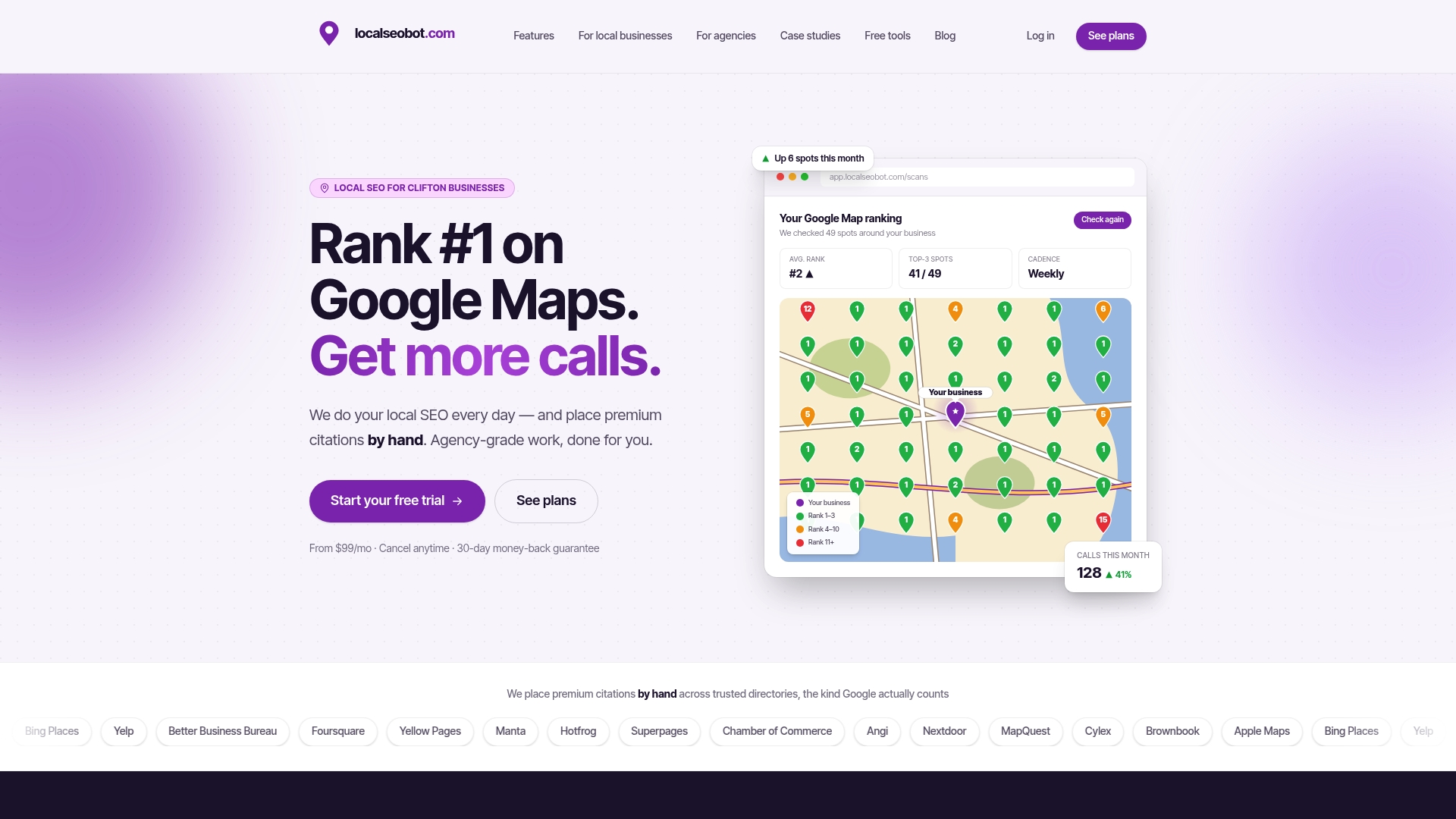
Our system audits and optimizes your Google Business Profile automatically, publishes regular posts to keep your profile active, and generates review requests while drafting AI-assisted replies so nothing sits unanswered. Behind the automation, our team manually builds premium citations on high-authority directories, the kind of placement that is slow to do by hand and easy to get wrong. We also run geo-grid scans across your full service area so you see exactly where you rank, not just how you rank from one point on the map.
- Automated GBP optimization and posting that keeps your profile complete and active.
- Manually built premium citations on directories that carry real authority.
- Geo-grid rank tracking across your entire service area, not a single address.
- Review generation and AI-drafted replies that keep response time fast.
We offer plans built for different needs: Foundation and Growth for individual locations, and Pro for agencies managing multiple clients under one dashboard. We are confident enough in the results that we offer a money-back guarantee if your business doesn’t see a ranking increase.
If map pack visibility is the goal, our Google Maps SEO service page walks through exactly how the pieces fit together, and you can check pricing and plans whenever you are ready to start.
FAQ
What should a local SEO audit checklist include?
A complete checklist covers Google Business Profile accuracy, review volume and response rate, citation and NAP consistency, local backlinks, on-page content and schema, technical health, keyword mapping, and ongoing monitoring. Each area ties into the next, since a technical crawl issue can undercut a perfectly optimized GBP.
How often should I audit my Google Business Profile?
A full audit every quarter catches most drift, but check hours, photos, and posts monthly since those fields change often and directly affect prominence in local rankings. Verification status and category accuracy deserve a check any time you add a location or change services.
What is NAP consistency and why does it matter?
NAP consistency means your business name, address, and phone number match exactly across your website, Google Business Profile, and every directory listing you appear on. Mismatches confuse the systems that cross-reference your identity across the web, which can weaken the trust signals behind your local rankings.
What are the biggest Google Maps ranking factors?
Google ranks local results on relevance, distance, and prominence, with Google Business Profile signals carrying the largest single share of that formula, followed by on-page signals, reviews, and links. A profile that is complete, accurate, and active tends to outperform one that is merely well-linked.
Can I run a local SEO audit myself, or do I need a tool?
You can run every step in this checklist manually with a spreadsheet, Google Search Console, and a few free directory searches. Tools speed up the process considerably, particularly for citation scans and geo-grid rank tracking across a full service area, which are difficult to replicate by hand at scale.
Sources
- Google Business Profile statistics (industry survey)
- Guidelines for representing your business on Google - Google Business Profile Help