Prioritize Calls or Traffic: Map Pack vs Organic for Small Businesses
Published September 25, 2026
Prioritize Calls or Traffic: Map Pack vs Organic for Small Businesses

For most single-location, high-intent local businesses, the Map Pack drives faster customer action, but organic search remains the durable path to broader discovery. The smart move is running both, with the Map Pack getting priority for immediate calls and foot traffic while organic work builds long-term visibility.
TL;DR:
- Prioritizing Google Business Profile optimization and manual citation building on high-authority directories delivers faster Map Pack rankings and customer calls.
- Organic rankings depend on high-quality, locally relevant content, backlinks, and technical site health, taking months to build but offering long-term visibility.
- Business profile completeness and citation accuracy have a greater impact on local map rankings than volume of listings or links.
- Businesses should focus on quick wins like profile updates and citations first, then invest in ongoing content and backlink efforts for sustained growth.
- Using geo-grid rank checks across multiple locations helps accurately measure visibility changes and avoid false negatives from single-point searches.
Table of Contents
- Map pack vs organic: what each result actually delivers
- What determines your ranking in the Map Pack
- How organic rankings actually work
- When to lean on the Map Pack versus organic
- Your optimization checklist for both channels
- Measuring what actually matters for each channel
- Manual citations, GBP work, and what actually moves rankings
- What the data actually tells you to prioritize
- How Local SEO Bot handles this for you
- Sources
- FAQ
Map pack vs organic: what each result actually delivers
The two results look different, sit in different places on the page, and satisfy different reader intent. The Map Pack sits at or near the top of the search results page, showing a small map with three business listings, star ratings, and direct action buttons for calling, getting directions, or visiting a website. Organic results appear below it as a list of blue links with page titles and descriptions.
A searcher who taps the Map Pack usually wants something now: a plumber tonight, a pizza place opens late, a dentist accepting new patients this week. Organic results tend to serve a different job: comparing options, reading reviews on third-party sites, researching a service before committing, or searching for something outside a specific geography.
That difference shows up in the numbers. Industry compilations tracking local click behavior found that roughly 42 to 44% of local clicks go to Local Pack results, compared with a smaller share landing on organic listings. Because the Map Pack surfaces contact actions directly in the listing, a click there often means a call or a directions request rather than a pageview, which changes what you should be measuring.
| Map Pack | Organic results | |
|---|---|---|
| Position on page | Top, with embedded map | Below Map Pack, text links |
| Typical searcher intent | Ready to act now | Researching or comparing |
| Common actions | Call, get directions, message | Read, browse, fill out a form |
| Click share on local queries | Roughly 42 to 44% | Smaller remaining share |
| Best for | Storefronts, urgent local services | Multi-location brands, content-driven businesses |
A few practical distinctions matter beyond the table:
- The Map Pack rewards proximity and profile completeness more than page content.
- Organic rewards depth, authority, and links, which take longer to build but travel further.
- A single click on the Map Pack often ends the search entirely, while organic clicks frequently lead to more browsing.
What determines your ranking in the Map Pack
Google has been consistent about this: local ranking comes down to relevance, distance, and prominence. Google’s own Business Profile guidance states that local results are based mainly on these three factors, and that complete, accurate profile information increases your odds of showing up.
Relevance measures how well your profile matches what someone is searching for. Distance measures how close your business is to the searcher or the location they typed. Prominence measures how well known and well regarded your business is, both online and offline.
You cannot do much about distance for a fixed location, which means relevance and prominence are where the real optimization work happens.
Fields worth getting right on your Business Profile:
- Primary and secondary categories that match exactly what you do.
- A complete services list with descriptions, not just category tags.
- Business attributes (wheelchair accessible, women-owned, outdoor seating) filled in honestly.
- Accurate hours, including holiday hours, updated as they change.
- Regular photo uploads showing your storefront, team, and work.
Prominence is built from a mix of signals: review count and quality, citation consistency across directories, local backlinks, and how established your website looks to Google. None of these move overnight, and none of them substitute for the others. A business with excellent reviews but inconsistent citations across directories often ranks lower than one with steady, matching listings everywhere.
Pro Tip: Audit your Business Profile categories every few months. Google periodically adds new category options, and picking a more specific one than “General Contractor” or “Restaurant” often improves relevance matching.
Ranking and visibility are not the same thing, and this trips up more businesses than any other Maps concept. A Search Engine Land analysis of Maps architecture found that Maps ranking involves multiple internal systems, including Geostore and Webref for building entity representations and Mapcore for controlling what actually renders on the visual map. A business can be eligible to rank and still not show up as a visible map label, because rendering and ranking are handled by separate processes.
This is why checking your ranking from a single location, like your own office, gives you an incomplete picture. Maps results vary by zoom level, map style, and the exact coordinates used for the search. A business might look invisible from one street corner and rank third from a block away.
One data point worth internalizing: the same Search Engine Land research identified roughly 72 distinct ranking signals feeding into Maps results, spread across relevance, distance, and prominence categories. That volume of signals is exactly why a single completed field or a handful of reviews rarely moves rankings on its own. Improvement tends to come from consistent work across many small inputs.
Practitioners who run geo-grid rank checks across multiple coordinates instead of a single search avoid the false negatives that come from checking from just one spot.
How organic rankings actually work
Organic search runs on a different set of signals entirely, and it rewards different behavior over a longer timeline. Where the Map Pack leans on profile completeness and proximity, organic ranking leans on content quality, link authority, and technical site health.
Google’s own ranking systems guidance confirms that link analysis and site structure remain core to how organic systems evaluate authority, alongside content relevance and a collection of other evolved ranking systems. In practice, three areas do most of the work:
- Content that actually answers the query, written for the person searching rather than stuffed with keywords.
- Backlinks from other websites, which still function as a vote of confidence in your site’s authority.
- Technical SEO, covering crawlability, page speed, mobile usability, and clean site architecture.
A well-built local landing page can capture both worlds at once. A page targeting “emergency plumber in [neighborhood]” with genuinely useful content, clear service descriptions, and a linked address can rank organically for that phrase while also reinforcing the relevance signals that help your Map Pack listing. This dual benefit is one reason local landing pages show up so often in local SEO advice: they are not a Map Pack tactic or an organic tactic, they support both.
Signals that carry the most weight for organic local rankings:
- Unique, useful content on every page, not templated boilerplate copied across locations.
- A clean site structure that lets Google (and visitors) find location pages easily.
- Backlinks from local news sites, community organizations, and industry directories.
- Fast page loads and functional mobile design, since most local searches happen on a phone.
Technical SEO deserves particular attention here because it is invisible to most business owners until something breaks. A technical SEO overview covering crawlability and site structure makes the case plainly: content quality cannot compensate for a site Google struggles to crawl or index in the first place.
Organic search is also the channel that keeps working when someone is not searching with local intent at all. A blog post answering “how often should you service a water heater” can rank nationally and bring in readers who later become local customers, something the Map Pack, tied to geography and business listings, simply cannot do.
When to lean on the Map Pack versus organic
Neither channel is universally better. The right call depends on your business type, budget, and timeline.
- Single-location retail or urgent services (locksmiths, emergency plumbers, walk-in clinics) should prioritize the Map Pack, since these searches convert fastest with a call or a directions tap.
- Businesses with a tight marketing budget needing quick proof of ROI should also start with the Map Pack, since profile optimization costs time rather than a large media spend.
- Multi-location brands competing across several markets need organic strength to build authority that lifts every location page at once.
- Content-driven or considered-purchase businesses (law firms, financial advisors, home renovation) benefit more from organic, since these searches involve research before a decision.
- Lead-generation businesses relying on long-term traffic growth rather than walk-in footfall should weight their effort toward organic content and links.
The tradeoff comes down to speed versus durability. Map Pack improvements from GBP hygiene and review growth can shift rankings within weeks. Organic gains from content and link building typically take months to show up, but they compound and tend to hold steadier against algorithm changes.
Pro Tip: If you can only fund one channel this quarter, ask whether your typical customer searches with an address in mind. If yes, start with the Map Pack. If they search a topic or question first, start with organic.
A simple checklist for deciding: count how many of your last 20 customers found you through a phone call versus a website contact form. A call-heavy business should weight Map Pack work higher. A form-heavy business should weight organic and landing page work higher.
Your optimization checklist for both channels
Once you know which channel to prioritize, the work itself is straightforward, if not always quick. Here is what to tackle first on each side.
Immediate Map Pack tasks:
- Complete every field on your Google Business Profile, including services, attributes, and business description.
- Choose the most specific primary category available, then add relevant secondary categories.
- Upload new photos monthly, covering your storefront, team, and completed work.
- Build a steady, ethical review generation habit rather than a one-time push.
- Fix inconsistent citations across directories so your name, address, and phone number match everywhere.
Immediate organic tasks:
- Publish a dedicated landing page for each service and each location you serve, written for the person searching rather than for search engines.
- Audit your site for crawl errors, broken links, and slow-loading pages.
- Add genuinely useful local content, such as neighborhood guides or answers to common customer questions.
- Pursue backlinks from local news outlets, chambers of commerce, and industry associations.
- Keep your name, address, and phone number identical across your website and every directory listing.
Sequencing matters more than most business owners expect. GBP fixes and citation cleanup come first because they are fast and because Search Engine Land’s guide to local versus traditional SEO points out that GBP hygiene and local landing pages compound when built together: profile signals improve map eligibility while landing pages capture organic traffic and support the link building that follows.
| Fast wins (weeks) | Ongoing work (months) | |
|---|---|---|
| Map Pack | Complete GBP fields, fix categories, clean citations | Steady review growth, photo updates |
| Organic | Fix technical errors, publish first landing pages | Content library, backlink outreach |
| Shared | Consistent business information everywhere | Local reputation building |
Citation work is one of the tasks businesses most often outsource, and for good reason: manually checking dozens of directories for consistency takes real time, and getting it wrong actively hurts prominence signals. A 15-task local SEO checklist is worth keeping on hand as a running reference, since these tasks repeat every quarter rather than ending once.
Technical SEO fixes, by contrast, are usually a one-time or annual project best handled by whoever manages your website, since they involve site code rather than ongoing content work.
Measuring what actually matters for each channel
Tracking the wrong metric is the fastest way to misjudge whether your effort is working. Map Pack and organic success look different on a dashboard, and mixing them up leads to bad decisions about where to spend time next.
Map Pack KPIs worth tracking:
- Phone calls generated directly from your Business Profile.
- Direction requests, which signal someone is heading your way.
- Profile views and search appearances inside Google Business Profile insights.
- Messages and booking requests submitted through the profile itself.
Organic KPIs worth tracking:
- Organic clicks and impressions, tracked through Google Search Console.
- Time on page and conversion rate on local landing pages, tracked through Google Analytics.
- Keyword rankings for location and service terms over time.
- Backlinks earned, both count and source quality.
| Metric | Channel | Where to track it |
|---|---|---|
| Calls and direction requests | Map Pack | Google Business Profile insights |
| Profile views | Map Pack | Google Business Profile insights |
| Organic clicks and impressions | Organic | Google Search Console |
| Landing page conversions | Organic | Google Analytics |
| Local rank position by neighborhood | Both | Geo-grid rank tracker |
Because Map Pack visibility shifts by coordinate, a single ranking check tells you almost nothing about how you look across your actual service area. Running a geo-grid scan, the kind tools like Maprank are built around, shows how visibility changes street by street rather than assuming one office address represents your whole market.
A reasonable reporting cadence is weekly for Map Pack metrics, since calls and direction requests fluctuate fast, and monthly for organic metrics, since content and link gains build slowly and daily noise obscures the trend.
Manual citations, GBP work, and what actually moves rankings
Prominence is built from many small, unglamorous inputs, and citation quality is one of the most misunderstood among them. Automated citation blasts, the kind sold as a bulk service, tend to place a business on hundreds of low-authority directories at once. Volume alone rarely helps, and inconsistent formatting across that many listings can actively hurt the consistency signals Google uses to judge legitimacy.

Manually building citations on high-authority directories takes longer, but it produces cleaner, more consistent data, and consistency is exactly what feeds the prominence signals behind Map Pack rankings.
A practical citation workflow looks like this:
- Audit existing citations first to find and fix mismatched names, addresses, or phone numbers.
- Prioritize a shortlist of high-authority directories relevant to your industry over generic mass listings.
- Build each citation manually, matching your Business Profile exactly.
- Recheck citations quarterly, since directories change formats and occasionally drop listings.
- Pair citation work with steady review growth, since the two signals reinforce each other.
Manual citation building on high-authority directories, combined with consistent Business Profile optimization, is designed to move Google Maps rankings and increase customer calls rather than just adding listing volume.
Local SEO Bot
This is the model behind Local SEO Bot’s approach: treat citations as a prominence signal worth building carefully, not a box to check quickly. Clients have reported improved Google Maps positions and more customer calls following this manual approach, which lines up with what the ranking signal research suggests: consistency and authority beat sheer volume every time.
What the data actually tells you to prioritize
The conventional advice, “just do both channels equally,” sounds safe but wastes effort for most small businesses. A single-location dentist and a five-city home services franchise have almost nothing in common strategically, yet they get handed the same generic checklist constantly.
What the numbers actually support is narrower: the Map Pack converts faster because it hands searchers a phone number and a map pin before they finish reading anything, while organic search builds a reservoir of visibility that survives longer but takes months to fill. The businesses that waste the most time are the ones chasing organic content strategies before their Business Profile is even complete, or the ones obsessing over Map Pack rank while ignoring that their website barely loads on a phone.
The most overrated piece of advice in this space is treating citations as a volume game. Consistency beats quantity, every time the data has been examined. If you fix one thing this quarter, fix your Business Profile completeness and citation accuracy before touching a content calendar. Everything else compounds from there.
— Local
How Local SEO Bot handles this for you
Fixing citations manually across dozens of directories, keeping your Business Profile current, and tracking rank changes across your whole service area takes real hours every month, hours most business owners do not have spare. Local SEO Bot exists to take that work off your plate.
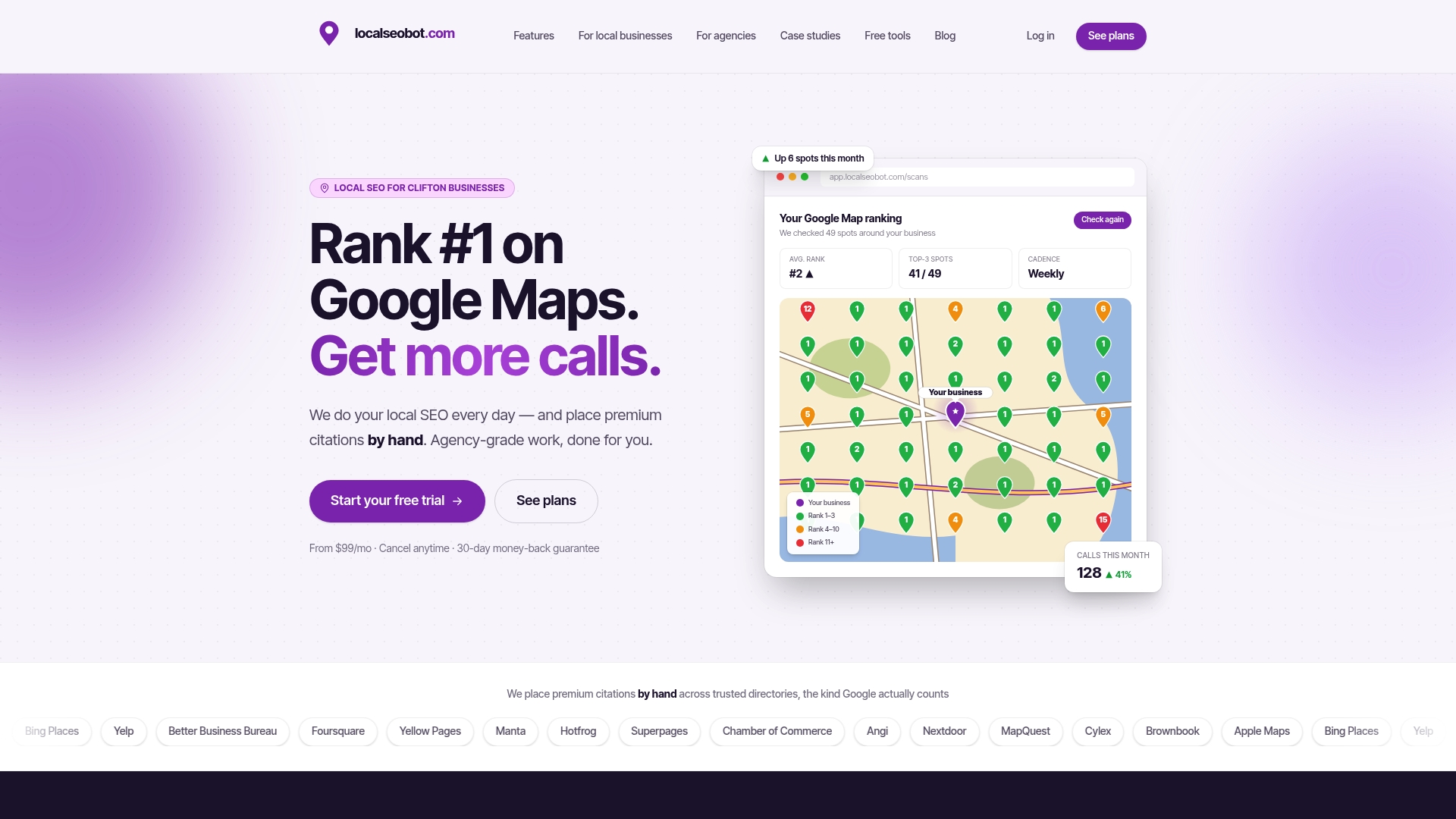
The service builds premium citations manually on high-authority directories rather than running automated blasts, pairs that with ongoing Google Business Profile optimization and posting, and layers in automated review generation with AI-driven review replies. Maprank, the geo-grid rank tracking tool, shows exactly how your visibility looks across your whole service area, not just from one address.
- Foundation costs $99 per month per location, suited to a single-location business getting started.
- Growth costs $199 per month per location, adding deeper optimization and tracking.
- Pro costs $399 per month per location, built for agencies managing multiple client locations with white-label reporting.
A 30-day money-back guarantee is offered if Google Maps rankings do not improve, demonstrating confidence in the manual citation process.
If you manage your own local SEO or run an agency reselling local visibility services, start by checking your pricing options or explore Maprank to see your current geo-grid visibility before committing to a plan.
Sources
- Tips to improve your local ranking on Google - Google Business Profile Help
- Inside Google Maps: 72 ranking signals and the architecture behind local search - Search Engine Land
- Ranking systems guide — Google Developers
FAQ
What does map pack mean?
The Map Pack, also called the Local Pack, is the group of three business listings with a map that appears near the top of Google search results for local queries. It shows business names, ratings, hours, and direct action buttons for calling or getting directions.
Is SEO considered paid or organic?
SEO refers to organic, unpaid efforts to improve visibility in search results, distinct from paid ads that appear labeled as sponsored. Map Pack rankings and organic search rankings are both earned through SEO work rather than purchased placements.
Is SEO dead now with AI?
No. Google’s own guidance on search fundamentals recommends focusing on foundational SEO, a crawlable site, accurate Business Profile information, and unique content, over chasing short-lived AI optimization tricks. Core ranking systems for both Map Pack and organic results still rely on the same relevance, authority, and technical signals they always have.
What is the 80/20 rule in SEO?
For local businesses, that usually means fixing GBP accuracy and citation consistency before investing heavily in broader content or link campaigns.