Restaurant Citation Sites: Which Ones Matter in 2026
Published November 16, 2026
Restaurant Citation Sites: Which Ones Matter in 2026

The restaurant citation sites worth your time are the ones diners and map apps already use: Google Business Profile, Apple Business Connect, Bing Places, Yelp and a booking or ordering platform, followed by local sources such as your chamber of commerce and city dining guides. Claim those first, make your name, address and phone number identical on each, and skip paid directory bundles. Then keep the details consistent as your hours, menu and phone line change. That maintenance is the part most owners drop, and it is where hands-on help pays off.
TL;DR
- Start with the free core listings: Google Business Profile, Apple Business Connect, Bing Places and Yelp. All four can be claimed at no cost.
- Add the booking, ordering and review platforms your guests actually use, then local sources such as visitor bureaus and chambers of commerce.
- Pick one exact format for your name, address and phone number (NAP) and copy it everywhere. Conflicting details confuse search engines and diners.
- Never pay anyone to “activate” or “protect” a Google listing. Claiming and verifying it is free.
- Premium citations on high-authority directories are slow, manual work. We build them by hand so you do not have to.
Table of Contents
- What a restaurant citation is
- The core citation sites every restaurant should claim first
- Booking, ordering and review platforms
- Local sources that carry real weight
- Free or paid: where money is worth spending
- How to keep your name, address and phone number consistent
- Mentions beyond directories
- Our view on restaurant citations
- How Local SEO Bot handles it
- FAQ
- Sources
What a restaurant citation is
A citation is an online mention of your business’s name, address and phone number. It can sit on a directory, a website or a social platform. Citations help Google verify that a business is accurate and legitimate, and consistent ones correlate with better local search and Google Maps visibility.
For a restaurant, there is a second payoff. A citation is also where a hungry person lands. A wrong phone number sends calls to a dead line. A wrong suite number sends delivery drivers around the building. A listing missing from a diner’s preferred reservation channel can cost you the booking outright. So citations do two jobs: they feed Google’s confidence in your business, and they make sure the person who finds you can reach you.
Google ranks local restaurant results on three factors: distance, relevance and prominence. OpenTable’s local SEO guide explains that prominence (reviews, ratings, links and mentions across the web) takes longer to build and is harder for a nearby competitor to copy. Citations feed that third factor, which is why they are worth doing even when you cannot change where your building sits.
If you are new to the vocabulary, our beginner guide to the types of local citations walks through structured and unstructured ones.
The core citation sites every restaurant should claim first
These are the listings that map apps, search engines and diners rely on. Do them before anything else.
| Site | What it does for a restaurant | Cost to claim |
|---|---|---|
| Google Business Profile | Controls how you appear on Google Search and Maps, with photos, reviews, orders, reservations and updates | Free |
| Apple Business Connect | Lets you claim and customize your place card across Apple Maps, Messages, Wallet and Siri, including action links for ordering or reserving | Free |
| Bing Places for Business | Manages listings in Bing Search and Bing Maps, with an import from Google listings and bulk editing | Free |
| Yelp | Business page with 20+ features; the review site many diners check before booking | Free page, paid ads optional |
| Hours, menu, photos and messages where many locals already follow you | Free |
Google Business Profile
This is the listing that matters most for Maps. Creating and listing your business is free. Restaurants should expect a stricter verification step: one 2026 owner guide describes a continuous phone video under about three minutes showing street signage, the front door and owner-only areas such as the kitchen, with review typically taking up to five business days. The same guide notes that anyone demanding payment to “protect” or “activate” a listing is running a scam. If you want a second pair of eyes on yours, our Google Business Profile audit is built for that.

Apple Business Connect and Bing Places
Both are free and both are often skipped. Apple’s tool reaches more than a billion Apple users across Apple Maps and other apps, and its Custom Action Links can point guests to ordering or table booking. Bing Places can import your Google listing, so setup is quick. A Website Builder Expert write-up of the October 2025 Bing Places update frames it as diversification: a presence outside Google reduces your reliance on a single source of traffic.
Yelp
Yelp’s business page is free. According to Yelp’s pricing page, its local-business pages average 2.4 million visitors a day, and Yelp Ads start at $150 a month and can be canceled anytime. Claim the free page first. Advertising is a separate decision about promotion, not about whether your citation exists.
Booking, ordering and review platforms
Once the core is done, add the platforms that match how your guests find a table.
- Reservation platforms. If you take bookings, being listed where diners reserve matters. Cost varies a lot, so read the terms before you sign.
- Delivery and ordering platforms. Add them if you offer delivery or pickup. Keep the menu and hours identical to your own site.
- TripAdvisor. Worth claiming in tourist areas. Its free Management Center lets owners post public responses and dispute reviews.
- Niche food sites. Some are editorial and free. IndieEats, for example, states its listings are free with no premium tier, and claim verification takes roughly 10 to 15 minutes by email from your official domain, a call to a listed number or a post from a verified social account.
What a reservation platform costs
OpenTable is the clearest example of why you read the fine print. Its US plans are Basic at $149 a month, Core at $299 a month and Pro at $499 a month, with per-cover fees on network bookings, and a standard contract of one year that renews annually unless canceled 30 days before renewal. Directory inclusion comes with the reservation service, so this is a booking decision first and a citation decision second. Restaurant owners also cannot respond publicly to OpenTable reviews but can message the reviewer privately.

Local sources that carry real weight
Generic directories with no visitors add little. Local organizations are different, because real people use them and they are hard to fake. Good places to look:
- City or county visitor bureau dining guides
- Chamber of commerce member directories
- Business improvement district maps
- Local media best-of lists and event calendars
- Partner websites and venue recommendation pages
Research on restaurant directories notes that most of these are free or come with a membership you may want anyway. Ask for a link and a listing that carries your exact NAP. Our local citations priority list shows a sensible order of work, and the Local Citation Finder helps you see where you are already listed.
Free or paid: where money is worth spending
The short rule: the listing is free, the promotion is not.
Tock’s 2024 discovery whitepaper says a Google Business Profile has a free base offering of location, hours and reviews, and that presence on review sites like Yelp and Tripadvisor is “free and up”. Costs appear when you advertise or upgrade.
Paid directories are a different story. A restaurant owner resource lists one directory charging $19.95 for a basic listing with a 15-word description and $99.95 for an enhanced listing, with no reviews on either tier. A listing with no reviews and no audience does little for a diner, and a bundle of such listings rarely earns back its price.
A practical budget order:
- Free core listings, done completely (photos, menu, hours, categories).
- Free local sources.
- A reservation or ordering platform if your business model needs it.
- Premium citations on high-authority directories, built carefully and once.
- Paid ads, only after the above are accurate.
How to keep your name, address and phone number consistent
Consistency is where citations pay off. OpenTable advises choosing one exact format for your name, address and phone number, then making your most important listings match, because conflicting information confuses both search engines and diners.
- Write your master NAP. Use your real name as it appears on your sign. Use the same suite format, the same phone number and the same website URL every time.
- Audit what exists. Search your name and old phone numbers. Old locations and former names are the usual culprits.
- Fix the core listings first. Google, Apple, Bing and Yelp carry the most traffic.
- Claim and fill every field. Hours, categories, menu link, photos and attributes.
- Recheck after any change. New hours, a new phone line or a move means updating every listing, not just Google.
The weak step is step 5. Most restaurants are accurate on opening day and out of date six months later. Our team handles listing management across multiple directories as part of our service, so a change in your details does not turn into a trail of wrong listings.
Mentions beyond directories
Citations are not the only signal. Mentions on local blogs, news sites and community pages also build prominence, and they behave differently from directory listings: they come from editorial coverage rather than a form you fill in. This local SEO academy explains how those mentions differ from directory listings. For how citations relate to links, see our guide to citations versus backlinks.
Our view on restaurant citations
Most restaurant owners we talk to about citations have the same problem: the work is repetitive, it is never finished and it is easy to do badly. A single wrong phone number copied across twenty sites is worse than ten accurate listings.
That is why we split the job. Our AI agent handles the ongoing work on your Google Business Profile: optimization, regular posts and review replies, and it tracks your rankings across your service area with map grid scans. Behind it, a dedicated team manually builds premium citations on high-authority directories, so the signals Google sees are consistent and trustworthy.
A restaurant owner should be cooking, not reconciling directory logins. Hands-off citation work lets you compete for top Maps positions without hiring an agency.
Devyn H
How Local SEO Bot handles it
Local SEO Bot is an AI agent that does the local SEO work instead of only reporting on it. For citations, our team builds premium listings by hand on high-authority directories. For everything else, the agent optimizes your Google Business Profile, publishes regular posts, responds to reviews and runs map grid scans to track your rankings across the area you serve.
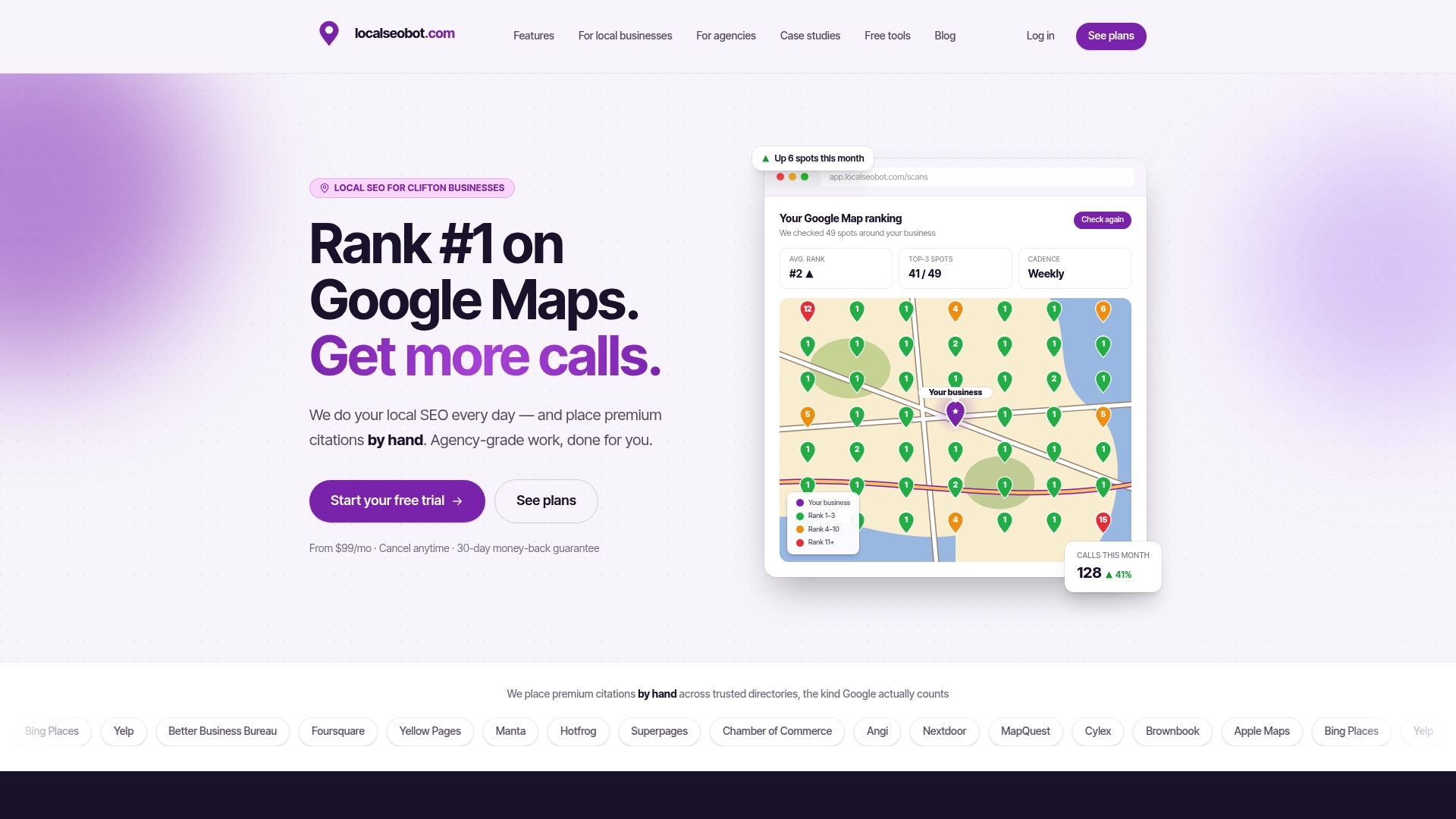
Plans are billed per location, per month: Foundation is $99 a month and Growth is $199 a month. Agencies managing restaurant clients can use white-label options, with the Pro plan at $399 a month per location. We also offer a 30-day money-back guarantee if you do not see a ranking increase. To see how the work is done, read about our local citation services.
FAQ
Are restaurant citation sites free?
Most core listings are free to claim: Google Business Profile, Apple Business Connect, Bing Places and the basic Yelp page. Costs appear with reservation platforms, advertising and some paid directories. Read the contract terms before you sign anything, especially renewal and cancellation windows.
How many citation sites does a restaurant need?
There is no magic number. A small set of accurate, complete listings on sites diners use beats dozens of thin listings on directories nobody visits. Start with the core sites, add your booking and local sources, then expand carefully.
What is NAP and why does it matter?
NAP stands for name, address and phone number. When it is identical across listings, Google can confirm your business is real and diners can reach you. When it differs, both get confused.
Can I pay someone to activate my Google listing?
No. Claiming and verifying a Google Business Profile is free. A request for payment to “protect” or “activate” it is a scam. If you want help keeping the profile and your other listings in good shape, that is the work we do.
Sources
- Local citations: structured vs. unstructured
- Google Business Profile for business owners
- Apple Business Connect announcement
- Bing Places update
- Yelp local business pricing
- Google Business Profile for restaurants
- Restaurant review sites
- IndieEats for restaurant owners
- Plans and pricing for restaurants
- Local SEO for restaurants
- Restaurant directories and citations
- Restaurant discovery whitepaper
- Restaurant citations PDF
- Local SEO academy