Best Business Directories for Small Businesses in 2026
Published August 6, 2026
Best Business Directories for Small Businesses in 2026

For most U.S. small businesses, the six directories to claim first are Google Business Profile, Apple Business Connect, Bing Places for Business, Yelp, the Better Business Bureau, and Facebook Business Page. Claim and verify each one, then standardize your name, address, and phone number (NAP) across all of them before moving to any secondary listings.
Your immediate next steps:
- Search for existing listings on each platform before creating new ones — duplicates hurt rankings.
- Claim and verify each profile using the official owner workflow (postcard, phone, or email verification).
- Add complete core data: business name, address, phone, hours, primary category, and at least five photos.
- Sync to data aggregators (Data Axle, Neustar Localeze, Foursquare) to push accurate NAP downstream to hundreds of smaller directories automatically.
- Log credentials for every platform in a shared document so you can access them for future updates.
Key Takeaways
Claim Google Business Profile and Apple Business Connect first, but also prioritize Bing Places, Yelp, Better Business Bureau, and Facebook Business Page—these six Tier 1 listings together deliver the broadest, most immediate impact on local search visibility and customer contact for U.S. small businesses.
| Point | Details |
|---|---|
| Claim Tier 1 first | Google Business Profile, Apple Business Connect, Bing Places, Yelp, BBB, and Facebook are the six non-negotiable listings for U.S. local businesses. |
| Standardize NAP immediately | Exact-match name, address, and phone across every directory prevents AI and search engines from surfacing incorrect business data. |
| Use aggregators for scale | Syncing through Data Axle, Foursquare, or Neustar Localeze pushes accurate NAP to hundreds of downstream directories automatically. |
| Prioritize vertical directories | Industry-specific listings (Clutch for B2B, Tripadvisor for hospitality, Angi for home services) often convert at higher rates than general directories. |
| Localseobot for managed citations | Localseobot manually builds citations on high-authority directories and includes a 30-day money-back guarantee on Google Maps ranking improvement. |
Table of Contents
- What are the best business directories for U.S. small businesses?
- Which directories should you prioritize first, second, and later?
- How do you claim, verify, and optimize a directory listing?
- How do you decide which directories are worth your time?
- How we selected these directories
- Why does citation accuracy matter more in 2026?
- How agencies handle directory management at scale
- Localseobot handles the directory work you do not have time for
- Sources
What are the best business directories for U.S. small businesses?
The table below covers the top directories by use case, cost, SEO reach, review system, industry fit, ease of claiming, and typical contact value. Authority and traffic comparisons draw on directory metrics published by Digital Web Solutions.
| Directory | Best for | Cost | SEO / Data reach | Review system | Industry fit | Ease of claiming | Contact value |
|---|---|---|---|---|---|---|---|
| Google Business Profile | All local businesses | Free (ads optional) | Highest — powers local pack & Maps | Yes, high intent | All verticals | Easy (postcard/phone) | Very high |
| Apple Business Connect | Mobile/iOS-heavy audiences | Free | High — iOS, Siri, Apple Maps | Limited | All verticals | Easy (email verify) | High |
| Bing Places for Business | Windows/enterprise users | Free | Medium-high — Bing search & maps | No native reviews | All verticals | Easy (import from GBP) | Medium |
| Yelp | Consumer-facing businesses | Free (paid ads optional) | High — ranks independently | Yes, strong intent | Food, services, retail | Easy | High |
| Better Business Bureau | Trust-sensitive businesses | Free basic / paid accreditation | Medium-high | Yes, complaint-based | All verticals | Moderate | High (trust-driven) |
| Facebook Business Page | Social-engaged businesses | Free (ads optional) | Medium | Yes, recommendations | All verticals | Easy | Medium-high |
| Foursquare | Multi-location brands | Free | High — aggregator/distribution | Limited | All verticals | Moderate | Medium |
| YellowPages | Legacy consumer segments | Free basic / paid upgrades | Medium | Yes | All verticals | Easy | Medium |
| Angi | Home services trades | Free basic / paid leads | Medium | Yes, project-based | Home services | Easy | High (lead gen) |
| Thumbtack | Local service pros | Free to list / pay-per-lead | Medium | Yes | Services | Easy | High (quote-driven) |
| Tripadvisor | Hospitality & tourism | Free basic / paid | High in travel queries | Yes, strong | Hospitality, food | Easy | High |
| Clutch | B2B service providers | Free | Medium-high | Yes, verified | B2B, professional services | Moderate | High |
| Dun & Bradstreet | B2B and enterprise | Free basic / paid | Medium | Limited | B2B, finance | Moderate | Medium-high |
| Nextdoor | Neighborhood-level visibility | Free | Low-medium | Yes, neighbor-based | Local services | Easy | Medium |
| Data Axle (InfoUSA) | Aggregator distribution | Paid | High — feeds many directories | No | All verticals | Managed | High (indirect) |
| Neustar Localeze | Aggregator distribution | Paid | High — feeds many directories | No | All verticals | Managed | High (indirect) |
Google Business Profile and Yelp deliver the most immediate ROI for most small businesses: GBP drives local pack placement directly, while Yelp ranks independently for high-intent searches like “best plumber near me.” Apple Business Connect is a close third given iOS’s share of U.S. mobile traffic.
Pro Tip: Instead of manually updating 50+ smaller directories, submit once through a data aggregator like Foursquare, Data Axle, or Neustar Localeze. A single accurate submission there propagates your NAP to partner apps and directories automatically, cutting update time significantly.
Which directories should you prioritize first, second, and later?
Tier 1: Claim these immediately
These platforms have the highest search visibility, the most direct impact on local pack rankings, and the broadest consumer reach. Missing even one creates a gap in your local presence.
- Google Business Profile — The single most important listing for any local business. It powers the Google local pack, Google Maps, and increasingly feeds AI-generated answers in Search. Fill every field: hours, services, photos, Q&A, and booking links where available. Per Search Engine Land’s citation guide, structured citations here are a primary source of truth for search engines and mapping products.
- Apple Business Connect (Apple Maps) — Covers every iPhone, iPad, and Siri result. Claim at businessconnect.apple.com and verify via email. Add photos and a business description; Apple Maps now surfaces rich content in iOS search.
- Bing Places for Business — Import directly from your GBP to save time. Reaches Windows desktop users and Microsoft’s enterprise ecosystem, a segment often overlooked by local businesses.
- Yelp — Consumer-facing businesses in food, home services, beauty, and retail cannot afford to ignore Yelp. It ranks independently for comparison queries and review-driven searches. Respond to every review.
- Better Business Bureau — A BBB listing carries real conversion weight for service businesses. Consumers check it before hiring contractors, financial advisors, and healthcare providers. Accreditation is paid but the basic profile is free.
- Facebook Business Page — Beyond social, Facebook profiles appear in directory-style searches and support direct messaging, which many customers prefer for first contact.
Tier 2: Add within your first 30 days
These directories offer meaningful SEO value, category-specific leads, or strong data-distribution reach.
- Foursquare — Its primary value is distribution: accurate data here flows to dozens of partner apps and mapping services.
- YellowPages — Still indexed broadly and relevant for older consumer segments. Free basic listing; paid upgrades add lead features.
- Angi (formerly Angie’s List) — For home services, Angi is a lead marketplace, not just a directory. A free profile is the floor; paid plans unlock quote requests.
- Thumbtack — Similar to Angi but broader across service categories. Pay-per-lead model means cost scales with activity.
- Nextdoor — Neighborhood-level visibility for local service businesses. Particularly effective for businesses serving residential customers within a defined radius.
- Manta — A general small-business directory with decent indexation. Free to claim; useful for citation breadth.
- Superpages — Owned by the same parent as YellowPages; claiming one often populates the other.
- MapQuest — Still used by a segment of navigation users, particularly on desktop. Free to claim.
- Chamberofcommerce.com — Adds a trust signal and local community association. Worth claiming if you serve a defined geographic area.
- Dun & Bradstreet — Priority for B2B businesses. D&B’s business directory and data cloud is used by sales and procurement teams at enterprise companies.
Tier 3: Supporting directories (claim when you have bandwidth)
These platforms have lower direct traffic but contribute to citation breadth, which reinforces NAP consistency signals across the web.
Citysearch, Local.com, EZLocal, ShowMeLocal, Brownbook.net, Hub.biz, Cylex, iBegin, Tupalo, Spoke.com, Hotfrog — each accepts a free basic listing. None will move the needle on their own, but collectively they strengthen the citation footprint that local ranking algorithms read. Use a local citation finder to check which ones already have a listing for your business before creating new ones.
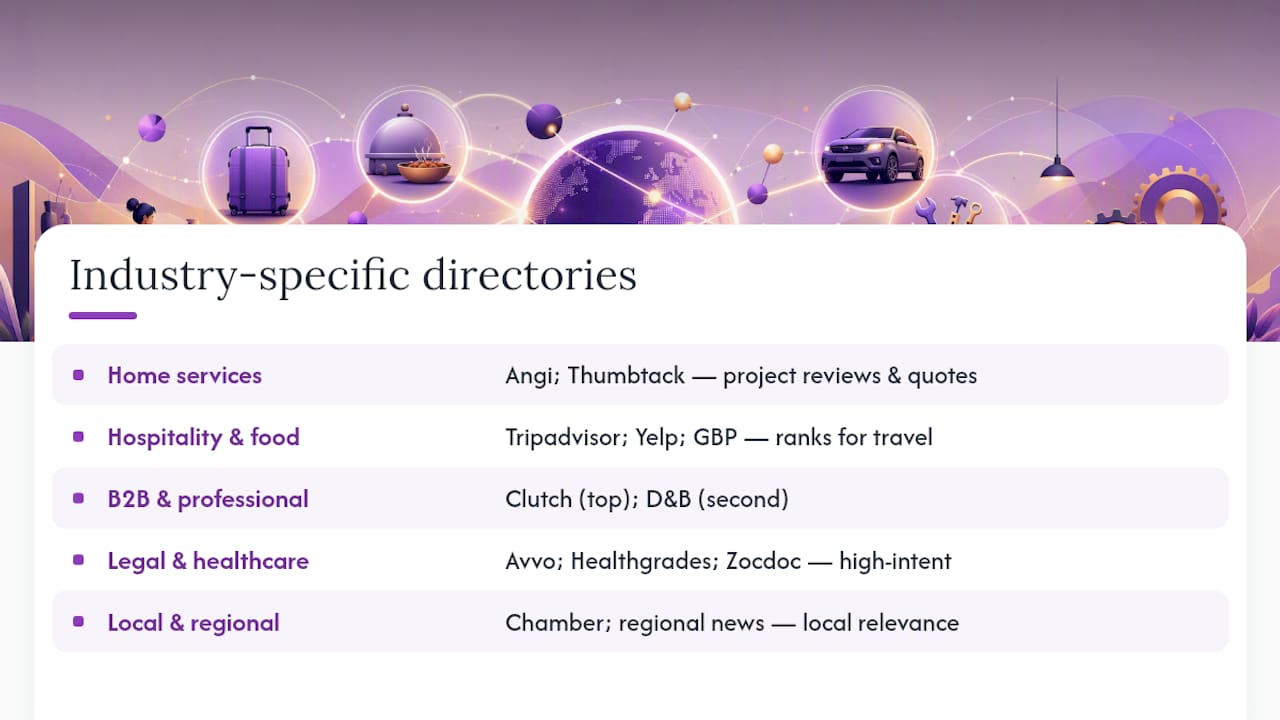
Industry-specific directories to prioritize
Home services (plumbing, HVAC, electrical, landscaping): Angi and Thumbtack are the highest-priority vertical directories. Both carry project-based reviews and quote-request workflows that convert at a higher rate than general directories for this category.
Hospitality and food: Tripadvisor is non-negotiable for hotels, attractions, and restaurants. It ranks for travel queries independently and drives direct booking referrals. Claim it alongside Yelp and GBP.
B2B and professional services: Clutch is the strongest vertical directory for agencies, consultants, and IT firms. Its verified client reviews carry procurement weight that general directories cannot replicate. D&B is the second priority for enterprise-facing businesses.
Legal and healthcare: Avvo (legal) and Healthgrades or Zocdoc (healthcare) are the category leaders. These directories rank for high-intent queries (“divorce attorney in [city]”, “dermatologist near me”) and often include booking or appointment features that general directories lack. Niche directories in regulated industries also carry stronger conversion trust than general listings.
Local and regional: Your local chamber of commerce directory and regional news site business listings matter more than most Tier 3 general directories. They carry local relevance signals and often link to your site, which general aggregators do not.
How do you claim, verify, and optimize a directory listing?
Step-by-step claiming workflow
- Search for existing listings on each platform using your business name and phone number. Unclaimed duplicates are common, especially on Yelp and YellowPages.
- Claim ownership through the platform’s official process. Most require you to log in or create an account, then select “claim this business.”
- Verify via the platform’s method: Google uses postcard or phone; Apple uses email; Yelp uses phone or email. Complete verification before editing any data.
- Merge duplicates if the platform allows it. On Google, report duplicate listings through the Business Profile dashboard. On Yelp, use the duplicate reporting tool.
- Complete the full profile before moving to the next directory.
Optimization checklist
Every listing should include:
- NAP: exact match across every platform — same abbreviations, same suite format, same phone number.
- Business hours: including holiday hours. Outdated hours are one of the most common reasons customers leave negative reviews.
- Primary and secondary categories: choose the most specific category available, not just the broadest.
- Business description: 250–750 words on most platforms; include your city, primary service, and a differentiator.
- Photos: minimum five, including exterior, interior, team, and product/service shots. GBP listings with photos receive more direction requests.
- Services or menu: fill out every structured field the platform offers. These feed AI-generated summaries.
- Booking or messaging links: enable where available. GBP’s booking integration and Yelp’s Request a Quote feature reduce friction for first contact.
For multi-location businesses, use batch upload templates where platforms support them (GBP supports bulk location management for 10+ locations). Keep a master NAP spreadsheet and use a tool like Localseobot’s NAP management guide to track consistency across locations.
Pro Tip: Use Localseobot’s local SEO checklist tool to run through every optimization field systematically. It surfaces missing fields and flags inconsistencies before they affect rankings.
Monitoring and maintenance
Check each Tier 1 listing monthly for user-suggested edits, which platforms like Google accept automatically if you do not review them. Track these metrics in your GBP dashboard: profile views, search queries, direction requests, and call clicks. For Yelp and BBB, monitor new reviews weekly and respond within 48 hours. Run a quarterly audit of your full citation footprint using a citation consistency analyzer to catch NAP drift before it compounds.
How do you decide which directories are worth your time?
A directory earns your attention when it scores well on five axes: relevance to your category, search visibility for local queries, data control (can you edit fields directly?), conversion features (reviews, booking, messaging), and maintenance cost relative to the traffic it sends. Per Digital Web Solutions’ directory metrics, these five factors reliably separate high-value directories from low-value ones.
Red flags that signal a low-priority directory:
- Pages are thin or not indexed in Google Search.
- No real user reviews or engagement visible.
- You cannot edit your own NAP without contacting support.
- The site uses nofollow on all outbound links and shows no referral traffic in analytics.
- The directory charges a high fee for a basic listing without evidence of category-specific traffic.
Questions to ask before investing time:
- Does this directory rank on page one for “[your service] in [your city]”?
- Does it show reviews that influence buyer decisions in your category?
- Does it accept structured fields (hours, services, categories) specific to your industry?
- Can you verify ownership and control edits without a paid plan?
On paid listings: Paid upgrades make sense when the directory already sends measurable referral traffic or when the paid tier unlocks lead-generation features (Angi, Thumbtack, Yelp Ads). Paying for a listing on a directory that does not rank for your category queries is rarely worth it. Aggregator services (Data Axle, Neustar Localeze) are worth the cost for multi-location businesses because they reduce manual update labor across many downstream directories.
How we selected these directories
Every directory on this list was evaluated against six criteria: search visibility (does it rank for local queries in Google?), indexed page volume, data-distribution reach (does it feed other directories or apps?), review volume and quality, category coverage for U.S. businesses, and documented referral traffic where available.
Trust signals checked included domain authority, presence in aggregator feeds, industry adoption across multiple verticals, and whether the platform provides direct data control to business owners. The Search Engine Land citation guide and Digital Web Solutions’ indexed directory metrics served as primary comparative references.
This list reflects conditions as of 2026. Directory authority shifts: platforms get acquired, traffic patterns change, and new aggregator relationships form. Re-check Tier 2 and Tier 3 priorities annually. Tier 1 platforms (GBP, Apple, Bing, Yelp, BBB) have been stable for several years and are unlikely to change in relative importance.
Why does citation accuracy matter more in 2026?
Structured citations on directories like Google Business Profile and Apple Business Connect are now a primary data source not just for traditional search engines but for AI-powered search tools and large language models. When a customer asks an AI assistant for a plumber’s phone number or a restaurant’s hours, the answer often originates from a directory listing.
Stat callout: Industry practitioners note that AI-driven search has increased the stakes of listing accuracy because LLMs frequently source facts from directory listings. Inconsistent NAP across directories can cause AI systems to present incorrect business data — wrong phone numbers, outdated hours, or mismatched addresses — directly to customers who never visit the original directory page.
The practical implication is straightforward: a business that relies on phone calls or in-person visits cannot treat directory accuracy as a set-and-forget task. Sync through well-known data aggregators to reduce the surface area for inconsistency, and audit Tier 1 listings monthly. For a deeper look at how AI-driven search affects local visibility, the downstream effects on citation sourcing are well documented. Localseobot’s guide to AI tools for local SEO covers how to adapt your listing strategy as AI search grows.
How agencies handle directory management at scale
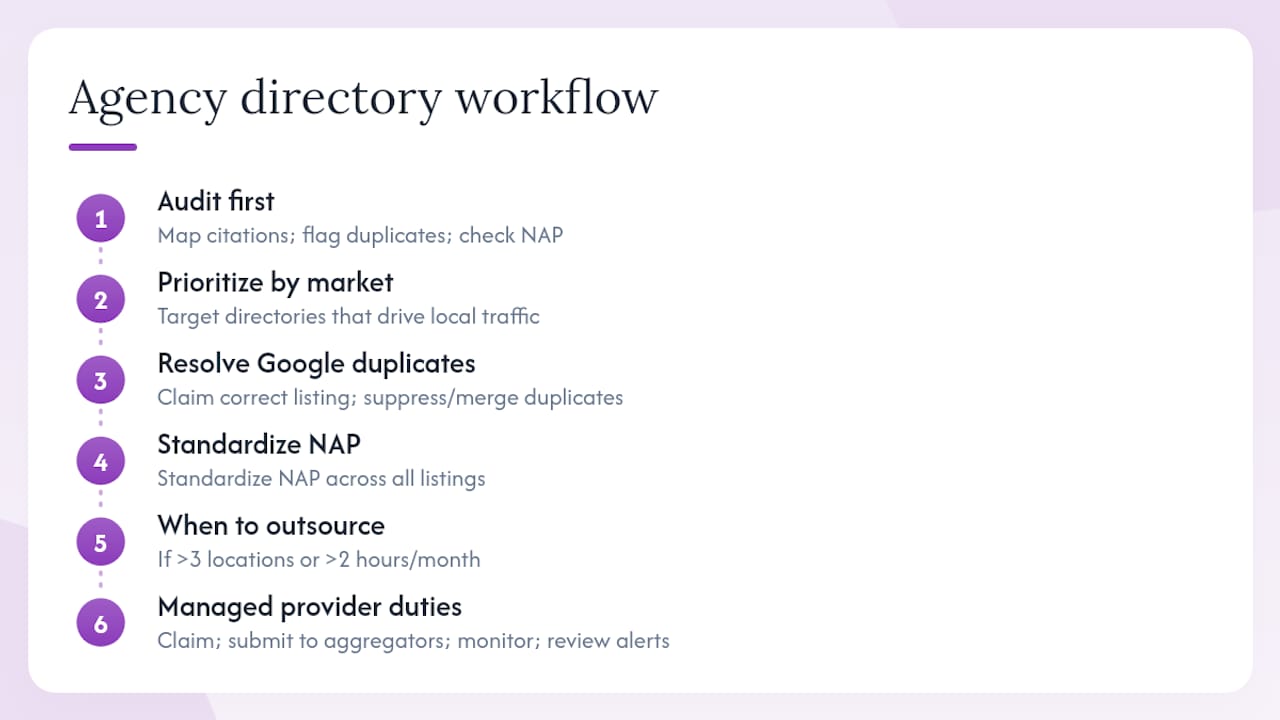
The typical agency workflow for a multi-location client starts with an audit, not a submission. Before touching any directory, a competent agency maps every existing citation, flags duplicates, and identifies NAP inconsistencies. Only then does the team build a priority list by market, because a directory that drives real traffic in Chicago may be irrelevant in a smaller metro.
A common problem that surfaces in almost every audit: a business has three or four Google Business Profile listings for the same location, created over the years by different employees or previous agencies. The fix is to claim the correct listing, suppress or merge the duplicates through Google’s reporting process, and then standardize the NAP before touching any other directory. Skipping the audit and going straight to new submissions compounds the problem.
The practical rule of thumb on outsourcing: if you have more than three locations, or if you are spending more than two hours per month managing listings manually, a managed service pays for itself in time savings alone. Expect a managed provider to handle initial claiming, aggregator submission, monthly monitoring, and review alerts. What separates a quality provider from a low-cost one is whether citations are built manually on high-authority directories or bulk-submitted to low-value sites that add noise without authority.
Localseobot handles the directory work you do not have time for
Claiming the essential directories is manageable within a weekend. Maintaining 30+ listings across Tier 1, Tier 2, and aggregator networks while monitoring for user-suggested edits, NAP drift, and new reviews is a different job entirely.
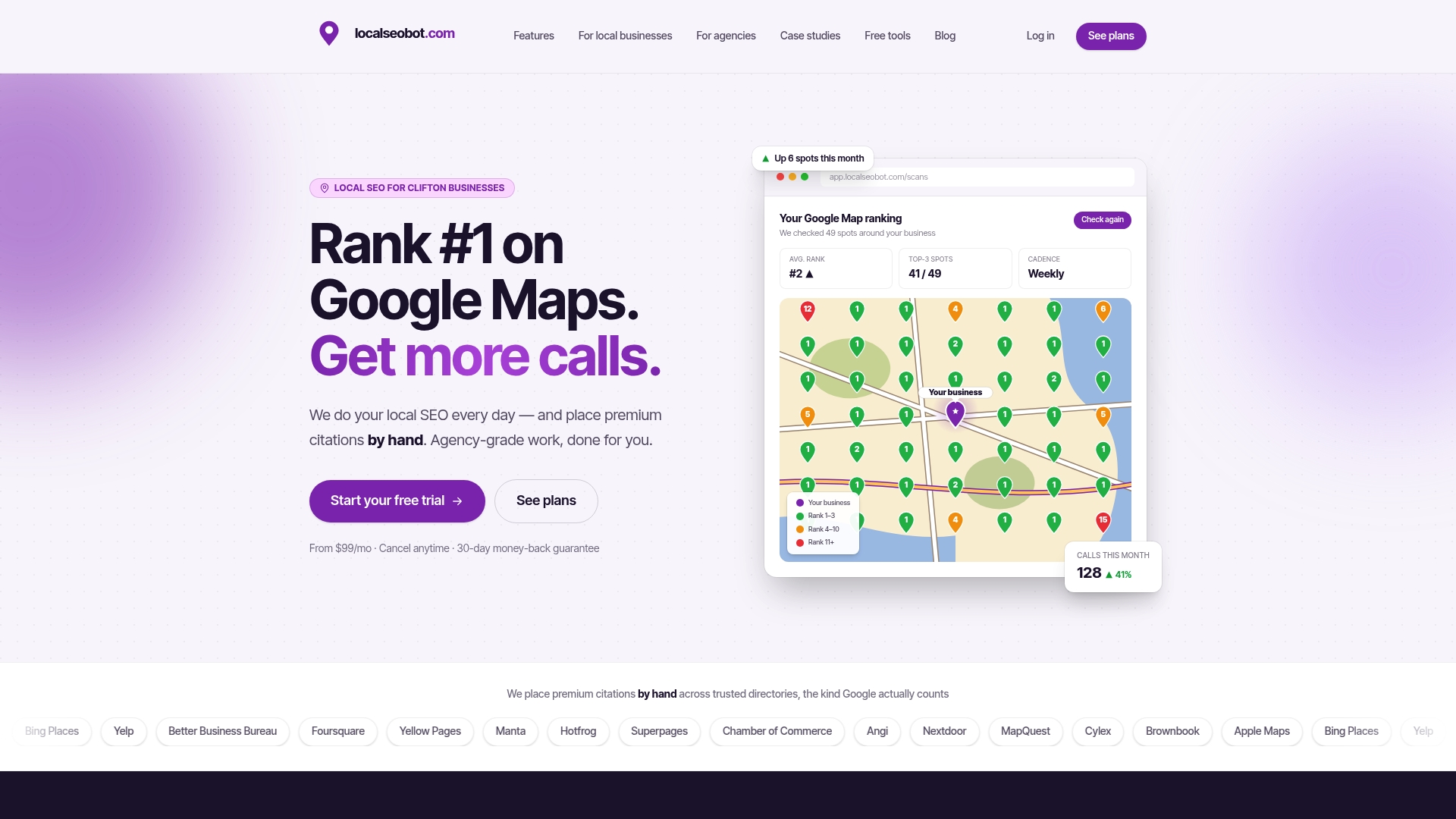
Localseobot’s local SEO service builds citations manually on high-authority directories rather than bulk-submitting to low-value sites. That distinction matters for ranking: search engines weight citation quality, not just volume. The platform also includes Google Maps rank tracking with geo-grids, automated GBP optimization, review generation, and monthly reporting, so you can see exactly what each listing is doing for your visibility.
When evaluating any managed citation provider, look for these specifics:
- Manual citation creation on verified, high-authority directories (not automated bulk submissions).
- Direct aggregator relationships with Data Axle, Foursquare, and Neustar Localeze.
- Verification practices that confirm ownership before editing any listing.
- Monthly reporting that ties directory activity to ranking changes and call volume.
- A money-back or performance guarantee that shows the provider stands behind their results.
Localseobot offers a 30-day money-back guarantee if your Google Maps ranking does not improve. Use the Google Business Profile optimizer to start with your most important listing, then let the managed service handle the rest.
Sources
- Structured vs Unstructured Citations for Local SEO
- Google Business Profile
- Yelp
- Bbb
- Top 50 General Business Directories - Digital Web Solutions
- Business Directory
- Clutch - The Leading Marketplace for Finding Business Services
- Foursquare Business Listings
- YellowPages