Do Citations Matter for Google Maps Rankings?
Published November 11, 2026
Do Citations Matter for Google Maps Rankings?

Yes, local citations matter, but not in the way most directory lists suggest. A citation is a reference to your business name, address and phone number on another site. It helps Google confirm that your business is real, stable and located where you say it is. Accurate, consistent citations on a handful of trusted sources do most of the work. Piling up hundreds of listings does not.
This guide covers what citations do, what Google says about them, how many you need, how to clean up the ones you already have, and where citations fit next to reviews, your Google Business Profile and proximity.
TL;DR
- Citations act mainly as verification. Consistent business details across the web help Google trust that your listing is accurate.
- Accuracy beats volume. A short set of correct, high-trust listings is worth more than a long list of weak ones.
- Google ranks local results on relevance, distance and prominence. Citations feed the trust behind those signals but do not replace a strong Business Profile or reviews.
- Duplicates, old addresses and wrong phone numbers do the most damage. Audit your listings on a regular schedule.
- New businesses, movers and rebranded businesses get the biggest payoff from citation work.
Table of Contents
- What a citation is (and what it is not)
- What Google says about citations
- Why consistency matters more than volume
- How many citations do you need?
- How citations compare with other local ranking factors
- How to find and fix bad citations
- Perspective: why we build citations by hand
- What a citation service should do for you
- Put citations to work with Local SEO Bot
- FAQ
- Sources
What a citation is (and what it is not)
A local citation is an online mention of your business details, usually name, address and phone number (NAP), on a third-party site. Search Engine Land explains that there are two kinds:
- Structured citations are formal listings on directories and platforms, such as Google Business Profile, Apple Business Connect, Yelp, YP.com and TripAdvisor.
- Unstructured citations are mentions elsewhere, such as local news articles, social media posts and press releases. They may or may not link to you.
Three things get confused with citations:
| Term | What it is | Needs a link? |
|---|---|---|
| Citation | A mention of your NAP or other business details on another site | No |
| Backlink | A hyperlink from another site to yours | Yes |
| Google Business Profile | The listing you control inside Google, which is itself a structured citation | No |
A citation can carry a link, and a link can carry your name, but they are different signals. If you want the full breakdown of types, our guide to the types of local citations walks through each one.
What Google says about citations
Google has never published a rule saying that citations are a ranking factor with a set weight. What it does publish is how local results work. According to Google’s own guidance on local ranking, results are based mainly on relevance, distance and prominence. Prominence draws on information Google has about a business from across the web, including how many sites link to it and how many reviews it has.

That is where citations come in. They are part of the web footprint Google uses to understand your business. An older Google Lat Long post on how local search ranking works makes the practical point plainly: the best way to help customers find you is to make sure basic details such as name, address and phone number are accurate.
Some industry writers go further. Search Engine Journal concludes that Google all but confirms it uses citations as a signal in the local pack and in localized organic results, because they help check whether your key business information is correct. You do not need to settle the debate over the exact weight. The safe reading is that citations support trust and accuracy, and wrong ones can hurt you.
For a clear way to connect citations to Google’s relevance, distance and prominence pillars without overstating their role, the Local SEO Academy guide on Google’s local ranking pillars is a good companion read.
Why consistency matters more than volume
Think of citations as a cross-check. When Google sees the same name, address and phone number on many reputable sources, it can be more confident that your Business Profile is correct. When sources disagree, that confidence drops.
One independent SEO analysis from 2026 argues the same thing: citations work as a baseline trust check rather than a score where the 50th listing helps more than the 10th. On that view, a business with accurate, consistent details across the major high-trust data sources gets essentially the full benefit, and hundreds of extra low-quality listings add little.
This matches what we see in practice. The listings that cause problems are rarely missing ones. They are wrong ones:
- An old suite number left on a directory from before a move.
- A tracking phone number on one site and the main line on another.
- A business name with “LLC” on some listings and without it on others.
- A duplicate listing created when someone re-submitted the business years ago.
Search Engine Land warns that neglected listings lead to data decay, outdated hours that damage your reputation, and missed local marketing opportunities. It recommends keeping NAP details and hours consistent on every platform.
Which details should match everywhere
Pick one version of each item and copy it exactly:
- Business name, exactly as it appears on your signage and Business Profile.
- Street address, including suite format and abbreviations (“Suite 200” or “Ste 200”, not both).
- Primary phone number.
- Website URL.
- Business category.
- Hours of operation, including holiday hours.
Google itself asks for accurate phone number, address, category and hours in its local ranking tips. If you run more than one location, the same rule applies per location, and the work multiplies. Our guide to NAP management for multi-location businesses covers how to keep that under control.
How many citations do you need?
There is no official number. A practical target for most small businesses is a core set of the major, trusted sources, plus the directories that are specific to your industry and city. Past that point, extra listings tend to add upkeep without adding much trust.
A sensible build order looks like this:
- Data and mapping sources. Google Business Profile, Apple Business Connect, Bing Places and the major aggregators that feed other sites.
- Major general directories. The big consumer directories people actually search.
- Industry directories. Sites for your trade, such as legal, medical, home services or hospitality.
- Local directories. Your chamber of commerce, city business associations and regional sites.
- Unstructured mentions. Local news, sponsorships and community pages. You earn these rather than submit them.
We lay out this order, with the eight core sites to start with, in our local citations list and priority workflow. If you want to see where you are missing, the Local Citation Finder shows gaps by business type and location.
Quality matters as much as count. A listing on a site with real traffic, editorial standards and a clean data feed carries more trust than a listing on a thin directory that exists only to sell submissions. Low-quality directories can also copy and spread your data, which is how a single wrong address ends up in twenty places.
How citations compare with other local ranking factors
Citations are one layer. They rarely lift a weak profile by themselves. Here is how they sit next to the other levers, based on Google’s own relevance, distance and prominence framework.
| Factor | What it influences | Your control |
|---|---|---|
| Business Profile completeness and categories | Relevance | High |
| Proximity to the searcher | Distance | None |
| Reviews: count, rating, recency, replies | Prominence | Medium |
| Website content and links | Relevance and prominence | High |
| Citations | Trust in your details, supporting prominence | High |
This gives a simple rule for priorities:
- Start with your Business Profile. If your categories, services, description and photos are thin, fix that first. Our Google Business Profile audit shows what is missing.
- Build citations next if you are new, have moved, or have changed your name or phone number. This is when citations pay off most, because Google has little or conflicting data about you.
- Keep earning reviews all the time. Reviews feed prominence and are also something customers read before they call.
- Track results by location. Rankings on Google Maps change from block to block, so a single “rank” number hides the real picture. A grid scan shows where you appear across your service area.
How to find and fix bad citations
Cleanup is where most small businesses see the quickest return, because it removes conflicting data rather than adding new listings. Plan on an afternoon for a single location.
Step 1: Write down your master record
Create one document with your exact name, address, phone, website, categories and hours. This is the version everything else must match.
Step 2: Search for yourself
Search your business name, your phone number and your old addresses or old names. Note every listing you find, whether it is correct, and who controls it. Our one-afternoon NAP consistency audit gives a full checklist, and the Citation Consistency Analyzer can speed up the comparison.
Step 3: Fix what you control
Claim each listing, then correct the name, address, phone, hours and website. Fix the high-traffic sources first, since other sites often pull from them.
Step 4: Deal with duplicates
Duplicates split your reviews and confuse Google about which listing is real. For duplicate Business Profiles, Google’s process starts inside your Business Profile manager. As Google’s help page on duplicate profiles describes, you can filter your businesses to the duplicate view, open the flagged listing and follow the steps to remove the duplicate. On other directories, use the site’s claim, merge or removal request form.
Step 5: Handle listings you cannot edit
Some sites scrape data and offer no way to edit. Send a correction request, and if the site has a data aggregator behind it, correct the aggregator as well.
Step 6: Set a review schedule
Check your core listings again after any move, rename, phone change or hours change, and as a routine every six to twelve months. Industry guides commonly suggest a similar cadence. Improvements from cleanup typically show up over weeks, not days, because directories and Google need time to recrawl.
Perspective: why we build citations by hand
We get asked all the time whether citations are “still worth it.” Our answer is yes, as long as you treat them as a trust layer and not a numbers game.
Most local SEO tools hand you a report listing 80 directories and leave the work to you. We think that approach misses the point. What matters is that the right sources carry the right details, and that nobody has to chase them down every time something changes.
That is why a dedicated team at Local SEO Bot manually builds premium citations on high-authority directories, while our AI agent handles the ongoing work on your Google Business Profile: optimization, regular posts, review replies and map grid tracking. Citations give Google a reason to trust your details. The profile work and the reviews give it a reason to show you.
Our approach is designed to give small businesses the signals Google trusts without hiring an agency, and we back it with a 30-day money-back guarantee if a business does not see a ranking increase.
Devyn H
What a citation service should do for you
If you outsource this work, judge the service on the points above, not on how many directories it advertises:
- Does it start with a clean master record and fix existing errors, or just add listings on top?
- Are submissions done manually on high-authority sources, or pushed in bulk to thin directories?
- Does it check for duplicates?
- Does it keep listings in sync when your details change?
- Does it connect to your Business Profile and rank tracking, so you can see whether visibility moves?
Our own local citation services are built around those points. If you want to understand the full range of what is included, see our local citations services overview.
Put citations to work with Local SEO Bot

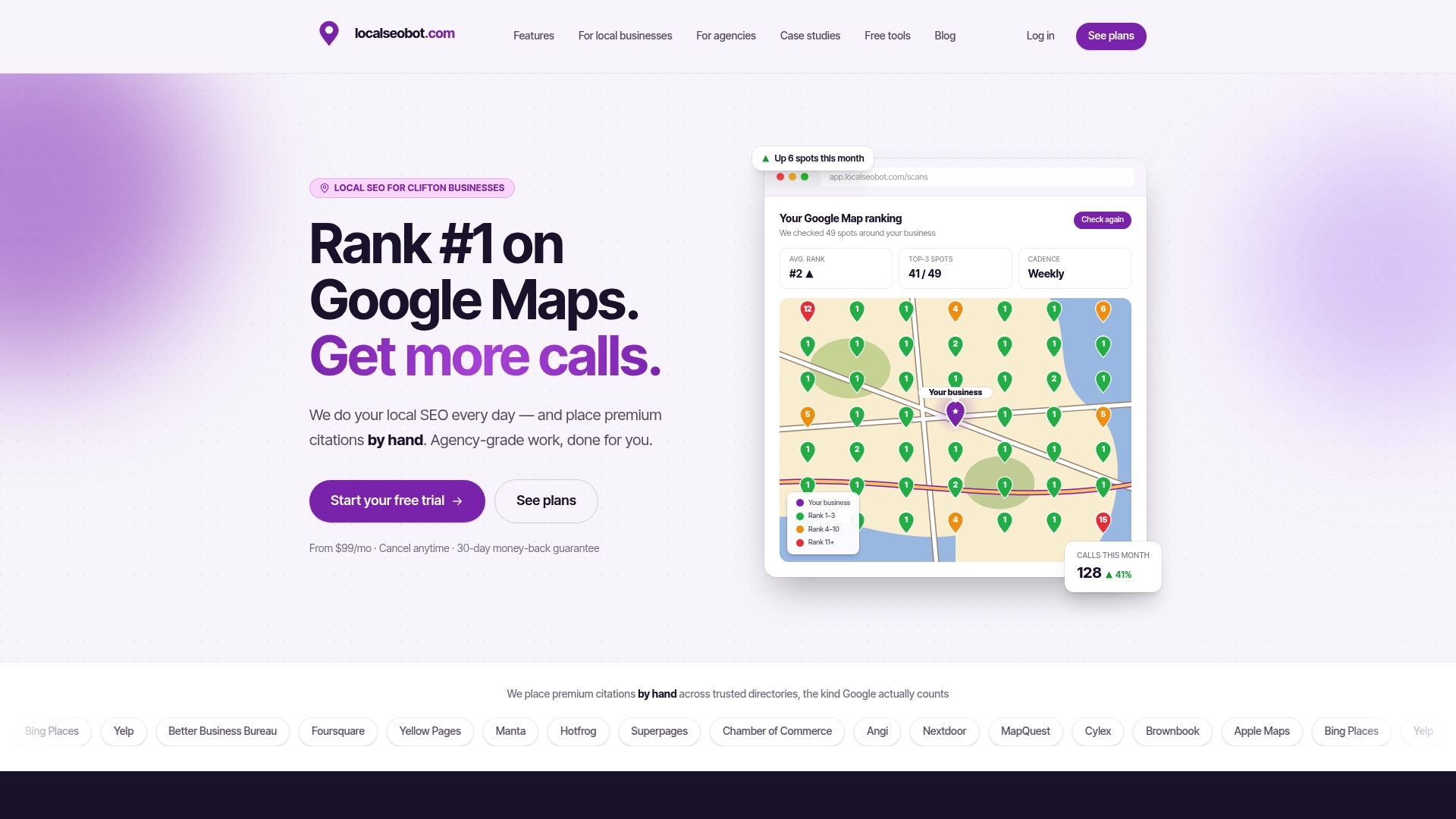
Citations are one part of ranking higher on Google Maps. Local SEO Bot is an AI agent that does the work itself: it optimizes your Google Business Profile, publishes regular posts, tracks rankings across your service area with map grid scans and responds to reviews. A team of people builds premium citations on high-authority directories behind it.
Plans are billed per location, per month: Foundation is $99 per month per location and Growth is $199 per month per location, both on our pricing page.
You can also see how Google Maps SEO fits into the bigger picture, or start from our homepage.
FAQ
Do citations still matter in 2026?
Yes, mainly as a check on accuracy. Google builds its picture of your business from many places, and citations help confirm your name, address, phone number and hours. They matter less as a standalone ranking boost and more as support for the Business Profile and reviews.
Do citations need a link to my website?
No. A citation is a mention of your business details, and it counts as one even without a link. Links are a separate signal. Some directory listings include a link and some do not, and both can help establish that your business details are correct.
Is it bad to have too many citations?
Not by itself, but poor ones create risk. Low-quality directories can copy wrong data and spread it, and every extra listing is one more place to keep current. Focus on a core set of trusted, relevant sources, then expand only where a directory serves your industry or city.
How long until I see results from citation work?
Cleanup and new listings take time to be picked up, so expect weeks rather than days. Results depend on your starting point. A business with conflicting or duplicate listings usually has more to gain than one that is already consistent.
Should I fix citations before working on my Google Business Profile?
Start with the profile, since it is the listing that appears in Maps. Then make sure the other listings match it. If you recently moved, changed your name or changed your phone number, do both together so the details agree everywhere.
Sources
- Structured vs Unstructured Citations for Local SEO, Search Engine Land
- Tips to improve your local ranking on Google, Google Business Profile Help
- How Local Search Ranking Works, Google Lat Long
- Are Local Citations (NAP) a Google Ranking Factor?, Search Engine Journal
- Is citation volume still a primary local ranking factor?, Vega SEO Talks
- How to fix: Duplicate Business Profile, Google Merchant Center Help
- Local SEO + AEO + GEO Academy