Manual Citation Building: How to Do It Right in 2026
Published October 29, 2026
Manual Citation Building: How to Do It Right in 2026

Manual citation building means creating, claiming and correcting your business listings by hand, one directory at a time, so your name, address and phone number (NAP) match everywhere. Done well, it gives you control over accuracy and avoids paying for bulk submissions. Done badly, it produces duplicates, typos and a spreadsheet nobody trusts. This guide shows the order to work in, the sources worth your time, the ones to avoid, and when handing the job off makes more sense.
TL;DR
- Audit before you build. Find what already exists, then fix and merge it before creating anything new.
- Build in layers: the main U.S. data aggregators, major platforms, industry directories, then local sources.
- Skip mass-submission services and low-level directories. A few relevant, accurate listings beat hundreds of junk ones.
- Track every listing in a spreadsheet with status, login and live URL, and review it regularly.
- Manual work is precise but slow and hard to scale. Multi-location businesses and agencies usually need help.
Table of Contents
- What manual citation building actually is
- Why citations still matter for Google Maps
- Manual vs. automated: an honest comparison
- Step 1: Audit what already exists
- Step 2: Fix the foundation first
- Step 3: Build the major platforms
- Step 4: Add industry and local sources
- How to create each listing properly
- Citation sources to avoid
- Fixing duplicates and outdated listings
- How many citations do you need?
- Our perspective: where manual work wins and where it breaks
- When it makes sense to hand it off
- A simple maintenance routine
- FAQ
- Sources
What manual citation building actually is
A local citation is an online mention of your business that includes its name, address and contact details, and sometimes your website. Search Engine Journal’s citation guide separates two kinds. Structured citations are directory-style listings on sites such as Yelp, Yellow Pages, Facebook and mapping services. Unstructured citations are mentions in news, blogs, social media and other non-directory pages.
Manual citation building is about the first kind. According to Ahrefs, it is the process of researching, creating, claiming and updating your NAP on individual directories and platforms to keep it accurate and improve local search visibility. A person fills in each form, picks each category and verifies each listing. Nothing is pushed out in bulk.
That is different from automated distribution, where one submission fans out to many sites. Both have a place, which we cover below.
Why citations still matter for Google Maps
Citations are a consistency and trust signal. They help search engines confirm that your business exists, where it is and how to contact it. Search Engine Journal notes that consistent citations help engines verify business information and judge authority and prominence.
They are not a magic ranking lever. Your Google Business Profile, reviews, proximity and on-page relevance carry more weight for most searches. Think of citations as the foundation: wrong data undermines everything built on top, while clean data lets your other work count. If you want the full picture of how the pieces fit, our Google Maps SEO overview covers it.
Manual vs. automated: an honest comparison
The tradeoffs are well documented. Search Engine Land says manual building gives direct control and avoids third-party fees, but it is labor-intensive, demands attention to detail, is hard to update when your business data changes, and does not scale well for multi-location businesses.
| Factor | Manual building | Automated distribution |
|---|---|---|
| Accuracy | High, because a person checks each field | Depends on the source data and the network |
| Control | Full control of category, description and photos | Limited to what the tool pushes |
| Speed | Slow, often hours per batch | Fast |
| Updates | Each listing edited by hand | One change can propagate |
| Multi-location | Hard to manage | Easier |
| Cost | Your time, or a per-listing fee | Subscription |
For a single-location business with a few dozen listings, manual work is realistic. For ten locations, it becomes a part-time job. A hybrid is common: automate the broad base and build the high-value listings by hand.
Step 1: Audit what already exists
Most businesses already have citations they never created. Data aggregators, old owners, past addresses and public edits all leave traces. Building new listings on top of that mess creates duplicates.
Set up a tracking spreadsheet first. Useful columns:
- Site name and URL
- Status: Good, Missing, Errors or Duplicate
- Login email and username (store passwords in a password manager, not in the sheet)
- Live listing URL
- Action needed
- Date last checked
Then search for yourself. Look up your business name, city and phone number on Google and on each citation site you plan to use. Search your old phone numbers, previous addresses and earlier business names too, since outdated versions are a common source of conflicts. Log everything you find, including errors and duplicates.
The NAP consistency audit we wrote fits into one afternoon, and our free Citation Consistency Analyzer can speed up the first pass.
Decide on your canonical NAP
Before touching any listing, write down the one version of your details that every listing will use. Decide:
- Exact business name, as it appears on your signage and Google Business Profile
- Street address format, including suite and abbreviations (“Suite 200” or “Ste 200”, but never both)
- One primary phone number, ideally a local number
- One website URL, with or without “www”, always the same
- Primary and secondary categories
- A short and a long business description
Copy these from a single document every time. Retyping from memory is where most inconsistencies begin.
Step 2: Fix the foundation first
The three primary U.S. data aggregators are Data Axle, Neustar Localeze and Foursquare, according to Search Engine Land. The same source says Data Axle is free for businesses with ten or fewer locations, while Neustar Localeze and Foursquare charge annual fees. Check current terms on each provider’s site before you commit, since fees change.
Why start here? Aggregators feed data to many downstream directories, apps and navigation services. An error at this level can keep reappearing on sites you have already corrected. Fix it upstream and your later work sticks.

Step 3: Build the major platforms
Next come the platforms that real customers use and that search engines treat as authoritative. A typical core set for U.S. local businesses:
- Google Business Profile (the most important listing you have)
- Bing Places for Business
- Apple Business Connect
- Facebook business page
- Yelp
- Better Business Bureau
- Yellow Pages
- Nextdoor business page, where relevant
Start with the two search engine profiles. Bing publishes quality guidelines for its listings, and its Places API documentation recommends updating business data at least every six months to avoid a “StaleBusinessData” flag. The same document defines a duplicate address issue as the same address used for multiple business entries in one account, which is a good reminder to check your own accounts for repeats.
Our priority citation list walks through eight core sites in the order we would build them. If you also need to tune your main profile, the Google Business Profile Optimizer is the place to start.
Step 4: Add industry and local sources
After the core set, the value comes from relevance. A plumber benefits from trade and home-services directories. A dentist benefits from health and provider directories. Any business benefits from local sources: the chamber of commerce, city or county business listings, local newspapers’ directories and neighborhood associations.
When choosing, ask three questions:
- Would a real customer plausibly find me here?
- Is the site maintained, with current listings and a real editorial or verification process?
- Does it let me control category, hours and a description?
If the answer to all three is yes, build it. If not, skip it. The local citation finder can surface relevant options for your category and city. For prioritizing among relevant directories and major U.S. platforms, this guide to local SEO sources offers extra background.
How to create each listing properly
The mechanics are simple. The discipline is the hard part.
- Search first. Look for an existing listing before you create one. Claim and correct it if you find it.
- Paste your canonical NAP. Do not retype it.
- Choose the closest category. Use the most specific option available and match your Google Business Profile.
- Write a unique description. Avoid pasting the same paragraph everywhere, and avoid keyword stuffing.
- Add photos and hours. Use the same logo and a few real photos.
- Verify. Many sites require a phone call, postcard or email code. Finish this step or the listing may never go live.
- Log it. Record the live URL, login and date in your spreadsheet.
An hour spent on three well-built listings is worth more than an afternoon of twenty rushed ones.
Citation sources to avoid
Not every directory deserves your business details. Search Engine Land advises avoiding services that promise rankings or mass submissions to low-level directories, and prioritizing major platforms plus prominent industry- or geography-specific directories. Ahrefs makes the same point: quality over quantity, with relevant and trusted sources rather than every site you can find.
In practice, steer clear of:
- Mass-submission offers that promise hundreds of listings for a flat fee
- Directories with no real audience, where the site exists mainly to sell listings or links
- Sites that publish pages with no verification, which tend to fill up with duplicates and scraped data
- Directories unrelated to your industry or region, which add noise rather than relevance
- Anything promising guaranteed rankings, since no one controls Google’s results
- Paid listings with auto-renewing fees you did not intend to sign up for
Before submitting anywhere, check whether the site shows up when you search for similar businesses in your city. If you cannot find any real local business pages on it, move on.
Fixing duplicates and outdated listings
Cleanup often delivers more than new building. The process is straightforward:
- Mark every duplicate and error in your audit sheet with the action required.
- Claim the listing you want to keep, and update it to your canonical NAP.
- For duplicates, use the site’s removal or merge request process. Where there is none, edit the duplicate so it matches your canonical details instead of leaving conflicting data live.
- Include previous names, addresses, phone numbers and websites in your search, so old versions do not hide.
- Re-check after a few weeks, because data from aggregators can overwrite your changes.
Bing’s documentation notes that multiple entries for the same business with identical published details may be merged internally, which allows unified management later. That is one more reason to keep details identical everywhere.
If you manage several locations, the process multiplies quickly. Our guide to NAP management for multi-location businesses covers how to structure it.
How many citations do you need?
There is no magic number. Our own audit-first directory submission guide suggests a range of 30 to 50 listings for most local businesses, and that includes the core platforms. A low-competition market may need fewer. A crowded city category may justify more, as long as each addition is relevant and accurate.
Measure results rather than guessing. Track your Google Maps positions across your service area with a grid scan before and after a citation round, so you can see whether changes help. Our Maprank tool does this with geo-grids.
Our perspective: where manual work wins and where it breaks
We build citations for a living, so we have a clear view of what works. Manual building is the right call for the listings that matter most. A person catches the wrong category, the stale suite number and the duplicate from 2017 that an automated push would copy forward. That is why, behind our AI, a team of people builds premium citations by hand on high-authority directories.
Where manual work breaks is time. Owners start with good intentions, build twelve listings, then life intervenes. Six months later the phone number changes and half the listings are wrong. The spreadsheet is stale, nobody remembers which email was used to register, and duplicates creep back in.
Our advice:
- Do the audit and the aggregator fixes yourself, or have someone do them once and properly.
- Keep a single source of truth for NAP and make every change there first.
- Treat citations as one input to Maps rankings, alongside your profile, reviews and posts. Do not expect them to carry the whole effort.
- Recheck on a schedule. Quarterly is realistic for most small businesses.
We also believe in measuring. If the work does not move your map positions, you should know. That belief is the reason we offer a 30-day money-back guarantee if a business does not see a ranking increase.
— Devyn H
When it makes sense to hand it off
Doing this yourself is a fair choice if you have one location, a free afternoon each month and a taste for detail. Consider help if:
- You run multiple locations and changes must propagate everywhere
- You have moved, rebranded or changed phone numbers recently
- Your audit shows dozens of conflicts and duplicates
- You manage client locations as an agency and need repeatable delivery
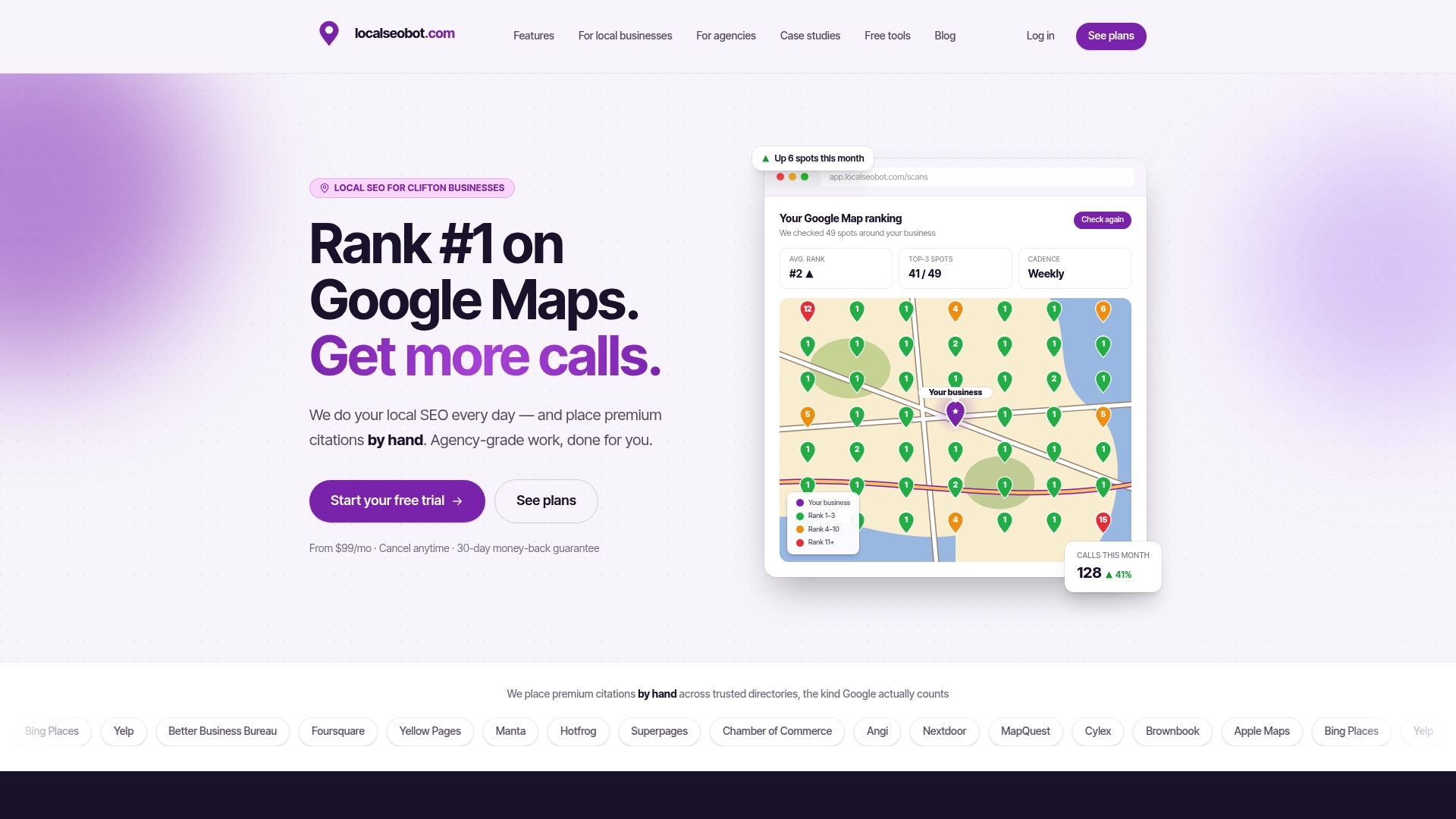
Local SEO Bot is an AI agent that does the work rather than handing you a report. It optimizes your Google Business Profile, publishes regular posts, tracks rankings with map grid scans and responds to reviews, while our team manually builds premium citations on high-authority directories. Plans are Foundation at $99 per month per location and Growth at $199 per month per location, both on our pricing page. Agencies can look at the Pro plan at $399 per month per location on the agency pricing page, which supports white-label use. You can read more about our local citation services too.
If you want to see where you stand first, run the free Citation Consistency Analyzer before deciding anything.
A simple maintenance routine
Citations decay. Businesses change, directories get edited by the public, and spam appears. Search Engine Land notes that listings need ongoing maintenance for exactly these reasons. A light routine keeps you ahead:
- Monthly: check your Google Business Profile and top five listings for edits you did not make.
- Quarterly: search your phone number and business name, and look for new duplicates.
- Every six months: review and refresh Bing Places data, per Bing’s own guidance.
- Whenever anything changes: update the master NAP document, then every listing, then the spreadsheet, in that order.
New to the vocabulary? Our guide to types of local citations and the complete beginner’s guide to citation building fill in the basics.
FAQ
What is manual citation building?
It is the hands-on process of finding, creating, claiming and correcting your business’s NAP listings on directories and platforms. A person submits and verifies each one instead of using a bulk tool. The aim is accurate, consistent data in places your customers and search engines trust.
How do I build citations manually?
Audit your existing listings first, define one canonical NAP, and fix the data aggregators. Then build the major platforms, followed by industry and local directories, logging each listing in a spreadsheet with its status, login and live URL. Verify every listing so it actually goes live.
Which citation sources should I avoid?
Avoid mass-submission packages, directories with no real audience or verification, and anything promising guaranteed rankings. Stick with major platforms and relevant industry or local directories. If a site would never send a real customer your way, skip it.
Is manual citation building better than automated tools?
It is more precise and gives you control, but it is slower and harder to keep current, especially across several locations. Many businesses build the most important listings by hand and use automation or a service for upkeep at scale.
How long does manual citation building take?
The audit usually takes an afternoon, and each well-built listing takes 15 to 30 minutes including verification. Verification by phone, postcard or email can add days before a listing goes live.
Sources
- A Guide to Local Citation Building, Search Engine Journal
- What Is A Local Citation? How They Help SEO, Ahrefs
- Structured vs Unstructured Citations for Local SEO, Search Engine Land
- Bing Places for Business API documentation
- Local SEO + AEO + GEO Academy, BabyLoveGrowth