Local Content Ideas That Win Customers and Maps Visibility
Published November 20, 2026
Local Content Ideas That Win Customers and Maps Visibility

The best local content ideas answer a question a nearby customer is already asking: who is good around here, what does it cost, and what should I do before I call. Publish those answers on your website and your Google Business Profile, tie them to real places, people and seasons in your service area, and keep doing it on a schedule. The hard part is not the ideas. It is publishing them every week without letting the work slide, which is why we built Local SEO Bot to do the publishing for you.
This guide gives you idea lists you can use today, examples by industry, a simple way to pick topics, and a posting routine. It is written for small business owners who want more Google Maps visibility and for agencies that run this work for clients.
TL;DR
- Good local content is useful, specific to your area and tied to a real customer question: pricing, how-tos, neighborhood guides, local events, job photos and reviews.
- Publish in two places: pages on your website, and short posts on your Google Business Profile, which can show up on Search and Maps.
- Pick topics with local keyword research and your own customer questions, not guesswork.
- Consistency beats volume. A weekly routine you can keep is worth more than a burst of posts that stops.
- Local SEO Bot publishes regular Google Business Profile posts automatically and tracks your rankings across your service area.
Table of Contents
- What counts as local content
- Content ideas that work for almost any local business
- Local content ideas by industry
- Interactive ideas: polls, quizzes and contests
- How to choose topics: keywords and customer questions
- Where to publish: website and Business Profile
- A weekly routine you can keep
- For agencies: adapting ideas across client locations
- Our perspective on local content
- Put the routine on autopilot
- FAQ
- Sources
What counts as local content
Local content is anything you publish that helps people in your service area choose you. It can be a page on your website, a post on your Google Business Profile (the listing that appears on Google Search and Maps), a photo, a video or a review response.
What separates it from generic content is proof of place. A plumber’s article on a running toilet is useful anywhere. The same article with the neighborhoods you serve, the local water-heater rules you work around and photos of your own jobs is local.
Google’s own help page says business posts let you share announcements, offers, updates and event details directly with customers on Search and Maps. Posts support text, photos and videos, and you choose a type: update, offer or event. That makes the profile the quickest place to publish local content, because it sits exactly where nearby customers are deciding.
Content ideas that work for almost any local business
These ideas fit most industries. Start with the two or three that match your customers’ questions.
Pricing and process pages
Customers want to know what a job costs before they call. Search Engine Land’s guide on local business content recommends transparent pricing as a way to build trust and convert visitors. You do not need exact quotes. Explain what drives the price, give typical ranges for your area and say what happens after the first call.
Neighborhood and area guides
Write about the places you serve: what the housing stock looks like, common problems there, parking or access quirks, and nearby landmarks you pass on the way. The same guide suggests neighborhood guides and area recommendations to show community presence. A page called “Roof repair in the Eastside” with real job photos beats a page that lists 40 city names.
Best-of lists and local recommendations
A restaurant can publish a guide to a weekend in its neighborhood. A hotel can list family activities. A law firm can explain which county court handles which filing. The format works because it is useful even to someone who never hires you, and it shows you know the area.
Local events and holidays
Share what is happening nearby: festivals, farmers markets, school-year deadlines, road closures, holiday hours. Timely event information is another tactic listed in the Search Engine Land guide. On your Business Profile, an event post or a holiday-hours update takes a few minutes and reaches people at the moment they search.
Seasonal content
Most local demand moves with the calendar: furnace tune-ups in fall, AC repair in the first heat wave, tax prep in winter, landscaping in spring. Plan these a month ahead so the page is live before the search spike. Our piece on how seasonal content boosts local search rankings walks through the planning side.
Customer stories and reviews
Real customers are your strongest content. Search Engine Land’s scalable local SEO guide lists staff, premises, vehicles, completed projects, community involvement, testimonials and customer photos as trust signals for location pages. Turn a finished job into a short before-and-after story, quote a review with permission and name the neighborhood.
Reviews are also content in themselves. Every reply you write is public, so a specific, friendly response shows future customers how you treat people. Our Google Reviews Management Tool page explains how review generation and replies are handled.
Photos and video
Google’s Business Photos success stories describe Toy Joy, a local attraction that used photos so customers could picture the store before visiting. Another story on the same page describes a spice market whose Google page impressions rose from about 30 per day to a high of 270, as the business’s own account. Treat that as one business’s experience, not a promise, but the lesson holds: fresh, real images give people a reason to choose you.
Behind-the-scenes content
Show how you work: the crew loading the truck, the kitchen prepping, the technician diagnosing a problem. It humanizes a business and costs only a phone camera.

Updates to old pages
Outdated pages cost you trust. The Search Engine Land guide includes updating outdated pages among its recommendations. Check prices, hours, service areas and photos at least twice a year.
Local content ideas by industry
The table below turns the general ideas into specific topics. Use it as a starting list, then replace the generic parts with your city and your customers.
| Business type | Content ideas | Where to publish |
|---|---|---|
| Restaurant or cafe | Weekend neighborhood guide, seasonal menu update, local supplier story, holiday hours, event nights | Business Profile posts, website blog |
| Plumber, electrician, HVAC | DIY explainers, “what this repair costs in [city]” page, emergency checklist, job photos by neighborhood | Service pages, Profile posts |
| Law firm or accountant | Local court or filing guide, deadline reminders, client FAQs, community sponsorships | Website articles, location page |
| Gym or studio | Class schedule updates, member stories, local race or event training plans | Profile posts, social media |
| Home contractor | Project galleries by neighborhood, permit basics for your city, seasonal maintenance lists | Gallery pages, Profile posts |
| Medical or dental office | New patient process, insurance FAQs, seasonal health reminders, staff introductions | Location page, Profile updates |
For trades, the Search Engine Land guide gives clear DIY examples: electricians can explain smoke-detector or light-switch replacement, plumbers can show how to unclog a sink or stop a running toilet, and HVAC firms can explain furnace-filter changes. Simple tasks build trust, and customers call you for the jobs that go past DIY. If you work in home services, our local SEO for home services and contractors pages cover the wider picture.
Interactive ideas: polls, quizzes and contests
Interactive formats get people to do something rather than just read. Good local examples:
- Polls: ask followers to vote on the next seasonal special, the next class time or the best local park for a weekend outing.
- Trivia: a short quiz about local history or landmarks, with a small prize from your business.
- Contests: a photo contest for customers who share a picture with your product at a local spot, with clear entry rules.
- Surveys: ask customers what they most want to know about your service, then write the answers up as content.
Keep the prizes small, tie them to your business and follow the platform’s contest rules. These work best on social channels, with a recap or winner announcement posted to your Business Profile.
How to choose topics: keywords and customer questions
Ideas are cheap. Choosing the ones people actually search for is what saves time. Use three inputs.
- Customer questions. List the ten questions you answer most often on calls, in messages and during jobs. Each one is a page or a post.
- Local keyword research. Find what local customers search for in your category and city, how often, and with what wording. A resource on what local customers search for can help you map topics to demand. Our Local Keyword Research Tool and Local Keyword Generator do the same for your city and services.
- Your service area. List the neighborhoods, landmarks and seasonal events where you actually work. This keeps your content honest and specific.
If you want a ready list, our Local SEO Content Idea Generator turns your business type and city into topics.
A quick filter for every idea
Before you write, ask four questions:
- Does it answer a real customer question?
- Does it mention a place, person, job or event that is real?
- Can a nearby customer act on it, by calling, booking or visiting?
- Can you keep up this kind of content every week?
If the answer is no to the first three, skip it.
Where to publish: website and Business Profile
Different content belongs in different places.

Your website holds the longer material: service pages, neighborhood pages, FAQs, project galleries and guides. The Search Engine Land guide recommends location pages that include accurate business details, hours, booking options, real staff or project visuals, community involvement, services, offers, reviews, FAQs and clear calls to action. Each page should feel like it was written for that place, not copied with the city name swapped.
Your Google Business Profile holds the short, frequent material: offers, events, updates, photos and review replies. Google says posts can appear in the Updates or Overview tabs on mobile, and that events and offers may also surface from your social channels. Fill in every field first. Our Google Business Profile Audit and Google Business Profile Optimizer show what a complete profile looks like.
Social media works for trends, behind-the-scenes clips and contests. Reuse the same ideas across all three places, adapting length and tone.
A weekly routine you can keep
A simple rhythm beats an ambitious plan you abandon in a month.
- Week 1: one Business Profile post (offer or update) and two new photos.
- Week 2: one event or seasonal post and replies to all new reviews.
- Week 3: one customer story or before-and-after project.
- Week 4: one new website page or a refresh of an old one, plus a check of hours and services.
Then measure. Rank movement shows whether the content helps in the neighborhoods you care about. A map grid scan checks your position at many points across your service area, not just from your office. Our Google Maps rank tracker does this, and the Local Ranking Calculator gives a quick first read.
For agencies: adapting ideas across client locations
Agencies face the same problem at scale: dozens of locations, each needing distinct content on a schedule. A few rules keep it manageable.
- Build one idea bank per industry, then localize each item with the client’s real neighborhoods, jobs and photos.
- Never duplicate a post across locations with only the city name changed. Use local details to differentiate each.
- Standardize the weekly routine, so every location gets posts, photos and review replies on the same rhythm.
- Report on map rankings per location, so clients see what the content is doing.
Our Pro plan is built for agencies, with white-label capabilities and a dashboard for managing client locations. See agency pricing.
Our perspective on local content
Most business owners we talk to do not lack ideas. They lack the hours. A post goes up in January, another in March, and then the profile goes quiet while a competitor posts every week.
That is why we built Local SEO Bot as an agent that does the work, not a tool that hands you a report. It optimizes the Google Business Profile, publishes regular posts, tracks rankings across your service area with map grid scans and responds to reviews, all on autopilot.
Content is one signal. Google also looks for trusted listings, so a dedicated team on our side manually builds premium citations on high-authority directories. Content and citations work together, and you should not have to run both yourself.
Our aim is simple: a small business should be able to compete for top Maps positions without hiring an agency. Use the ideas in this guide, and let us carry the routine.
Devyn H
Put the routine on autopilot
Local SEO Bot publishes your Google Business Profile posts, answers reviews, tracks your map rankings and builds citations through our team, per location, every month. Foundation is $99 per month per location, Growth is $199 per month per location, and Pro for agencies is $399 per month. If you do not see a ranking increase, our 30-day money-back guarantee applies.
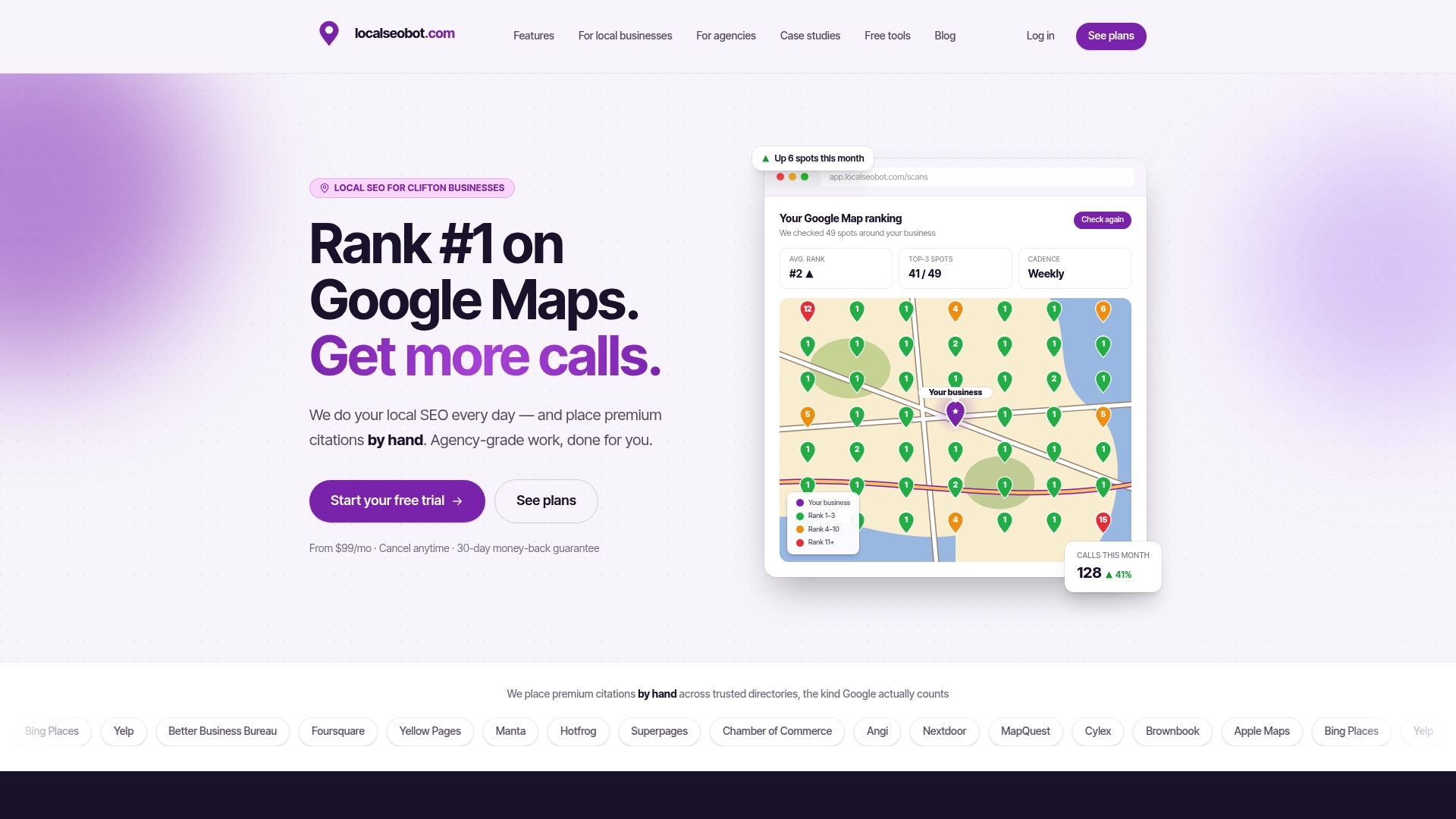
See the plans on our pricing page, or look at how our Google Maps SEO service works.
FAQ
How often should a local business post content?
A realistic target is one Google Business Profile post per week, plus a new or refreshed website page each month. Pick a pace you can sustain, because regular activity matters more than occasional bursts. Review replies and new photos count too.
What local content works best on Google Business Profile?
Offers, events, updates and photos, since those are the post types Google offers. Seasonal specials, holiday hours, new project photos and event notices are all easy wins. Keep each post specific, with a clear button such as call or book.
Do I need a blog to do local content?
Not necessarily. Service pages with real local detail, a location page, an FAQ and regular Business Profile posts cover most of what a small business needs. A blog helps when you have many customer questions to answer in depth.
How do I find local content topics fast?
Start with the ten questions customers ask you most, then check them against local keyword research for your city. Add your neighborhoods and seasonal events. Our content idea generator can produce a list from your business type and location.
Sources
- Create & manage posts on your Business Profile, Google Business Profile Help
- How to create local business content that converts, Search Engine Land
- Scalable Local SEO Practices That Actually Work, Search Engine Land
- Success Stories, Business Photos, Google Maps (Toy Joy)
- Success Stories, Business Photos, Google Maps (Spice Market)
- Local SEO Academy