Service Area Business SEO: How to Rank Without a Storefront
Published August 15, 2026
Service Area Business SEO: How to Rank Without a Storefront
Ranking a service-area business comes down to one move: configure your Google Business Profile correctly as a service-area business, then back it up with dedicated, high-quality service-area pages that prove where you actually work. Do those two things well and everything else (citations, reviews, schema) reinforces them.
Here’s where to start today:
- Verify your Google Business Profile and hide your address if you don’t serve walk-in customers.
- Set up defined service areas by city or ZIP code within realistic reach, not an overly broad area like an entire state.
- Publish three city-specific landing pages for your top revenue areas.
- Ask recent customers in different cities to name their neighborhood in their review.
- Add
areaServedschema markup to each service-area page.
Pro Tip: Treat your service-area setup like a moving target, not a one-time task. Revisit it every quarter as your coverage or crew capacity changes.
Mobile behavior makes this urgent. Mobile devices generate the majority of website traffic today, according to Statista, which means your service-area pages need to load fast and convert on a phone screen, not just rank on a desktop preview.
Key Takeaways
Ranking a service-area business requires a correctly configured Google Business Profile, unique service-area landing pages for your top markets, and geographically distributed reviews and citations.
| Point | Details |
|---|---|
| Configure GBP as an SAB | Hide your address if customers don’t visit, and list up to 20 real service areas. |
| Stay within realistic coverage | Keep service areas within roughly a two-hour drive rather than claiming statewide reach. |
| Build fewer, better pages | Publish unique landing pages for your top three to five revenue areas before expanding. |
| Distribute reviews by location | Ask customers to mention their neighborhood or city so reviews prove coverage. |
| Get hands-on citation support | Localseobot builds manual premium citations and tracks Maps rankings with geo-grids, backed by a 30-day guarantee. |
Further Reading and Primary Sources
- Business Profile for service businesses overview: Google’s own definitions of SAB and hybrid business types.
- Manage your service areas: the official procedure for adding, editing, and removing service areas.
- Service area pages guide: Search Engine Land’s checklist for building crawlable, non-doorway city pages.
Table of Contents
- What Is a Service Area Business SEO Strategy Built Around?
- How Do Service Areas Work in Google Business Profile?
- How Do You Set Up and Manage Service Areas in GBP?
- What Makes a Google Business Profile Rank for Service Businesses?
- How Do You Build Service-Area Pages That Actually Rank?
- Do Citations and Reviews Still Matter for Service-Area Businesses?
- What Should You Track, and What Mistakes Tank Rankings?
- Why Manual Local SEO Work Still Outperforms Automation
- A Publisher’s Take on What Actually Moves the Needle
- How Localseobot Helps You Rank Faster Across Every Service Area
- Frequently Asked Questions
- Sources
What Is a Service Area Business SEO Strategy Built Around?
A service-area business (SAB), in Google’s own terminology, is a business that visits or delivers to customers at their location rather than serving them at a fixed address. Think plumbers, mobile dog groomers, HVAC technicians, and traveling notaries. A hybrid business does both: it has a staffed office customers can visit and it travels to serve them, like a landscaping company with a retail showroom and a crew that does on-site installs.
Google’s Business Profile documentation treats these two categories differently in setup, and that distinction decides your entire configuration.
- Pure SAB: hide your address, list only your service areas.
- Hybrid business: show your address, but still define service areas for the territory you cover.
- Multi-location business: separate profiles are only valid at staffed, physically distinct offices.
Pro Tip: If customers never visit your business location, hide the address. Showing an address you don’t actually serve customers from is one of the fastest ways to trigger a Google Business Profile suspension.
How Do Service Areas Work in Google Business Profile?
Once you mark a profile as a service-area business, Google lets you define where you work instead of pinning a single storefront location. You can add multiple cities, ZIP codes, or counties, and Google uses that list, combined with your review history and proximity signals, to decide whether your profile shows up for a search in a given area.
Google’s own documentation confirms that service areas exist specifically to help customers find your Business Profile in both Search and Maps, not just to describe your coverage for your own records.
A few mechanics matter here:
- Google doesn’t treat all service area slots equally. Areas closer to your business address (even if hidden) generally carry more ranking weight.
- Proximity is calculated from your base location.
- Overly broad coverage dilutes relevance for every area.
Search Engine Journal’s guidance recommends staying within roughly a two-hour drive of your base. Claiming statewide coverage might feel ambitious, but it usually just tells Google you’re not truly local to any of it.
Pro Tip: Resist the urge to list every city you’d theoretically drive to. A tighter, realistic list of service areas outperforms a padded one almost every time. Skip the workarounds, too: virtual offices, PO boxes, or borrowed addresses violate Google’s policies and put your whole profile at risk.
How Do You Set Up and Manage Service Areas in GBP?
Setting up a service-area business correctly takes about 30 minutes if you follow the sequence in order. Skipping steps is what creates half-finished profiles that never rank.
- Create or claim your profile at business.google.com if you haven’t already.
- Verify ownership through postcard, phone, or email, depending on what Google offers for your business category.
- Set your business type to service-area business and hide the address if customers never visit it.
- Add your service areas by city, ZIP code, or county, starting with your highest-revenue territories.
- Choose your primary category carefully, then add relevant secondary categories.
- List your specific services rather than leaving the generic category description to do all the work.
- Upload photos of your team, vehicles, and completed jobs, ideally geotagged where possible.
- Set accurate hours and add a booking link if you take online appointments.
A few operational notes worth flagging: editing or removing a service area later is instant, so don’t be afraid to adjust as your business grows or a territory proves unprofitable. Only create a second GBP listing if you open a genuinely separate, staffed office. Duplicate listings for the same crew working from one location get flagged as spam.
- Keep a simple audit spreadsheet tracking category, services listed, and service-area list per profile.
- Note verification method and date for reference if you ever need to appeal a suspension.
Pro Tip: Postcard verification is slower but far more reliable than phone verification for service-area businesses, since it confirms a real physical base rather than just a phone number.
What Makes a Google Business Profile Rank for Service Businesses?
A verified profile is the baseline. Ranking well requires filling in every field Google gives you and treating your review section as a marketing channel, not an afterthought.
Fields worth full attention:
- Primary and secondary categories (specific beats generic every time: “Mobile Dog Groomer” outranks “Pet Service”)
- Complete services list with brief descriptions
- Business description using natural language, not stuffed keywords
- Photos across your team, vehicles, equipment, and completed work
- Attributes (licensed, insured, veteran-owned, and similar)
- Booking links and languages spoken
Reviews carry outsized weight for service-area businesses because you lack a physical location signaling where you actually work. Search Engine Journal points out that review distribution across your named service areas helps prove coverage that Google can’t otherwise verify.
- Ask each customer for a review within 24 to 48 hours of job completion.
- Prompt them, gently, to mention their neighborhood or city in the review text.
- Respond to every review within a few days, referencing the same location detail back.
Avoid these mistakes, which routinely trigger suspensions or ranking drops:
- Stuffing extra keywords into your business name (“Bob’s Plumbing - Emergency 24/7 Denver Plumber”)
- Using a category that doesn’t match your primary service
- Listing an address customers can’t actually visit
The Google Business Profile Optimizer walks through each of these fields if you want a structured audit rather than working from memory.
How Do You Build Service-Area Pages That Actually Rank?
Your Google Business Profile gets you into Maps. Your website’s service-area pages get you into organic search results, and they give Google independent proof that you genuinely serve each city you claim.
A page that ranks needs:
- A unique URL combining city and service, like
/plumber-denver-corather than a generic/service-areascatchall - A local-first opening paragraph naming the city, not a copy-pasted intro with the city swapped in
- Specific services offered in that city, ideally with pricing ranges or typical job examples
- A visible contact or booking call-to-action above the fold
- Localized photos and, where you have them, reviews specific to that area
areaServedschema markup identifying the business and its coverage territory
Search Engine Land’s guide to service-area pages is blunt about the failure mode here: thin, templated doorway pages that swap out one city name per page get filtered out or ignored entirely. Every page needs enough unique content and utility that it would stand on its own if a competitor’s city page didn’t exist.
- Start with your top revenue-producing service areas, not every ZIP code you cover.
- Add case studies, FAQs, or before-and-after photos specific to that market.
- Link each page from your main navigation or an HTML sitemap so Google can crawl it without hunting.
- Expand to additional cities only once the first batch is indexed and generating traffic.
SEO Learning Center’s technical breakdown recommends adding GeoShape data to your schema where your coverage area has an irregular boundary, which gives Google a more precise picture than a simple radius.
Pro Tip: Publish fewer, better pages first. Five genuinely useful city pages will outrank forty thin ones, and Google increasingly treats mass-produced location pages as a quality signal working against you. Use a local keyword research tool to confirm each target city actually has search demand before you write the page.
Do Citations and Reviews Still Matter for Service-Area Businesses?
Yes, and arguably more than for a business with a physical storefront, since citations and reviews are often the only independent confirmation Google has that you operate where you claim.

Essential citation sources include major data aggregators, industry-specific directories (HomeAdvisor for contractors, for example), and your local Chamber of Commerce. Name, address, and phone number (NAP) consistency matter even when your GBP address is hidden. Google still cross-references your business name and phone number against directory listings to confirm legitimacy.
Local backlinks reinforce the same signal:
- Sponsor a local youth sports team or community event in a target service area
- Get listed on your Chamber of Commerce member page
- Write a guest post for a neighborhood blog covering a service area you want to rank in
- Build partner pages with complementary local businesses (a roofer linking to a gutter installer, for instance)
The partner guide on local link-building strategies covers additional outreach tactics worth adapting to a service-area footprint.
Pro Tip: When you ask for reviews, request the neighborhood name specifically, not just “great service.” A review mentioning “fast response in Aurora” does more for local relevance than a generic five stars.
What Should You Track, and What Mistakes Tank Rankings?
Measure what actually moves the needle: GBP views, calls, and direction requests broken out by area; organic clicks landing on each service-area page; rank position across a geo-grid rather than a single search from your office; and review velocity segmented by city. Rank-tracking tools built for Maps make the geo-grid piece far less tedious than checking manually from different browser locations.
Common pitfalls that quietly erode visibility:
- Claiming a service area too broad for your actual capacity to fulfill jobs
- Publishing doorway pages that just swap a city name into identical boilerplate
- Using a fake or virtual address to appear closer to a target market
- Letting NAP details drift out of sync across directories
- Incentivizing reviews in ways that violate Google’s policies
Violating Google’s guidelines on any of these can result in profile suspension. If that happens, Google provides a reinstatement request process through the Business Profile dashboard, but appeals can take weeks, and a documented, policy-clean setup from the start avoids the problem entirely.
Why Manual Local SEO Work Still Outperforms Automation
Proof of localness is what separates a ranking service-area business from one stuck on page two. Photos taken on-site, reviews naming specific neighborhoods, and citations built by hand on relevant directories all signal something automated tools struggle to fake convincingly.

Localseobot builds premium citations manually across high-authority directories rather than mass-submitting to low-quality ones, which matters because directory quality affects how much trust Google places in the signal. Combined with geo-grid rank tracking and hands-on Google Business Profile optimization, that manual approach gives service-area businesses the kind of coverage evidence that templated automation tends to miss.
Results vary by market competition and how established your competitors already are, so expect meaningful movement in Maps rankings over a few months of consistent work, not days.
A Publisher’s Take on What Actually Moves the Needle
Templated automation can fill out a profile fast, but it can’t fake a photo taken on a real job site or a review that names an actual neighborhood. That’s the gap that decides who ranks. If you do one thing after reading this, audit your current GBP setup against the checklist above, then build three service-area pages for your best markets this month. Everything else compounds from there.
How Localseobot Helps You Rank Faster Across Every Service Area
Building service-area pages and optimizing a Google Business Profile by hand takes real hours most small business owners don’t have between jobs. Localseobot handles the manual work, premium citation building on high-authority directories, geo-grid rank tracking across your service areas, and automated GBP posting and review management, so your coverage gets documented correctly without you learning local SEO as a second job.
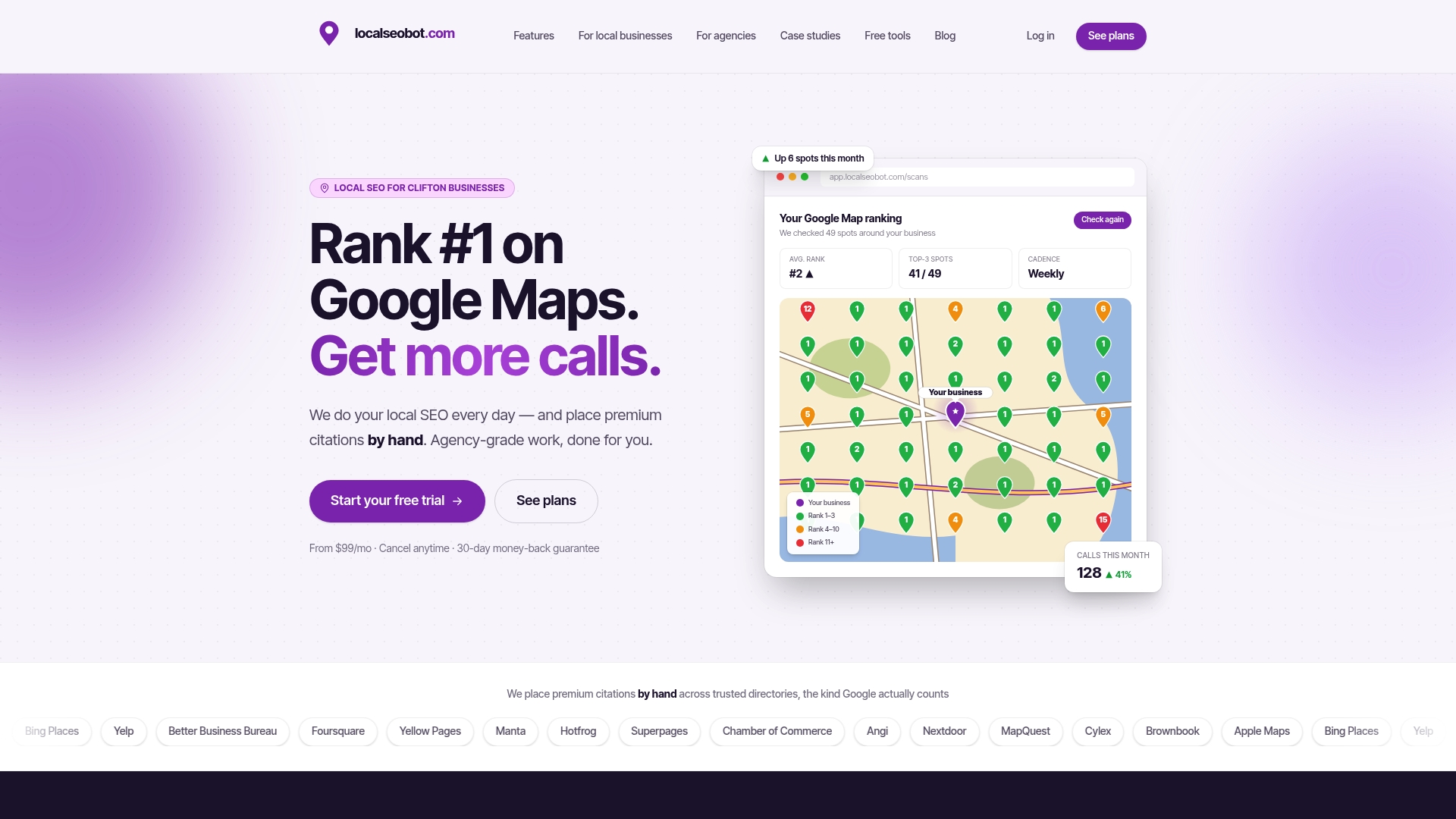
Unlike agencies that lock you into long contracts before showing results, Localseobot backs its citation work with a 30-day money-back guarantee if your rankings don’t improve. If you’re not sure where your profile currently stands, run it through the Local SEO Checklist Tool to see exactly which fields and service areas need attention before you commit to a plan.
Frequently Asked Questions
How many service areas should a service-area business list on Google Business Profile? Google allows up to 20, but list only the areas you can realistically serve within about a two-hour drive of your base. Padding the list with distant cities dilutes relevance everywhere.
Should I hide my address if I run a service-area business? Yes, if customers never visit your location. Hiding the address is part of correctly configuring your profile as a service-area business rather than a storefront.
Do I need separate service-area pages for every city I serve? No. Start with three to five pages for your highest-revenue markets, each with unique content, then expand once those pages are indexed and generating traffic.
Can Google Local Services Ads work alongside organic service-area SEO? Yes. Local Services Ads run separately from organic Maps rankings and can capture leads while your GBP and service-area pages build organic visibility over time.
What’s the fastest way to audit my current setup? Run your profile through the Google Business Profile Optimizer to check categories, services, and service-area configuration against current best practices.
Sources
- Business Profile for service businesses overview - Google Business Profile Help
- Manage your service areas for service-area & hybrid businesses
- Local SEO For Service Area Businesses: Targeting Your Coverage - Search Engine Journal
- Service area pages: Boost local SEO across locations - Search Engine Land
- Service Area SEO Explained - SEO Learning Center