Stop Guessing: Geo Grid Local Pack Tracking for SEO Pros
Published September 21, 2026
Stop Guessing: Geo Grid Local Pack Tracking for SEO Pros

Track Local Pack rankings by running repeated geo-grid scans that record pack presence and position for the same keyword, device, and search point over time. The single metric that matters most is where you rank across a grid of locations, not one lucky screenshot from your office. Set up recurring scans, log the search context every time, and you have a defensible record instead of a guess.
TL;DR:
- Tracking local pack rankings requires repeated geo-grid scans across multiple locations to accurately measure visibility and avoid misleading single-point snapshots.
- It is essential to record pack presence, map ranking, search context, auxiliary signals, and snapshots at every scan to verify changes and rule out anomalies.
- Movement in rankings must be validated over multiple grid points and scans before attributing it to any specific optimization, as noise and competitor activity often cause fluctuations.
- Blending local pack data with organic rankings distorts analysis, since they respond to different factors and change independently depending on proximity and relevance.
- Consistent, annotated, and verified geo-grid data provides a solid foundation for actionable insights and reliable measurement in local SEO efforts.
Table of Contents
- What Exactly to Measure for Local Pack Performance
- How Local Pack Tracking Differs From Ordinary Rank Tracking
- Setting Up Geo-Grid Scans That Actually Hold Up
- Turning Ranking Movement Into a Priority List
- Common Pitfalls and How to Verify Your Data Before You Trust It
- What Field Experience Actually Shows About Local Pack Tracking
- Effect of Google My Business Posts and Q&A on Rankings
- How Algorithm Updates Affect Local Pack Rankings
- Impact of Competitors’ Activities on Local Pack Rankings
- Role of Citation Consistency and Local Backlinks
- How Local SEO Bot Handles Local Pack Tracking
- A Pragmatic Take on Measurement Over Vanity Metrics
- Sources
- FAQ
What Exactly to Measure for Local Pack Performance
A blended “rank” number tells you almost nothing. Local Pack tracking works only when you separate the map results from organic results and record them side by side for the same keyword, device, and search context over time.
Here’s what a real tracking record needs to capture on every scan:
- Pack presence and position — did your business show up in the 3 pack, and at what rank?
- Maps ranking — your position in the full Google Maps results, which often differs from the pack.
- Search context — exact keyword phrase, device type, and the latitude/longitude or ZIP code the search originated from.
- Auxiliary signals — your listed Google Business Profile category, current review count, star rating, and NAP (name, address, phone) consistency at scan time.
- A SERP snapshot — a saved screenshot or archived HTML of the actual results page.
That last point isn’t optional bookkeeping. A good local tracking workflow records SERP snapshots for verification and timestamps them against any edits you made, so when a client asks “why did we drop on Tuesday,” you have proof instead of a theory. Skip the snapshot and every ranking conversation becomes a memory contest.
How Local Pack Tracking Differs From Ordinary Rank Tracking
Organic rank tracking answers one question: where does your website rank for a keyword. Local Pack tracking answers a completely different one: where does your listing appear on a map, and that answer changes depending on exactly where the searcher stands. Regular rank tracking focuses on organic positions while Local Pack tracking focuses on map and listing visibility, and treating them as interchangeable is where most reporting goes wrong.
Google has been consistent about the mechanics behind this. Local results run on three axes:
- Relevance — how well your profile matches what was searched.
- Distance — how close your listing is to the searcher (or the location they searched from).
- Prominence — how well known and well reviewed your business is overall.
That distance factor is why a single city-wide rank is close to meaningless. A landscaper ranking third downtown might be invisible ten minutes away in the suburbs, and neither number is “wrong.” They’re both true at different points on the map. Combine organic and Local Pack data in your reporting only when you’re explaining the full customer journey, like someone searching your brand name organically before checking the map for your hours.
Setting Up Geo-Grid Scans That Actually Hold Up
A single search from your laptop isn’t a scan, it’s an anecdote. A geo-grid turns that anecdote into data by checking the same keyword from dozens of points spread across your service area.
- Pick your grid radius and density based on the business, not habit. A dentist with a 5-mile service area needs a tight, dense grid. A regional HVAC company covering three counties needs a wider grid with fewer points per square mile, since service-area businesses must test where their actual customers are, not just downtown.
- Set separate device profiles for mobile and desktop. Google’s local results can differ by device, and most of your customers are searching on a phone standing in a parking lot, not a desktop in an office.
- Lock in a scan cadence and stick to it. Weekly is the practical floor for most small businesses; competitive markets or active campaigns often justify daily scans on priority keywords.
- Log the search context and save a snapshot every single time. Keyword, device, grid point, timestamp, and a saved SERP image, with no exceptions for “just a quick check.”
- Cross-check anomalies by hand. If one grid point shows a wild swing, run it again manually before you report it as real movement.
A tool built for this, like Maprank’s geo-grid rank tracker, automates the repetitive part (grid setup, scheduled scans, historical trending) so your time goes into interpreting results instead of babysitting spreadsheets.
Pro Tip: Run your first geo-grid scan before you change anything on the profile. Without that baseline, you’ll never know if a ranking bump came from your edits or from normal week-to-week noise.
Turning Ranking Movement Into a Priority List
Movement in a geo-grid report means nothing until you can tie it to something you actually did, or rule out that it’s just noise. Annotate every profile edit, every new review, every citation build with a date, and expect some fluctuation even when nothing changed.
Use the data this way:
- Map signals to specific actions. A pack-position gain that shows up two weeks after you completed your Google Business Profile categories and services is a real signal worth repeating elsewhere.
- Require movement across multiple grid points, not one. A single point jumping three spots is weak evidence. The same jump across a cluster of neighboring points is strong evidence.
- Watch related keywords, too. If your primary term improves but five closely related terms stay flat, something narrower than a true visibility gain is happening.
- Use heatmaps to prioritize, not just to visualize. Geo-grid heatmaps are the fastest way to identify where profile optimizations and review generation will actually move the needle, rather than guessing which neighborhood needs attention.
Single-scan bumps are usually noise. Validating a real improvement requires repeated positive movement across multiple scans and grid points before you credit it to your work, brief a client on it, or build a case study around it.
Common Pitfalls and How to Verify Your Data Before You Trust It
Most bad local SEO reporting comes from treating a single scan as gospel. A drop on one grid point on one Tuesday could be an algorithm blip, a competitor’s temporary promotion, or a scanning error, not a trend.
- Never average organic and Local Pack ranks into one number. They measure different things and blending them hides the truth from both.
- Check the time series before you react. One bad data point next to five stable ones is noise; five bad points in a row is a trend.
- Run the verification checklist: repeat the scan, check it on a second device, pull the SERP snapshot, and confirm you’re tracking the correct listing ID.
- Escalate immediately for anything that looks like a listing suspension, a sudden multi-point drop, or a category hijack rather than treating it like routine fluctuation.
What Field Experience Actually Shows About Local Pack Tracking
Some SEO services pair manually built premium citations with geo-grid tracking through tools like Maprank, because clean citation data and clean ranking data have to work together to mean anything. Clients using such combinations sometimes report meaningful Google Maps position gains and more inbound calls, and some providers offer a 30-day money-back guarantee if rankings don’t improve. Field results consistently show the same lesson: precise measurement, not guesswork, drives the fixes that matter.
Effect of Google My Business Posts and Q&A on Rankings
Google Business Profile posts and the Q&A section don’t carry the same direct ranking weight as reviews or category selection, but they influence the signals that do. Posts keep your profile active, and an active, complete, regularly updated profile feeds into the prominence factor Google weighs when deciding who to show in the pack.
The more practical value shows up in behavior, not algorithm mechanics. A well-answered Q&A section reduces the chance a potential customer bounces to a competitor’s listing out of confusion about your hours, pricing, or services. Fewer bounces and more profile engagement feed the same prominence signal that posts do.
Track this alongside your geo-grid scans rather than expecting it to move rankings on its own. Note the dates you publish posts or answer questions, then watch whether pack position shifts over the following two or three scan cycles. If you see consistent, sustained movement tied to an active posting cadence across multiple keywords, you have a real signal. If you see nothing after several cycles, that’s useful information too: it tells you to redirect effort toward reviews or citations instead.
How Algorithm Updates Affect Local Pack Rankings
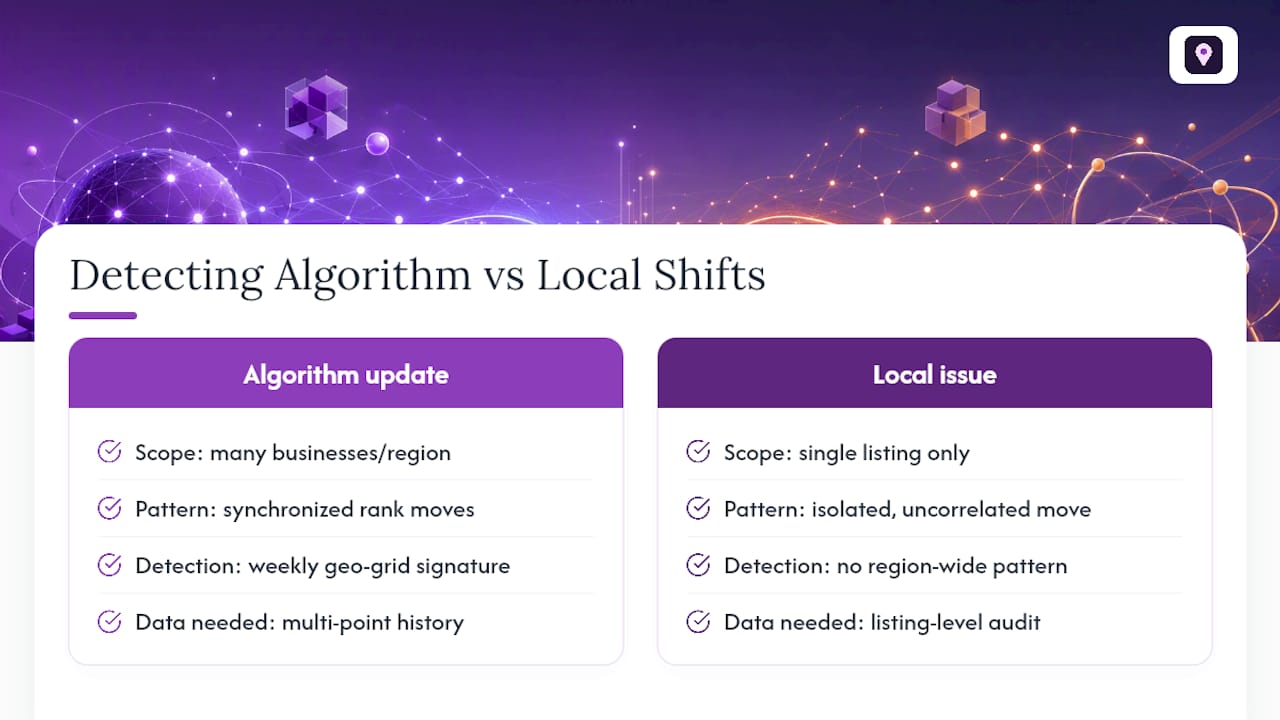
Google updates its local algorithm far more quietly than its core organic algorithm, and most updates never get an official name or announcement. That’s exactly why a geo-grid history matters more for local SEO than it does for organic tracking. Without a baseline, an algorithm-driven shift looks identical to a random Tuesday fluctuation.
When an update does land, it typically shows up as a shift across many businesses in a category or region at once, not a single listing dropping in isolation. If your dental practice drops three spots the same week every other dentist in a 10-mile radius also drops or rises, that’s an algorithm signature. If you drop alone while competitors hold steady, the cause is more likely local: a review, a suspended listing, or a category change.
This is where annotated, multi-point historical data pays off. A report that only checks rank “sometimes” can’t distinguish an algorithm update from a citation problem you caused yourself. A report built on consistent weekly geo-grid scans can, because you can look back at the exact week things changed and cross-reference it against what else moved industry-wide. When in doubt, hold off on major profile changes for a week or two after a suspected update. Chasing a moving target usually creates more noise in your data than it resolves.
Impact of Competitors’ Activities on Local Pack Rankings
Your rankings don’t move in a vacuum. A competitor who fixes their category selection, adds fifty reviews, or opens a second location closer to the city center can push you down the pack without you doing anything wrong.
This is exactly why a local competitor analysis alongside your own geo-grid data matters. Run the same grid scan against your top three or four competitors and watch what happens to the pack lineup over time, not just your own row. If a competitor’s review count jumps 40 in a month and their pack position climbs at the same time, you’ve just found your next priority: match or beat their review velocity.
Watch specifically for competitors occupying multiple grid points where you don’t appear at all. That’s a coverage gap, and it usually points to either a proximity disadvantage you can’t fully fix or a profile completeness gap you absolutely can. Track competitor category changes, too. Businesses that add or shift primary categories sometimes gain sudden pack eligibility for searches they previously never showed up in, and that shift will look like your own ranking drop if you’re only watching your own listing.
Role of Citation Consistency and Local Backlinks
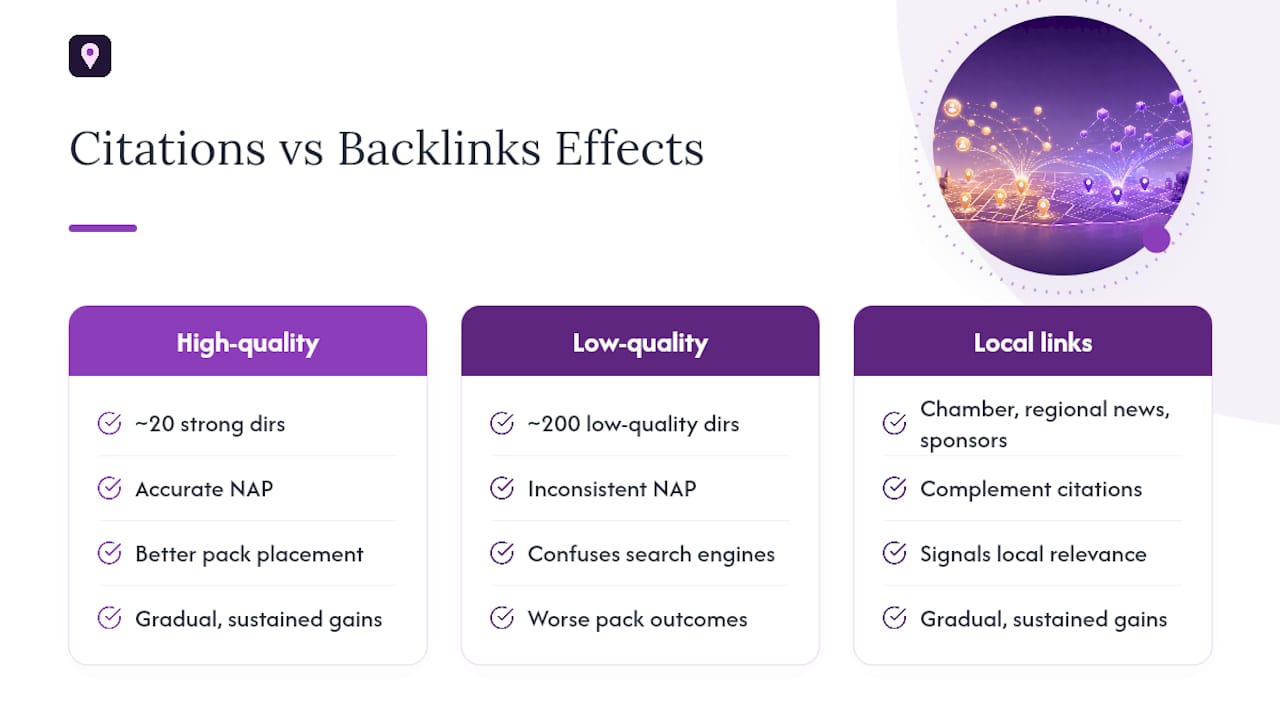
Citations feed directly into the prominence and relevance signals Google uses to decide pack placement. An inconsistent NAP (your business name, address, and phone number listed differently across directories) creates confusion that search engines have to resolve, and that resolution process rarely favors you.
Manual, high-authority citations tend to outperform bulk automated citation blasts, because directory quality and consistency matter more than raw citation count. A business listed accurately on twenty strong, relevant directories usually outperforms one listed inconsistently across two hundred low-quality ones.
Local backlinks work alongside citations rather than replacing them. A mention and link from a local chamber of commerce, a regional news site, or a community sponsorship page signals real-world local relevance in a way a generic directory listing can’t. Neither citations nor local links move rankings overnight; both work on the same timeline as reviews, showing up as gradual, sustained movement across grid points over several scan cycles rather than a single dramatic jump. If you’re auditing your current citation footprint, a citation consistency check against your geo-grid history will usually reveal which inconsistencies are actually costing you pack visibility versus which ones are cosmetic.
How Local SEO Bot Handles Local Pack Tracking
Localseobot is the practical alternative to piecing together spreadsheets and one-off manual searches for geo-grid tracking. Maprank runs scheduled geo-grid scans, records SERP snapshots automatically, and builds the historical heatmaps you’d otherwise have to assemble by hand, paired with the manually built premium citations that feed the same prominence signal your rankings depend on.
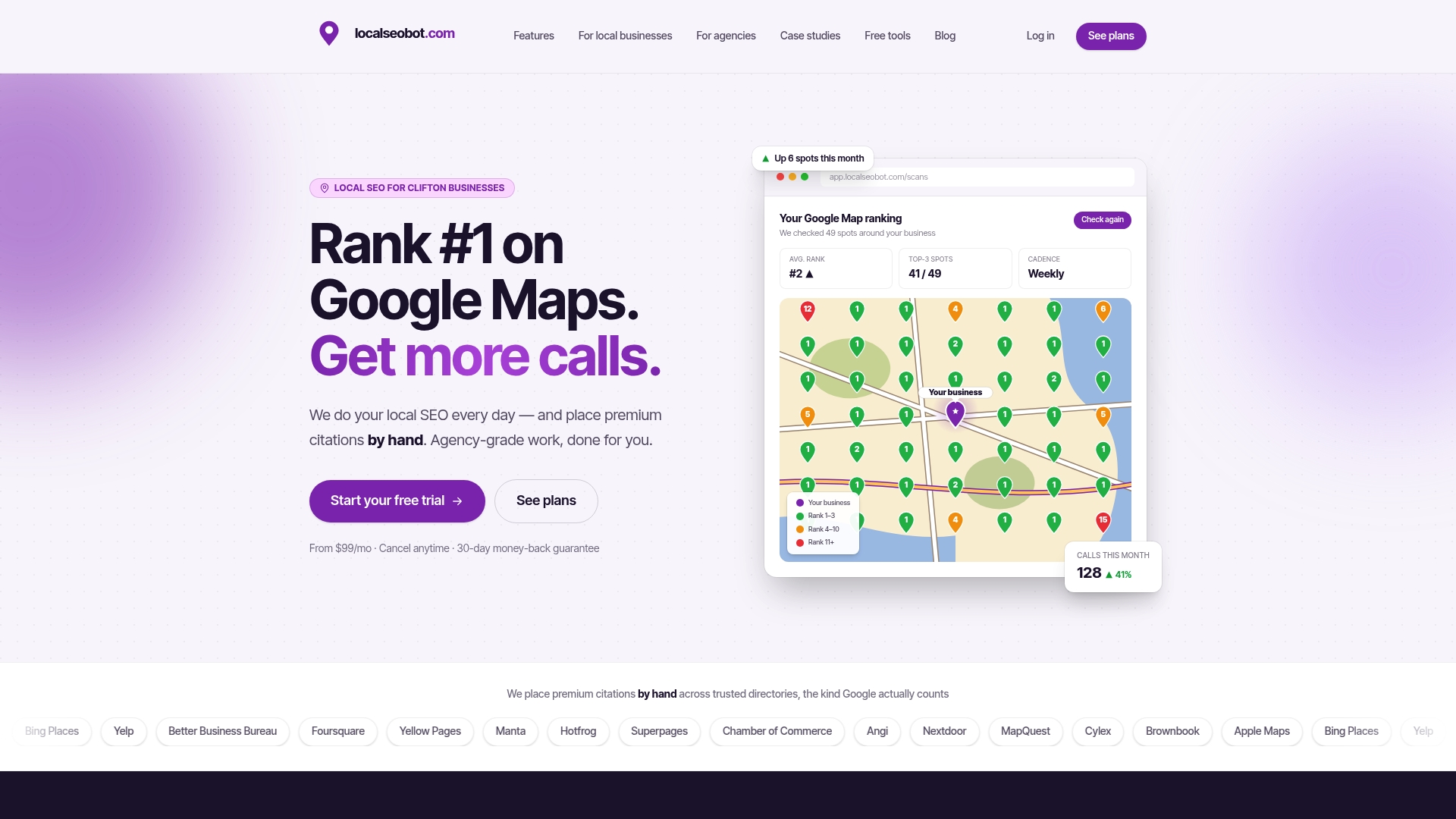
Every plan connects tracking data to the profile and citation work that actually moves it, instead of handing you a rank number with no next step. If you want to see what a managed geo-grid setup looks like for your specific service area, start with the Foundation or Growth plans, or check the Maprank product page directly if rank tracking is your immediate priority. Agencies managing multiple client locations should look at the Pro plan for white-label reporting. And because Local SEO Bot backs its citation work with a 30-day money-back guarantee if rankings don’t improve, there’s little downside in testing it against whatever manual process you’re running today.
A Pragmatic Take on Measurement Over Vanity Metrics
Precise, geo-based measurement beats a single vanity rank number every time. Annotated, repeatable scans with verification built in are what separate defensible local SEO work from guesswork dressed up as strategy.
— Local
Sources
- Tips to improve your local ranking on Google - Google Business Profile Help
- Local Pack Rank Tracker - GEO Rank Tracker
- Local Rank Tracker: Check Local SERP for Your Keywords - SE Ranking
FAQ
What Is the Best Way to Track Local Pack Rankings?
Run repeated geo-grid scans that record pack presence and position for the same keyword, device, and location over time, then save a SERP snapshot with every scan. A tool built for geo-grid tracking, like Maprank, automates the scheduling and heatmap generation so you’re not doing this by hand.
How Is Local Pack Tracking Different From Regular Rank Tracking?
Regular rank tracking measures organic website position; Local Pack tracking measures where your Google Business Profile appears in the map results. The two answer different business questions and should never be blended into one metric.
How Often Should I Run Geo-Grid Scans?
Weekly is a practical baseline for most small businesses, with daily scans reserved for competitive markets or active campaigns you’re actively monitoring. Consistency matters more than frequency, since a broken time series makes it impossible to tell a real trend from noise.
Can I Prove a Specific SEO Change Caused a Ranking Increase?
Only if you see sustained movement across multiple grid points and related keywords after annotating the change, not just a single scan bump. Single-scan improvements are usually noise rather than confirmed cause and effect.
Does Localseobot Offer a Rank-Tracking Tool?
Yes. Maprank is Local SEO Bot’s geo-grid rank tracker, and it’s paired with manually built premium citations rather than automated citation blasts. Pricing details are available on the pricing page, and current plans include a 30-day money-back guarantee if rankings don’t improve.