90 Day Playbook for Local Businesses: Make Your Local SEO AI Legible in 2026
Published September 24, 2026
90 Day Playbook for Local Businesses: Make Your Local SEO AI Legible in 2026

AI-driven local recommendations have replaced the ten-blue-links model as the main battleground for visibility, which means the top priority for 2026 is making your business “AI-legible.” That comes down to three things: relentless Google Business Profile upkeep, steady review velocity with specific sentiment, and structured data paired with hyperlocal content. This isn’t a checklist you finish once. It’s ongoing operational work, and businesses that treat it that way are the ones showing up when someone asks an AI assistant where to go.
TL;DR:
- Maintaining a complete and consistently updated Google Business Profile with weekly posts, photos, and review replies is essential to signal active management.
- High-quality, detailed reviews that are recent and specific weigh more in AI-driven local rankings than overall star ratings alone.
- Structured data with accurate schema markup for address, hours, and services enhances AI recognition and eligibility for rich results.
- Creating unique hyperlocal pages with real neighborhood content and reviews improves visibility in conversational AI queries.
- Running weekly audits on business info across all platforms, including Google, Apple, and Bing, ensures data accuracy and prevents AI from ignoring your business.
Table of Contents
- Local SEO Trends 2026: The Priority List
- Google Business Profile: The 2026 Playbook
- Why Do Reviews Matter More Than Star Ratings Now?
- Structured Data: The Fields That Make You Machine-Readable
- Hyperlocal Pages: Specific Without Getting Duplicated
- Measuring Local 5.0: What to Track Weekly
- Your 90-Day, 6-Month, and 12-Month Roadmap
- How Manual Citations and Governed Data Improve AI Visibility
- Voice Search and Conversational AI Impact on Local Search
- Mobile-First Indexing: What It Still Means in 2026
- The Role of Video and Visual Content in Local SEO
- Local Link Building and Citation Quality in 2026
- Emerging Local Search Platforms Beyond Google
- Three Mindset Shifts Worth Making for 2026
- Get Your Local SEO Playbook Running With Localseobot
- Where These Numbers Came From
- Sources
- FAQ
Local SEO Trends 2026: The Priority List
Search behavior split in two directions at once. People still type into Google Maps, but a growing share now ask ChatGPT, Perplexity, or Google’s AI Overviews for a direct recommendation instead of a list of links. Industry analysts have started calling this shift Local 5.0, the stage at which AI systems evaluate connected context across your website, your Google Business Profile (GBP), your reviews, and third-party citations before deciding whether to name your business at all, according to Search Engine Land’s analysis.
Here’s what to act on first, ranked by impact:
- AI Overviews and Local GEO. Generative Engine Optimization for local search means feeding AI systems the same clean, structured facts you’d want a human dispatcher to have: hours, services, service area, price range. Google’s own guidance confirms that foundational SEO practices remain essential for eligibility in these generative features, not a separate discipline.
- GBP vitality. A profile that’s merely “claimed” isn’t enough. Completeness plus weekly activity (posts, photos, review replies) signals a business that’s actually open and attentive.
- Review velocity and sentiment. Recent, specific reviews now outweigh a high star average alone.
- Structured data. Schema markup gives AI systems a machine-readable version of facts that used to live only in prose.
- Hyperlocal content. Neighborhood-specific pages answer the “near me” and conversational queries that generic city pages can’t.
- Multi-platform discovery. Apple Maps, Bing Places, and social platforms increasingly feed their own AI layers, so measurement can’t stop at Google.
Consumer research backs the urgency here. The Local Discovery Index found that a majority of consumers now use AI tools during local discovery, and they tend to cross-check what the AI tells them against reviews and search results before committing. That verification loop rewards businesses whose information matches everywhere it appears, and punishes the ones with a stale phone number on one directory and a different one on the website.
Pro Tip: Run the same “best [your service] near me” query in Google, ChatGPT, and Perplexity once a month. If your business shows up in one and not the others, you’ve found your next fix.
Google Business Profile: The 2026 Playbook
GBP remains the single highest-leverage asset in local search, and Google is explicit that ranking depends on relevance, distance, and prominence, with a complete, consistent profile feeding all three.
Start with the fields businesses most often leave half-finished:
- Services list with individual descriptions, not just category tags.
- Opening hours, including holiday hours entered ahead of time, not the week of.
- Amenities and attributes (wheelchair access, outdoor seating, appointment-only).
- Booking or ordering links that go directly to the transaction page, not the homepage.
- Business description written in plain language that mirrors how customers actually phrase requests.
Completeness only gets you halfway. GBP rewards activity, and the cadence that tends to work is roughly one post per week, fresh photos monthly, prompt replies to every review, and same-day responses to Q&A and direct messages. A profile that goes quiet for two months starts looking abandoned, both to customers and to the algorithm.
Run a short weekly audit: confirm your name, address, and phone number match your website exactly, check that no outdated service area or price range is lingering from a past update, and scan for duplicate listings that Google sometimes creates automatically. Tools like the Google Business Profile Optimizer can flag these mismatches faster than a manual check.
Here’s the part most owners miss: when your GBP hours say “closed” but your website says “open,” AI systems don’t guess which one is right. They either suppress the mention entirely or, worse, tell a customer you’re closed when you’re not. Consistency isn’t a nice-to-have here. It’s the difference between being recommended and being skipped.

Why Do Reviews Matter More Than Star Ratings Now?
A 4.9 average built on reviews from three years ago carries less weight than a 4.5 average with fresh, specific reviews arriving every week. AI-driven recommendation shortlists tend to run two to three names deep, and the tiebreakers are increasingly recent, detailed reviews rather than raw star count.
The mechanism matters: AI systems parse review text for attribute mentions like “open late,” “takes insurance,” or “offers financing,” according to Search Engine Land’s Local 5.0 research. A review that says “great service” gives an AI nothing to match against a specific query. A review that says “they stayed open past 6pm to fit me in” gives it a fact to cite.
Getting that kind of specificity requires prompting customers well. A generic “leave us a review” request gets generic reviews. Asking “what made your visit easy?” or “what almost stopped you from booking?” tends to surface the concrete detail an AI can actually use.
- Send review requests within 24 hours of service, while details are fresh.
- Ask one specific, open-ended question instead of a blanket request for stars.
- Reply to every negative review within 48 hours, acknowledge the specific complaint, and note the fix if one happened.
- Track velocity (new reviews per month) alongside average rating, not instead of it.
Negative reviews aren’t a crisis to hide. They’re a remediation opportunity that, handled well and publicly, often reads as more trustworthy than a suspiciously perfect record.
Structured Data: The Fields That Make You Machine-Readable
Schema markup is the layer where a lot of small businesses quietly lose ground, because it’s invisible on the page but critical to how AI systems parse your facts. Google documents both required and recommended LocalBusiness structured data properties, and skipping the recommended ones is where most sites fall short.
Prioritize these:
addressandgeocoordinates, precise to the building, not the city center.openingHoursSpecification, formatted correctly for holiday exceptions.priceRange, which lets AI match budget-based queries like “affordable” or “upscale.”aggregateRating, pulled from genuine review counts, never fabricated.- Individual
ServiceorProductschema for each offering, rather than one generic blob.
Complete schema with these recommended fields improves eligibility for rich results and lets AI match constraint-based queries, such as “open now” or a specific cuisine or service type, according to Google’s own developer documentation.
Validate everything with Google’s Rich Results Test and the Schema.org validator before publishing, and recheck after any site redesign. Retailers with physical inventory should also look at a Merchant Center feed, since product-level data feeds AI shopping and local inventory features that pure page content can’t reach on its own.
Hyperlocal Pages: Specific Without Getting Duplicated
A single “Locations” page listing five cities in one paragraph doesn’t answer conversational queries. A page built specifically for one neighborhood does, which is why hyperlocal targeting increasingly outperforms broad city-level pages in AI-driven local discovery.
A strong hyperlocal page includes reviews from customers in that specific area, real neighborhood context (a nearby landmark, a parking note, a transit stop), original photos taken on location, and a short FAQ block answering questions people actually ask about that area, like “do you serve [neighborhood] on weekends?”
- Write unique copy for each location page; never duplicate the same template with only the city name swapped.
- Cap the number of location pages to what you can genuinely support with distinct content and local proof.
- Link each page to the matching GBP location or service area attribute so the signals reinforce each other.
- Include micro-FAQs phrased the way a voice assistant or chatbot would ask them.
Pro Tip: If you can’t write three genuinely unique sentences about why a location page exists for that specific neighborhood, you don’t have enough content for the page yet, and publishing it thin risks looking cloned to both Google and AI crawlers.
Measuring Local 5.0: What to Track Weekly
Rank tracking alone no longer tells the full story, since a business can rank well organically and still get skipped entirely by an AI Overview. The metric set needs to expand to four core signals: visibility (do you show up at all), share of voice (how often you’re named versus competitors), accuracy (does the AI state your facts correctly), and opportunity (queries where you’re absent but qualified).
- Run a fixed set of AI audit queries weekly across Google AI Overviews, ChatGPT, and Perplexity, alongside a standard Maps rank check.
- Log whether your business is named, and whether the facts cited (hours, price, services) are correct.
- Track share of voice by counting how many competitor names appear alongside yours in the same query.
- Prioritize fixes by impact: a wrong phone number cited by AI outranks a missing Instagram link every time.
A geo-grid rank tracker like Maprank makes the Maps portion of this audit far less manual, since it can track ranking across a full grid rather than a single point.
Your 90-Day, 6-Month, and 12-Month Roadmap
Trying to fix everything in week one is how most local SEO efforts stall. Sequence it instead.
- Weeks 1 to 4: Audit GBP for completeness, fix every NAP inconsistency across your site and top directories, add critical LocalBusiness schema, and run your first round of AI test queries to establish a baseline.
- Months 2 to 3: Build hyperlocal pages for your highest-value service areas, launch a structured review-request cadence, and create content templates so new pages stay consistent without starting from scratch each time.
- Months 4 to 12: Shift into governance mode. Automate the repeatable parts (review requests, GBP posting), invest in local PR and editorial mentions, and run the AI visibility audit on a fixed monthly loop rather than an ad hoc one.
Resourcing depends on bandwidth more than budget size. A single-location owner with time can run weeks 1 to 4 manually. An agency managing a dozen clients, or a business with multiple locations, tends to hit a wall fast without a SaaS layer handling citation consistency and rank tracking at scale. That’s usually the point where a tool becomes cheaper than the hours it saves.
How Manual Citations and Governed Data Improve AI Visibility
AI systems recommend businesses they can describe with confidence. When your name, address, and category vary across ten directories, an AI often can’t resolve which version is authoritative, so it plays it safe and omits you rather than guessing. Localseobot’s approach centers on manually built premium citations across high-authority directories, geo-grid rank tracking through Maprank, and automated GBP tooling, all aimed at closing that entity-ambiguity gap rather than papering over it with bulk-submitted, low-quality listings.
In practice, resolving that kind of ambiguity looks simple but takes discipline: one business found its category listed as “Restaurant” on one directory and “Cafe” on another, which is a small mismatch that’s enough to make an AI system hedge on a specific recommendation. Standardizing the category and address format across directories, and pairing it with weekly GBP activity, tends to be what tips a business from “occasionally mentioned” to “consistently recommended” in AI answers.
- Manual citation building on high-authority directories, not automated blasts
- Geo-grid Maps rank tracking via Maprank
- Automated GBP optimization and posting
- Citation consistency auditing across multiple directories
Voice Search and Conversational AI Impact on Local Search
Voice queries have always skewed conversational, longer, and more likely to include a location (“where’s a plumber near me that’s open now”). What’s changed in 2026 is that the same conversational pattern now dominates text-based AI chat, too, not just voice assistants. Someone typing into ChatGPT phrases the query almost exactly like they would speak it.
That shift rewards content written in natural language over keyword-stuffed service pages. A page that answers “do you offer emergency appointments on weekends” in plain sentences gives both voice assistants and chat-based AI something to lift directly into an answer. A page that just lists “24/7 Emergency Plumbing Services” as a heading, with no supporting sentence, gives them nothing to quote.
Structured FAQ content, written the way a customer would actually ask, tends to perform well here because it maps almost one-to-one onto how conversational queries get phrased. The businesses catching this early are the ones auditing their site copy for question-and-answer pairs, not just keyword density.
Practically, this means reviewing your own service pages and asking whether they’d survive being read aloud by a smart speaker. If a sentence sounds like it was written for a search engine crawler instead of a person asking a question, it probably needs a rewrite.
Mobile-First Indexing: What It Still Means in 2026
Google has indexed the mobile version of sites as the primary version for years now, but the implications keep sharpening as more local discovery happens through AI assistants running on phones. If your mobile site loads slowly, hides key information behind a menu, or renders your address differently than desktop, that’s the version Google and AI systems are actually evaluating.
Local businesses get hit by a specific version of this problem: click-to-call buttons, embedded maps, and booking widgets that work fine on desktop but break or disappear on mobile. Since a large share of local searches happen on a phone in the moment someone needs a business right now, a broken mobile booking link isn’t a minor bug. It’s a lost customer and a signal to Google that the page underperforms.
Test your own site the way a customer would: on a phone, on a spotty connection, trying to find your hours and call button within five seconds. If your NAP details are formatted differently in the mobile footer than in the desktop header, fix that inconsistency immediately, since it’s exactly the kind of mismatch that undermines the schema and GBP consistency work described earlier. Page speed still matters, but for local businesses, mobile completeness and consistency matter just as much.
The Role of Video and Visual Content in Local SEO
Photos on a GBP listing get engagement, but video is where the momentum has shifted, particularly short-form clips that show a real space, a real technician, or a real product in use. AI systems and platforms increasingly favor visual proof over stock imagery when deciding what to surface, because a genuine walkthrough video is harder to fake than a polished photo.
For a local business, that means a thirty-second video of your storefront, your team, or a service in progress tends to outperform a professionally staged photo shoot in terms of trust signals. Upload video directly to your GBP listing where the option exists, and keep a rotating library on your website tied to specific services or locations rather than one generic “about us” reel.
Captioning matters here too. Auto-generated captions on video content give search engines and AI crawlers a text layer to parse, which means a video with no captions is invisible to the same systems that might otherwise cite it. Pairing video with a short written summary on the same page closes that gap without much extra effort.
Local Link Building and Citation Quality in 2026
Directory link building used to be a volume game: get listed everywhere, as fast as possible. That approach is losing ground fast, because AI systems trained on editorial and contextual mentions treat a name-dropped citation on a low-quality directory very differently from a mention in a local news article or community organization page.
Local GEO reframes link building as an editorial exercise. PR and genuine local editorial coverage now drive AI recommendation likelihood more than bulk directory links do, since AI systems appear to weight context-rich mentions higher than a bare listing with no surrounding narrative.
That doesn’t make citations obsolete. It makes citation quality the deciding factor. A handful of consistent, accurate listings on major, high-authority directories still anchors your NAP data, and Google’s own guidance on prominence as a ranking factor confirms that consistent signals across the web still count. But chasing hundreds of low-quality directory submissions is largely wasted effort now, especially compared to landing one solid mention in a local news roundup or chamber of commerce feature. Tools like a citation consistency analyzer help confirm the citations you do have are accurate before you invest in earning more.
Emerging Local Search Platforms Beyond Google
Google still dominates local search volume, but it’s no longer the only place customers look, and it’s increasingly not the only place AI pulls from either. Apple Maps has quietly become a primary discovery surface for iPhone users asking Siri for a nearby business, and its business listing data is separate from Google’s, which means a business that only manages its GBP is invisible to a meaningful slice of mobile searchers.
Bing Local feeds Microsoft’s Copilot AI assistant, giving it a second life beyond the traditional search share Bing has always held. Social platforms with built-in map and location features add a third layer, particularly for younger consumers who search Instagram or TikTok before they open Google at all.
The practical takeaway isn’t to chase every platform equally. It’s to make sure your core business data (name, address, hours, category) is claimed and accurate on Apple Business Connect and Bing Places at minimum, since both feed AI systems your Google presence never touches. A twenty-minute setup on each platform closes a visibility gap that’s easy to miss when all your attention goes to Google.

Three Mindset Shifts Worth Making for 2026
Stop treating citation building and review counts as numbers games. A hundred low-quality directory links or a wall of one-word five-star reviews did less for AI visibility in 2026 than a smaller set of accurate, editorial-quality mentions and a handful of detailed, recent reviews.
Start running continuous AI audits instead of annual SEO reviews, and start treating your business data as something that needs active governance, not a form you fill out once and forget. The businesses pulling ahead right now are the ones publishing real evidence (specific reviews, accurate schema, genuine local content) on a weekly rhythm.
Operationalizing Local 5.0 isn’t a project with an end date. It’s a habit.
— Local
Get Your Local SEO Playbook Running With Localseobot
This service offers an alternative to a traditional agency retainer for businesses that need this playbook executed, not just explained. Instead of automated citation blasts that flood low-quality directories, this service manually builds premium citations on high-authority directories, the exact governance work this article outlines to close AI entity-ambiguity gaps.
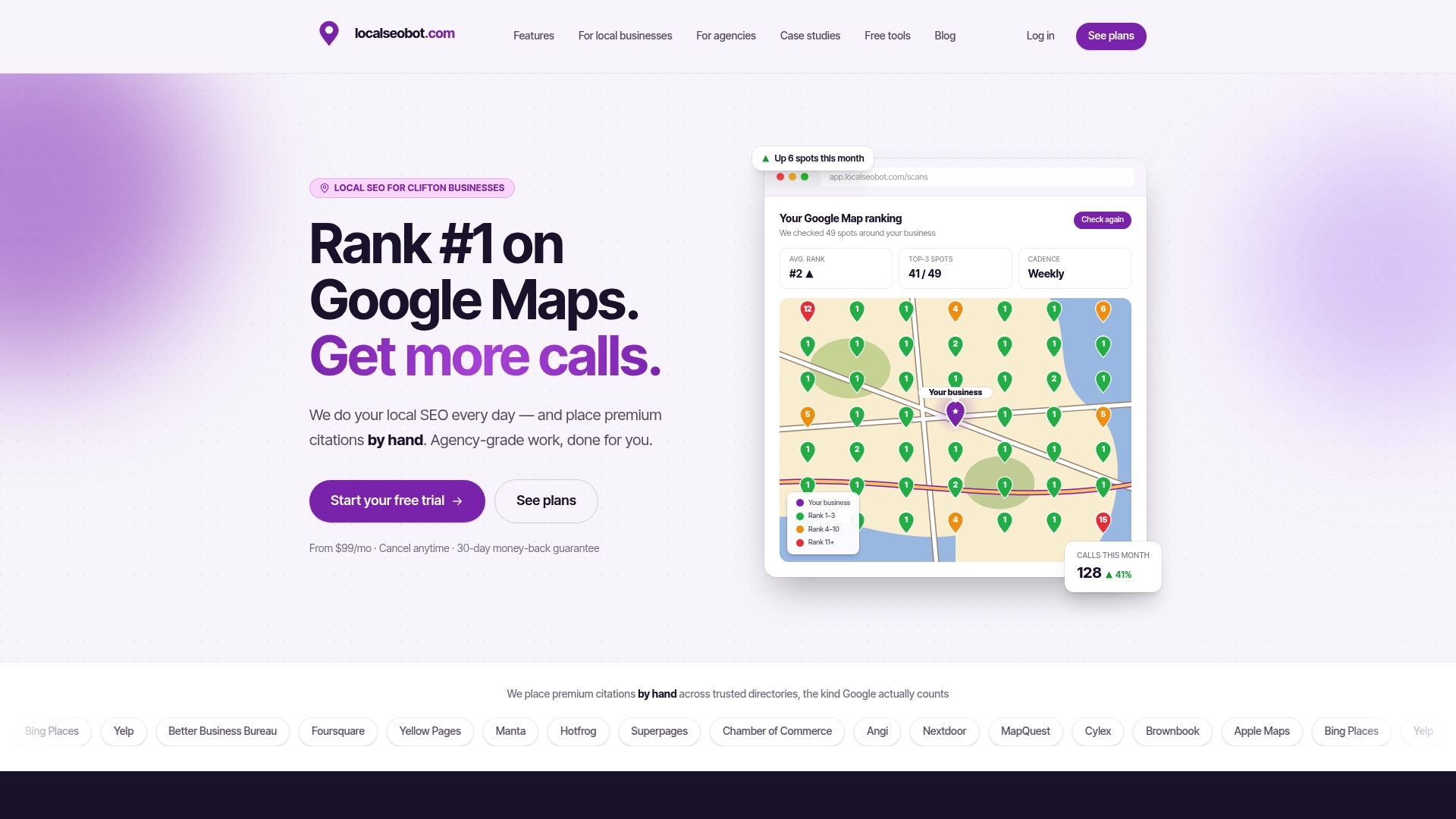
The platform also covers the rest of the roadmap: automated GBP optimization and posting to keep your profile active without daily manual work, AI-driven review generation and reply management to build the velocity and specificity AI systems now weight heavily, and Maprank, a geo-grid Maps rank tracker for measuring whether your visibility work is actually paying off week over week.
Plans start with Foundation at $99 per month per location, with Growth at $199 per month per location for businesses needing more coverage, and a Pro plan at $399 per month per location on the agency pricing page for teams managing multiple client locations under white label. The service offers a 30-day money-back guarantee if Google Maps rankings do not improve. Check current features and start with an audit of your own profile today.
Where These Numbers Came From
- Google Business Profile help: official ranking factors (relevance, distance, prominence).
- Google Search Central AI guide: generative feature optimization.
- Local 5.0 analysis: AI context evaluation framework.
- LocalBusiness schema docs: required and recommended properties.
Sources
- Google Business Profile help: How local ranking works
- Google Search Central: AI optimization guide
- Local 5.0: AI and the next evolution of local search
- LocalBusiness structured data — Google Developers
FAQ
What Are the Top Local SEO Trends for 2026?
The biggest shift is AI-driven discovery through tools like Google AI Overviews, ChatGPT, and Perplexity, which now sit alongside traditional Maps and search results. The priorities that matter most are a fully active Google Business Profile, steady and specific review velocity, complete structured data, and hyperlocal content built for conversational queries.
What Is the Future of Local SEO Beyond 2026?
Local SEO is moving toward continuous data governance rather than periodic optimization projects, since AI systems recheck business facts constantly rather than relying on a periodic crawl. Businesses that treat their GBP, schema, and reviews as living data sources, updated weekly, are positioned better than those running an annual audit.
How Is Local SEO Different From Traditional SEO Now?
Traditional local SEO focused on ranking in the Maps pack and organic results, while today’s version also has to earn a named mention inside AI-generated answers. That requires machine-readable data like LocalBusiness schema and consistent facts across every platform, not just strong backlinks and citations.
Do I Still Need Traditional Citations if AI Search Is Growing?
Yes. Citations still anchor the name, address, and phone consistency that both Google and AI systems check before trusting a business’s facts. Quality now matters more than volume, which is why manually built citations on high-authority directories tend to outperform bulk directory submissions.
How Much Does Local SEO Software Like Localseobot Cost?
Localseobot’s Foundation plan is $99 per month per location, Growth is $199 per month per location, and the agency-focused Pro plan is $399 per month per location, listed on the agency pricing page. All plans include a 30-day money-back guarantee if Google Maps rankings don’t improve.