Multi-Location SEO for Marketing Managers: A Playbook
Published August 4, 2026
Multi-Location SEO for Marketing Managers: A Playbook

Multi-location SEO gets each physical branch found and chosen. The discipline, formally called multi-location or multi-site local SEO, is the practice of making every individual location visible in Google Maps, the local pack, organic results, and AI answer engines simultaneously. It differs from single-location SEO in one critical way: you manage data integrity, authority, and relevance at scale, and a mistake replicated across 50 locations costs 50 times as much to fix.
Start with these five priorities this week:
- Canonicalize your NAP data. Create one master data sheet with the exact business name, address, and phone number for every location. This is your single source of truth.
- Publish or fix location pages on your corporate domain, one per physical address, with unique content, schema, and local signals.
- Claim and standardize Google Business Profiles for every location. Unclaimed profiles are the fastest path to lost rankings.
- Set up review acquisition and response workflows so each location generates steady, recent reviews with location-specific language.
- Implement governance and automation to prevent data decay — NAP drift, duplicate profiles, and stale GBP posts are the silent killers of multi-location programs.
Quick-win vs. long-term investment:
| Priority | Type | Timeline |
|---|---|---|
| Master data sheet | Quick win | Week 1 |
| Claim/verify GBPs | Quick win | Weeks 1–2 |
| Fix critical NAP errors | Quick win | Weeks 1–3 |
| Location page publishing | Long-term | 30 days |
| Governance + automation | Long-term | 60 days |
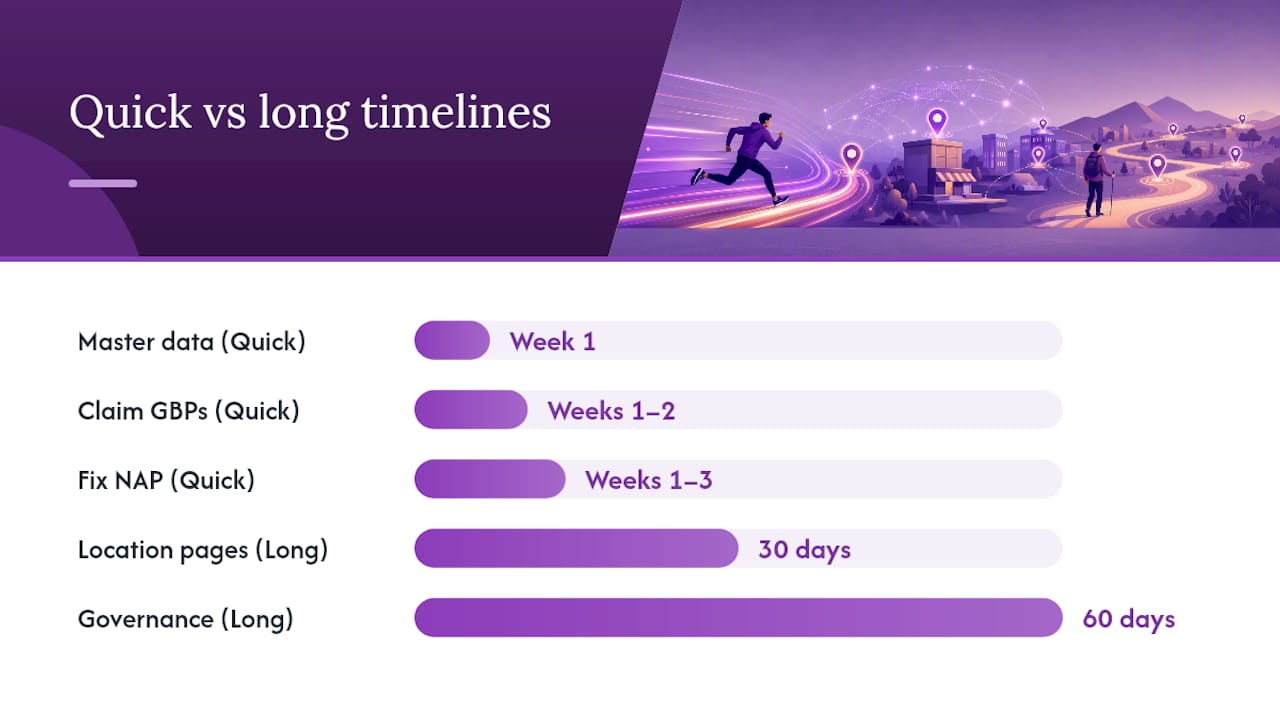
Table of Contents
- When does multi-location SEO make sense for your business?
- How should you structure your site for multiple locations?
- What does every location page actually need?
- How do you manage Google Business Profiles across every location?
- How do you keep NAP consistent across hundreds of directories?
- How do you build a review system that works at every location?
- How do you write location content that AI engines actually cite?
- What local link-building tactics actually scale?
- What KPIs and tools should you track for every location?
- How do you govern multi-location SEO without data decay?
- What are the most common multi-location SEO problems and how do you fix them?
- Key Takeaways
- Why governance paired with hybrid automation is the real differentiator
- Localseobot covers the full multi-location playbook in one place
- Authoritative sources and further reading
When does multi-location SEO make sense for your business?
The short answer: any business with two or more physical addresses serving geographically distinct customer bases needs a dedicated multi-location strategy. But the shape of that strategy depends on your business model.
Place-bound storefronts (retail chains, restaurants, clinics) compete for foot traffic. Their KPIs are map-pack impressions, direction requests, and in-store visits. Service-area businesses (HVAC fleets, cleaning franchises, mobile repair) compete for territory leads. Their KPIs are organic clicks to service-area pages, phone calls, and form fills. Conflating the two leads to the wrong page structure and the wrong content.
Expected deliverables from a well-run program include local pack visibility for each location’s primary service keywords, location-level organic traffic from city and neighborhood searches, AI/answer-engine citations when customers ask tools like ChatGPT or Perplexity for local recommendations, and higher branded search volume in each target market.
Use-case examples worth noting:
- A 12-location dental group needs unique location pages, GBP profiles per office, and review workflows tied to post-appointment SMS.
- A 200-unit franchise needs centralized data governance, templated location pages with locally variable content blocks, and automated citation syndication.
- A regional law firm with four offices needs location-specific practice-area pages and local press mentions to build authority per market.
Scale changes everything. At 10 locations, a marketing manager can handle most tasks manually. At 100 locations, automation becomes non-negotiable — manual NAP updates, review requests, and GBP posts simply cannot keep pace without a system.
Pro Tip: Use a local search volume calculator to estimate demand per city before deciding which locations to prioritize first. High-volume markets with weak current rankings are your fastest ROI.
How should you structure your site for multiple locations?
Site architecture is the highest-leverage decision in multi-location SEO. Get it wrong and you spend months fighting cannibalization and diluted authority. Get it right and every new location page inherits the corporate domain’s trust.
The core rule: subfolders win for most setups
Subfolders on the main corporate domain (e.g., yourbrand.com/locations/chicago/) concentrate link equity, avoid duplicate-content penalties, and make internal linking straightforward. Subfolders nearly always outperform subdomains for multi-location brands because Google treats subdomains as separate sites, splitting authority rather than pooling it.
| Structure | Authority | Maintenance | When to use |
|---|---|---|---|
Subfolder (/locations/city/) |
Pooled — strongest | Centralized | Most multi-location setups |
Subdomain (city.brand.com) |
Split — weaker | Distributed | Regulatory or brand separation needs |
Separate domain (brandcity.com) |
Isolated — weakest | High overhead | Distinct legal entities, acquired brands |
Subdomains or separate domains make sense in narrow cases: a franchise where each franchisee is a legally distinct entity, a brand acquisition where the acquired name carries its own authority, or a regulated industry requiring geographic separation. Outside those cases, the subfolder path is the right call.
Implementation checklist
- Audit existing URLs before building. Identify any city or location pages already indexed and map their current traffic.
- Choose a consistent naming convention:
/locations/[state]/[city]/or/locations/[city-state]/and apply it universally. - Set canonical tags on every location page pointing to itself, not the parent
/locations/index. - Implement 301 redirects from any old location URLs to the new structure before launch.
- Update the XML sitemap to include all location pages and submit via Google Search Console.
- Add internal links from the corporate homepage and service pages to each location page.
Geographic page structure at scale works best when each page has a clear, distinct job. The corporate homepage targets brand + category keywords. Location pages target city + service keywords. Overlap between the two is where cannibalization starts.
What does every location page actually need?
A location page that ranks and converts is not a copy-paste of the corporate homepage with a city name swapped in. Google’s quality guidelines and AI models both penalize thin, templated pages with no genuine local differentiation.
Mandatory page elements
- Embedded Google Map — with the correct pin location
Schema guidance
Every location page needs LocalBusiness schema with parentOrganization linking back to the corporate entity. Add AggregateRating tied to real GBP reviews, Service schema for each service offered at that location, and FAQPage for the FAQ block. Where the page explains a process (e.g., how an installation works), HowTo schema helps AI models parse and cite the steps.
Entity-based optimization is critical in 2026: use explicit SameAs links to the location’s GBP URL, Yelp profile, and other high-authority directory listings so AI models can verify the entity relationship.
The 70/30 template rule
Structure each location page so roughly 70% of the content is templated (brand story, service descriptions, schema framework) and 30% is genuinely unique to that location. The unique 30% includes local staff bios, neighborhood-specific FAQs, local testimonials, and references to nearby landmarks or service areas. Pages that are 100% templated get treated as doorway pages and suppressed.
| Content block | Type | Notes |
|---|---|---|
| Brand intro + services | Template | Reusable across locations |
| NAP + hours + map | Variable | Unique per location |
| Staff profiles | Variable | Real names, local photos |
| Local testimonials | Variable | Location-specific reviews |
| City/neighborhood FAQ | Variable | Unique questions per market |
| Schema markup | Template + variable | Framework reusable; data unique |
Pro Tip: Name image files with the location and service before uploading (e.g., chicago-hvac-installation-team.jpg). Multimodal AI models read filenames and alt text when building citations, and descriptive naming gives you an edge most competitors skip.
How do you manage Google Business Profiles across every location?
GBP remains the single most direct lever for map-pack rankings. GBP completeness, review volume and recency, citation consistency, and local backlinks are the top local ranking factors, and direction requests and branded search volume are significant differentiators for top pack positions.
Claiming and verifying at scale
For 10 or more locations, use Google’s bulk verification process through the Business Profile Manager. You will need a single Google account with manager access to all profiles. Prepare a spreadsheet with exact NAP data, categories, website URLs, and service areas before starting — errors entered during bulk upload are harder to fix than errors caught before submission.
Category selection rules:
- Choose the most specific primary category that matches the core service at that location.
- Add secondary categories only for services genuinely offered at that address.
- Never add categories to match competitor profiles if those services are not actually available.
Optimization checklist
- Write a unique description for each location (750 characters max) that includes the city, primary service, and one differentiator.
- Upload at least 10 photos per location: exterior, interior, team, products/services, and before/after where relevant. Use the photo optimization guidance for filenames and captions.
- Add UTM parameters to the website link in GBP (
?utm_source=google&utm_medium=gbp&utm_campaign=location-name) so GA4 can attribute traffic correctly. - Enable booking links where the platform supports your booking system.
- Seed the Q&A section with three to five common questions and answers before customers ask them.
- Post at least twice per month per location — offers, events, and service updates all qualify.
Suspension risks and remediation
Common suspension causes include using a virtual office or UPS Store address, keyword-stuffing the business name (e.g., “Brand Name | Best Plumber Chicago”), creating duplicate GBP profiles for the same address, and listing a phone number that routes to a call center rather than the location.
If a profile is suspended: remove any policy violations first, then submit a reinstatement request through the Business Profile Help form with documentation (utility bill, lease, or business license showing the address). Do not create a new profile for the same location while a suspension is under review.
Use the Google Business Profile Optimizer to audit completeness scores across all locations and identify gaps before they affect rankings.
How do you keep NAP consistent across hundreds of directories?
NAP inconsistency is the most common and most damaging problem in multi-location programs. A single address formatted differently across 40 directories (“Suite 100” vs. “Ste. 100” vs. “#100”) creates conflicting signals that reduce confidence in the entity and suppress rankings.
Build a master data sheet first
The master data sheet is a spreadsheet (or database record) with one row per location containing:
- Legal business name (exact formatting, no abbreviations unless the legal name uses them)
- Street address (standardized to USPS format)
- Suite/unit designation (pick one format and never deviate)
- City, state, ZIP
- Primary phone number (local number preferred over toll-free for local SEO)
- Website URL (location-specific page, not the homepage)
- Business hours including holiday exceptions
- Primary and secondary GBP categories
- Service area (if applicable)
Every citation, directory submission, and GBP profile must match this sheet exactly. When an address changes, update the master sheet first, then push changes outward.
Syndication strategy
- Submit to the four major U.S. data aggregators: Data Axle, Neustar Localeze, Foursquare, and Factual. These feed hundreds of downstream directories automatically.
- Manually claim and update tier-1 directories: Yelp, Apple Maps, Bing Places, Facebook, and industry-specific directories relevant to your vertical.
- Prioritize government and official sources: city business registries, Chamber of Commerce directories, and state licensing boards carry high authority and are rarely contested.
- Use a citation consistency analyzer to scan existing listings for NAP mismatches and flag duplicates before they compound.
Audit workflow
- Run automated NAP scans monthly using a citation management tool.
- Manually review the top 20 directories per location quarterly.
- When a duplicate listing is found, claim it and merge it into the primary profile rather than leaving it live. Duplicate GBPs and duplicate directory listings split authority and confuse both users and algorithms.
- Log every change with a date stamp in the master data sheet so you can trace when a discrepancy was introduced.
Synchronizing listings with GBP requires a consistent update cycle. When hours change seasonally or a location moves, the master sheet update must trigger a cascade to all active directories within 48 hours.
How do you build a review system that works at every location?
Review velocity and recency are direct ranking signals. A location with 200 reviews averaging 4.6 stars and a steady stream of new reviews will consistently outrank a location with 500 older reviews and no recent activity.
Response templates and escalation
Every review, positive or negative, deserves a response within 48 hours. For positive reviews, acknowledge the specific service mentioned and include the location name naturally. For negative reviews, acknowledge the issue, apologize without admitting liability, and move the conversation offline with a direct contact.
Escalation rule: any review mentioning a safety concern, legal threat, or media contact goes to management within two hours, not 48.
Using reviews as local relevance signals
Reviews that mention specific services and locations (“the plumbers at the Austin branch fixed our water heater in two hours”) reinforce the entity relationship between your location page, GBP, and the service keyword. Mark up first-party reviews on location pages with Review and AggregateRating schema so Google and AI models can parse the rating data directly.
Pro Tip: When training staff on how to ask for reviews, give them a brief script that naturally prompts location and service specifics: “If you mention what we helped you with today and where you found us, it really helps other customers.” This stays within Google’s review policy while encouraging the kind of language that reinforces local relevance.
How do you write location content that AI engines actually cite?
Local SEO in 2026 is two-front optimization. GBP and citations handle traditional search. Your website content handles AI citations from tools like ChatGPT, Gemini, and Perplexity. Winning multi-location brands combine consistent third-party corroboration with deep on-site answers — entity signals from directories and reviews, plus content depth that AI models can extract and quote.
AEO checklist for location pages
- Write a dedicated FAQ section on every location page with questions formatted exactly as customers ask them: “How much does drain cleaning cost in Denver?” “How long does a roof inspection take in Phoenix?”
- Use clear H2 and H3 headings that mirror natural language questions. AI models parse heading structure to identify citable passages.
- Include step-by-step process descriptions for your core services.
HowToschema on these blocks increases citation probability. - Add a pricing or cost-range section even if it is approximate. “Drain cleaning in Denver typically runs $150–$300 depending on blockage severity” is more citable than “contact us for a quote.”
- Link internally between related location and service pages using descriptive anchor text that names both the service and the city.
- Add
SameAsschema pointing to the GBP URL, Yelp profile, and any other authoritative directory listing for that location.
Content patterns AI models prefer
- Direct answers in the first sentence of each section, followed by supporting detail.
- Tables comparing service options, timelines, or price ranges.
- Numbered step-by-step processes with clear outcomes at each step.
- Named entities: staff names, certifications, local landmarks, neighborhood names.
- Consistent use of the city and service name in body text, headings, and image alt text.
Measuring AI citation presence
Run test queries in ChatGPT, Perplexity, and Google’s AI Overviews monthly: “Who are the best [service] providers in [city]?” and “How much does [service] cost in [city]?” Document which sources are cited. If competitors appear and you do not, compare their page structure against yours and identify the content gap. Building a local SEO strategy that works for both Google and AI search requires treating AI citation as a measurable output, not a side effect.
What local link-building tactics actually scale?
Local links remain a powerful ranking signal, and the tactics that work at scale are not the ones that require the most effort per link. Prioritize relevance and local authority over raw link count.
Scaling outreach without losing quality
The key is a playbook for location managers. Give each manager a one-page outreach guide with three to five specific targets in their market (the local Chamber, two community organizations, one press contact) and a templated email they can personalize. Local linkbuilding and community mentions work best when the outreach comes from a local contact, not a corporate marketing address.
Track link acquisition per location in a shared spreadsheet. Flag locations with zero local links as a priority for the next quarter’s outreach cycle. Avoid bulk directory submissions to low-authority sites — one link from the local Chamber is worth more than 50 links from generic citation farms.
What KPIs and tools should you track for every location?
Measurement at scale requires a defined KPI set, a geo-grid methodology for Maps tracking, and a process for monitoring AI citation presence. Without these, you are optimizing blind.
Core KPI set
| KPI | What it measures | Recommended tool |
|---|---|---|
| Map-pack impressions | GBP visibility per location | GBP Insights, Localseobot |
| Map-pack position (geo-grid) | Rank at specific lat/long points | Localseobot geo-grid tracker |
| Location page organic clicks | Search-driven website traffic | GA4 + Search Console |
| Calls and direction requests | Conversion from GBP | GBP Insights, call tracking |
| Review velocity and average rating | Reputation health per location | GBP Insights, Localseobot |
| Branded search volume | Market awareness per city | Google Trends, Search Console |
| AI citation presence | Visibility in AI answer engines | Manual query testing, prompt monitoring |
Geo-grid tracking methodology
A geo-grid overlays a grid of GPS points around a location and checks the map-pack rank at each point. This reveals how far a location’s visibility extends from its address and where it drops off. Practical local SEO measurement requires geo-grid tracking for Maps, UTMs for GBP links, and tying calls to specific locations for accurate attribution.
Run a geo-grid for each location monthly. Use a 7x7 or 9x9 grid with 0.5-mile spacing for urban locations and 1-mile spacing for suburban or rural ones. Compare grids month-over-month to identify rank improvements or drops after optimization changes. The Local Search Visibility Analyzer combines geo-grid data with GBP and GA4 metrics in a single dashboard, which saves significant reporting time at scale.
Measuring AI citations: Run 10–15 test queries per location monthly in ChatGPT and Perplexity. Log which sources are cited. Track whether your location pages appear, and note the specific content block cited. This tells you which content patterns are working and which pages need deeper answers.
How do you govern multi-location SEO without data decay?
Data decay is the slow erosion of accurate location data across directories, GBP profiles, and location pages. It happens when there is no clear ownership model and no scheduled audit cycle. Scaling multi-location SEO by hand leads to data decay; the fix is a governance model that combines central standards with automated execution.
When to automate vs. when to go manual
Automate: NAP syndication to aggregators, review request SMS/email sequences, basic GBP posting (offers, hours updates), and rank tracking. These tasks are high-frequency, low-judgment, and error-prone when done manually at scale.
Keep manual: high-authority directory submissions (government sites, industry associations, Chamber of Commerce), review responses for negative or sensitive feedback, and local content creation. These tasks require judgment, local knowledge, or relationship management that automation cannot replicate.
Pro Tip: Build a “location health score” for each location combining GBP completeness, citation accuracy, review velocity, and geo-grid rank. Review the bottom 10% of locations by score each month and assign a remediation task. This prevents the common pattern where a handful of underperforming locations drag down the program’s overall results.
What are the most common multi-location SEO problems and how do you fix them?
Most multi-location programs fail for the same handful of reasons. Here is a fast diagnostic checklist.
Troubleshooting checklist
- Duplicate GBP profiles: — Search Google Maps for your business name in each market. If two profiles appear for the same address, claim both, then request a merge through the Business Profile Help form. Never delete a duplicate without merging first — you will lose the reviews.
- Conflicting NAP data: Run a citation scan using the Citation Consistency Analyzer. Prioritize fixing the top 10 directories by domain authority first.
Quick triage steps (under one hour)
- Search Google Maps for your top five locations. Confirm the correct address, phone, and hours appear.
- Check GBP Insights for any location showing a sudden drop in impressions or direction requests.
- Run a spot-check of three to five directories for your most important location. Confirm NAP matches the master sheet.
- Check Search Console for any location pages with a significant drop in clicks over the past 28 days.
When to escalate
Escalate to technical SEO when: a location page is indexed but receiving zero organic clicks, a canonical tag is pointing to the wrong URL, or a redirect chain is breaking link equity. Escalate to legal when: an address dispute involves a franchisee claiming ownership of a GBP profile, or a competitor is using a trademarked business name in their GBP listing.
Signals of systemic problems include a simultaneous rank drop across many locations (likely a GBP policy update or algorithm change), a surge in duplicate profiles (often caused by a data aggregator pushing old address data), and API sync failures that leave dozens of directory listings with stale information.
Key Takeaways
Multi-location SEO succeeds when a single source of truth for NAP data drives every downstream action, from GBP profiles to directory citations to location page content.
| Point | Details |
|---|---|
| Start with the master data sheet | Every citation, GBP profile, and location page must match one canonical NAP record. |
| Subfolders beat subdomains | Use yourdomain.com/locations/city/ to pool authority across all location pages. |
| GBP + location pages = dual optimization | GBP drives map-pack rankings; location pages with schema drive organic and AI citations. |
| Governance prevents data decay | Assign ownership, automate NAP sync and review requests, and audit citations quarterly. |
| Localseobot covers the full stack | Localseobot handles citation building, GBP optimization, geo-grid tracking, and review workflows in one platform. |
Why governance paired with hybrid automation is the real differentiator
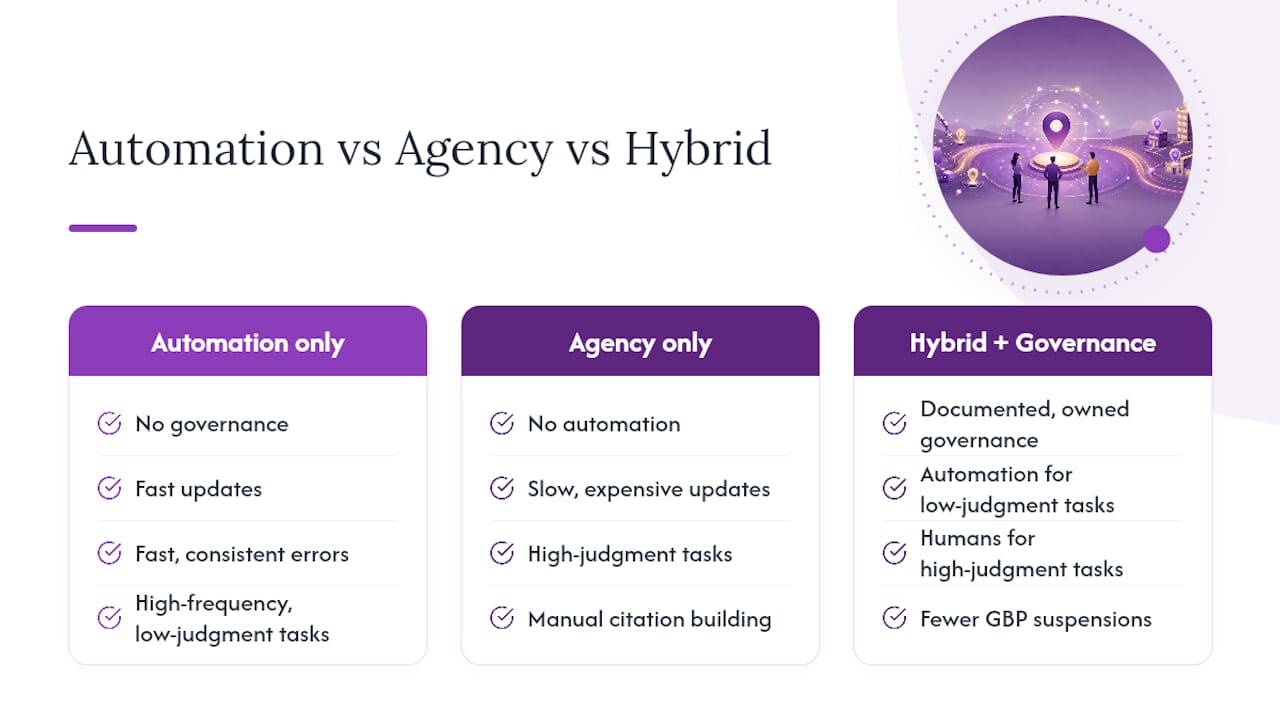
The conventional wisdom in multi-location SEO is to automate everything you can and hire an agency for the rest. That framing misses the actual problem. Automation without governance produces fast, consistent errors. Agencies without automation produce slow, expensive updates. The programs that actually hold their rankings at scale are the ones that treat governance as a product: documented, owned, and iterated on.
Manual citation building still matters, specifically for high-authority directories where automated submissions get rejected, formatted incorrectly, or placed in the wrong category. A Chamber of Commerce listing, a state licensing board directory, or a vertical industry association requires a human to navigate the submission process and verify the result. Automating these submissions typically produces lower-quality placements than a careful manual submission.
The hybrid model works like this: automation handles the high-frequency, low-judgment tasks (NAP syndication, review request sequences, GBP posting cadence, rank tracking). Humans handle the high-judgment tasks (local content creation, relationship-based link outreach, negative review responses, and high-authority directory submissions). The governance layer defines which tasks belong in which category and who owns each one.
The practical result is fewer GBP suspensions, faster recovery when data drift occurs, and a measurable reduction in the manual hours required to maintain a healthy multi-location program. The brands that win in AI-driven local search are not the ones with the most automation. They are the ones with the most accurate, consistent, and deeply corroborated entity data across every source Google and AI models consult.
Localseobot covers the full multi-location playbook in one place
Running multi-location SEO across dozens or hundreds of locations means managing citation accuracy, GBP completeness, review velocity, rank tracking, and content quality simultaneously. Most marketing teams either spread that work across five separate tools or hand it to an agency that charges a monthly retainer per location.
Localseobot is built specifically for this problem. It manually builds premium citations on high-authority directories (the kind automated tools get wrong), automates GBP optimization and posting, tracks geo-grid rankings per location, and runs review acquisition and AI-driven response workflows from a single dashboard. Agencies get white-label reporting. Marketing managers get a centralized view of every location’s health score without logging into ten different platforms.
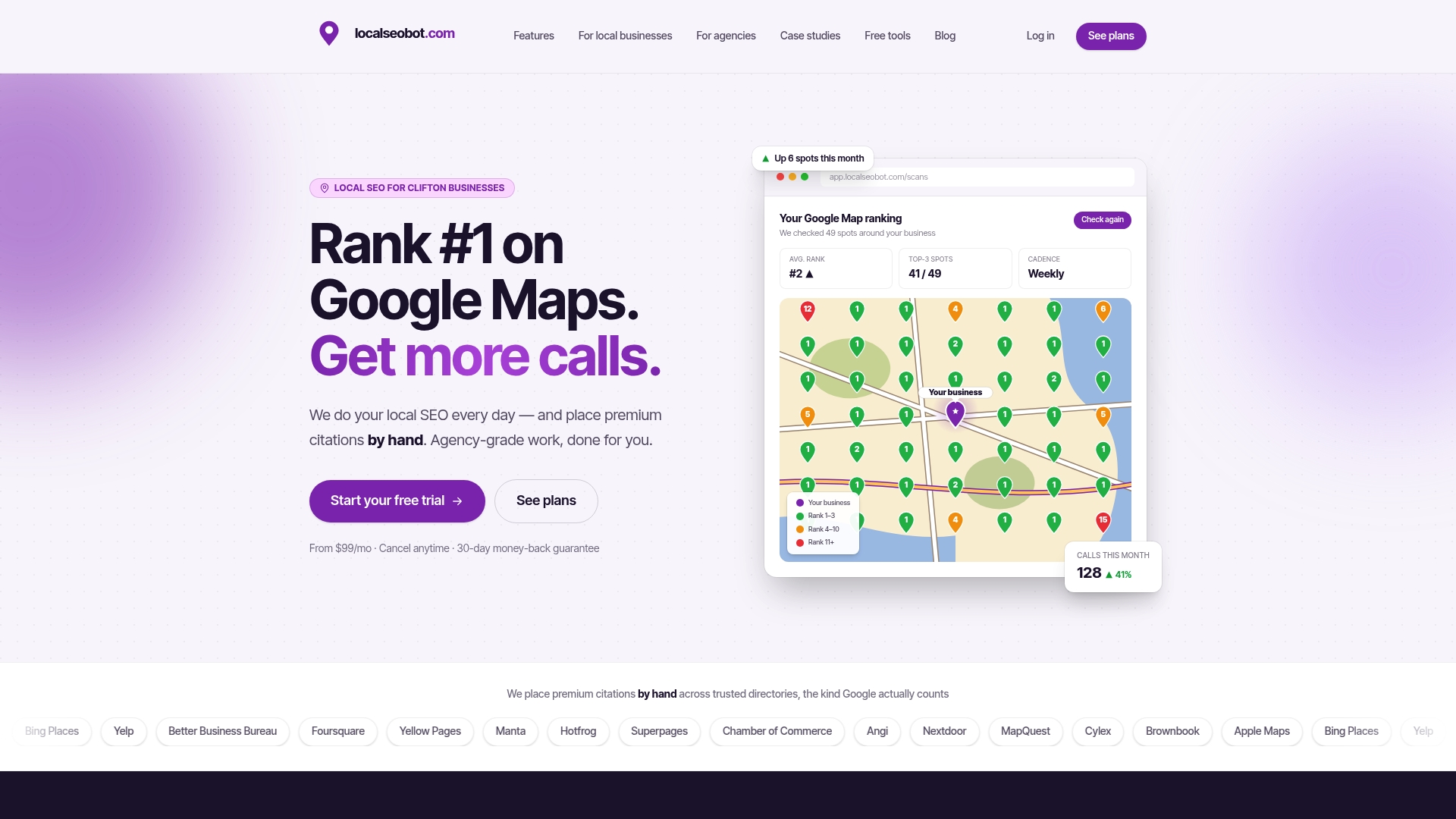
The 30-day money-back guarantee means there is no risk in testing it against your current setup. Start with a local SEO audit to identify which locations need the most attention, then use the Local Search Visibility Analyzer to set your baseline before the first citation goes live.
Authoritative sources and further reading
The following sources informed this guide and are worth bookmarking for your implementation team:
- Multi-Location SEO: How to Scale Without the Chaos
- Multi-location search visibility: winning in Google & AI
- Multi-location SEO: How to structure geographic pages at scale
- Local SEO tips
- What is local SEO? — Semrush
- How to Create an SEO Strategy for Large Multi-Location Businesses
- Franchise SEO: Brand Authority + Local Rankings Without Cannibalization