30 Day Refund Test for Local Businesses: Google Maps Guarantees
Published September 20, 2026
30 Day Refund Test for Local Businesses: Google Maps Guarantees

Most “guaranteed top 3 on Google Maps” offers are misleading, because no vendor controls the distance factor Google uses to rank local results. A narrow, documented guarantee tied to specific keywords, a defined geographic grid, and measurable Google Business Profile actions can be legitimate. This article shows the red flags, the vetting questions, and the checklist to tell one from the other before you sign a contract.
TL;DR:
- Most “guaranteed top 3 on Google Maps” promises are misleading, often based on low-competition keywords or narrow geographic areas chosen by vendors.
- True local ranking factors include relevance, distance, and prominence; businesses can control only relevance and prominence, not distance or Google’s internal algorithms.
- Vendors using tactics like fake reviews, citation spam, or check-in manipulation may produce quick rank jumps but risk penalties or profile suspension from Google.
- A trustworthy guarantee specifies exact keywords, a clear geo-grid, baseline rankings, and outcome metrics beyond position, such as calls or website clicks.
- Effective local SEO efforts focus on profile optimization, consistent NAP data, and genuine review growth, with guarantees tied to measurable improvements within defined parameters.
Table of Contents
- What a Google Maps Ranking Guarantee Actually Means
- How Google Actually Ranks Local Results (What You Control and What You Don’t)
- Shady Tactics Vendors Use to Fake a Ranking Win
- What a Trustworthy Guarantee Actually Looks Like
- Questions to Ask Before You Sign Anything
- How Long Real Results Take and What They Cost
- How Local SEO Bot Approaches Guarantees Differently
- When a Guarantee Is Worth Taking
- Local SEO Bot: A Direct, Verifiable Alternative
- Sources
- FAQ
What a Google Maps Ranking Guarantee Actually Means
Vendors selling a “Google Maps ranking guarantee” rarely mean what a business owner assumes they mean. The phrasing sounds absolute. The fine print is not.
Look closely at the language and you’ll usually find one of these patterns: “Top 3 for [keyword],” “ranked in 90 days,” or “money-back if not achieved.” Each phrase sounds like a hard commitment, but the guarantee usually applies only under conditions the vendor picks, not the ones you’d choose yourself.
Here’s how that scope typically narrows behind the scenes:
- The agency selects a low-competition keyword no customer actually searches, rather than the term that drives revenue.
- The geographic radius shrinks to a single grid point, often centered on your office, instead of the wider service area customers search from.
- Direct competitors get quietly excluded from the comparison set used to measure “top 3.”
- The guarantee measures a paid placement, like Local Services Ads, and presents it as organic map-pack success.
That last point deserves its own callout. Paid visibility and organic map-pack ranking are two entirely different systems. Google Ads and Local Services Ads let you buy placement above or beside the map pack. The map pack itself, the three organic pins tied to a search, cannot be bought at any price, according to Google’s own guidance on local ranking. A guarantee that quietly delivers ad clicks while calling it a “ranking win” isn’t lying outright, but it’s not answering the question you asked either.
How Google Actually Ranks Local Results (What You Control and What You Don’t)
Google ranks local results using three factors: relevance, distance, and prominence. Understanding which of those you can influence, and which you can’t, is the fastest way to spot an impossible guarantee.
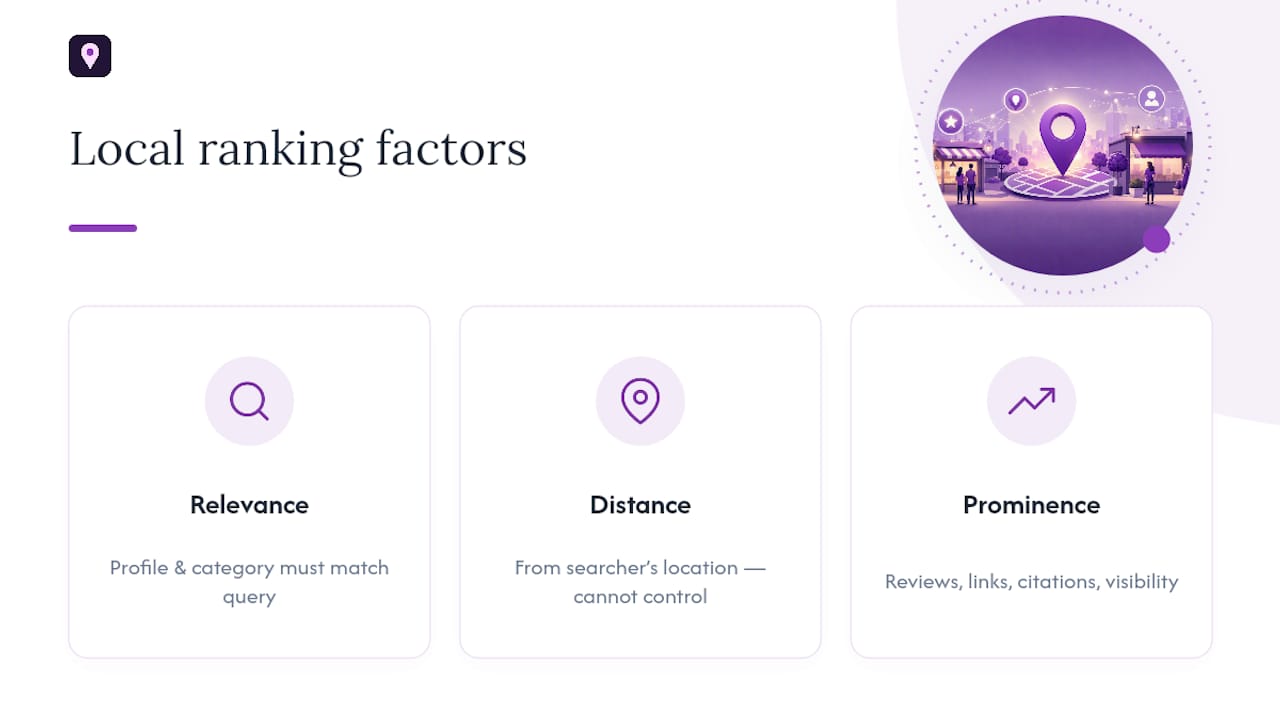
Relevance measures how well your Google Business Profile matches what someone searched. A plumber who lists “emergency plumbing repair” as a service and keeps that phrase consistent across their profile and website ranks better for that exact search than a plumber who only lists “plumbing services.” Primary category selection matters here more than most owners realize. Choosing “Plumber” over the more specific “Emergency Plumber” can cost you visibility for the searches that convert best, a point Ahrefs’ local SEO guide reinforces when it ranks profile completeness and category accuracy among the top-controllable signals.
Distance is calculated from the searcher’s location or the location term they typed, and no vendor can change where a customer happens to be standing when they search. This is the single biggest reason a blanket “top 3 citywide” promise falls apart under scrutiny: your rank for the same keyword can differ block by block across a service area.
Prominence reflects how well-known your business is, based on reviews, links, citations, and general online visibility. This is the one factor that rewards sustained effort rather than one-time fixes.
Businesses control profile completeness, category selection, review volume and response, consistent name/address/phone (NAP) data across directories, and on-site local signals. Businesses do not control the searcher’s exact location, Google’s internal algorithm weighting, or the live experiments Google runs on ranking signals. Any guarantee that ignores the distance factor entirely, promising one ranking outcome across an entire metro area, is making a promise Google’s own system doesn’t support.
Shady Tactics Vendors Use to Fake a Ranking Win
Some agencies chase the numbers a guarantee requires by using tactics that produce a short-term bump and a long-term risk. Recognizing these tactics in a sales pitch or a case study is worth more than any contract clause.
- GPS or driving check-in manipulation: bulk sign-ins or spoofed location pings meant to simulate “prominence” signals. Google’s fraud detection has gotten better at spotting the pattern, and profiles caught doing it can see rankings drop rather than rise.
- Bulk or incentivized reviews: a sudden spike of five-star reviews within days looks nothing like organic customer behavior and violates Google’s review policies, risking review removal or profile suspension.
- Citation spam: submitting your business to hundreds of low-authority directories in a single week, a volume play that industry analysis of guaranteed-ranking claims flags as one of the most common tricks behind “guaranteed” promises.
- Geo-farm schemes: fake or duplicate business locations set up purely to dominate search results in a neighboring area, a direct violation of Google’s guidelines.
- Click manipulation: paid or scripted clicks meant to inflate engagement metrics artificially.
Every one of these can produce a visible rank jump within days. Almost none of them survive Google’s next spam sweep.
Pro Tip: Ask any vendor directly whether their method involves review incentives, bulk citations, or check-in tools. A confident “no, here’s exactly what we do instead” answer is worth more than any glossy case study.

What a Trustworthy Guarantee Actually Looks Like
A credible guarantee reads more like a service level agreement than a marketing headline. If a vendor can’t produce something resembling the structure below in writing, treat the guarantee as decorative.
- Named deliverables. The contract specifies the exact keyword or phrase, a defined geo-grid (not a single point or a whole city), a documented baseline rank recorded before work begins, and the tool used to measure it going forward.
- Outcome metrics beyond rank position. Rank alone can be gamed or misread. A stronger guarantee also tracks Google Business Profile actions, phone calls, direction requests, and website clicks generated directly from the map listing.
- Realistic milestones. Instead of a single all-or-nothing date, the agreement lays out incremental checkpoints, for example, measurable movement within 30 days and a larger target by 90, with clear language on what triggers a refund if those checkpoints aren’t hit.
- Defined client responsibilities. You agree to keep your NAP data accurate, grant profile access, and follow an agreed review-request process. A guarantee that places zero responsibility on the client is usually a guarantee with an easy escape hatch for the vendor.
Geo-grid tracking tools that scan dozens of points across your service area, rather than a single address, give both sides a shared, verifiable dataset to check the guarantee against.
Questions to Ask Before You Sign Anything
Before any contract gets signed, put the vendor’s guarantee through a short interrogation. A legitimate agency answers these questions without hesitation. A vendor selling smoke stalls, deflects, or gets vague.
- Ask for the written scope: which exact keywords, which geographic grid points, and what baseline data was recorded before work started.
- Ask what specifically will change on your profile and website, and what will stay exactly as it is. Vague answers here are the clearest red flag in the entire process.
- Ask to see a sample report or live rank-tracking dashboard from an existing client, not a static screenshot pulled for the sales call.
- Ask for the refund or remediation clause in writing, including the exact conditions that trigger it.
- Ask for at least one verifiable client reference you can actually call.
One red flag matters more than the rest: pressure to sign before you’ve seen a sample report. Transparent reporting and a defined geo-grid are the clearest trust signals an agency can offer, and any vendor unwilling to show that before payment is asking you to trust a black box.
How Long Real Results Take and What They Cost
Profile fixes move fast. Choosing the right primary category, filling in every field, adding photos, and correcting NAP inconsistencies can happen within days and often show measurable movement within a couple of weeks. Prominence is slower. Review growth and the link and citation signals that build long-term authority typically take months to compound, not days.
Pricing in legitimate local SEO work tends to follow one of three shapes: a flat monthly per-location retainer, an upfront audit fee followed by ongoing monthly maintenance, or a base fee plus a smaller performance bonus tied to agreed KPIs. Watch for the pricing model that mirrors the guarantee red flags above: an unusually low monthly rate combined with an aggressive 30 or 60 day “top 3” promise is a pairing that rarely survives contact with reality.
The KPIs worth prioritizing are calls, direction requests, and website clicks generated from your Google Business Profile, plus sustained rank across a geo-grid rather than a single spiking data point.
Pro Tip: If a proposal only reports one ranking number for one keyword, ask what your rank looks like across ten other points in your service area. The answer tells you whether you’re looking at a real result or a cherry-picked one.
How Local SEO Bot Approaches Guarantees Differently
Local SEO Bot builds citations manually across high-authority directories rather than relying on the automated, low-quality blasts that trigger the citation-spam problems described earlier. That manual approach is slower than a bulk directory submission tool, and it’s meant to be: quality citations built on relevant, high-authority sites carry more weight than volume ever will.
Rank movement gets tracked with Maprank, a geo-grid scanning tool that measures your position across multiple points in your actual service area rather than one address. That’s the same kind of grid-based measurement this article recommends demanding from any vendor before you sign anything. Google Business Profile optimization, review request workflows, and AI-assisted review responses round out the day-to-day work behind the citation building.
Local SEO Bot backs its work with a 30-day money-back guarantee if a business doesn’t see a ranking increase, a conditional promise scoped to a measurable outcome rather than a blanket “top 3 citywide” claim. That structure is intentional: it’s built to survive the same scrutiny this article just walked you through.
When a Guarantee Is Worth Taking
Take a guarantee seriously only when it’s narrow, measurable, and backed by a methodology the vendor will actually show you before you pay. Walk away from anything leaning on short-term tricks, whether that’s review bursts, citation blasts, or a “top 3 citywide” claim that ignores how distance ranking works. The best way to think about any guarantee is as one component of an ongoing map-pack strategy, not a finish line. Rankings that were bought quickly tend to disappear just as quickly.
— Local
Local SEO Bot: A Direct, Verifiable Alternative
If you’ve read this far, you already know the difference between a guarantee built on cherry-picked keywords and one built on a verifiable geo-grid. Localseobot’s guarantee is scoped the way this article recommends: a 30-day money-back promise tied to an actual ranking increase, not a vague citywide claim with an easy exit clause for the vendor.
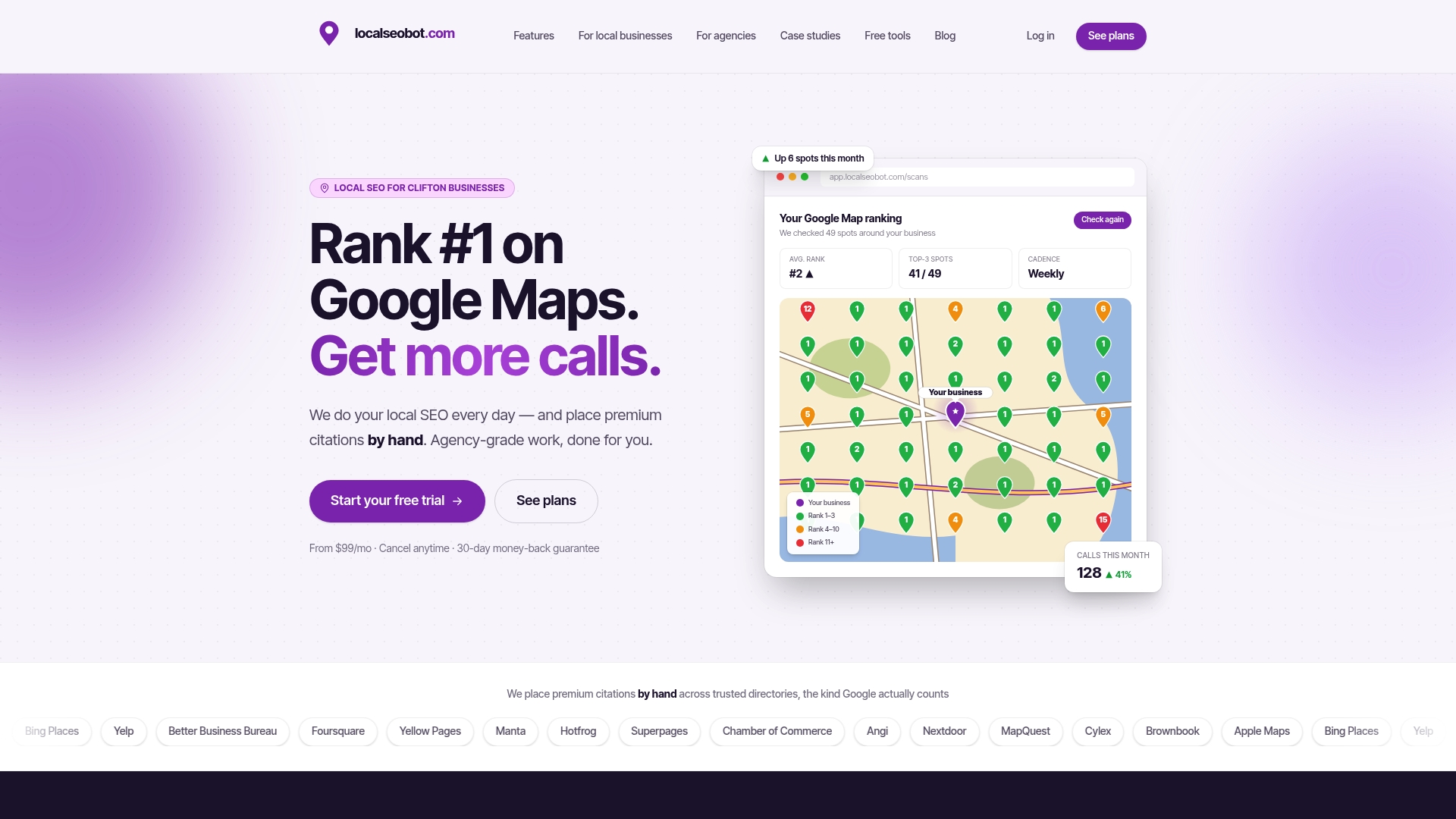
The work behind that guarantee runs on three plans. Foundation, at $99 per month per location, covers the core citation-building and profile optimization work most single-location businesses need. Growth, at $199 per month per location, adds deeper review workflows and reporting. Pro, at $399 per month per location, is built for agencies managing multiple client locations under a white-label dashboard. Every plan ties its reporting to Maprank, the geo-grid scanner that shows your rank across your actual service area rather than a single cherry-picked point, so you can watch the same data your account manager sees. For a broader monitoring strategy alongside rank position, pairing grid data with practical SEO performance tracking helps you connect ranking movement to real business outcomes like calls and direction requests.
Request an audit or compare plan details on the pricing page to see exactly what’s included before you commit to anything.
Sources
Claims in this article draw on Google’s own local ranking guidance, practitioner guides from Ahrefs and WordStream, and industry analysis of misleading ranking guarantees. Local SEO Bot’s own tools, including Maprank, provide additional case-study and monitoring detail for readers evaluating vendors.
FAQ
How Can I Increase My Google Maps Ranking?
Complete every field in your Google Business Profile, choose the most specific accurate primary category, keep your name, address, and phone number consistent across directories, and build reviews steadily rather than in bursts. These are the same controllable relevance and prominence signals Google’s own guidance points to, and tools like the Google Business Profile Optimizer can help you check completeness.
Does Google Still Use RankBrain?
RankBrain remains part of Google’s broader search ranking system, but local map-pack results are governed specifically by relevance, distance, and prominence rather than RankBrain directly. For map-pack purposes, focus your effort on profile completeness, reviews, and citation consistency rather than general algorithm signals.
What Is Google Maps Ranking?
Google Maps ranking refers to the order in which businesses appear in local search results and the map pack, determined by how well a profile matches a search (relevance), how close the business is to the searcher (distance), and how well-known the business is online (prominence). No one can pay Google directly for a higher organic position in this ranking.
How Do I Increase Google Ranking for Free?
Claim and fully verify your Google Business Profile, add accurate categories and photos, request reviews from real customers after each job, and fix any inconsistent business listings across directories using a tool like the Citation Consistency Analyzer. These steps cost time rather than money and address the same relevance and prominence factors any paid service would target first.
Is a Google Maps Ranking Guarantee Ever Legitimate?
A guarantee can be legitimate when it’s scoped to specific keywords, a defined geographic grid, and measurable outcomes like calls or direction requests, with clear refund terms if those targets aren’t met. Localseobot ties its 30-day money-back guarantee to an actual ranking increase rather than a vague citywide promise, with current plan pricing listed on its pricing page.